AI

AI Call Scoring vs. Manual Reviews: Why Consistent Coaching Requires Automation
Feb 13, 2026
10 min read
AI Call Scoring vs. Manual Reviews: Why Consistent Coaching Requires Automation
Your best sales manager just left. And with them went the only person who knew what "good" sounded like on a call.
Every sales organization hits this wall eventually. Coaching quality depends entirely on who's doing the coaching. One manager listens for discovery technique. Another focuses on objection handling. A third cares mostly about closing language. As a result, reps get different feedback depending on which manager reviews their calls, what mood that manager is in, and whether they happened to catch a good call or a bad one. In practice, the result isn't coaching. It's a lottery.
In 2026, the gap between teams using AI call scoring and those still relying on manual reviews isn't just widening — it's becoming a competitive disadvantage that compounds every quarter. When your coaching process depends on a handful of managers listening to a fraction of calls, you're building your revenue engine on a foundation of inconsistency. And inconsistency is the enemy of repeatable growth.
Before examining the solution, it's worth understanding why manual call reviews fail at scale. The problem isn't effort or intent — it's arithmetic.
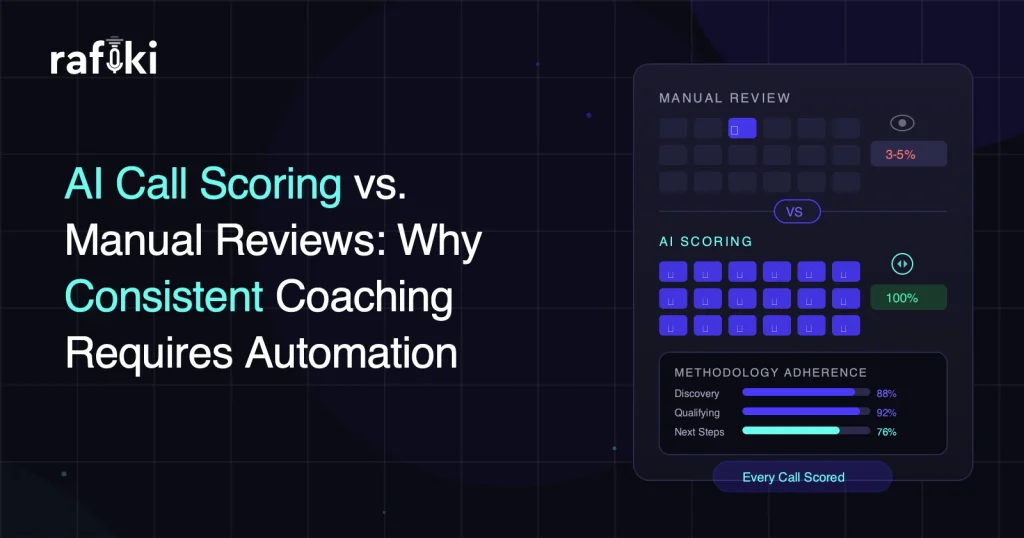
A typical frontline sales manager oversees eight to twelve reps. Each rep runs multiple calls per day — discovery calls, demos, follow-ups, negotiations. Consequently, a single month generates hundreds of conversations. Even the most dedicated manager can realistically listen to and score a small handful of calls per rep each month. The rest go unreviewed, unscored, and uncoached.
In turn, this creates several compounding problems:
Put simply, the uncomfortable truth is that most organizations are making coaching decisions based on a statistically irrelevant sample of their team's actual performance. It's like evaluating a baseball player's season by watching three at-bats.
Inconsistent coaching doesn't just frustrate reps — it creates organizational dysfunction that shows up in pipeline metrics, ramp time, and attrition.
When coaching varies by manager, reps learn to optimize for their specific manager's preferences rather than developing skills that actually close deals. For example, a rep under Manager A learns to always lead with ROI framing, while a rep under Manager B learns to prioritize relationship-building openers. Neither approach is wrong, but when reps transfer teams or managers rotate, everything resets. Institutional knowledge evaporates because it was never institutional — it was personal.
The downstream effects are measurable:
AI call scoring doesn't replace coaching. Rather, it replaces the bottleneck that prevents coaching from happening at scale. Instead of one manager reviewing a handful of calls with subjective criteria, every single conversation gets evaluated against the same standards, every time, within minutes of the call ending.
The shift is fundamental. Manual reviews ask: "Did I happen to catch something worth coaching?" In contrast, AI scoring asks: "Where are the highest-impact coaching opportunities across every call this week?"
This means the manager's role shifts from reviewer to coach. Instead of spending hours listening to recordings and taking notes, managers receive prioritized insights showing exactly which reps need attention, on which skills, with specific call evidence to reference. As a result, the time that used to go into finding coaching moments now goes into delivering coaching that sticks.
The power of automated scoring starts with standardization. When you define scoring criteria once and apply them uniformly, you eliminate the variability that makes manual reviews unreliable.
Rafiki's Smart Call Scoring evaluates every call against your chosen framework — whether that's a built-in methodology like MEDDIC, BANT, or SPIN, or a fully custom scorecard that reflects your unique sales process. Each criterion gets scored individually, producing granular visibility into where reps excel and where they struggle.
Because of this objectivity, several advantages emerge that manual reviews simply cannot match:
A manager reviewing individual calls sees individual calls. They might notice that a rep struggles with objection handling on a particular recording. However, they can't see that the same rep handles objections well on inbound calls and poorly on outbound calls, or that the struggle only appears when competitors are mentioned, or that it started three weeks ago after a product update changed the competitive positioning.
In contrast, AI call scoring operates across your entire conversation dataset simultaneously. It detects patterns that no human reviewer could identify because the patterns only emerge at scale. Specifically, Rafiki surfaces these insights automatically, turning hundreds of data points into actionable coaching priorities.
The types of patterns that automated scoring reveals include:
Ultimately, these patterns are the difference between coaching that addresses symptoms and coaching that fixes root causes.
Understanding the impact of AI call scoring becomes clearest when you compare the actual workflows side by side.
The difference isn't incremental — it's structural. More importantly, the manager's time shifts from finding problems to solving them.
Sales organizations spend significant resources on methodology training — MEDDIC workshops, SPICED certification, BANT frameworks. The investment in aligning teams around a common selling language is real. Yet without enforcement, methodologies decay. Within months of training, most teams drift back to individual habits because no one is measuring adherence call by call.
That said, this is precisely where AI-powered call scoring delivers outsized value. Rafiki scores every conversation against your chosen methodology, tracking whether reps are actually executing the framework they were trained on — not occasionally, not on reviewed calls, but on every call.
In practice, the impact shows up in three ways:
The half-life of coaching feedback is short. Research from the Harvard Business Review has shown that most corporate training content is forgotten within days if not reinforced through application. Similarly, the same principle applies to sales coaching: feedback delivered a week after a call has a fraction of the impact of feedback delivered the same day.
AI call scoring compresses the feedback loop from days to minutes. As a result, reps can review their own scores immediately after a call, see exactly which criteria they hit and which they missed, and adjust their approach before their next conversation. This creates a continuous improvement cycle that doesn't depend on manager availability.
Meanwhile, Rafiki enables frontline managers to build coaching cadences around scored data rather than calendar availability. Instead of waiting for a scheduled one-on-one to deliver observations, managers can flag specific scored moments and share them with reps in real time. In this way, coaching becomes an ongoing conversation, not a weekly event.
One of the most compelling arguments for AI call scoring is the scaling math. As your team grows, manual review coverage shrinks. On the other hand, hiring more managers to maintain review ratios is expensive and creates its own consistency challenges — now you have more managers with more subjective opinions.
Automated scoring, however, scales linearly with your team. Ten reps or a hundred reps, every call gets the same evaluation. Because of this, the coaching infrastructure grows with the team without proportional cost increases. This advantage is particularly valuable in three scenarios:
In addition, Rafiki's Gen AI Reports further amplify this scaling advantage by synthesizing scoring data into team-level insights. Instead of aggregating individual call reviews manually, managers receive automated reports showing team trends, skill distribution, and priority coaching areas across their entire organization.
Perhaps the most underappreciated benefit of AI call scoring is what it does to rep behavior. When reps have access to their own scores, trends, and specific improvement areas, many of them naturally start coaching themselves. After all, the best performers are often the most eager consumers of their own data — they want to know where they can improve, and they don't want to wait for a manager to tell them.
Consequently, this self-coaching dynamic changes the entire team culture around performance development:
Not all AI call scoring solutions deliver consistent coaching outcomes. The technology matters, but so does the implementation approach. With that in mind, when evaluating platforms, prioritize these capabilities:
Rafiki's sales coaching platform delivers on all of these requirements while integrating scoring data with conversation intelligence, CRM sync, and generative AI reports to create a complete coaching infrastructure.
Ultimately, the debate between AI call scoring and manual reviews isn't really about technology. It's about whether your organization can afford inconsistency as a coaching strategy.
Manual reviews served their purpose when teams were small, call volumes were manageable, and managers had time to listen. However, that reality no longer exists for most revenue organizations. Teams are larger, distributed, and running more conversations than any human can systematically review.
AI call scoring doesn't make coaching less human. Instead, it makes coaching more available, more consistent, and more impactful by removing the bottleneck that prevented it from scaling. Every call scored. Every rep coached. Every methodology reinforced. Every pattern detected.
The organizations that win in 2026 and beyond won't be the ones with the best individual coaches. They'll be the ones with coaching systems that deliver consistent, data-driven development to every rep on every call — regardless of which manager they report to, which office they sit in, or which calls happened to get picked for review.
In the end, that's not automation replacing coaching. That's automation making coaching possible at the scale your business demands.
Start for free — no credit card, no seat minimums, no long contracts. Just better sales intelligence.