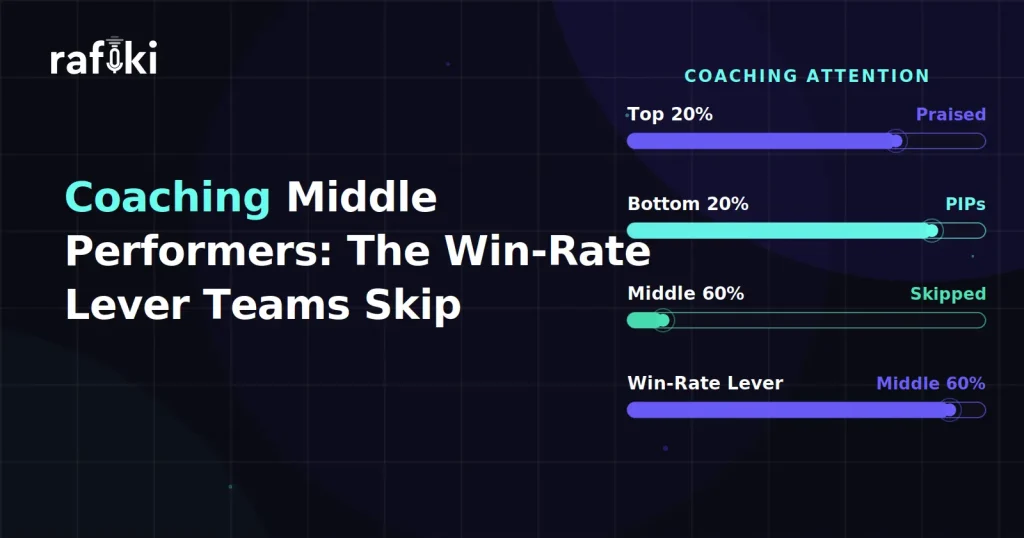
Walk into any pipeline review and watch where the manager's attention goes. The top rep gets a shout-out, the struggling rep gets a remediation plan, and everyone in between gets a nod and a "keep it up." Coaching middle performers is the single biggest win-rate lever most sales teams never pull — and in 2026, it is also the easiest one to reach.
This is not a story about lazy managers. Rather, it is a story about visibility and incentives. Top performers win loudly, bottom performers miss loudly, and the middle stays quiet — steady enough to avoid alarm, unremarkable enough to avoid celebration. Quiet reps get quiet coaching, which in practice usually means none at all.
Here is the uncomfortable structural truth: because the middle is where most of your reps sit, it is also where most of your winnable deals live. Move that cohort even slightly and the effect ripples through every forecast you run. This article makes the structural case for middle-focused coaching, explains why managers default to the tails, and lays out an AI-scaled cadence — one skill per rep per quarter — that frontline teams can actually sustain.
Coaching middle performers means directing structured, skill-specific development at the reps who are neither your stars nor your strugglers — the solid, consistent performers who make quota some quarters and miss narrowly in others. In most teams, this group is colloquially called the "middle 60%," and it is the least-coached segment on the floor.
The skip happens for a simple reason: nothing about a middle performer demands attention. There is no crisis to fix, no blowout deal to celebrate, and no escalation landing in the manager's inbox. Consequently, coaching hours flow to the tails by default, and the middle becomes a maintenance zone rather than a development zone.
That default is expensive. A middle rep is, almost by definition, one or two correctable habits away from performing like a top rep. What separates them from the top tier is rarely talent — more often, it is an unexamined gap in discovery depth, negotiation posture, or multithreading that nobody has ever pointed out to them.
You do not need a spreadsheet to see why the middle matters — the argument is structural. Your team's blended win rate is a weighted average across every rep, and the weighting follows headcount and deal volume. Because middle performers form the largest cohort and touch the largest share of opportunities, any improvement in their conversion carries the heaviest weight in the blend.
Compare the alternatives. Squeezing more out of your best rep improves a segment that is already converting well, so the headroom is small. Rescuing a bottom performer might produce a dramatic individual turnaround, but it lifts only a thin slice of total pipeline. In contrast, a modest, repeatable improvement across the widest segment moves more revenue than heroics at either tail — not because the per-rep gain is large, but because it multiplies across so many reps and so many deals.
There is a compounding effect, too. Middle reps tend to stay — unlike the tails, they are neither poached away nor washed out. As a result, skills you build in the middle keep paying off quarter after quarter, while investments at the tails frequently walk out the door in one direction or the other.
If the middle is the highest-leverage segment, why does almost every manager coach the edges? Three forces pull attention outward, and each one is understandable on its own.
Visibility. Top reps generate the moments managers notice — big wins, competitive knockouts, deals worth retelling. Naturally, managers gravitate toward those conversations because they are energizing and career-relevant. Reviewing a star's calls feels like studying excellence; reviewing a middle rep's perfectly adequate call feels like homework.
Urgency. Bottom performers create deadlines. A rep trending toward a performance plan triggers HR processes, skip-level scrutiny, and documented improvement steps. Meanwhile, no calendar invite ever appears that says "develop the reliable rep in seat fourteen." Urgent work displaces important work, and the middle is never urgent.
Squeaky wheels. The tails ask. Top reps request deal support because they are ambitious; struggling reps request help because they are drowning. Middle performers, however, rarely raise their hands — a dynamic we will return to shortly. As Harvard Business Review's reporting on sales teams growing alongside AI suggests, the teams pulling ahead are the ones using technology to redirect human attention toward development work that would otherwise never happen.
Middle performers are structurally invisible, and part of that invisibility is self-inflicted. A rep who is "doing fine" has little incentive to advertise a weakness. Asking for coaching can feel like confessing a problem, and the middle rep's core identity is precisely that they do not have a problem.
There is also a knowledge gap underneath the confidence gap. Many middle reps genuinely cannot name what separates them from the top tier, because they have never seen the comparison laid out. Since they hear the same trainings and run the same plays as everyone else, they reasonably conclude the difference is luck, territory, or lead quality. Without evidence to the contrary, "work harder" becomes their only self-improvement plan, and working harder on the wrong skill changes nothing.
Managers compound the silence. When one-on-ones with middle reps happen at all, they default to pipeline inspection — "where is this deal, what is the next step" — rather than skill development. For example, a manager might review the same stalled opportunity three weeks running without once asking why that rep's discovery calls keep producing single-threaded deals. Firms studied by McKinsey's growth, marketing and sales practice consistently describe commercial excellence as a management-cadence problem before a talent problem, and the silent middle is where that cadence breaks first.
The middle stays invisible because no human can watch it. A frontline manager with eight reps might personally review a handful of calls a week, and those reviews inevitably chase the loudest deals. Modern conversation intelligence changes the economics: every call gets recorded, transcribed, and scored against a consistent rubric, so the quiet middle produces the same evidence trail as the noisy tails.
Scored calls turn vague impressions into specific, coachable gaps. Instead of "Priya is solid but never breaks out," a manager sees that Priya's calls consistently score well on rapport and product knowledge yet weak on quantifying business impact. That is no longer a personality judgment — it is a named skill with a before-and-after measurement waiting to happen.
Crucially, AI scoring surfaces gaps the rep would never report. Middle performers do not ask for help, but their calls ask for them. A pattern of skipped budget questions, one-contact deals, or unchallenged objections shows up in the scores whether or not the rep perceives it. This means the manager's coaching agenda can finally be driven by evidence rather than by who happened to speak up, a shift we examined in our post on the coaching coverage crisis and how AI bridges the gap.
The two approaches differ in who gets attention, what triggers it, and what improvement looks like. Neither is wrong in isolation; however, only one of them moves the blended win rate structurally.
| Dimension | Tail-Focused Coaching | Middle-Focused Coaching |
|---|---|---|
| Who gets coached | Top reps and at-risk reps | The largest cohort — the middle 60% |
| Trigger | Crisis or celebration | Scheduled cadence, evidence from scored calls |
| Coaching content | Deal rescue, performance plans | One named skill per rep, practiced deliberately |
| Visibility of gaps | Obvious — reps or results demand attention | Surfaced by AI call scoring, not by requests |
| Improvement pattern | Occasional dramatic saves | Modest gains multiplied across many reps |
| Durability | Fragile — stars leave, strugglers churn | Compounding — middle reps stay and retain skills |
| Effect on win rate | Marginal at the team level | Structural, because the cohort carries most pipeline |
| Measurement | Anecdotes and saved deals | Cohort skill scores and conversion movement |
Notice that middle-focused coaching does not abandon the tails. Top reps still get strategic deal support, and genuine performance issues still get managed. The difference is that the default coaching hour gets reassigned to the segment where it compounds.
Middle-performer coaching fails when it tries to fix everything at once. A rep told to improve discovery, negotiation, and multithreading simultaneously improves none of them. The sustainable alternative is deliberately narrow: one named skill, per rep, per quarter, with evidence at both ends. This is where a platform like Rafiki AI turns a good intention into an operating system, because the diagnosis and measurement steps no longer depend on manager listening hours.
Start with instrumentation, not opinions. Rafiki AI's Smart Call Scoring evaluates every recorded conversation against your chosen methodology — MEDDIC, BANT, SPIN, SPICED, or fully custom criteria — so each middle rep enters the quarter with a skill profile built from their actual calls. Importantly, calibrate the rubric with your managers first so reps trust what the scores say; we covered how in our guide to call scoring calibration that makes AI scores reps trust.
Review each rep's scoring profile and choose the single weakest dimension that plausibly affects win rate. For one rep that might be uncovering decision criteria; for another, engaging economic buyers. Resist the urge to stack goals. Specifically, write the skill down as a sentence the rep can repeat: "This quarter, I am working on quantifying impact before proposing."
Define, with the rep, what a better call will look like in the scores. Because the skill is named and the rubric is consistent, progress stops being a feeling and becomes a visible trend line. In addition, this step converts coaching from something done to the rep into a shared experiment the rep owns.
Each week, the manager reviews one or two AI-flagged moments relevant to that rep's single skill — a strong example to reinforce, a missed opportunity to replay. Short and specific beats long and general. For managers wondering where the time comes from, our weekly AI coaching playbook for the frontline manager's hour shows how this fits inside a single recurring block. Rafiki AI's AI Role Play capability lets reps rehearse the skill between touchpoints without consuming manager time at all.
Close the loop. Compare the rep's end-of-quarter scores on the target skill against the baseline, celebrate movement explicitly, and select the next skill. Over a year, each middle rep accumulates several deliberately built skills — the same compounding that separates top performers, now manufactured on purpose. Teams that want to see this loop running on their own calls can start a free trial today and score a week of real conversations before committing to anything.
Tail-focused coaching measures itself in stories: the saved deal, the turned-around rep. Middle-focused coaching demands a different scoreboard, because its wins are individually small and collectively large. The unit of measurement must be the cohort, not the anecdote.
In practice, that means tracking three movements over rolling quarters. First, watch the middle cohort's average skill scores on the dimensions you targeted — this confirms the coaching changed behavior. Second, watch stage-to-stage conversion for deals owned by that cohort — this confirms the behavior touched outcomes. Third, watch the shape of your performance distribution: healthy middle-focused coaching gradually shifts reps upward from the middle band rather than merely producing one promotion-worthy story.
Guard against two measurement traps. Do not attribute a single quarter's win-rate wiggle to coaching, since deal mix and seasonality add noise; trends across cohorts are the honest signal. Similarly, do not let one rep's dramatic improvement stand in for the program — that is the anecdote habit returning in disguise. Rafiki AI's Gen AI Reports make the cohort view a standing report rather than a quarterly spreadsheet project, so the scoreboard survives busy months.
None of this works if it depends on managers finding extra hours, because those hours do not exist. The realistic design goal for frontline managers is redistribution: the same weekly coaching time, aimed at different people, armed with better evidence. AI handles the listening, the scoring, and the pattern-finding; the manager keeps the judgment, the relationship, and the conversation.
A workable weekly rhythm looks like this. The manager opens their sales coaching dashboard, scans scored calls filtered to each middle rep's focus skill, and picks the moments worth discussing. Fifteen minutes per rep later, every middle performer has received specific, evidence-backed coaching that week — coverage that no amount of manual call review could achieve.
Enablement leaders play a multiplier role here. Because scoring rubrics are consistent across the team, enablement can spot skill gaps that recur across many middle reps and build one targeted asset instead of generic training. Meanwhile, sales leaders get something they have rarely had: a defensible answer to "is our coaching working?" grounded in cohort movement rather than manager optimism.
Win rates are a weighted average, and the middle holds the weight. Praise at the top and PIPs at the bottom will always have their place, but neither moves the blended number the way a modest, deliberate lift across your largest cohort does. The middle has stayed uncoached for one reason — it was invisible — and in 2026 that excuse is gone.
AI call scoring makes every middle rep's gaps as visible as a star's big win or a struggler's missed quota. From there, the playbook is almost boring: one skill per rep per quarter, fifteen-minute weekly touchpoints, cohort measurement instead of anecdotes. Boring is the point. Coaching middle performers is not a heroic intervention; it is a management habit that compounds, and the teams that build the habit first will spend years collecting the difference.
Because the effect of coaching scales with the size of the cohort it touches. Your blended win rate is a weighted average across all reps, and middle performers are both the largest group and the owners of the largest share of opportunities. Consequently, even a modest improvement in their skills carries more weight in the blend than a dramatic change at either tail. Top reps have limited headroom, and bottom reps affect only a thin slice of pipeline — and both tails churn, taking your investment with them. Middle performers, in contrast, tend to stay, so skills built there keep compounding quarter after quarter. Tail coaching still matters for deal strategy and performance management; it simply is not the structural lever that middle-focused coaching is.
Middle performers rarely ask for help, so their skill gaps never surface through the usual channel of rep-initiated requests. AI call scoring removes that dependency by evaluating every recorded conversation against a consistent rubric — MEDDIC, BANT, SPIN, SPICED, or custom criteria. Instead of waiting for a rep to volunteer a weakness, the manager sees patterns directly in the evidence: skipped budget questions, single-threaded deals, objections left unchallenged. For example, a rep who scores strongly on rapport but consistently weakly on quantifying impact now has a named, specific gap rather than a vague reputation for being "solid but stuck." That said, scores only work if reps trust them, which is why calibrating the rubric with managers before rollout is an essential first step.
It follows five steps. First, score every call to build a baseline skill profile for each rep. Second, choose the single weakest skill that plausibly affects win rate — one skill only, written as a sentence the rep can repeat. Third, agree with the rep on what progress will look like in the scores, so improvement is a shared experiment rather than a verdict. Fourth, reinforce weekly in fifteen-minute touchpoints built around one or two AI-flagged call moments, with role-play practice between sessions. Finally, re-measure at quarter end, celebrate movement, and rotate to the next skill. Over a year, each middle rep deliberately builds several distinct skills — the same accumulation that top performers develop by accident, now manufactured on purpose.
Measure the cohort, not the anecdote. Track three things on rolling quarters: the middle cohort's average scores on the targeted skill dimensions, stage-to-stage conversion for deals that cohort owns, and the overall shape of your performance distribution as reps shift upward out of the middle band. Together, these confirm that behavior changed, that the change touched outcomes, and that the effect is broad rather than one memorable story. Avoid two traps in particular. Do not credit coaching for a single quarter's win-rate movement, because deal mix and seasonality create noise; trends are the honest signal. Likewise, do not let one rep's turnaround stand in for the program — that is anecdote-driven thinking returning in a new costume.
Rafiki AI's conversation intelligence platform — with Smart Call Scoring, AI Role Play, and autonomous AI agents working every call — starts at $19 per seat per month with no minimums and no annual commitment. Start your free trial today or book a demo to see how coaching your middle 60% becomes the easiest win-rate lever you will pull in 2026.
Start for free — no credit card, no seat minimums, no long contracts. Just better sales intelligence.