Sales Coaching

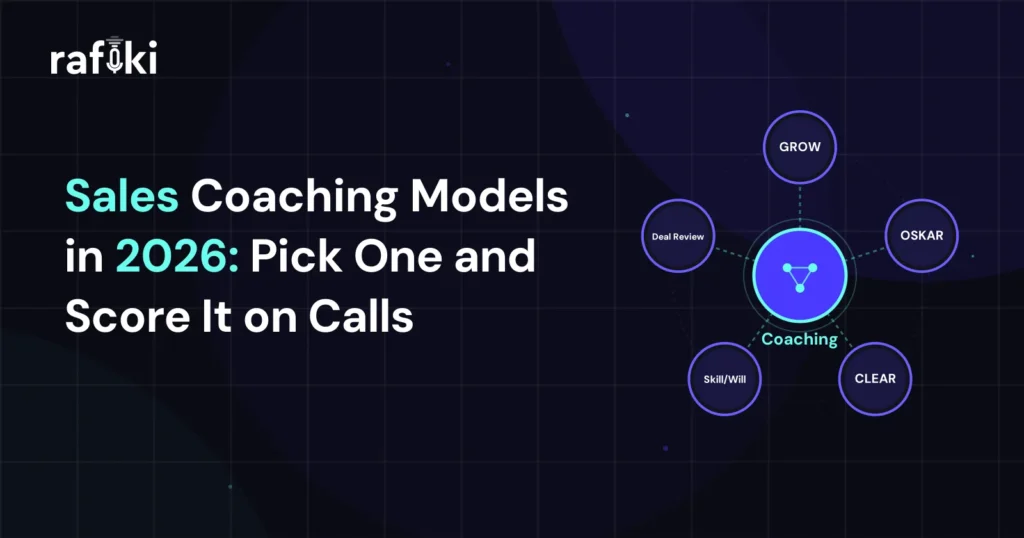
Sales Coaching Models in 2026: Pick One and Score It on Calls
Nov 4, 2026
12 min read
The last box on Grace's GROW worksheet holds Mateo's one commitment: ask every prospect how they will measure success before starting a demo. She picked GROW the night before from a long list of sales coaching models. Her one-on-one with Mateo, the newest AE on her team, felt productive to both of them.
A week later, neither of them can say whether Mateo asked the question. Grace never opened his calls in between, and Mateo believes he asked it "on most of them" when she brings it up. His Tuesday discovery call with a logistics prospect sits unplayed in the recording library. On that call he starts the demo eleven minutes in and never asks it once.
GROW did its job in the room, because the session ended with a clear goal and a commitment. What failed was the week after, since nothing connected the session to the calls Mateo ran over the next six days. Any of the common sales coaching models can work for Grace, as long as she picks one and scores the behavior it targets on Mateo's real calls between sessions.
A sales coaching model is a repeatable structure for a coaching conversation between a manager and a rep. It sets the order of the questions so the rep does most of the thinking and leaves with one change to try.
The common sales coaching models fall into three groups, and it helps to separate them before you choose. GROW, OSKAR and CLEAR are conversation structures borrowed from executive coaching. The skill/will matrix is a diagnostic, because it tells a manager which conversation a rep needs before any structure starts. Deal coaching and skill coaching are a third group, since they name what a session covers.
Trouble starts when a manager expects a conversation structure to diagnose the rep as well. A model organizes the talk, but the topic has to come from evidence of what the rep did on calls. None of these models supplies that evidence by itself.
Sales coaching models die between sessions because the manager has no record of what the rep did since the last one. The structure holds for thirty minutes, and then the next session starts from memory. Memory favors the calls that went badly and the ones the rep chooses to mention.
Managers also have less room than they did a year ago. Gartner reported in April that 47% of managers say they are working harder than a year ago. In a stretched week, coaching prep is the easiest task to drop, because no report shows that it slipped. Grace had a forecast call, two deal reviews and a hiring loop that week, so she never opened Mateo's calls.
Reps face the same squeeze from the other side. In a May 2026 survey, Gartner put the time AI saves sellers at nearly five hours per week. It also found that 72% of sales organizations fail to reinvest that time in high-value activities. Practicing the success question on his next five discovery calls would be a good use of Mateo's hours. That practice is also the first thing to lapse when nobody plays the calls back.
The fix costs a manager a few minutes per rep each week, and all of it goes to calls. Before the session ends, agree on the call behavior you will look for. Then check two calls for it before the next one-on-one. Grace could have found the Tuesday miss in five minutes by jumping to minute eleven, where the demo starts.
GROW is a four-step conversation structure: Goal, Reality, Options and Way forward. The rep sets a goal, describes what is happening now, lists options and commits to one next step. John Whitmore made GROW popular in executive coaching, and some versions call the last step Will. A new sales manager may already know it from a management course.
In a sales one-on-one, GROW works best when the Goal is a call behavior you can hear. "Get better at discovery" is a poor goal, because nobody can check it on a call. By contrast, Grace can check "Ask how the buyer will measure success before the demo" in two minutes from a transcript.
The common mistake with GROW is letting the Reality step run on the rep's memory. Mateo described his discovery calls as thorough, and he believed it. Had Grace played three minutes of the Tuesday call, the Options step would have started from what actually happened.
GROW fits reps who have a clear gap and the motivation to close it. Its weakness is that every session starts fresh, so the manager carries the thread from week to week on her own.
OSKAR is a solutions-focused model with five steps: Outcome, Scaling, Know-how, Affirm and action, and Review. Paul Z Jackson and Mark McKergow built it around what already works, so sessions dwell on the rep's strengths.
The Scaling step is where OSKAR earns its place in sales. A manager might ask a senior AE to rate Tuesday's pricing conversation from 1 to 10. The follow-up, "What made it a 6 and not a 4?", gets her to name what she did right. Once she can name it, she can repeat it on purpose.
Use OSKAR for experienced reps who would bristle at a GROW session on basics. Its risk is a generous self-rating, such as a 7 for a call that was really a 4. So score the call yourself first, then spend the session on the gap between the two numbers.
CLEAR, from Peter Hawkins, is the model for managers who talk too much. Its five stages are Contracting, Listening, Exploring, Action and Review. In my experience, managers who were strong reps solve problems out loud. During a one-on-one, that habit turns into the manager explaining how she would have run the call. The rep learns to wait for answers, and the Listening stage puts a brake on that habit.
Contracting keeps the session from drifting into pipeline review, and Review ties it to call evidence. Ending with "Which call this week will show whether this worked?" gives both people a recording to open.
Pain funnel coaching takes the Sandler pain funnel and points it at the rep. The funnel is a sequence of narrowing questions that reps use with buyers, moving from broad to specific to personal. In a one-on-one, the manager follows the same path until the rep names the real problem behind a stuck deal. A typical funnel runs through questions like these:
This model suits stuck opportunities and reps who deflect with surface answers. It needs a manager who can sit through long pauses without rushing to fill them. The funnel also depends on the recording, because a rep's "the CFO went cold" may describe a call where three pricing questions went unanswered.
The skill/will matrix is a diagnostic that sorts a rep by skill and motivation for one specific task. Max Landsberg described it in The Tao of Coaching, with a response for each quadrant. A manager directs a rep low on both and guides one with will but little skill. She excites a rep with skill but little will, and delegates to one high on both.
The phrase "for one specific task" carries the whole model. Mateo may rate high on will and low on skill for discovery, but high on both for demos. One rating of Mateo as a person gives Grace a label. A rating per behavior tells her which conversation to have about which call.
Use the matrix to pick the coaching model for each behavior. Low skill calls for GROW with a recording in the Reality step, because the rep needs instruction and practice. High skill with low will calls for OSKAR, or for a CLEAR session that asks what changed. In that quadrant the rep knows how and has stopped doing it. Delegation means you stop coaching the behavior and check its score once a month.
Deal coaching helps a rep win one specific opportunity, while skill coaching works on a behavior the rep repeats across every deal. Both have a place, but deal coaching crowds out skill coaching because the forecast is due Friday and every deal carries a dollar figure.
The two feel similar in the room but lead to different outcomes. For example, a deal session on the logistics prospect might end with Mateo booking a call with the VP of operations. A skill session would end with Mateo practicing how to ask for that access on every first call. His next ten deals would then need no rescue at all.
A workable split keeps deal coaching in pipeline review and protects the one-on-one for skill coaching. When a deal problem comes up in a one-on-one, ask which behavior caused it and coach that behavior. Our guide for first-time sales managers covers how to hold that line in the first 90 days, when deal rescues pull hardest.
The table below puts the common sales coaching models side by side, including what each one asks of the manager. Read the last column first, because the evidence a model needs decides whether it survives past week two.
| Model | Structure | Best for | What it needs from the manager | What evidence it needs |
|---|---|---|---|---|
| GROW | Goal, Reality, Options, Way forward | Reps with a clear skill gap | Discipline to keep the goal to one behavior | A recent call clip for the Reality step |
| OSKAR | Outcome, Scaling, Know-how, Affirm and action, Review | Experienced reps refining strengths | Willingness to ask before advising | A manager score to compare with the self-rating |
| CLEAR | Contracting, Listening, Exploring, Action, Review | Managers who over-direct | Patience through the Listening stage | The call named in the Review stage |
| Pain funnel | Broad, then specific, then personal questions | Stuck deals and reps who deflect | Comfort with silence | The call where the problem showed up |
| Skill/will matrix | Four quadrants by skill and motivation | Choosing which model to run | A rating per behavior per rep | Scores on that behavior across several calls |
| Deal coaching | Review one opportunity and its next step | Late-stage or at-risk deals | Deal context and stakeholder knowledge | Calls with every buyer on the deal |
| Skill coaching | One behavior practiced until it shows up | Repeated misses across deals | A weekly check on the target behavior | The same score trended over several weeks |
A manager with six to eight reps can run a weekly coaching cadence on about an hour of prep. That hour goes to calls, with one skill focus per rep and a thirty-minute one-on-one each week. Our frontline manager's weekly coaching playbook covers the AI side of this routine in more depth.
Grace's prep for Mateo takes about eight minutes. She pulls his scores from five discovery calls and cues the Tuesday clip at minute eleven. For contrast, she adds a call where he asked the success question and the buyer answered with a budget figure. In the session she plays the good clip first, which makes the miss easier for Mateo to hear without getting defensive.
This cadence breaks when a manager tries to coach three behaviors at once. Pick one behavior per rep and keep it for six weeks. Move on only when the scores have held for the last two of those weeks.
Measure coaching by comparing a rep's score on the target behavior before and after the sessions started. Win rate and quota attainment move too slowly, and depend on too much else, to judge last month's sessions.
Set a baseline from the four weeks before coaching starts. Then compare it with the last four weeks of the six-week focus. Say a team of 10 reps each works on one behavior, scored 0, 1 or 2 per call. If seven reps raise their average and hold it, the coaching worked for them. For the three who stayed flat, change either the model or the behavior.
Two checks keep the numbers honest. Calibration comes first, because a trend means little if two managers score one call differently. Our piece on call scoring calibration explains how to get managers to agree on a score. Call mix comes second, because a switch from renewal calls to new-logo calls moves scores on its own.
Show the result to the rep as well as to your own manager. When Mateo's success question goes from one call in five to four in five, he can see the process work.
The weakest point in every model above is the week between sessions, and that week is where Rafiki AI does its work. It records Mateo's calls from video meetings and the dialer, so the Tuesday call would not sit unplayed. In Smart Call Scoring, Grace could turn the GROW commitment into a custom criterion. The criterion would read "rep asks how the buyer will measure success before the demo." Each of Mateo's calls would then carry a score for it before Monday's prep.
The Coaching Agent, one of Rafiki AI's autonomous AI agents, runs that scoring on every call against the criteria Grace sets. Her Monday prep then starts with the scores in place. She spends her ten minutes picking clips for the Reality step, instead of hunting for them.
For practice between sessions, AI Role Play lets Mateo rehearse the success question against a custom persona. Grace can model that persona on the logistics buyer, and Mateo gets a discovery-questions score before he tries it live. For the before-and-after view, Grace can ask Gen AI Reports for each rep's average on the target criterion. That report sets the four baseline weeks beside the last four weeks of the focus. Rafiki's sales coaching software page covers the full workflow, and frontline managers have their own overview of the weekly routine.
Start next Monday with one rep and one behavior, and leave the rest of the team on their current routine. Choose the rep with the clearest gap and use the skill/will matrix to pick GROW or OSKAR. Write the behavior as a sentence you could check in a transcript. Before the first session, score the last four weeks of that rep's calls on it to set a baseline.
Run six weekly sessions with the clip-first cadence above, then compare the scores. Add a second rep once the behavior has moved. When it stays flat, check calibration and the skill/will rating before you blame the model. Grace ran this with Mateo, and by week three he was asking the success question on most discovery calls. She added a second rep after week six, once his scores had held for two weeks.
Rafiki AI's conversation intelligence platform starts at $19 per seat per month with no minimums and no annual commitment. Start your free trial today or book a demo to score your reps' calls on the one behavior you plan to coach this quarter.
Each answer assumes the routine Grace ran with Mateo, with one rep and one behavior scored on calls for six weeks.
Pairing a diagnostic with a conversation structure works well, such as using the skill/will matrix to choose between GROW and OSKAR. Mixing two conversation structures in one session does not, because the rep loses track of which step comes next. Keep one structure per rep for the whole focus period.
Twenty to thirty minutes a week covers one behavior if the manager has already played the clips. Hold the session within two days of the call you plan to discuss, while the rep still remembers the buyer. Sessions that run longer tend to drift into pipeline updates.
A sales methodology like MEDDIC or SPICED governs the conversation between the rep and the buyer. The coaching model governs the conversation between the manager and the rep. In practice, the methodology supplies the behaviors worth coaching, such as confirming the economic buyer or naming a critical event.
Yes, ideally a day before the one-on-one, so the rep arrives with an opinion about the calls. Ask the rep to pick one call to discuss alongside the one you picked. Reps who pick a call tend to own the change, and their pick shows what good looks like to them.
Start for free — no credit card, no seat minimums, no long contracts. Just better sales intelligence.