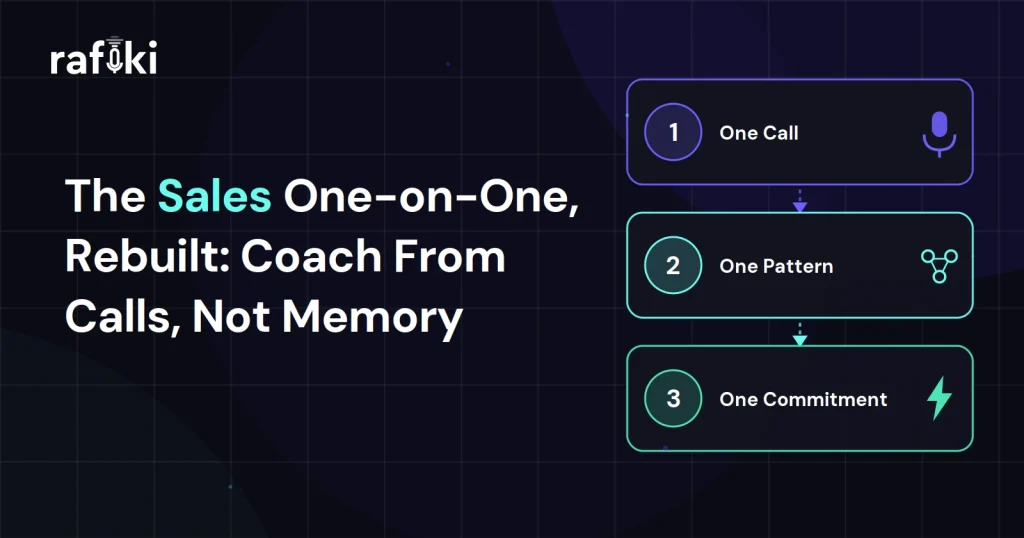
Thursday at two o'clock, the same as every week. The manager opens the CRM, the rep opens their pipeline, and the sales one-on-one begins the way it always does: "Walk me through your deals." Forty minutes later they have discussed twelve opportunities, moved three close dates, and agreed that the big one "needs a push." Nothing was said about how the rep actually sells. The one moment of coaching, if it happened at all, was a line the manager half-remembered from a call two weeks ago: "I think you talked too much on that one."
This is the most common coaching ritual in sales and the least designed. Nearly every manager holds a weekly one-on-one, and remarkably few of them coach in it, because the meeting has quietly become a pipeline review with a person attached. The rep leaves with a to-do list. The manager leaves with a forecast update. Skill, the thing that would make next quarter's pipeline better, never comes up, because nobody in the room has evidence about it.
The excuse used to be that the evidence did not exist. A manager could not watch every call, so feedback came from memory and instinct. In 2026, every call is recorded, transcribed, and scored, which means the sales one-on-one can be rebuilt around what actually happened on the phone. This article lays out that rebuild: what the meeting is for, why the pipeline walk crowds out coaching, the four-part agenda that fixes it, and how to make the coaching stick between meetings.
A sales one-on-one is the recurring private meeting between a manager and a rep whose purpose is to improve the rep's results by improving how the rep sells. It is the only regular moment in the week that belongs to one person's development rather than to the team's number. Everything else on the calendar, from the forecast call to the pipeline review to the team meeting, serves the business first and the individual second.
That purpose has a practical implication: the one-on-one should be the meeting where skill is discussed with evidence, and it should not be the primary place where deals are inspected. Deals have their own rituals. When the one-on-one absorbs the pipeline review, the rep's development becomes the thing that gets squeezed out whenever the quarter tightens, which is exactly when it matters most.
Well-run one-on-ones compound. A rep who gets one specific, evidence-backed observation every week, and who practices it on the next five calls, changes visibly within a quarter. A rep who gets a pipeline interrogation every week learns to manage the manager. The difference between those outcomes is the agenda.
Why does the one-on-one turn into a deal review even when both people intend otherwise? The forces are structural, and naming them explains why "let's talk about skills more" never survives contact with a Thursday afternoon.
The common thread is that pipeline has evidence and skill does not, or did not. As McKinsey's people and organizational performance research keeps emphasizing, AI transformations run on trust and on redesigning how people actually work, rather than on layering tools over unchanged rituals. The one-on-one is the ritual most worth redesigning, because it is where a manager's time turns into a rep's skill.
The direct cost is obvious: reps do not improve, so the same skill gaps produce the same lost deals quarter after quarter. The indirect costs are larger and easier to miss.
First, the manager's leverage collapses. A frontline manager with eight reps has roughly eight hours a week of one-on-one time, which is the single largest block of coaching capacity in the organization. Spending it on deal inspection that a dashboard could do is the most expensive use of a manager's calendar. Second, early-career reps disengage. Salesforce's State of Sales research has made the experience of newer sellers a recurring theme, including how much of their week goes to work other than selling and how little feedback they get on the selling they do. A one-on-one that never discusses a real call is where that gap lives.
Third, and most quietly, the manager loses the ability to diagnose. When every one-on-one is a pipeline walk, the manager knows what each deal is doing but not why the rep's deals behave the way they do. Coaching without diagnosis is guesswork, and reps can tell.
The rebuilt sales one-on-one has a fixed agenda with four parts, in a fixed order, and the order matters. Skill comes first, while attention is fresh and before the pipeline can consume the meeting. Each part has an input that must be prepared before the meeting, which is what turns the ritual from a conversation into a system.
Before the meeting, the rep picks one recent call they want to talk about and shares the moment they want reviewed: an objection they fumbled, a discovery thread they lost, a close they are proud of. Letting the rep choose does two things. It converts exposure into ownership, and it tells the manager what the rep is already thinking about, which is where coaching lands fastest. The manager listens to that segment before the meeting, not during it.
The manager brings one observation drawn from across the rep's recent calls, not from a single moment. "In your last six discovery calls, you asked about budget before you asked about the problem" is a pattern. "You seemed rushed on Tuesday" is an impression. Patterns are coachable because they are undeniable and specific, and because they point at a habit rather than a bad day. One pattern per week is the limit; more than that and none of them stick.
The skill portion ends with a single behavioral commitment the rep will practice on their next several calls, phrased as something observable: "Ask two problem questions before any budget question." The commitment is written down where both people can see it, and it becomes next week's first agenda item, checked against the calls that happened in between. This is the loop that makes coaching compound.
Only then does the meeting turn to deals, and only to the ones where the rep needs a decision or the manager sees a risk the rep has not. Routine deal updates belong in the CRM, where the conversation record already keeps them current. The pipeline segment is shorter than it used to be because the rest of the week's rituals carry the load, and because the skill work upstream is what fixes the pipeline downstream.
The rebuilt agenda assumes both people can arrive with evidence, which is the step that used to be impossible. A manager cannot listen to forty hours of calls a week to find one pattern per rep. A conversation intelligence platform that records, transcribes, and scores every call is what makes the preparation take minutes instead of hours.
In practice, the preparation follows a short routine:
The preparation is also what keeps the meeting honest. When the manager arrives with a pattern across six calls and the rep arrives with a moment they chose, neither person can retreat to impressions, and the pipeline walk loses its status as the only thing with data.
Rafiki AI is built to make the rebuilt one-on-one practical for a manager with a full team, because it turns every call into evidence a manager can use in minutes. Every meeting and phone call is recorded, transcribed in more than sixty languages, and analyzed, so the raw material for "one call, one pattern, one commitment" exists automatically.
Smart Call Scoring scores every call against the team's methodology, whether MEDDIC, SPICED, Challenger, or custom criteria, so a frontline manager sees each rep's pattern across many calls without listening to all of them. The consistently low-scoring element is the week's pattern; the specific calls that illustrate it are one click away.
Gen AI Search answers the follow-through question directly: did this rep ask problem questions before budget questions on their calls this week? The cited moments make the commitment check a matter of evidence rather than trust. Smart Call Summary gives the rep a fast way to review their own calls and choose the moment they want to bring. And for managers who want a standing view, Gen AI Reports produces a weekly per-rep coaching snapshot in plain language, so preparation becomes reading rather than digging.
The sales coaching workflow in Rafiki AI is designed around this loop. Its autonomous AI agents do the listening and the scoring; the manager keeps the judgment about what to coach and the relationship that makes coaching land.
| Dimension | Pipeline-walk one-on-one | Evidence-based one-on-one |
|---|---|---|
| Opening question | "Walk me through your deals" | "Let's listen to the moment you picked" |
| Source of feedback | Manager's memory | Scores and moments across recent calls |
| Who chooses the topic | Manager, reactively | Rep picks the call; manager brings the pattern |
| Output | Updated close dates | One observable behavioral commitment |
| Follow-through | "How did it go?" | Checked against the next calls |
| Pipeline discussion | The whole meeting | Last, by exception |
| Rep's experience | Interrogation to manage | Development they own |
The rebuilt one-on-one fails in the same way the old one did if it is not protected: the quarter tightens, the pipeline expands to fill the meeting, and the skill agenda quietly disappears. A few guardrails keep it alive.
Run this way through the end of Q3 and into Q4, the one-on-one becomes what it was always supposed to be: the hour each week where a manager's attention turns into a rep's ability, with the evidence to prove it.
The sales one-on-one became a pipeline review because pipeline had data and skill did not. That asymmetry is gone. Every call is now evidence, and a manager can arrive with a pattern across a rep's week while the rep arrives with the moment they want to work on. Put skill first, limit the coaching to one observable commitment, check it against the next calls, and leave the pipeline for last. Rafiki AI makes the preparation take minutes, with autonomous AI agents that score every call, surface every pattern, and answer whether the commitment showed up. Rebuild the meeting this week. Your reps will notice by the third one.
A sales one-on-one should cover the rep's skill development first and their pipeline last. The rebuilt agenda has four parts: one recent call chosen by the rep, with a specific moment they want reviewed; one pattern the manager has observed across the rep's recent calls, not a single impression; one observable behavioral commitment the rep will practice on their next calls, checked at the next meeting; and pipeline discussion only by exception, for deals where the rep needs a decision or the manager sees a risk. Routine deal updates belong in the CRM. Putting skill first protects it from being crowded out when the quarter tightens.
Weekly, at a fixed time, for most reps. The evidence-based structure works because the commitment made in one meeting is checked against the calls that happen before the next, and a week is long enough to produce several calls while short enough to keep the behavior fresh. Newer reps sometimes benefit from a shorter second touchpoint mid-week focused only on the commitment. The cadence matters less than the protection: a weekly one-on-one that is cancelled whenever the forecast is due teaches reps that their development is optional.
Let the rep choose the call. When the rep picks the moment they want to review, the recording becomes their tool rather than the manager's evidence against them. Pair that with patterns rather than gotchas: an observation across six calls about a habit is coaching, while a replay of one bad moment is an ambush. Keep the number of observations to one per week, phrase the commitment as something the rep can practice rather than something they did wrong, and close the loop by showing the rep their own improvement in their own calls. Transparency about what is recorded and who can hear it, established up front, does the rest.
A pipeline review inspects deals; a one-on-one develops a person. The pipeline review asks where each opportunity stands, what the next step is, and whether the forecast category holds, and it is best run as a team ritual with the CRM and conversation record on screen. The one-on-one asks how the rep is selling, what habit is helping or hurting across their calls, and what they will practice next. When the two merge, the deal review always wins, because deals have dates and skills do not. Keeping them separate, with the one-on-one putting skill first, is what allows coaching to happen at all.
Rafiki AI's conversation intelligence platform starts at $19 per seat per month with no minimums and no annual commitment. Start your free trial today or book a demo to see how evidence changes the one-on-one for every manager on your team.
Start for free — no credit card, no seat minimums, no long contracts. Just better sales intelligence.