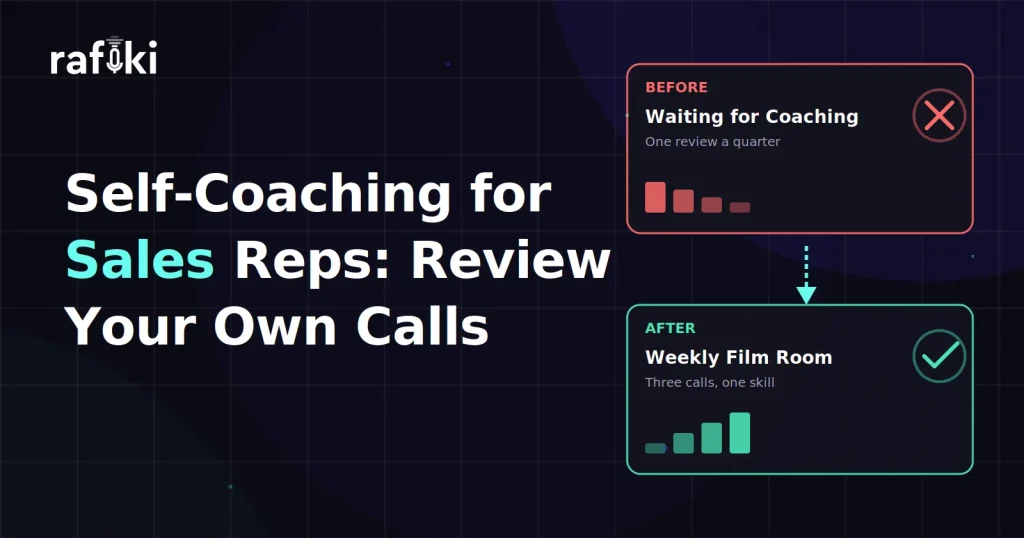
The best athletes in the world watch their own film. Nobody schedules it for them; they pull up the tape, wince at the mistakes, and study what actually happened — because memory lies and film doesn't. Self-coaching works exactly the same way for sales reps: you review your own calls, on your own schedule, with a specific skill in mind. It is the single highest-leverage habit in your development, and almost nobody does it.
Think about your own week. Every discovery call, every demo, every objection you fumbled — recorded, transcribed, sitting in a library you could open right now. Yet if you are like most account executives and SDRs, you have listened to maybe a handful of your own calls this quarter, usually only when a manager asked you to. Meanwhile, you wait for coaching that arrives sporadically, covers one call out of dozens, and often focuses on the deal rather than your skills.
This article makes the case for becoming your own film room. We will cover why reps avoid their own recordings, the 30-minute weekly ritual that fixes it, exactly what to listen for by skill, and how AI scoring turns a pile of recordings into a guided curriculum.
Let's name the real reasons, because they are more human than anyone admits. First, there is the cringe. Nobody likes their recorded voice — the filler words, the nervous laugh, the moment you talked over the buyer. It stings, so you skip it.
Second, nobody ever taught you what to listen for. A recording without a lens is just an hour of audio. Without a specific question in mind — did I quantify the pain, did I panic on the pricing objection — reviewing a call feels aimless, so you skip it and make more dials instead.
Third, review has historically been something done to you, not by you. It usually means a manager pulling a call apart in a team meeting, which trains you to associate recordings with judgment rather than growth. As Harvard Business Review's reporting on sales teams growing alongside AI suggests, the teams pulling ahead are the ones where reps use these tools to develop themselves, not just the ones where managers use them to inspect.
Here is the uncomfortable truth: the discomfort you feel listening to yourself is not a reason to avoid the tape. It is the signal that the tape contains information your memory has been protecting you from. Your recollection of a call is a story you told yourself on the drive home. The recording is what actually happened, and the gap between those two things is precisely where your growth lives.
Athletes figured this out generations ago. A quarterback does not skip film because interceptions hurt to rewatch; the pain is what makes the correction stick. In the same way, hearing yourself deflect a budget question — really hearing it, in your own voice — will change your behavior faster than any workshop ever could.
The good news is that the cringe fades fast. After a few sessions, your recorded voice becomes just data, and what remains is curiosity. You stop hearing "ugh, that's me" and start hearing "interesting, I always rush the silence after a hard question." That shift — from self-consciousness to self-observation — is the moment self-coaching starts compounding.
This is not a knock on your manager. Frontline managers juggle forecast calls, deal reviews, hiring, escalations, and their own leadership's demands. Research like Salesforce's State of Sales has documented for years how much of a seller's week disappears into non-selling work, and the same squeeze applies twice over to the people managing them. Coaching time is structurally scarce, and it always will be.
Do the math on your own team. One manager, eight or ten reps, dozens of recorded calls per rep every week. Even a heroic manager reviews a tiny slice of it, skewed toward big deals and struggling reps. If you are a solid mid-performer, you may go weeks without anyone examining your craft.
Self-coaching is the only coaching model that scales to every rep, every week, without waiting for anyone's calendar. More importantly, it puts the person with the most at stake — you — in charge of the curriculum. Your manager's coaching becomes a multiplier on work you are already doing, rather than the only development you get.
A ritual beats an intention. Block 30 minutes on your calendar at the same time every week — Friday afternoon works well, when the week's calls are fresh but the pressure is off. Then follow a fixed format so you never waste time deciding what to review.
The format is three calls, one lens:
Never try to review everything. Skim to the moments that matter — the first discovery question, the objection, the close — rather than replaying entire hours. Reviewing three calls with one question in mind beats reviewing ten calls with none. Consistency, not volume, is what makes self-coaching compound.
Discovery is where deals are won quietly and lost invisibly, so it deserves the sharpest lens. When your monthly skill focus is discovery, listen for these specific things:
One honest listen with these four questions will teach you more about your discovery than a quarter of pipeline reviews.
Objection moments are the emotional core of any recording, and they reward slow, repeated listening. Queue up the exact minute the buyer pushed back — on price, timing, a competitor, or a missing feature — and study your own response like film.
Listen for pause versus panic. Did you take a breath, acknowledge the concern, and ask a question to understand it? Or did you jump in before the buyer finished, voice a half-step higher, stacking three answers onto a question that needed one? Panic is audible, and hearing your own is the fastest cure for it.
Then listen for resolve versus deflect. A resolved objection ends with the buyer saying "okay, that makes sense" — you can hear the tension leave the conversation. A deflected objection just changes the subject; the concern goes underground and resurfaces as ghosting two weeks later.
In addition, notice whether you ever verified the resolution ("does that address it, or is there more behind that question?"). Reps who check almost always discover the first objection was hiding a second one.
The last five minutes of any call are the cheapest place to find lost revenue, because that is where vague hope replaces specific commitment. When your skill focus is closing and next steps, jump straight to the end of each recording and grade what you hear.
Specific next steps sound like this: a named person, a concrete action, and a date. "You'll intro me to your CFO, I'll send the security doc today, and we meet Thursday at ten to review it together." Vague hope sounds like this: "Great, I'll send some info over and we can find time in a few weeks." Both feel fine in the moment. Only one predicts a deal that moves.
Also listen for who proposed the step. If every commitment came from your side while the buyer just agreed, the deal is running on your energy alone. Strong closes get the buyer to take an action — an introduction, a data pull, an internal meeting — because effort is the most honest buying signal there is.
Finally, check whether you tied the next step back to the buyer's problem, not just your process. "So we can get your team live before your Q4 kickoff" beats "so we can move to the next stage."
Put the two development models side by side and the difference stops being philosophical:
| Dimension | Waiting for Coaching | Self-Coaching Weekly |
|---|---|---|
| Cadence | Whenever the manager has time | Every week, on your calendar |
| Coverage | A few calls a month, skewed to big deals | Your calls, chosen by you |
| Focus | Usually the deal, sometimes the skill | One skill, held for a month |
| Feedback loop | Days or weeks after the call | Same week, while it's fresh |
| Ownership | Manager drives, rep receives | Rep drives, manager multiplies |
| Feels like | Inspection | Film study |
| Compounding | Stalls between sessions | One experiment every week |
Waiting is not a plan. The reps who pull ahead in 2026 are the ones who treat their own recordings as a personal training ground, and then use manager time for the questions only a manager can answer.
The classic objection to self-review is time: which of this week's twenty calls deserve your 30 minutes? This is exactly where a conversation intelligence platform earns its keep. Rafiki AI's Smart Call Scoring evaluates every call against your team's methodology — MEDDIC, BANT, SPIN, SPICED, or custom criteria — so you can see at a glance where you scored strong and where you scored weak.
Treat those scores as a map, not a grade. A low discovery score does not tell you that you are bad at discovery; it tells you this call, this section, is worth your ears. The score points to which calls and which moments deserve attention — however, the learning happens in the listening. Skip straight to the flagged moment, hear what you actually said, and draw your own conclusion before reading the AI's rationale.
This ordering matters for trust, too. As we covered in our guide to call scoring calibration, scores earn credibility when humans check them against reality — and self-coaching is that check, run weekly, by the person who was on the call. Ready to see your own calls scored this way? Start your free trial today and pick your first three calls tonight.
Self-coaching gets dramatically faster when you stop studying only your own tape and start studying the best tape on your team. Suppose your weak skill this month is objection handling. Instead of guessing what "good" sounds like, pull the top-scored objection-handling calls from your team's call library and listen to how your strongest peers do it.
The contrast is the curriculum. You will hear the pause you skip, the clarifying question you never ask, the calm tone you have not found yet. Because you just listened to your own version of the same moment, the differences jump out with unusual clarity.
We wrote a full playbook on this in turning your sales call library into a playbook, and the self-coaching version is simple: every week, pair one of your calls with one top-scored call on the same skill. Rafiki AI makes the pairing trivial, since the library is searchable by topic, methodology stage, and score. Ten minutes of your call beside ten of the best call is the fastest apprenticeship available to any account executive.
Listening without writing is entertainment. To make self-coaching compound, close every weekly session by writing exactly two lines in a running log:
One of each — not five. A single deliberate experiment per week actually changes behavior; a list of ten improvement areas changes nothing. Next Friday, your first task is to check whether the experiment showed up on tape, which turns each week's session into a test of the last one.
Then, once a month, read the whole log top to bottom. Patterns emerge that no single session reveals: the same observation appearing three weeks running, or an experiment that quietly fixed a problem you forgot you had. That monthly read is where the compounding becomes visible, and it also hands you a ready-made agenda for your next 1:1. Fifty-two experiments a year, each one grounded in your own tape — no training program comes close.
If you lead a team, your job here is gardener, not driver. Self-coaching dies the moment it becomes surveillance, so the manager's playbook has three moves.
First, protect the time. Put the 30-minute block on the team calendar, defend it from meeting creep, and never treat it as slack capacity when the forecast gets tight. What leaders protect, teams believe.
Second, ask — don't tell. In 1:1s, replace "here's what I heard on your call" with "what did you notice this week?" Reps who articulate their own gaps fix them faster than reps who are handed a list, and the question signals that the film room belongs to them. Your sales coaching time then goes where it is irreplaceable: role-playing the fix, unblocking the deal, sharing the pattern you have seen across the whole team.
Third, never weaponize self-review. The fastest way to kill the habit is to quote a rep's own self-coaching log back at them in a performance conversation. Keep development artifacts developmental. As we argued in our piece on the coaching coverage crisis, managers cannot personally coach every rep every week — but they can build the conditions where every rep coaches themselves, and that is the coverage model that actually scales.
Every argument in this article reduces to one sentence: the rep who studies their own tape improves every single week, and the rep who waits for coaching improves whenever someone gets around to it. Self-coaching is not a substitute for a great manager — it is what makes a great manager's scarce time land harder, because you arrive at every 1:1 already knowing what you are working on.
The ritual is deliberately small. Thirty minutes a week, three calls, one skill, two lines in a log. AI scoring tells you where to point your ears, the team's best calls show you what good sounds like, and the monthly log review proves the work is compounding. The cringe of the first few sessions is the tuition; everything after that is profit.
Your calls from this week are already recorded and already scored. The only question is whether you will be the athlete who watches the film.
Thirty minutes is the sweet spot — long enough to review three calls with intent, short enough to survive contact with a real selling week. The key is to skim, not binge: jump to the moments that matter, like the first discovery question, the objection, and the final five minutes, rather than replaying entire recordings. AI call scores make this dramatically faster because they flag exactly which sections deserve attention.
If you genuinely cannot find thirty minutes, do fifteen and review one win call and one stall call through a single skill lens. However, protect the slot on your calendar like a customer meeting, because a ritual that moves around is a ritual that disappears. Consistency beats duration every time.
Use the three-call format: one win, one loss or stall, and let one skill focus guide the selection of both. The win call teaches you what to repeat on purpose; the stall call shows you the moment a conversation turned; the skill lens keeps you from drifting into aimless listening. Never attempt to review everything you recorded — that path leads to overwhelm and abandonment.
AI scoring helps here, too, because it surfaces your highest and lowest scored calls on the specific skill you are working on, such as discovery depth or objection handling. In addition, pair one of your calls with a top-scored call from a teammate on the same skill, since the contrast between the two is often the fastest lesson available.
No — and treating them as a replacement misses the point entirely. Scores are the guide, not the verdict. They tell you which calls and which moments deserve your attention, which solves the biggest practical problem in self-coaching: deciding where to spend thirty minutes when you made twenty calls. The learning, however, happens in the listening: hearing yourself rush a silence or deflect a budget question changes your behavior in a way that reading a score never will.
The best practice is to listen to the flagged moment first, form your own judgment, and then compare it with the AI's rationale. When your read and the score agree, trust deepens; when they disagree, you have found either a calibration gap or a blind spot — both worth knowing.
Three moves matter most. First, protect the time: put the weekly block on the team calendar and never reclaim it when pipeline pressure spikes, because reps watch what leaders protect. Second, change the 1:1 question from "here's what I heard" to "what did you notice on your calls this week?" — reps who articulate their own gaps fix them faster, and the question signals ownership.
Third, keep development artifacts developmental: never quote a rep's self-coaching log or self-identified weakness back at them in a performance review, since one such moment will end the honest self-review habit across the whole team. Managers who follow these rules get a team that arrives at coaching conversations already self-aware, which makes every scarce coaching minute land harder.
Rafiki AI's conversation intelligence platform gives every rep a personal film room — Smart Call Scoring on every conversation, a searchable call library of your team's best moments, and autonomous AI agents working in the background — starting at $19 per seat per month with no seat minimums. Start your free trial today or book a demo to see how self-coaching becomes a weekly habit your whole team keeps.
Start for free — no credit card, no seat minimums, no long contracts. Just better sales intelligence.