Your sales engineers are spending more time writing follow-up emails and updating CRM fields than actually solving technical problems for buyers — and it is costing you deals.
Presales is the most technically demanding function in B2B sales. Sales engineers decode complex requirements, architect solutions on the fly, and translate product capabilities into business outcomes that procurement committees care about. Yet in most organizations, SEs spend a disproportionate share of their working hours on activities other than these high-value tasks. The rest disappears into administrative work: transcribing demo notes, drafting recap documents, logging technical requirements into CRM systems, and preparing handoff summaries for post-sales teams. That imbalance is not just frustrating — it is a structural bottleneck that limits pipeline velocity and deal quality simultaneously.
The rise of AI sales engineer tools has created a genuine inflection point for presales organizations. Not the kind of incremental improvement that shaves a few minutes off a task, but a fundamental restructuring of how technical selling gets done. Teams that adopt the right AI-native workflows are reporting double-digit hours reclaimed per SE per week — time that goes directly back into customer-facing technical engagement, the activity most correlated with win rates. Teams that ignore the shift are watching their competitors move faster, respond more precisely, and close more complex deals with leaner presales rosters.
The presales productivity crisis is the gap between the technical value sales engineers create in live conversations and the administrative overhead required to capture, distribute, and act on that value afterward. It has been worsening for years, and legacy tools have not kept pace.
Consider the typical post-demo workflow for an SE supporting an enterprise deal. After a sixty-minute technical deep dive, the SE must:
That sequence takes ninety minutes to two hours for a single meeting. Multiply it across several demos a day for a busy SE, and administrative work consumes the majority of the workweek. Non-selling administrative tasks are widely recognized as one of the largest drains on revenue team capacity — a problem that scales linearly as deal complexity increases. The result: your most expensive, most technically skilled team members operate as part-time data entry clerks.
The cost of presales administrative overload extends far beyond wasted hours. It degrades deal outcomes in ways that rarely appear on a dashboard but always appear in your win rate.
Every one of these problems compounds as your team scales. Hiring more SEs does not fix a broken workflow — it multiplies it. The path forward requires removing the administrative layer entirely, not optimizing it.
Autonomous capture is the principle that every piece of actionable information from a presales interaction should be extracted, structured, and distributed without requiring the SE to do any post-call work. It is the foundational capability that AI sales engineer tools must deliver to be worth adopting.
This means more than transcription. Transcription gives you a wall of text. Autonomous capture gives you structured output:
The distinction matters. Legacy tools that record and transcribe calls create more data. AI-native tools that autonomously capture and structure information create less work. The best AI sales engineer tools operate as an invisible layer — the SE runs the demo, and every downstream artifact is generated without interrupting the technical conversation.
Not all presales workflows benefit equally from AI. The highest-ROI applications are the ones that combine high frequency with high cognitive load — tasks SEs do repeatedly that require synthesizing unstructured conversation data into structured deliverables. Here are the five that matter most.
Writing a thorough follow-up email after a technical demo is one of the most time-consuming recurring tasks for SEs. AI compresses this to a review-and-send workflow that takes minutes. The system drafts a structured summary including discussion topics, technical requirements, agreed-upon next steps, and open questions — all extracted directly from the conversation.
Updating CRM records after every call is the single most resented task in presales. It is also the most important for pipeline visibility. AI sales engineer tools that auto-populate methodology-specific CRM fields from call content — MEDDIC criteria, technical decision-makers, identified pain, economic buyer, and custom fields — eliminate this friction entirely.
The presales-to-post-sales handoff is one of the most critical moments in the customer lifecycle. AI generates implementation-ready handoff documents that include every technical requirement, integration constraint, and success criterion discussed across multiple calls — not just the last one.
Buyers mention competitors in nearly every evaluation. Those mentions — including specific feature comparisons, pricing references, and positioning language — are gold for product marketing and competitive strategy. AI flags and categorizes every competitive mention across all presales conversations, building an always-current competitive intelligence database without requiring SEs to fill out another form.
Preparing for a demo is as time-consuming as following up from one. AI tools that analyze previous conversations with the same account, surface the buyer's stated priorities, and recommend demo focus areas based on similar won deals compress preparation time dramatically.
AI-native architecture refers to platforms built from day one on multi-model AI infrastructure, where intelligence is embedded in every layer of the product — not added as a feature to an existing recording or CRM tool. The distinction matters enormously for presales teams.
Bolt-on AI features typically offer transcription plus a generic summary. They treat every conversation the same regardless of context. They cannot map outputs to your specific qualification methodology, your custom CRM fields, or your team's unique handoff workflow. They generate more text for you to read, not more structured intelligence for you to act on.
For presales specifically, the AI-native distinction determines whether the tool saves SEs ten minutes per call or ten hours per week. The gap between those two outcomes is the gap between a feature and a platform.
Rafiki AI is an AI-native revenue intelligence platform built on multi-model architecture with six autonomous AI agents that operate continuously across every customer conversation. For presales teams, it eliminates the administrative layer that separates technical selling from technical documentation.
Here is how Rafiki AI maps to the five high-impact workflows outlined above:
Rafiki AI supports 60+ languages, integrates with Salesforce, HubSpot, Zoho, Pipedrive, Freshworks, Zoom, Teams, and Google Meet, and deploys in fifteen minutes. There are no seat minimums, no annual contracts, and pricing starts at $19 per seat per month — a fraction of what enterprise incumbents charge for less capable bolt-on features.
Adopting AI sales engineer tools effectively requires more than flipping a switch. The most successful presales teams follow a phased approach that builds trust in AI outputs before expanding adoption.
Each phase builds on the previous one. Attempting to deploy all capabilities simultaneously overwhelms adoption and prevents teams from calibrating AI outputs to their specific context.
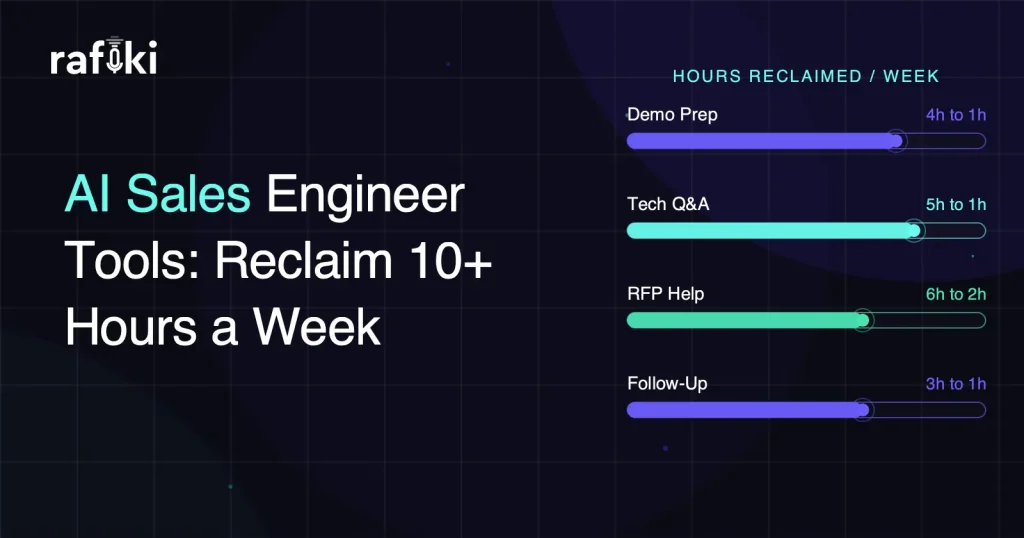
The ten-hour-per-week figure is based on representative estimates across common presales workflows. Here is an illustrative breakdown of where the time comes from across a typical SE workweek:
For a presales team of ten SEs, the aggregate time savings can represent the equivalent of multiple full-time SE hires worth of capacity — without adding headcount. The reclaimed time goes directly into the activities that drive win rates: more demos, deeper technical discovery, more thorough proof-of-concept engagements, and faster response to buyer questions.
Track these metrics to quantify impact:
The presales function is undergoing the same AI-driven transformation that has already reshaped SDR workflows and customer success operations. As McKinsey's research on generative AI's economic potential makes clear, the productivity gains from AI are largest in knowledge-intensive, language-heavy work — a description that fits presales precisely.
The competitive implications are straightforward:
The presales teams that treat AI as optional are already falling behind. The ones that treat it as infrastructure — as fundamental as CRM or video conferencing — are pulling ahead in deal velocity, win rate, and SE satisfaction simultaneously.
Rafiki AI gives presales teams enterprise-grade revenue intelligence without enterprise pricing, annual lock-in, or seat minimums. Six autonomous AI agents handle summarization, follow-up, CRM sync, call scoring, search, and reporting — so your SEs spend their hours on technical selling, not administrative overhead. Start free today or book a demo to see how your presales team reclaims ten or more hours every week.
Start for free — no credit card, no seat minimums, no long contracts. Just better sales intelligence.