The fall release goes live on a Tuesday in October, and the launch checklist is full of green checkmarks. Product marketing shipped the deck last week, and every rep passed the quiz at the end of enablement's two live sessions. By the usual measures, launch readiness looks complete, so the VP of Sales tells the executive team the field is ready.
Two weeks later, the VP opens a pair of recorded calls from the mid-market team. On the first call, the rep never mentions the new product, even though the buyer describes the exact problem it solves. A different rep pitches it with real confidence on the second call. He also promises a reporting integration that the product team has scheduled for next year.
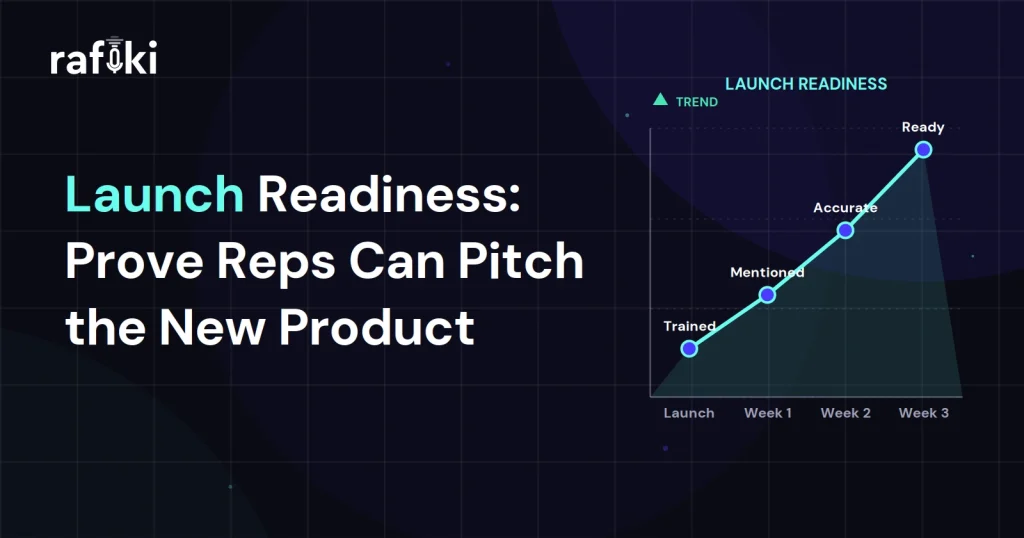
Nothing in the training report predicted either call, because quiz scores measure what reps recall in a classroom. This article measures launch readiness from the first two weeks of real calls instead. It looks at whether reps bring up the new product, whether they describe it correctly, which buyer questions stump them, and which segments respond. The article closes with a 14-day scorecard and a rule for when to send reps back for more practice.
Launch readiness is the point at which reps can pitch a new product accurately and answer the questions buyers ask about it. Most sales enablement teams mark it complete when the last training session ends. We think the call recordings give the better answer, since they show reps talking to buyers who have budgets and objections. A rep who aces the quiz and then skips the product on every discovery call still needs work.
The definition matters because it decides what you measure. If readiness means finishing training, you count attendance and declare victory on launch day. A definition based on pitching makes you wait for evidence, and the earliest evidence is two weeks of recorded calls.
That window is short enough to fix problems before they spread through the quarter's pipeline. It is also long enough for most reps to get several chances to pitch. In practice, a launch team that reviews calls early can correct a wrong claim while only a few buyers have heard it. After a month, that same claim lives in proposals and recap emails, where nobody on your side can reach it.
Attendance proves that reps sat through the session, and a quiz proves they can pick the right answer. Neither one predicts what a rep will say when a buyer interrupts the demo with a hard question. Classroom training also rehearses the pitch in the order product marketing wrote it. Real buyers, by contrast, ask about pricing and migration before the rep reaches slide four.
The gap between the classroom and the call has a handful of common causes, and most launch teams will recognize them.
We made a similar case in our piece on sales certification built on evidence over attendance. A product launch is the most time-sensitive version of that problem. Every week of wrong or missing pitches reaches real buyers while they are still deciding.
Buyers now research a new product before the first call, and many of them use AI tools to do it. Gartner's May 2026 survey of B2B buyers found that 45% had used generative AI for vendor and product research. The same survey found that 69% of buyers prefer to validate AI-generated insights with a sales rep.
For a launch, the buyer may walk into the first call holding an AI summary that a model wrote from your press release. Buyers know those summaries can be wrong, since 51% in the same Gartner survey expect generative AI to give them misleading information. The rep on the call is the person who confirms or corrects the summary. So when a rep describes the product vaguely, the AI version stays in the buyer's head, errors included.
Launch weeks also squeeze rep time. Each rep still has a full pipeline to work, and the launch adds a new deck and a new price sheet on top of it. More classroom hours won't fix that, so the enablement lead needs a fast way to see which reps need help.
The first two weeks of calls answer four questions, and each one points to a different fix. Track all four by rep and by team, so the launch lead can tell whether a gap belongs to one person or to the whole launch.
Mention rate is the share of eligible calls where the rep raises the new product. Eligibility matters, because a renewal call with a small customer may be the wrong place for an enterprise add-on. Before launch, define the call types that count, such as mid-market discovery and demo calls. Then measure mentions only on those calls.
When mention rate is low, the usual cause is confidence. Reps avoid a product they worry they can't defend, and they fall back on the pitch they know by heart.
Accuracy compares what reps say with the approved message about the new product. That message covers what the product does, who it's for, what it costs, and when each capability ships. The dangerous errors are confident ones, such as a promised integration that belongs to next quarter's release.
Product marketing should write a short list of approved claims and a separate list of claims reps must never make. With those two lists, a reviewer can check accuracy call by call without debating what "close enough" means.
Every launch produces buyer questions that the training never covered. Listen for the moments when a rep says "let me check on that" or changes the subject. Log the question that caused each stall, along with the call and the rep. After ten days, a few questions usually account for most stalls, and product marketing can answer them in a one-page FAQ.
Track how buyers react when reps raise the product, broken out by segment and deal size. Some segments will ask detailed follow-up questions and request a second demo, while others nod politely and move on. That split tells marketing where to aim the next campaign. It also shows sales leaders which part of the pipeline should hear about the new product first.
The enablement team can't listen to every launch call, but a structured sample gives the launch lead a reliable picture in a few hours a week. To work, it has to cover every team and include both new and tenured reps. With a conversation intelligence platform, the reviewer can search every transcript for the product name and skip hours of scrubbing.
Frontline managers should own the rep-level conversations, while enablement owns the pattern across teams. When three teams repeat the same wrong claim, the problem sits in the launch material. In that case, product marketing should fix the source before anyone coaches individual reps.
The two approaches measure different things, and they report at different times. This table compares them on the questions a sales leader asks during the first month of a launch.
| Question | Training-based readiness | Call-based readiness |
|---|---|---|
| What does the team measure? | Attendance and quiz scores | Mentions, accuracy, open questions, segment response |
| When does the answer arrive? | Launch day | Day 7, then day 14 |
| What is the evidence? | A completion report | Timestamped call clips |
| When does a wrong claim surface? | When a deal stalls | In the first weekly sample |
| What happens to a struggling rep? | They retake the quiz | They practice the exact gap |
| What does marketing learn? | Very little | The buyer questions nobody answered |
Neither column replaces the other, since training still gives reps the first version of the pitch. The call evidence then tells you whether that version held up in front of buyers.
The scorecard turns the four signals into a two-week routine with a few hours of review each week. Pick your thresholds before launch day, so nobody moves the goalposts after seeing the data. For example, a team might call a rep ready after two weeks of raising the product on most eligible calls with no never-say claims.
In the first three days, the launch lead only checks whether reps raise the product at all. Look at mention rate by team, and message any manager whose team has no mentions yet. A quiet team this early often means the manager skipped the launch in the weekly meeting.
By the end of the first week, most reps will have had a few eligible calls. Run the two-calls-per-rep sample, score it against both claim lists, and send out the clips on Friday. Then share the unanswered buyer questions with product marketing, since writing answers takes a few days.
During the second week, managers coach the reps who made errors, and product marketing publishes the FAQ. Any rep with a repeated accuracy problem goes into practice on the specific claim they got wrong. Meanwhile, the launch lead starts tracking segment response, because a week of calls shows which buyers want a second meeting.
Run the second sample and compare it with the first. Reps who meet the thresholds are ready, and the launch lead reports them to the VP by name. Anyone who falls short gets a specific plan for the next two weeks. The VP also gets a one-page launch readiness summary covering mention rate, accuracy, open questions, and segment response.
A second round of practice makes sense when the calls show a specific gap that practice can close. Run it for a rep who made the same never-say claim twice on live calls. A whole team needs it when one unanswered question keeps stalling their calls. In both cases, build the scenario from real calls, using the buyer's actual question and the pushback that followed.
Skip the second round when the only problem is mention rate. Reps who describe the product well but rarely raise it need a talk with their manager about which calls qualify. A practice session won't change that habit, because the rep already knows the pitch.
The best window for a second round is days 10 to 14, after the first sample shows the pattern. Keep each session short and tied to one skill, such as answering the migration question. Our walkthrough of AI role play with AI buyers shows how to set up those scenarios so they sound like the calls reps will face next week.
Many readiness gaps start in the launch material, so the call evidence belongs to product marketing too. If half the team uses the same wrong phrase, the phrase probably came from a slide. Product marketing should find that slide and rewrite it before anyone blames the reps.
The unanswered-questions list is the other big input for product marketing. Each question that stalled a call points to a gap in the launch kit. Its answer belongs in the FAQ and on the product page. The product page matters more than it used to, because the buyer's AI assistant reads it and repeats what it finds.
Segment response should reach the demand team before the next campaign goes out. Say one industry asks for second demos while another shrugs. In that case, marketing can shift spend toward the segment that leaned in. Sales leadership can then adjust the quarter's new-product goals before the quarter's forecast locks.
Rafiki AI is the intelligence layer between your team's calls and your launch decisions. It records and transcribes sales calls on video and phone in more than 60 languages. As a result, the launch lead can track the four signals on every call, including calls from regional teams that pitch in Spanish or German.
Before launch day, the enablement lead adds launch criteria to Smart Call Scoring. One criterion might check whether the rep raised the product on an eligible call, and another might compare the description with the approved claims. Rafiki AI then scores every call on those criteria alongside the team's MEDDIC, SPICED, BANT, or custom scorecard. With every call scored, the manual sample becomes a spot check.
During the two weeks, Gen AI Search answers plain-English questions across all calls. A manager can ask "Which reps promised the reporting integration?" and see the calls where it happened. Meanwhile, Smart Call Summary captures buyer questions in every call recap. Product marketing then has a running list of questions for the FAQ.
For reporting, Gen AI Reports builds a weekly launch view by team and segment for the VP. Smart CRM Sync can fill in a custom field like "new product discussed" on each opportunity. It writes to Salesforce, HubSpot, or another connected CRM, so pipeline reports show launch activity too. When a rep's scores show a gap, AI Role Play gives them a practice buyer who asks the question that stalled the call.
If your release ships in October, the work that decides launch readiness happens this week. Sit down with product marketing and write the approved-claims list and the never-say list. Then agree on which call types count as eligible for the new product. Put two 45-minute reviews on the calendar for day 7 and day 14, and invite the frontline managers.
Expect the day 7 review to surface errors that the quiz scores hid. Tell the managers that ahead of time, so they walk in ready to assign clips and practice sessions on the spot.
Rafiki AI's conversation intelligence platform scores every launch call against the claims your team approved. Pricing starts at $19 per seat per month, and there is no seat minimum. You can start a free trial and add your launch criteria today. If you'd like a walkthrough first, book a demo and see your own calls scored before the release.
Launch readiness is the point at which reps can pitch a new product accurately and answer buyer questions about it. Many teams measure it with training attendance and quiz scores. A more reliable measure comes from the first two weeks of real calls. Those calls show whether reps raise the product and describe it correctly.
Two weeks is a practical window for the first readiness call. By then most reps have had several eligible calls, and wrong claims haven't spread into proposals yet. Keep tracking mention rate and accuracy through the first month, since some reps pitch for the first time in week three.
A useful scorecard tracks four signals by rep and by team. Two of them are mention rate on eligible calls and accuracy against approved and never-say claims. The scorecard also lists the buyer questions reps couldn't answer and how each segment responded. Set the thresholds before launch day, so the team judges results against a standard it agreed on.
Certification checks whether a rep knows the material at one moment, usually right after training. Launch readiness checks whether that knowledge shows up on live calls with buyers. A rep can pass certification and still skip the product or misstate it. Only call evidence will show that gap, and it usually surfaces within the first two weeks.
Start for free — no credit card, no seat minimums, no long contracts. Just better sales intelligence.