Every sales team has a certification story that goes the same way. Reps watch the training modules, pass a short quiz, and collect the badge. Then they join their next discovery call and run the exact pitch they were running before the training started. That gap — between what sales certification claims to verify and what it actually verifies — is the quiet failure sitting at the center of most enablement programs in 2026.
The failure isn't a lack of effort. Enablement teams build thoughtful curricula, leaders sponsor the rollout, and reps genuinely complete the work. However, the certification itself measures the wrong thing. It confirms that a rep sat through content. It says nothing about whether that rep can execute the skill when a real buyer pushes back on price, questions the roadmap, or brings a skeptical CFO to the second call.
Timing makes this conversation urgent. Late summer is when enablement leaders design the certification programs that will launch at sales kickoff. The decisions you make now — what "certified" means, what evidence it requires, who judges it — will define whether next year's training compounds into skill or evaporates into completion reports. This article lays out the case for a different standard: certification earned on real calls, not attendance sheets.
Attendance-based sales certification fails because it measures exposure, not execution. A rep can watch every module, score perfectly on the quiz, and still be incapable of running the new talk track under live pressure. The badge certifies memory. The job requires behavior.
Think about what a typical certification actually asks of a rep. Watch the videos. Answer multiple-choice questions about the methodology. Perhaps record a one-take pitch video that a manager skims at double speed. None of these artifacts resemble a real conversation, because none of them include the thing that makes selling hard: a buyer who doesn't follow the script.
This is why the pattern repeats every year. Training launches with energy, completion dashboards turn green, and then win rates and talk tracks stay exactly where they were. As Harvard Business Review's reporting on sales teams growing alongside AI makes clear, the teams pulling ahead are the ones treating skill development as an operational discipline — measured, verified, and reinforced — rather than a content-delivery exercise.
Meanwhile, enablement takes the blame. Leadership sees training that "didn't stick" and questions the program's value. In fairness, nothing ever measured sticking in the first place. The program was accountable for attendance, so attendance is what it produced.
A quiz tests recall under zero pressure. A deal tests execution under maximum pressure. Those are different capabilities, and passing the first has never guaranteed the second.
Consider a rep certifying on a new pricing narrative. The quiz asks: "What should you establish before presenting the price?" The rep correctly selects "the value anchor." Two days later, a prospect interrupts a demo with "just tell me what it costs," and the rep quotes the number cold — no anchor, no framing, no recovery. The knowledge was present; the behavior was absent.
Every experienced manager has watched this movie. Under stress, people revert to their oldest habits, and a slide deck viewed once is never anyone's oldest habit. Research communities that study seller behavior, including analysts publishing through Gartner's sales insights, keep returning to the same theme: seller effectiveness comes from practiced, verified behaviors, not from information transfer.
Consequently, any certification that stops at the quiz is certifying the wrong layer. It confirms the rep knows what good sounds like. It cannot confirm the rep can produce it.
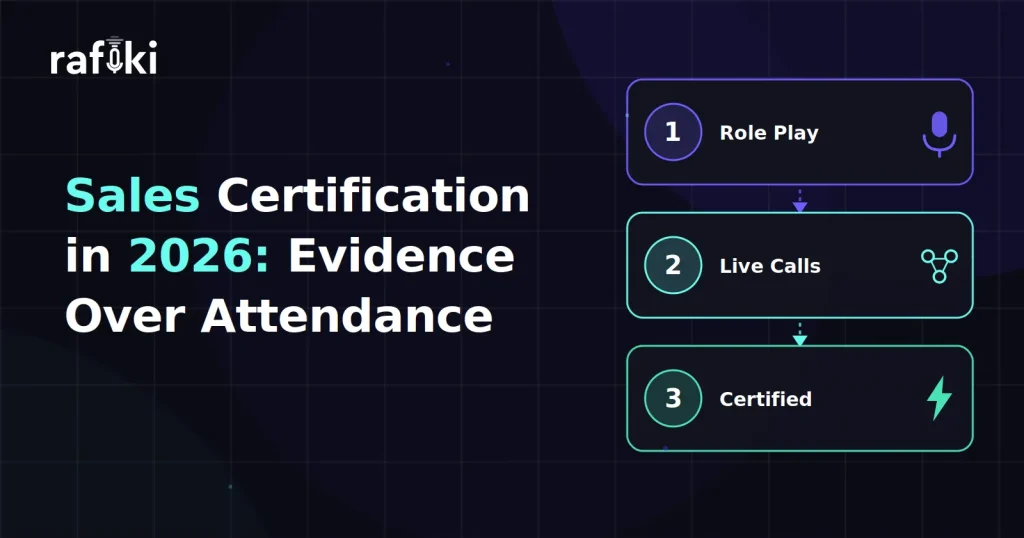
Evidence-based sales certification is a model where a rep earns certified status by demonstrating a defined behavior on real customer calls, scored against a consistent rubric. Attendance and quizzes may remain as prerequisites, but they no longer confer the credential. Evidence does.
The model runs in three stages, each raising the stakes:
Notice what changes. Certification stops being an event that happens in a training portal and becomes a state that is earned in the field. The badge now carries a specific, falsifiable meaning: this rep does this thing on real calls, and we have the recordings to prove it.
Most certification programs die at the definition stage, because the skill is described at slogan level rather than behavior level. "Sell on value" is a slogan. "Presents pricing with a value anchor before stating the number" is a behavior — observable, binary, and scoreable on any recorded call.
A usable certification rubric describes what a passing call sounds like. For a pricing-narrative certification, that might include: the rep restates the quantified problem before the quote, ties the price to the specific outcomes discussed, and holds the frame when the buyer pushes for a bare number. Each line is something a reviewer can hear and mark, without interpretation debates.
In addition, good rubrics define the failure modes. What does a near-miss look like? What disqualifies a call entirely? Writing these down before certification begins is what makes scoring consistent later — and consistency is what makes the credential mean something.
No rep should debut a new behavior on a live prospect. The middle stage of evidence-based certification is demonstration: the rep runs the behavior in simulated conversations until they can produce it reliably, including against objections designed to knock them off script.
This is where practice technology has changed the economics. AI Role Play lets a rep rehearse against a simulated buyer that pushes back, stalls, and interrupts — unlimited attempts, no manager calendar required, no prospect burned in the process. A rep can fail the pricing conversation eight times on a Tuesday night and pass it clean on Wednesday morning.
Role play performance becomes the gate to the live-call stage. Until a rep can execute the behavior against a difficult simulated buyer, there is no reason to expect it on a real one. That said, role play is the rehearsal, not the credential. Simulated success proves capability; only live calls prove adoption.
The credential itself is earned on real conversations. The rep's actual customer calls, across a qualifying stretch — enough conversations to rule out a lucky day — are scored against the rubric, and certification is granted when the behavior shows up consistently.
Doing this manually is where programs used to collapse. Nobody has managers with time to review every call for every certifying rep against a multi-line rubric. This is exactly the burden conversation intelligence was built to carry: score every recorded call against the certification rubric — whether it encodes MEDDIC, SPICED, a custom pricing narrative, or a new-product pitch — and apply the same standard to every rep, every call, every time.
As a result, certification stops depending on which manager happened to listen and how generous they felt. Every rep is scored on the same evidence, the same way. The recordings are the record, and the badge finally means what it says.
The two models differ at every layer — what gets measured, who judges it, and what the badge actually guarantees.
| Dimension | Attendance-Based Certification | Evidence-Based Certification |
|---|---|---|
| What it measures | Content completion and quiz recall | Behavior demonstrated on real calls |
| Where it happens | Training portal | Role play, then live conversations |
| Passing standard | Watched the modules, passed the quiz | Rubric behaviors observed across a qualifying stretch of calls |
| Who judges | The quiz engine | Consistent call scoring, calibrated with managers |
| What the badge means | The rep was exposed to the material | The rep executes the skill under live pressure |
| When it expires | Never — the plaque is permanent | When the behavior fades or the message changes |
| Accountability for enablement | Blamed when training "doesn't stick" | Credited with verified skill change |
Certification isn't one program — it's a design pattern you apply wherever unverified skill creates risk. Three tracks cover most of the territory.
New hires should earn their way to live pipeline through staged gates: certify discovery in role play, then on shadowed calls, then on solo calls, before carrying real territory. Structured this way, ramp becomes a sequence of evidence rather than a countdown of days. We covered the full gate structure in our 30-day ramp playbook for new sales hires, which pairs each week of onboarding with a demonstrable skill milestone.
A product launch is a controlled message reaching uncontrolled conversations. Before a rep carries the new pitch into accounts, they should certify it: rubric-level definition of the positioning, role play against the predictable objections, then verification that the pitch survives contact on early live calls. Otherwise, launch week becomes an uncoordinated field experiment, and marketing spends the next quarter wondering why the message in the deck never reached a buyer's ears.
MEDDIC and SPICED adoption is usually "verified" by checking whether reps filled in the CRM fields. However, a populated Metrics field proves typing, not questioning. Evidence-based certification checks the calls themselves: did the rep actually quantify the pain, actually test the champion, actually surface the decision process in conversation? Methodology certification should live where the methodology lives — in dialogue with buyers.
Building these tracks takes weeks of rubric writing and calibration, which is precisely why the work belongs in August and September. If you want live-call evidence flowing before your kickoff rollout, start your free trial today and put your first rubric against real calls this week.
Evidence-based certification does not sideline managers — it gives them a sharper job. Their first responsibility is calibration: before the program launches, managers score the same sample calls against the rubric and reconcile their differences until "passing" sounds the same to everyone. Skip this step and certification fractures into per-team standards, which is just the old subjectivity wearing a rubric costume.
Their second responsibility is coaching between attempts. When a rep's live calls fall short of the bar, the scores show exactly which rubric line failed — the anchor came after the number, the champion test never happened. The manager coaches to that specific gap, the rep drills it in role play, and the next stretch of calls becomes the retry. We described this loop in detail in our guide to AI skill scoring as a closed-loop coaching system: score, coach, practice, re-score.
Certification without coaching is just judgment. The manager is what turns a failed attempt into a development plan instead of a dead end.
Skills decay and messages evolve, which means a certification earned in January describes January. The rep who nailed the pricing narrative during launch season may have drifted back to old habits by summer. Meanwhile, the narrative itself has probably changed — new competitor pressure, new packaging, new proof points.
Evidence-based programs therefore treat certification as a living state rather than a plaque. Because every call is already being scored against the rubric, recertification requires no new event — the evidence simply keeps flowing. When a certified rep's recent calls stop showing the behavior, the system flags the drift, the manager coaches, and the rep re-earns the state on their next stretch of conversations.
This also solves the awkward politics of recertification. Nobody is dragged back to a classroom to re-watch modules they resented the first time. The rep who is still executing stays certified without lifting a finger; only genuine drift triggers intervention.
For enablement, this model is a change of profession: from content producer to skill verifier. The old deliverables — decks built, modules shipped, completion tracked — give way to a more defensible one: behaviors defined, demonstrated, and verified on revenue-bearing conversations.
That shift changes the conversation with leadership entirely. Instead of reporting that the team completed training and hoping the numbers move, enablement leaders can report which reps demonstrably execute the new motion on live calls and which reps are still in coaching. Evidence replaces hope. When a program underperforms, the call scores show whether the problem is the message, the training, or the field execution — so the fix targets the actual failure instead of restarting the whole cycle.
The tooling follows the same logic. A modern sales enablement platform is no longer a content library with a quiz engine attached; it is the system that connects practice, live-call evidence, and coaching into one loop. Rafiki AI's Smart Call Scoring evaluates every conversation against your certification rubric, and its autonomous AI agents carry the repetitive load — surfacing drift, flagging coaching moments — so enablement and managers spend their time on judgment, not on listening marathons.
A credential that gates territory or product access will be challenged, so the program must be built to survive scrutiny. Three guardrails matter most.
Certify on visible behavior only. The rubric should score what a reviewer can hear on the recording — questions asked, frames held, anchors placed — never vibes, style, or personality. If two reviewers can't point to the same moment in the call, the criterion doesn't belong in the rubric.
Account for territory and call-mix differences. A rep working inbound demos gets pricing conversations weekly; a rep breaking into a new enterprise territory may go weeks without one. For that reason, the qualifying stretch should be defined in opportunities to demonstrate, not in calendar days, and reps with thin call mix should be offered structured chances — role play credit toward the gate, or targeted call assignments — rather than a silent penalty for their patch.
Give every rep an appeal path with the recording as arbiter. When a rep disputes a score, the answer is not a debate — it's the tape. Manager and rep replay the moment, read the rubric line, and resolve it against what was actually said. In practice, this is the fairness advantage of the whole model: attendance-based certification offers no evidence to appeal to, while evidence-based certification is made of nothing else.
Sales certification should certify one thing: this rep demonstrates this skill on real calls. Everything else — the modules, the quizzes, the completion dashboards — is preparation, not proof. Attendance theater gave enablement teams years of green dashboards and unchanged win rates, and it earned certification badges a reputation as wall decoration.
The evidence-based model replaces that theater with a chain of proof: define the behavior at rubric level, demonstrate it in role play, certify it across a qualifying stretch of live conversations, and keep the state alive through continuous scoring. Managers calibrate and coach; enablement verifies instead of hopes; reps get a credential that actually reflects what they can do. Design that program now, before kickoff season, and next year's training will be the first one that provably stuck.
Evidence-based sales certification is a model where reps earn certified status by demonstrating a defined behavior on real customer calls, scored against a consistent rubric — rather than by completing training content and passing a quiz. The model has three stages. First, the behavior is defined at rubric level, precisely enough that independent reviewers would score the same call identically. Next, the rep demonstrates the behavior in role play, proving execution in a safe environment. Finally, the rep certifies on live-call evidence: the behavior observed across a qualifying stretch of real conversations. Attendance and quizzes can remain as prerequisites, but the credential itself is granted only when recorded calls show the skill in action. The badge then carries a falsifiable meaning, backed by recordings anyone can review.
It fails because knowledge and behavior are different capabilities, and attendance-based programs only measure the first. A quiz tests recall in a zero-pressure environment; a deal tests execution against a buyer who interrupts, objects, and refuses to follow the script. Under that pressure, reps revert to their oldest habits — and a module watched once is never a habit. The result is a familiar cycle: training launches, completion dashboards turn green, and field behavior stays unchanged. Enablement then gets blamed for training that "didn't stick," even though nothing in the program ever measured sticking. Because the badge certifies exposure rather than execution, it cannot predict performance, and over time both reps and leaders stop taking it seriously.
Anchor fairness in three guardrails. First, certify only on behavior visible in the recording — questions asked, frames held, anchors placed — never on style or personality, so the standard is identical for everyone. Second, define the qualifying stretch in opportunities to demonstrate the skill rather than in calendar days, because call mix varies: an inbound-heavy rep sees pricing conversations constantly, while an enterprise rep opening new territory may wait weeks for one. Reps with thin call mix should get structured alternatives, such as role play credit toward the gate or targeted call assignments. Third, provide an appeal path where the recording is the arbiter: rep and manager replay the disputed moment, read the rubric line, and resolve the score against what was actually said.
Treat certification as a living state rather than a scheduled event. Skills decay and messaging evolves, so a badge earned at launch describes the rep at launch — not the rep six months later. The practical approach is continuous: because every call is already scored against the rubric, the evidence never stops flowing. A rep whose recent conversations keep showing the behavior remains certified automatically, with no re-enrollment or repeated coursework. When the scores reveal drift — the value anchor disappearing, the champion test skipped — the system flags it, the manager coaches the specific gap, and the rep re-earns the state on their next stretch of calls. Recertification should also trigger on message changes, such as new pricing narratives or repositioned products, since the old certified behavior no longer matches the current playbook.
Rafiki AI's Smart Call Scoring turns every rep conversation into certification evidence, starting at $19 per seat per month with no seat minimums and no annual commitment. Start your free trial today or book a demo to see how evidence-based certification works on your team's real calls.
Start for free — no credit card, no seat minimums, no long contracts. Just better sales intelligence.