Sales Enablement

Sales Onboarding Plan: A 30-60-90 Day Template Built on Calls
Nov 18, 2026
11 min read
Yusuf ran his first solo discovery call in his sixth week, with an operations director at a regional logistics company. His sales onboarding plan showed green on every line, from product certification to the recorded calls he had watched. Twenty minutes in, the buyer mentioned that the contract with their current vendor ran out in March. Yusuf moved straight into the demo without asking what March meant for the buyer's team.
His manager, Ingrid, played the recording that evening while she cleared her inbox. She heard a rep who knew the product well and had no habit of chasing what the buyer said. The plan could not have caught that gap, because every item checked attendance and none tested a call.
A calendar-based plan ends on day 90 whether or not the rep is ready. That leaves the manager to find the gap in a lost deal. A call-based 30-60-90 day plan puts recorded calls at the center of each phase, with readiness gates in place of dates. Each new rep studies scored calls first, practices against them next, and then runs his own while his manager scores them.
A sales onboarding plan is the schedule, goals, and sign-off rules that take a new rep from day one to a full quota. Good plans judge readiness by what the rep can do on a call, while weak ones count the sessions he attended.
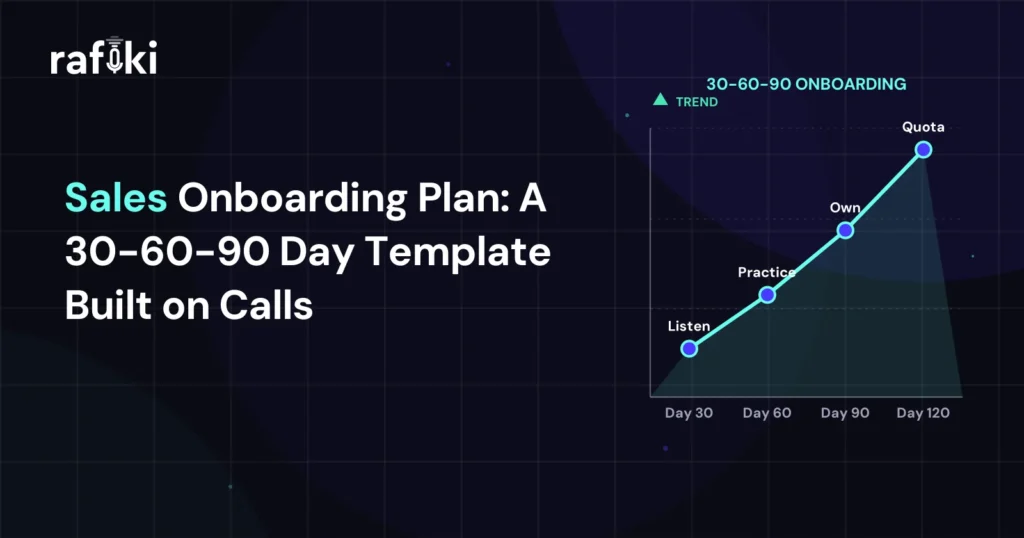
The 30-60-90 format splits the first three months into three phases with one job each. In the first 30 days the rep listens to recorded calls and learns to judge them. During days 31 to 60 he practices and then takes live calls with a manager listening. By days 61 to 90 he owns pipeline and a partial quota, and his call scores have to hold up without help.
Two people share ownership of the plan. Enablement builds the content, the call library, and the scorecard, while the frontline manager signs off each phase. Without a named sign-off, the plan drifts into a checklist the new hire completes alone. That is how Yusuf ended up green across the board.
A calendar-based sales onboarding plan measures whether the schedule ran, so it can report success on a rep who is not ready. Yusuf passed his certification because it tested recall of product facts, and he could recite them. The buyer never asked him to recite anything and instead mentioned a deadline he needed the reflex to ask about.
Product-heavy onboarding also eats the hours a new rep needs for practice. Salesforce's State of Sales 2026 announcement reports that the average seller spends 40% of their time selling, and Gen Z reps spend 35%. Onboarding repeats that pattern when product modules fill the calendar, so a new hire can go weeks without hearing a buyer.
A plan that treats recorded calls as optional homework at the end of each week loses them first. New reps skip homework when the calendar fills up, and in a first month it always fills up. Put the calls into working hours instead. Have the rep score each one himself, so he learns what the team counts as a good call.
The first phase teaches a new rep what a good call sounds like with your buyers and your product. He should spend more of this month scoring calls than sitting in product training.
| Days | Goal | Evidence of readiness | Who signs off |
|---|---|---|---|
| 1-10 | Learn why customers buy | Explains recent wins in his own words, quoting the buyers | Enablement lead |
| 11-20 | Study discovery on recorded calls | Scores top-rep discovery calls close to the manager's scores | Frontline manager |
| 21-30 | Map objections and next steps | Lists the common objections with the best response heard on a real call | Frontline manager |
Pick the library by call score, so a manager's favorite rep does not supply every example. On a team with eight tenured AEs, pull their highest-scoring discovery calls from the last two quarters. Add a few strong demos and one call from a lost deal. The lost deal teaches what a polite stall sounds like, which a new rep usually cannot hear yet.
Scoring in days 11 to 20 teaches more than the listening does. Yusuf scores each call against the team scorecard and compares his marks with Ingrid's. That way he learns the criteria before anyone measures him against them. With a criterion like "rep follows up on every date the buyer mentions," he catches that miss on other reps' calls before he makes it himself.
The second phase moves the rep from judging calls to running them, first in role play and then with real buyers. A fumbled objection costs nothing in role play, but the same fumble on a live call can cost a real opportunity.
| Days | Goal | Evidence of readiness | Who signs off |
|---|---|---|---|
| 31-40 | Rehearse discovery and objections | Role play scores at or above threshold against more than one buyer persona | Enablement lead |
| 41-50 | Lead live calls with a senior rep listening | Manager scores each call and records one coaching point | Frontline manager |
| 51-60 | Run discovery calls alone | Several consecutive solo calls at or above the team threshold | Frontline manager |
Run role play against the objections the rep mapped in phase one, so practice matches what buyers actually say. Our 30-day ramp playbook covers how to structure the sessions themselves. After a few rehearsals of the March-renewal moment, a rep asks the follow-up question without thinking.
Flip the shadowing arrangement in days 41 to 50. A new hire who sits silently on a senior rep's calls is repeating phase one with worse audio. Have the new rep lead while the senior rep listens and steps in only if the deal is at risk.
Score every call in this phase, but do not ask the manager to listen to all of them. Ingrid reviews the calls below threshold plus one random call a week, so review fits inside her normal schedule.
In the third phase the new rep carries his own accounts and a partial quota. His call scores have to stay above threshold without a senior rep on the line. The manager's question shifts to whether he can build and defend pipeline.
| Days | Goal | Evidence of readiness | Who signs off |
|---|---|---|---|
| 61-70 | Work assigned accounts alone | Discovery and demo scores hold at threshold for the period | Frontline manager |
| 71-80 | Build his own pipeline | Hits the pipeline target set at day 60, with a next step on every deal | Frontline manager |
| 81-90 | Forecast his own deals | Defends each committed deal with quotes from the buyer's calls | Sales director |
The last row is the hardest gate in the plan and the easiest one to leave out. A rep who says "the CFO told us on the 14th that the budget cleared" knows his deal. One who says "it feels strong" is guessing. Asking for call evidence in his first pipeline review builds the habit before he carries a full number.
Set the partial quota so he can hit it with honest work. Say the full quota is four new deals a quarter. One deal in the third month gives him a real goal he can reach without rushing deals to close.
A readiness gate is a check a new rep must pass before the next phase, based on scored call evidence. Each gate has a named person who signs it. With gates in place, the dates in a sales onboarding plan become estimates, and the evidence decides when a phase ends.
Under a gate system, Yusuf would not have run a solo discovery call in week six. His scored practice calls would have shown that he rarely followed up on what buyers said. Ingrid would then have assigned two more role plays on that one skill. The logistics call would have happened with a senior rep listening, ready to ask about March if Yusuf missed it.
Gates also let fast reps move faster. An experienced hire who clears the phase-one gate in two weeks should start practice early. Holding him to the calendar wastes the energy he arrived with. Our piece on the evidence-based sales interview applies the same idea one step earlier, at the hiring decision.
Two or three criteria per phase is plenty, and each should be something a manager can score from a recording in a few minutes. A gate with eight criteria turns into a second certification exam that nobody finishes on time.
Decide in advance what happens when a rep stalls at a gate. A short extension with one coaching focus is fair, and a second stall at the same gate calls for a direct conversation about fit. Writing that rule into the plan protects the rep, because he knows exactly what he has to show.
In my experience, onboarding grows by addition: each team that once struggled with a new hire adds a session, and nobody removes one. Ask of each session whether a rep needs it before his first live call. Anything he needs later moves to the week he needs it.
These four can usually go, or move later, without costing a new rep anything he uses on early calls:
Cutting feels risky because each session has an owner who believes in it. Ask that owner what evidence shows the session changes call behavior, and keep it if they can point to calls. When they cannot, the hours go back to listening and practice.
Ramp time is the number of days from a rep's start date to a defined productivity bar, such as his first closed deal. Some teams use the first month at full quota pace instead. Pick one bar, write it down, and keep it the same across hiring cohorts so the comparison means something.
The formula is simple: ramp time equals the date the rep hits the bar minus his start date. Report the median for each cohort, because one rep who closes an inherited deal in week three drags the average down. Say a team hires 12 reps over a year and the median days to first closed-won deal comes to 140. That median is the baseline to compare against after you switch to a gated plan.
Days to first deal is a lagging number that arrives months after the plan ran. Track days to pass each gate as the leading signal. If the phase-two gate keeps taking longest, the problem sits in practice or in the gate itself. Enablement can then fix it before the next cohort starts.
Be careful with small samples, because one cohort of four reps proves little. Pair the numbers with a few recordings from each rep's second month. The AI-driven SDR ramp post shows how SDR teams, which hire in larger groups, can read these signals sooner.
Phase one depends on a call library, and Gen AI Search helps an enablement lead build one from the team's own recordings. The lead can ask for discovery calls where a buyer named a contract end date and the rep asked what it meant. Those moments become Yusuf's first-week listening list.
The Notetaking Agent records, transcribes, and summarizes every sales conversation, with transcription in more than 60 languages. A team hiring in Madrid can build the same library from Spanish-language calls.
Smart Call Scoring turns each gate into a number. Ingrid can add "rep follows up on dates the buyer mentions" as a custom criterion and set the score a new rep must reach. Rafiki AI's autonomous AI agents include a Coaching Agent that scores every call against those criteria. By the time Ingrid opens her queue, Yusuf's live calls from days 41 to 60 already carry scores.
AI Role Play lets Yusuf rehearse the March-renewal moment with a practice buyer before he meets a real one. Ingrid can review those practice calls against the same scorecard before she signs the days 31 to 40 gate. After each live call, Smart Call Summary writes up the conversation so Ingrid can scan Yusuf's calls before choosing which to play.
For enablement leaders, these pieces put the call library, practice calls, and live-call scores in one place. The sales enablement use case page shows how teams set this up.
Starting a call-based sales onboarding plan takes one afternoon and needs no new hire in the seat. Pull the ten highest-scoring discovery calls from the last two quarters and add one lost deal. Then have your best frontline manager score three of them against the team scorecard. Those three scored calls become the answer key for the phase-one gate.
Next, write one gate for each phase with no more than three criteria, and name who signs it. Expect the first cohort through the new plan to expose a gate that is too hard or a criterion nobody can score from a recording. Fix that after 30 days, and leave the rest of the plan alone until the second cohort finishes.
If Yusuf had started under this plan, Ingrid would have heard the March-renewal miss on a practice call in week five. A fifteen-minute session on that one habit would have fixed it before it reached a live buyer.
Rafiki AI's conversation intelligence platform starts at $19 per seat per month with no minimums and no annual commitment. Start your free trial today or book a demo to build your first onboarding call library from your own top reps' calls.
A rep still moves on only when a scored call shows readiness, whatever kind of rep or team the question covers.
Yes, because SDRs run fewer call types and can reach live calls sooner. An SDR plan usually compresses the listening phase and spends more time on cold-call openers and objection role plays. The gates work the same way, with each one scored on recorded calls.
Review the library every quarter, and replace calls right away when pricing, packaging, or the core pitch changes. A new rep who studies a call with old pricing will repeat it to a buyer. Swap in recent calls from reps who joined in the last year, since their calls show what a new hire can realistically do.
Remote reps cannot overhear senior reps on the floor, so the recorded call library carries more of the load. Schedule live listen-ins on a senior rep's calls at least weekly in the first month, and hold gate reviews on video with the recording open. A short daily check-in with the manager replaces the hallway questions an office hire would ask.
Start recording your top reps' calls now, and build the first library from whatever a few weeks produce. Until then, have a top rep run a mock discovery call with a manager playing the buyer, and score it like a live call. Replace those stand-ins with real calls as soon as you have them, since new reps learn buyer language from real buyers.
Start for free — no credit card, no seat minimums, no long contracts. Just better sales intelligence.