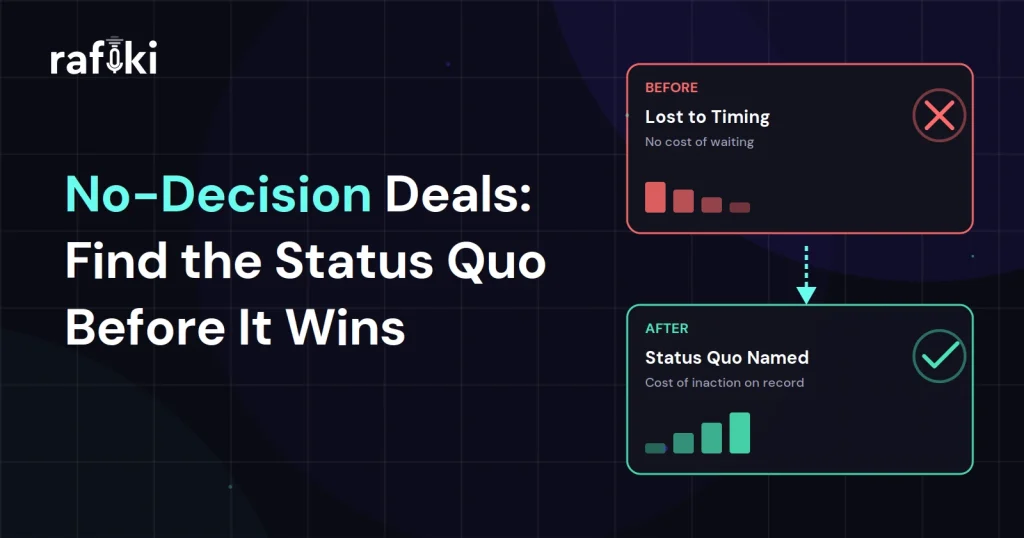
For most of October, the AE had this deal in commit, and nobody on the Thursday forecast call questioned it. Her buyer, an operations director, loved the demo, and the close date sat in the second week of December. Then the proposal went unanswered until mid-November, when the director wrote that her team would revisit it next year. The AE picked "budget" from the closed-lost dropdown, which is where a lot of no-decision deals end up.
Nobody on the buyer's side signed with another vendor. Her team kept its spreadsheet and its Monday status meeting, because nothing forced a change before year-end. In the September recordings, she calls the current process "annoying" and never once says what it costs her.
Most pipelines carry a few of these deals, and you can hear them on the second discovery call if you know what to listen for. Sales leaders who build that habit can pull these deals from the December forecast while there's time to fix discovery.
No-decision deals are opportunities that end without the buyer choosing any vendor. The buyer keeps the spreadsheet or the workaround, and the project slides onto next year's list or fades away.
Call the status quo what it is: a competitor that never joins a call and never has to answer an objection. It wins whenever the buyer decides the pain is tolerable for one more quarter, and your battlecards can't touch it.
Most CRMs don't even give these deals their own reason code. Reps pick the closest option in the dropdown, so the closed-lost report says the team lost on price. In most of those deals the buyer simply stayed put. That makes the report the most misleading page in the QBR deck, because it sends leaders off to fix pricing.
Reps choose "budget" or "timing" because the buyer said those words, and a buyer's words feel like evidence in a deal review. They usually aren't, since "no money this year" means her project lost a ranking contest inside her company.
Companies find money for problems that someone above the buyer can feel. Budget "running out" means finance funded a project with a clearer cost, and yours fell below the line.
Timing works the same way. A buyer who asks to revisit in Q1 has decided her current process can survive a few more months. Nothing the AE heard on earlier calls gave her a date that argues otherwise.
Managers accept these labels because the labels protect the manager too. Budget sounds like something that happened to the deal, while an unsized cost sounds like a missed discovery question. On Thursday the rep says "they're just busy," the manager moves to the next deal, and nobody opens a recording.
The status quo has two advantages no vendor can match: it costs nothing today, and somebody already approved it. Every current process has survived at least one budget cycle, so it skips every approval a new purchase has to clear.
Think about the operations director's side of this. To buy anything new, she has to write a business case and find a sponsor above her. Then she sits through procurement and a security review and sells a rollout to a team that likes its spreadsheet. Keeping the spreadsheet costs her none of that work, and nobody loses their job over a rollout that never started.
That gap explains why a great demo predicts so little about the close. A great demo tells you the buyer sees value, and nothing yet about whether she can justify the effort to her boss. The AE who reads enthusiasm as intent finds out in November, when the proposal goes quiet.
Harvard Business Review has written about how sales teams can use generative AI to discover what clients need. For no-decision risk, the need worth finding is the one that makes staying put hurt more than changing. If discovery never finds it, the business case stays empty and the spreadsheet wins without anyone arguing for it.
You can hear no-decision deals coming on the first two or three calls, long before anyone drafts a proposal. Every warning sign is something the buyer didn't say, which is why a friendly call hides them so well.
Pick one discovery call from last week and play it through with the CRM record closed. As you listen, note which of these gaps show up:
One gap on an early call is normal. Three or more after the second meeting usually mean the deal is losing to the status quo. At that point the AE goes back to discovery before anyone sends pricing.
The CRM won't show you any of this. A late-stage deal with a champion who answers every email can still have no cost of inaction on record. So when a deal moves into commit, open the first discovery recording before you read the rep's notes, and listen for what the buyer said about cost.
By the end of the second call, the AE should know why this buyer would change now. Have the AE and manager keep the answers in one place, so the forecast call argues from evidence. The five questions go in order, because each answer sets up the next one.
Ask the buyer to walk you through how the work happens today, step by step, and who touches each part. Write it down in her language, including the nicknames her team uses for the workarounds. When the business case reaches her boss, that language is what makes the problem sound familiar.
Ask what made her take the first meeting this quarter and not last year. Real projects almost always have a trigger, like a new leader, a missed target, a bad incident, or a planned expansion. If she can't name one, forecast the deal as exploratory and say so in your next forecast update.
Reps skip this question more than any other, because asking a buyer what her problem costs feels rude. Ask her anyway what the current process costs over a quarter, and take even a rough number. A number the rep supplies won't survive her first meeting with finance, and most AEs learn that the hard way. If she hesitates, offer a range and ask which end sounds closer.
Finance rarely funds a problem that only hurts the champion. Find out who else lives with the current process, especially anyone facing customers, since that pain gets attention faster. Then ask the champion to bring one of those people to the next call.
Ask by when she needs a fix and what happens on that date. A real deadline comes from something outside the deal, like a board meeting or the renewal date on the old tool. Put that date in the CRM next to the rep's close date, so any mismatch shows up in pipeline review.
The best cost-of-inaction questions sound like curiosity, because buyers clam up when a question feels like the setup for a pitch. Ask the buyer to describe consequences first and size them second. These work best on the second call, once she has walked through the current process:
What you do after the answer matters more than the question. When the buyer says "it slows us down," ask how much and for whom, then stop talking. The silence will feel long, and most reps fill it with a product benefit that lets the buyer off the hook.
Some buyers really can't size the problem. Ask who could, and get that person on the next call. A champion who won't do either is telling you the project has no owner with a budget.
Put two deals side by side, and the difference starts on the first call, months before any closed-lost reason. Almost every row below comes down to a discovery habit that a manager can coach.
| Stage of the deal | Lost to timing | Status quo named |
|---|---|---|
| First discovery call | Rep asks about features and budget | Rep maps the current process and trigger |
| Cost of the problem | "It's frustrating" in the notes | A rough cost the buyer stated |
| People on calls | One champion | Champion plus someone who feels the pain |
| Close date | End of the rep's quarter | Tied to the buyer's own deadline |
| Proposal | Pricing and product summary | Current cost next to the price |
| Closed-lost reason | "Budget" or "timing" | "Chose to keep current process" with the reason |
Most sales training tells reps to create urgency when a deal stalls, and that advice fails with a status quo buyer. You can't create urgency for a buyer who hasn't found her own. A December discount only lowers the price of a problem she never sized.
Walking away sounds easy in a training deck and feels terrible in December. Pipeline coverage targets push reps to keep every deal alive. Then the champion asks for a refreshed quote to "keep on file," and the stalled deal looks like money one more time. So after the status quo check, the AE and manager decide each deal out loud and write it down.
Push when the buyer has named a cost and a trigger but the rep hasn't reached the approver. The champion needs help turning her estimate into a one-page case. So the AE drafts that page with her and asks to meet the approver before the end of October.
Walk away for now when the buyer still can't name a cost or a trigger after two or three calls. Moving the close date to Q1 keeps the forecast honest and gives the AE November for deals that can actually close. When the VP asks why December dropped, a Q1 close date backed by the buyer's own vague answers is easier to defend than a January miss.
The middle case is a buyer with a real cost and a deadline next spring. Keep that deal open with her date and agree on one small next step for December. When spring gets closer, pull out our playbook for re-engaging stalled deals.
Some no-decision deals hide until pricing goes out, the first moment the champion has to defend the purchase. Now she's weighing a price against a problem nobody sized, and next to that price the spreadsheet looks cheap.
A redline sitting in legal means someone on her side is working the deal. Compare that with a proposal that draws no questions for a week, which means nobody is. Silence usually means she can't answer her boss's questions, and another "just checking in" email won't change that. Send her something she can forward instead, like a short summary of the cost and deadline she described.
If the AE never collected cost and deadline, the proposal stage is late but still workable. Ask for a short call to check that the proposal fits her team. On that call, ask the cost and trigger questions the AE skipped in September. Our piece on the proposal dead zone goes further into this stage.
Most AEs learned discovery as BANT, and BANT asks about budget before anyone knows what the problem costs. That order trains reps to accept "no budget" as a final answer, and the closed-lost report fills up with fiction. Frontline managers can retrain the habit inside the call reviews they already run.
Start with two recent losses the team logged as budget or timing. Listen to the first discovery call on each and mark the moment the buyer described the problem without a cost. In the next one-on-one, play that clip and ask what follow-up would have helped. Let the rep answer before you do.
Role play helps, because cost-of-inaction questions feel awkward the first few times anyone asks them. One AE plays a friendly buyer who dodges numbers while the other practices the follow-up and the pause. Then score real calls on whether the AE asked for a trigger and heard a cost in the buyer's words.
Teams on MEDDIC or SPICED already have the pieces, since the pain and critical event sections cover this ground. In practice, many reps treat those fields as boxes to tick on a Friday afternoon. Tying each field to a specific question is what makes it usable on a live call.
Spotting the status quo early depends on the buyer's exact words about her current process. Rafiki AI records calls on video meetings and on Aircall and OpenPhone, then transcribes them in more than 60 languages. Months later, a manager can still search what each buyer said about cost and deadlines.
Smart Call Summary summarizes each call, so account executives can reread what the buyer said about the problem and see what they still need to learn. For coaching, Smart Call Scoring scores every call against any methodology, including MEDDIC, SPICED, or custom criteria. Managers can add status quo behaviors to the scorecard, like asking for the trigger event.
Stakeholder participation mapping shows which buyer contacts took part in each call, and blocker detection flags the objections and obstacles buyers raise. With Smart CRM Sync, Rafiki AI fills in methodology fields and custom CRM fields, like one for the buyer's deadline.
Before a pipeline review, a sales leader can use Gen AI Search to look through recent calls for what buyers said about cost on open deals. RevOps leaders can also use Gen AI Reports to pull together what buyers said on calls in deals the team lost. For practice, AEs can rehearse cost-of-inaction questions against an AI buyer in AI Role Play until the wording feels natural.
This week, pull every open deal with a close date in November or December and sort them by value. For the top ten, the AE and the manager listen to the first two calls together. They check for four things: a trigger, a cost, a second person who feels the pain, and a deadline.
If a deal is missing two of those four, the AE books another discovery call before October 30. When the buyer declines that call, the manager moves the close date to Q1. That way the December forecast carries only deals where the buyer has her own reason to sign.
Then ask RevOps for a closed-lost reason that says the buyer kept the current process, with a required note. By the end of Q4, you'll have your first honest count of deals lost to the status quo. Next year's pricing and discovery debates can start from that number.
Rafiki AI's conversation intelligence platform starts at $19 per seat per month, and a team can buy a single seat. Try Rafiki AI free on your open Q4 deals and hear what each buyer said about the process she would have to give up. To talk it over with the team first, book a demo and bring the one deal you suspect the status quo is winning.
A no-decision deal is an opportunity where the buyer never picks a vendor and keeps the current process instead. The project goes on hold or fades out of the buyer's calendar. Reps often log these deals as lost to budget or timing, which hides how often the status quo wins.
Listen to the early calls for what the buyer leaves out. Warning signs include a buyer who never puts a cost on the problem and a close date that matches only the rep's quarter. A champion who can't say what happens if nothing changes is another strong signal.
Ask the buyer what her team's week looks like a year from now if nothing changes. Then ask who fixes the process when it breaks and roughly what the last failure cost. The follow-up matters most, so wait for a real answer before you say anything about the product.
A rep should step back when the buyer still has no cost or trigger event after two or three calls. The AE moves the close date to the next quarter and checks back when something changes, like a new leader. That keeps the December forecast honest and gives the AE more time for deals with a real deadline.
Start for free — no credit card, no seat minimums, no long contracts. Just better sales intelligence.