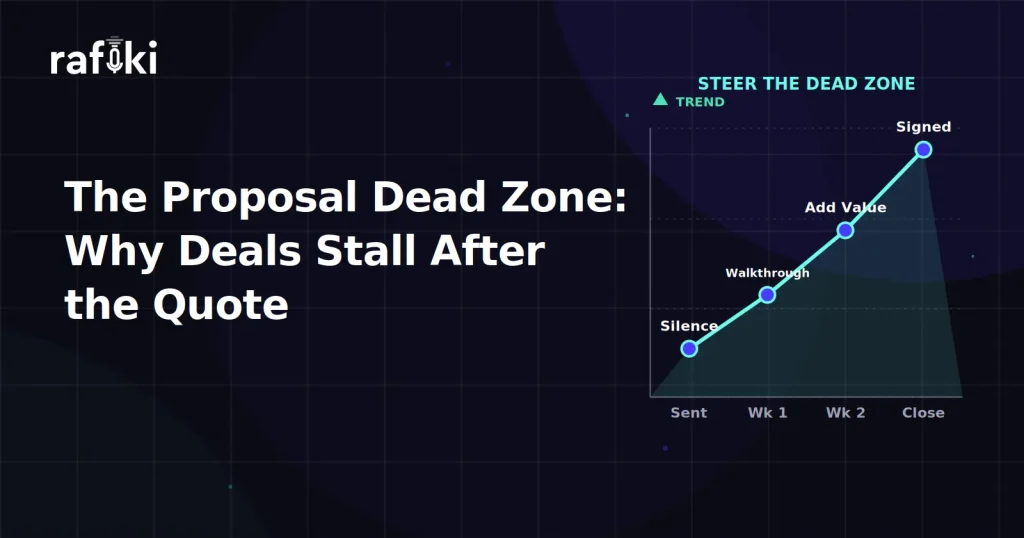
The demo landed. Stakeholders nodded along. That evening the rep polished a proposal and hit send at 9:47 a.m. The opportunity moved to "Negotiation," and the forecast call heard it would close this quarter. Then nothing happened. Welcome to the proposal dead zone — the stretch between "proposal sent" and an actual decision. More pipeline quietly dies here than at any objection a buyer ever voices out loud.
Here is the uncomfortable truth behind that silence. Reps treat sending the proposal as progress. Buyers treat receiving it as permission to disappear. The moment the document leaves your outbox, the deal moves into internal rooms you cannot see. Its timeline is no longer yours to influence, and its case is argued by people you may never have met.
Objections are survivable because they are visible — you can hear them, unpack them, and answer them. Silence offers nothing to work with. This article breaks down why the dead zone exists and how the strongest sellers refuse to enter it unarmed. It also shows how to keep steering a deal after you hit send.
The proposal dead zone is the period between delivering a quote or proposal and receiving a decision, during which buyer communication drops sharply. Throughout that window, the seller has no reliable visibility into the deal. It is the most dangerous stage in the sales cycle precisely because it does not feel dangerous. Nothing has gone wrong yet. Nobody has said no.
That comfort is the trap. A stalled discovery call announces itself. In contrast, a stalled proposal just sits there while the rep tells the pipeline review "it's with the buyer now." Meanwhile the close date slips a week, then a month, then into next quarter. In practice, most of those deals were never rejected — they simply dissolved while nobody was steering.
The dead zone is also unusual for another reason: the seller creates it voluntarily. No competitor forced it, and no buyer demanded it. By emailing a document instead of running a process, the rep handed over control of pace, interpretation, and next steps. All at once, all for free.
Post-proposal silence is not rudeness, and it is rarely a mystery. Three mechanics produce it almost every time.
The proposal answers the last open question. Throughout the sales cycle, the buyer kept meeting with you because you held information they needed — pricing, scope, implementation detail, contract terms. The proposal hands over every remaining answer in one attachment. As a result, the buyer's rational need to talk to you drops to zero the moment the document arrives.
It removes the reason for the next meeting. Every prior stage carried a built-in follow-up: discovery led to a demo, the demo led to a technical review, the review led to pricing. A proposal sent without a scheduled next step leads nowhere by default. The calendar goes blank, and blank calendars are where deals go to age.
The deal moves into rooms you cannot see. Gartner's research on B2B buying has long shown that buying groups do most of their deciding away from suppliers, in internal conversations among stakeholders with competing priorities. Your proposal is now being summarized — probably badly — by a champion in a meeting you were not invited to. It competes with budget requests you have never heard of and faces a CFO you have never met.
None of this is malicious. It is simply what happens when a seller trades an active conversation for a static document.
The single highest-leverage rule for escaping the proposal dead zone: do not send proposals — present them. Before the document ever leaves your outbox, a proposal walkthrough meeting should already sit on the buyer's calendar. If the buyer will not book thirty minutes to review a purchase this size, pay attention. That reluctance is the most important discovery data you have collected all quarter.
The walkthrough changes everything about how the proposal lands. Instead of a PDF being skimmed between meetings, you get a live audience. You watch faces when the pricing slide appears. The questions tell you which sections matter and which got skipped. Better still, a misreading gets cleared up in seconds instead of festering for weeks inside the buyer's internal debate.
Just as importantly, the walkthrough ends with a next step negotiated in the room: who reviews what, by when, and when you reconvene. Harvard Business Review's analysis of how generative AI will change sales makes a related point. As AI absorbs the mechanical work of selling, the seller's remaining value concentrates in exactly these judgment-heavy live moments. Giving away your best one by attaching it to an email is strategic self-harm.
A useful script when the buyer asks you to "just send it over": "Happy to — and because there's context behind several of the numbers, I'd rather walk you through it in twenty minutes so you're not left guessing. What does Thursday look like?" Most buyers accept. The ones who refuse are telling you where the deal really stands.
A brutal-but-fair reframe: a deal that dies in the dead zone was usually wounded two calls earlier. Silence after the quote is the symptom; the disease is what the pre-proposal calls failed to secure. Before any proposal goes out, three things should already be on the record.
You should be able to name every step between "proposal received" and "signature." That means who evaluates, who can veto, whether procurement and legal get involved, and what the buyer's own deadline pressure looks like. If the record shows you never asked, the coming silence is not the buyer ghosting — it is you flying blind. Co-building that path with the buyer works even better. Our guide to the mutual action plan template covers how to turn the route to signature into a shared document instead of a private hope.
The proposal should never be the first time the buyer sees a number. On a call before you draft anything, float a verbal estimate and watch what happens: "Before I put this in writing, the investment will land in this general range — how does that sit against what you've budgeted?" A buyer who engages with the range will engage with the document. On the other hand, a buyer who goes vague, changes the subject, or says "just put it all in the proposal" is previewing the silence to come.
Someone inside the account will present your proposal without you in the room. Decide who that is on purpose, then arm them properly. That means an executive summary in their language, the ROI logic finance will demand, and honest answers to the likely objections. An unequipped champion mumbling through your pricing table is how strong proposals die in conference rooms you will never see.
Here is the operational habit that separates disciplined teams: before approving any proposal, check the call record for all three. If the recordings and notes contain no decision-process answer, no verbal pricing test, and no equipped champion, the proposal is not ready. That holds regardless of how eager the rep is to move the stage.
Two sellers can send identical documents to identical buyers and live in completely different deals afterward. The difference is the operating model around the send.
| Dimension | Send-and-Hope | Send-and-Steer |
|---|---|---|
| Delivery | Emailed as an attachment | Presented live in a scheduled walkthrough |
| Next step | None; calendar goes blank | Booked before the proposal is sent |
| Pricing reaction | First seen alone, in the document | Pre-tested verbally on an earlier call |
| Champion | Left to summarize it from memory | Equipped with an executive summary and ROI logic |
| Silence | Interpreted by anxiety and guesswork | Read against evidence from the last calls |
| Follow-up | "Just checking in" pings | Value-add touches tied to voiced concerns |
| Timeline | Open-ended waiting | Walk-away line set by the buyer's own process |
Send-and-hope feels polite and low-pressure. In reality, it outsources the fate of your biggest deals to internal meetings you cannot attend, championed by people you did not prepare.
Not all post-proposal silence means the same thing. The evidence for decoding it already exists — in what the buyer said on the last calls before the quote went out. Silence is a lagging indicator; conversation content is the leading one.
Silence that usually means digesting looks like this in the call record:
Silence that usually means ghosting reads very differently:
Two identical weeks of silence therefore deserve opposite responses. The first buyer needs patience and a well-timed value-add; the second needs a direct requalification conversation, not a fourth cheerful nudge. We covered the underlying signal patterns in our post on deal momentum tracking through conversation signals. The same signals that predict momentum earlier in the cycle predict what silence means after the quote.
"Just checking in" is the sound of a seller with nothing to offer. Every dead-zone touch should instead deliver something the buyer's internal process actually needs — and the best source for what that is remains the calls themselves. Each follow-up should trace back to something a stakeholder voiced out loud.
Four touches that consistently move stalled proposals:
Notice the pattern: none of these ask the buyer for anything. Each one makes the internal case easier to carry, which is the only job that matters while the deal lives in rooms you cannot enter.
Everything above assumes someone remembers what was said across five calls. Someone has to notice the eighth day of silence and connect a pause on a pricing slide to the right follow-up. At one deal, discipline suffices. Across a whole pipeline in 2026, it does not — which is exactly the gap conversation intelligence platforms were built to close.
This is where Rafiki AI turns the dead zone from a blind spot into an instrumented stage. Its autonomous AI agents watch every recorded conversation across the deal, so the evidence for reading silence is never locked in a rep's memory:
For sales leaders and frontline managers, the payoff is a forecast conversation grounded in evidence. Not "it's with the buyer," but "walkthrough held, timeline confirmed on the call, CFO packet sent, review booked Friday." Start your free trial today and put instrumentation on the stage where your pipeline actually dies.
Even well-run deals sometimes go quiet. Every proposal therefore needs a walk-away line — the point at which silence stops meaning "digesting" and starts meaning "requalify." Crucially, that line should come from the buyer's own words, not from your patience. If they said legal review takes two weeks, silence in week four is a broken commitment, not a busy inbox.
When the line is crossed, stop nudging and requalify. Name the gap directly and offer a graceful exit: "When we spoke, you targeted an end-of-month decision. That date has passed, so I have to assume priorities shifted. Should we close this out, or has something changed I should understand?" Deals revive under that kind of honesty far more often than under a sixth follow-up. It restores the one thing the dead zone destroyed — a real conversation.
Whatever revives should re-enter the pipeline with a new mutual plan, a fresh timeline, and a scheduled next step. Whatever does not respond deserves an honest exit from the forecast. For push risk across the rest of the pipeline, our deal slippage playbook covers how to catch and clean it up before it distorts the quarter.
The proposal dead zone exists because sellers keep mistaking a send for a step. In truth, the quote is the moment your deal leaves your hands and enters the buyer's internal machinery. Everything about surviving that transition is decided by what you secured beforehand and how you steer afterward. Map the decision process before you draft. Pre-test the price out loud. Equip the person who will pitch you in absentia, present the document live, and follow up with value tied to what was actually said. Above all, instrument the stage so silence becomes a signal you read instead of a void you fear. Deals do not stall in the dead zone because buyers are cruel. They stall because somebody stopped steering.
Ideally, you never "wait" at all. The follow-up was scheduled before the proposal went out — the walkthrough meeting or a review call booked on the buyer's calendar. If a deal has already slipped into silence, anchor your timing to the buyer's own stated process rather than an arbitrary rule. When they said the committee meets Tuesday, follow up Wednesday with a specific, value-adding reason to talk. Absent any stated process, a few business days is reasonable for the first touch, provided it delivers something useful. Good examples: an answer to a question they hesitated on, a finance-ready ROI summary, or security documentation. What matters more than the interval is the content: every touch should make their internal decision easier, never just remind them you exist.
Treat the refusal as discovery data, because that is exactly what it is. A buyer seriously evaluating a meaningful purchase will almost always accept twenty minutes to understand the numbers behind it. One who insists you "just email it" is often signaling low intent, a predetermined vendor choice, or a price-shopping exercise. First, reframe the ask around their interest: offer a short walkthrough so their team is not left interpreting pricing without context. If they still decline, send the proposal with a one-page executive summary designed for internal circulation. Then test commitment another way: ask who will review it and by when, and request a firm decision date. If none of those commitments materialize either, requalify the deal rather than forecast it.
No — silence is ambiguous on its own, which is precisely why it causes so much anxiety. The reliable way to decode it is to read the conversations that preceded it. A buyer who confirmed a timeline, asked onboarding questions, and pulled new stakeholders into late-stage calls is usually digesting. Your proposal is moving through a real internal process that simply does not require you daily. In contrast, a buyer who went vague at the verbal pricing test, stopped asking questions before the send, and kept the deal single-threaded was disengaging before the document ever arrived. Same silence, opposite meanings. Evidence from the call record — not the number of quiet days — should determine whether you respond with patience or with a direct requalification conversation.
AI closes the two gaps that make the dead zone deadly: memory and timing. A conversation intelligence platform like Rafiki AI records and analyzes every call in the deal. The evidence for reading silence — pricing reactions, confirmed timelines, stakeholder engagement — becomes searchable instead of trapped in a rep's memory. Its autonomous AI agents then act on that evidence. They flag proposals that sit unanswered past a defined window, surface risk signals like vague pricing responses or dropped engagement, and draft follow-ups grounded in what buyers actually said. Managers get an honest view of which "Negotiation" deals are genuinely progressing, and reps get prompted toward the right touch at the right moment — before the quarter ends, not after.
Rafiki AI's conversation intelligence platform starts at $19 per seat per month with no seat minimums and no annual commitment. Start your free trial today or book a demo to see how Rafiki AI keeps your deals moving long after you hit send.
Start for free — no credit card, no seat minimums, no long contracts. Just better sales intelligence.