The deal looked healthy right up until it died. Your champion loved the product, the demo landed, and pricing was "in range." Then the buying committee met on a Tuesday afternoon — a meeting you were never going to attend — and chose the status quo. Multithreading in sales exists for exactly this moment: the decision that happens in a room you never enter, argued by people you never met, based on a version of your value story that your champion half-remembered under pressure.
Multithreading is not new advice. Sellers have been told to "get wide" in accounts for decades. What has changed is the arithmetic. Buying committees keep growing, consensus requirements keep tightening, and the real decision increasingly happens asynchronously — in budget reviews, internal chat threads, and hallway conversations. Meanwhile, most sellers still run the entire deal through one contact and call it a relationship.
This article is the 2026 update to a classic craft. If you want the fundamentals — the definition, the basic process, the benefits — start with our definitional guide to multithreading in sales. This piece goes further: mapping the real committee from call evidence instead of the org chart, auditing thread coverage deal by deal, and opening new relationships without spending your champion's political capital.
A single-threaded deal is one where every conversation, every requirement, and every internal argument flows through a single buyer contact. It feels efficient. In practice, it means your entire forecast line rests on one person's calendar, credibility, and memory.
Single-threaded deals rarely die loudly. Instead, they fail in one of three quiet ways:
None of these show up in the CRM as a warning. The deal goes quiet, slips a quarter, and then closes lost with a vague reason code. Single-threading is the quiet killer because everything looks fine until the vote.
B2B purchase decisions have shifted from individual sign-offs to group consensus. As Gartner's sales research has long documented, buying groups span more functions than ever — finance, security, legal, operations, and end users all get a voice. Any one of them can stall or veto, and much of the committee's deliberation now happens without a seller present.
At the same time, the way committees evaluate has changed. Buyers research independently, compare options with AI assistants, and arrive at vendor calls with positions already forming. Research published in Harvard Business Review on how successful sales teams are embracing agentic AI describes how the highest-performing teams respond: they use AI to widen their situational awareness across accounts rather than relying on a single contact's version of events.
The implication for sellers is uncomfortable but useful. You will not attend the meeting where the decision is made. Consequently, your job is to make sure that when the committee votes, several people in that room can argue your case in their own words — and that no critical voice hears your story secondhand for the first time.
Multithreading in sales is the practice of building direct, value-based relationships with multiple stakeholders inside a buying committee, so that no single contact carries the entire deal. That definition has not changed. What has changed is the starting point.
The classic playbook said: pull up the org chart, identify titles, and request meetings. The 2026 practice inverts this. Before you multiply contacts, you map the committee as it actually behaves — because the org chart tells you who reports to whom, not who decides. A director can outweigh a VP on a specific decision; an "end user" can hold informal veto power because the executive trusts their judgment.
In other words, modern multithreading has two distinct steps that older guides collapse into one:
Sellers who skip the mapping step end up multithreaded in the worst way: five relationships with people who do not matter, and none with the person who does.
Your calls already contain the map. Every discovery session, demo, and group review leaves behind participation patterns that reveal power far more reliably than a hierarchy diagram. Here is what to extract:
These signals also tell you where the deal actually sits in the buyer's process. For a deeper treatment of reading stage from conversation evidence, see our guide to buyer journey mapping with AI call-stage detection.
A thread audit is a simple, ruthless review: for each active opportunity, count the distinct buyer voices you have actually heard across all recorded calls and meetings. Not names in the CRM. Not people copied on emails. Voices — stakeholders who have spoken with you directly.
Run the audit like this:
Doing this by memory is where the audit breaks down, because sellers overestimate coverage — email threads get remembered as relationships. This is where conversation intelligence changes the exercise: when every call is recorded, transcribed, and attributed to named speakers, the voice count becomes a fact you can pull up, not an impression you defend. Frontline managers can then run the audit across an entire pipeline and flag every one-voice deal before the forecast call.
The fastest way to destroy a good deal is to make your champion feel bypassed. Multithreading in sales done badly — cold-calling their boss, emailing their peers without warning — reads as distrust. It spends the very political capital you were trying to protect. The craft is opening new threads with your champion, not around them.
Three rules keep the expansion safe:
A shared plan makes all of this easier to orchestrate. When you co-build a mutual action plan with your champion, stakeholder introductions become named steps on a joint timeline rather than favors you keep requesting. "Security review with Marcus — week of the 14th" is a milestone, not an ambush.
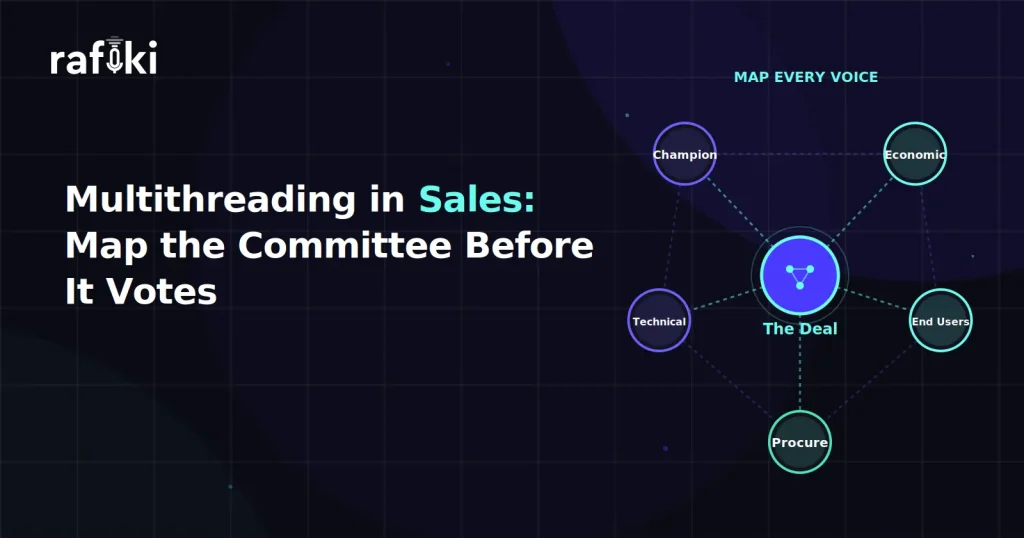
Breadth alone is not the goal — balance is. A well-threaded deal covers four distinct roles, and each role needs to hear a different story:
Your calls reveal which roles are missing. If nobody on any call has asked about data handling, the technical evaluation has not started. Similarly, if pricing questions only ever come from your champion, the economic buyer is hearing numbers secondhand. Silence from a role is not comfort; it is an uncovered flank.
Group calls are the one place where the committee performs its real structure in front of you. Most sellers are too busy presenting to watch it. The dynamics worth reading:
Reading all of this live, while also running the meeting, exceeds human attention. This is where modern tooling changes the job: post-call analysis of speaker participation and per-stakeholder sentiment turns a group call from a blur into a legible map of the committee. Start your free trial today and run your next group call through this kind of analysis before the committee meets again.
The contrast is easiest to see side by side:
| Dimension | Single-Threaded Deal | Multithreaded Deal |
|---|---|---|
| Buyer voices on calls | One | Several, across roles |
| Champion leaves | Deal resets to zero | Deal continues on other threads |
| Committee vote | Argued secondhand by one advocate | Argued firsthand by multiple advocates |
| Objections | Surface at the vote, too late | Surface early, on calls, while answerable |
| Value story | One generic pitch, retold with loss | Tailored story per role, told directly |
| Procurement | Engaged after verbal yes; adds delay | Engaged early; path to signature pre-cleared |
| Forecast confidence | Rests on one person's optimism | Rests on observable committee coverage |
| Silent risk | Invisible until closed-lost | Visible as a coverage gap you can act on |
Notice that every row on the multithreaded side is observable. That is the deeper point: multithreading does not just improve win rates, it makes deal risk inspectable instead of anecdotal.
The last mile of multithreading is memory. A stakeholder map scribbled in a notebook fails the moment the deal gets handed off or forecasted. The map has to live in the CRM and stay current without depending on rep discipline on a Friday afternoon.
This is where Rafiki AI earns its place in the workflow. Rafiki AI analyzes every recorded conversation and extracts the committee evidence automatically: who attended, who spoke, what each stakeholder asked about, and how their sentiment trended. Its Smart Call Summary captures stakeholder-level detail from each call — including those "we'd need to run this by..." mentions that name ghost stakeholders — so the map grows from evidence instead of recollection.
From there, Smart CRM Sync pushes the structured record into your CRM: contact roles, methodology fields, blockers, and next steps, updated after every call. The stakeholder map stops being an artifact someone builds before the QBR and becomes a living view that reflects last Tuesday's call by Wednesday morning. For account executives, that means the thread audit is always current; for managers, it means coverage questions get answered from data, not from a rep's confident summary.
Because Rafiki AI's autonomous AI agents work across the whole pipeline continuously, the one-voice deals surface on their own — no one has to remember to go looking for them.
Multithreading fails as an initiative when it stays a slogan. It sticks when managers inspect it the way they inspect pipeline math. A practical weekly cadence:
Coaching changes tone here, too. Instead of "you should multithread more" — advice reps have heard for years — the conversation becomes specific: "Finance has been named on three calls and we've never spoken to them. What's our reason-that-serves-the-champion for that intro?" Evidence turns a platitude into a plan.
The committee will meet without you. That is no longer a failure of access — it is how modern B2B buying works. The question is what happens in that room: one tired advocate defending a half-remembered pitch, or several stakeholders who each heard your story firsthand, in their own language, and have their own reasons to want it approved.
Multithreading in sales, practiced the 2026 way, is committee cartography first and relationship-building second. Read the power structure from call evidence — attendance, deference, ghost mentions, sentiment splits. Audit every deal for distinct voices and treat one voice as the red flag it is. Open new threads through your champion with reasons that serve them, cover the four roles, and let the stakeholder map maintain itself from conversations instead of memory. Deals will still be decided in rooms you never enter. But you get to decide, long before the vote, who in that room is arguing for you.
Multithreading in sales is the practice of building direct relationships with multiple stakeholders inside a buying committee, rather than running the entire deal through a single contact. Each "thread" is a distinct line of communication — with the economic buyer, the technical evaluator, end users, and procurement — so the deal no longer depends on one person's availability, memory, or internal influence. The modern version adds a mapping step: before opening new threads, sellers analyze call evidence to identify who actually holds power in the committee, which is often different from what the org chart suggests. Our definitional guide covers the fundamentals in depth.
Think in roles before numbers. A resilient deal has at least one direct relationship in each of the four core roles: the economic buyer who owns budget, the technical evaluator who guards the stack, an end-user voice who will live with the product, and procurement, who controls the path to signature. Complex purchases naturally require more threads, because committees keep growing and each added function can stall a decision. More useful than any fixed target is the thread audit: count the distinct buyer voices you have actually heard on calls. One voice means single-threaded and at risk; several voices in one role means wide but unbalanced. Coverage across all four roles is the configuration that survives surprises.
Make every new thread something your champion benefits from, and route it through them. Ask for introductions with a reason that serves their interests — for example, offering to handle the CFO's payback questions directly so your champion is not defending the numbers alone. In addition, lead with value rather than meeting requests: send each stakeholder content built for their specific problem before asking for their time. Co-building a mutual action plan helps, because stakeholder conversations become scheduled milestones on a shared timeline instead of ad-hoc favors. The one hard rule: never cold-call around a champion. If they resist opening doors, diagnose that resistance first — bypassing them converts an ally into an opponent.
AI removes the two bottlenecks that make multithreading fail in practice: observation and memory. On the observation side, conversation intelligence analyzes every call to show who attended, who spoke about which topics, who was deferred to, and how sentiment differed between personas — the participation patterns that reveal the committee's real structure. On the memory side, tools like Rafiki AI turn that evidence into a living stakeholder map: Smart Call Summary captures stakeholder-level detail from each conversation, and Smart CRM Sync writes it into the CRM automatically. As a result, thread audits run from data, ghost stakeholders get flagged when named on a call, and managers can inspect coverage across the pipeline.
Rafiki AI's conversation intelligence platform starts at $19 per seat per month with no seat minimums and no annual commitment. Start your free trial today or book a demo to see how evidence-based stakeholder mapping keeps your deals multithreaded before the committee votes.
Start for free — no credit card, no seat minimums, no long contracts. Just better sales intelligence.