Felix, an account executive, could not answer the one question his CRO, Hannah, sent on Slack about his latest discovery call, because he had never asked the buyer. Ten minutes after the 45-minute call with a logistics firm's operations director, she had opened the opportunity to check the SPICED sales methodology fields her team added in September. She still reviews new opportunities herself, because the rollout is only a month old. Situation held three paragraphs about the buyer's warehouse software, and Pain said "manual reporting." Critical Event said "Q1," and Impact was empty.
Hannah's Slack message asked what happens to this buyer if nothing changes by Q1. The call was pleasant and the director liked the demo. Still, nothing she said gave the deal a reason to close this quarter or next.
In my experience, this is what a SPICED rollout looks like a month in. The team knows the acronym and the CRM has five new fields, but reps fill those fields from memory after the call. As a result, the record shows what the rep recalls, and that can differ sharply from what the buyer said. The fix is to score each SPICED letter 0, 1 or 2 on what the buyer said in the recording, and to measure a 30-day rollout from those calls.
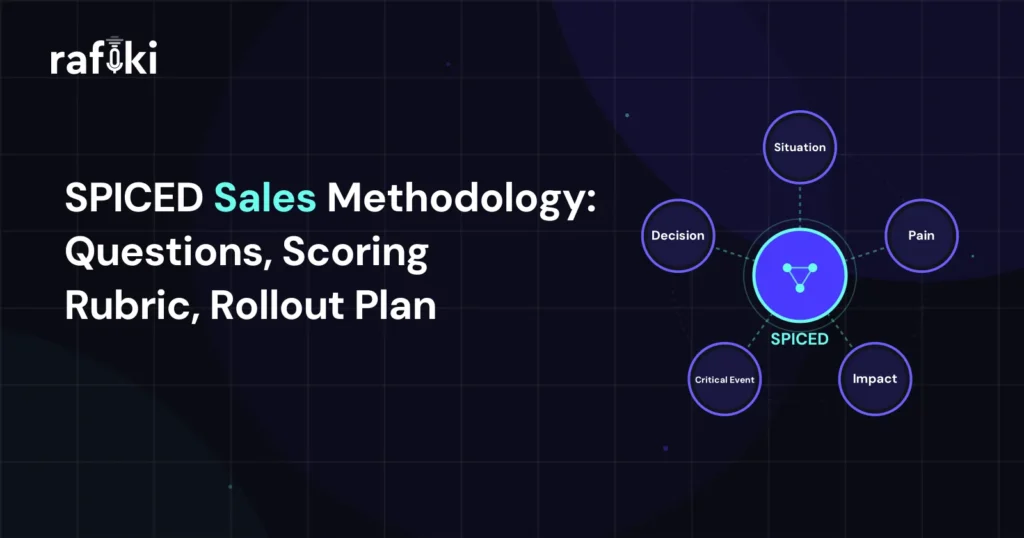
The SPICED sales methodology is a discovery and qualification framework with five elements: Situation, Pain, Impact, Critical Event and Decision. Winning by Design built it for recurring-revenue businesses, where the sale is the start of a customer relationship. In that model, the value the buyer expects at signature becomes the yardstick at renewal.
The letter count shows where the framework puts its weight. MEDDIC, built for large enterprise deals, gives three of its six letters to the buying process. Those three are the economic buyer, decision criteria and decision process. SPICED gives the buying process one letter and spends the other four on the buyer's setup, problem, value and deadline. Customer success inherits that value on day one, so a vague Impact field becomes a CS problem later.
The letters also follow the order of a good discovery call. A rep learns the situation, finds the pain and sizes its impact. Then the rep ties that impact to a date and maps how the buyer will decide. Harvard Business Review looks at how sales teams can use gen AI to discover what clients need, with AI as a research aid. SPICED adds what research cannot supply: five buyer statements that a manager can check for in the recording afterward.
Situation covers how the buyer works today, including the team, the tools, the process and the trigger for the call. By the end of discovery, the rep should be able to describe that setup in the buyer's own words.
Felix's buyer would satisfy Situation by describing her Monday routine in detail. Three coordinators pull data from two systems into a spreadsheet, and she checks it on Tuesday. His three paragraphs came from the company website, so they gave him background but nothing about how her team works. Keep Situation short, because a rep who spends twenty minutes here runs out of time for Impact.
Pain is the problem the buyer admits to in their own words, along with who feels it. A pain the rep suggests and the buyer merely agrees with does not count. The buyer will not fight for that problem in a budget meeting, so it cannot carry the deal.
Listen for a specific incident with a date attached. Suppose the director says, "Last month the Monday report was wrong, and we shipped to a closed warehouse." Her answer names the pain and tells you when it last hurt. By contrast, Felix's field said "manual reporting," which describes a task the buyer never complained about.
Impact is the result the buyer expects once the pain goes away, in numbers or in personal terms. SPICED puts impact at the center because it justifies the purchase and later becomes the customer's success metric.
Winning by Design separates rational impact, the business metric, from emotional impact, which is what changes for the person. A strong answer carries both. For example, Felix's buyer might say that fewer misrouted shipments would cut the credits she issues to customers. She might add that she would get her Tuesday mornings back from checking spreadsheets.
Customer success will ask about Impact before any other letter. When the rep records the buyer's words here, the CS team can open the account with the same goal. Our guide to the customer kickoff call shows how CS uses that goal on day one. Felix left the field empty, so the deal had no stated value and his CS counterpart would start from scratch.
A critical event is a date the buyer cares about, paired with a consequence if the date passes. Any field that says "Q1" holds the rep's guess at a timeline, so it tells a manager nothing about whether the deal will move.
Good critical events come from the buyer's calendar: a contract expiry, a peak season, a board meeting or a site opening. Felix's buyer might say her warehouse software contract renews March 31 and that she will not sign another year. That one statement gives Felix a date, a consequence and a plan to work backward from with her.
Push back on events the rep invented, such as an end-of-quarter discount. A buyer who has seen the same discount return next quarter gives that date no weight, so it will not move the deal.
Decision covers the buyer's criteria, the steps in their buying process and the people who approve. A rep has satisfied Decision when the buyer names those people and steps, ideally with a date against each step.
SPICED is thinner here than enterprise frameworks, because it has no separate letter for a champion or an economic buyer. Teams selling larger deals can ask the champion question inside Decision and score it there. That keeps one framework in the CRM and still covers the person who will sell internally for the rep.
A SPICED scoring rubric gives each letter a 0, 1 or 2 based on what the buyer said. Once you write down the evidence for each score, two managers who review the same call should land on the same score. The table pairs one question from each bank above with the buyer evidence for each score.
| Letter | Question bank (sample) | Evidence that satisfies it | Score 0 / 1 / 2 |
|---|---|---|---|
| Situation | How does your team handle this today, and who owns each step? | Buyer describes current process, owners and tools | 0 = rep assumed it; 1 = general description; 2 = buyer gave steps, owners and trigger |
| Pain | What frustrates you most, and when did it last cause a problem? | Buyer names the problem and a recent incident | 0 = none stated; 1 = rep proposed it and buyer agreed; 2 = buyer named it with an example |
| Impact | Which number would move, and what does the problem cost today? | Buyer ties the fix to a metric or personal outcome | 0 = none; 1 = qualitative benefit; 2 = buyer named a metric or cost and a personal stake |
| Critical Event | Is there a date this has to work by, and what happens if it slips? | Buyer states a date and a consequence | 0 = rep-set date; 1 = date or consequence alone; 2 = buyer stated both |
| Decision | Who signs, and what did approval look like last time? | Buyer names approvers, steps and criteria | 0 = unknown; 1 = some people or steps; 2 = people, steps and criteria named |
A deal that earns a 2 on every letter totals 10. Before an opportunity moves past discovery, a team can require a minimum, such as 7 with no zero on Impact.
SPICED fits recurring-revenue deals where impact and timing decide the sale. MEDDIC suits enterprise deals with large committees and formal procurement, while BANT suits a fast first-call screen. All three ask who decides and when, but each one spends a different share of the call on the buyer's problem.
BANT asks about budget, authority, need and timing, usually on the first call. That makes it a good fit for SDRs who need to decide quickly whether to pass a lead. MEDDIC covers metrics, the economic buyer, decision criteria, decision process, pain and a champion, so it suits a six-month deal with several approvers. SPICED keeps the buyer's problem at the center and makes the rep earn a dated reason to act. Our post on agentic CRM hygiene shows how frameworks like MEDDIC and SPICED turn into CRM fields.
| Framework | Built for | Strongest on | Weakest on |
|---|---|---|---|
| SPICED | Recurring-revenue sales with a CS handoff | Impact and a dated critical event | Champion and competition |
| MEDDIC | Enterprise deals with large committees | Economic buyer and decision process | Speed on smaller deals |
| BANT | Early lead qualification | A quick go or no-go | Depth on pain and impact |
Avoid running two frameworks on the same opportunity. Suppose Hannah's team had kept its six MEDDIC fields and added five SPICED fields. Felix would then face eleven fields after every call and fill only the ones his manager checks first. Pick one framework for the opportunity record, then borrow single questions from the others where your deals need them.
Run the rollout in four weekly steps: baseline, training, live calls and review. Hannah's team skipped the baseline in September, so a month later nobody could say whether discovery had improved.
Pick ten to twenty recent discovery calls and score them against the rubric before you announce anything. Have two managers score the same five calls, then rewrite any rubric line they scored differently. The baseline shows which letters the team already covers and which ones nobody asks about.
Run one session per letter, using clips from baseline calls where a rep earned a 2. Next, add the five SPICED fields to the opportunity with a score field for each. Keep the free-text fields short so that reps quote the buyer instead of summarizing. In role play, have reps practice the Impact and Critical Event questions, because those are the ones they ask least.
Every rep uses the framework on real discovery calls this week. Managers review two calls per rep against the rubric and give each rep one fix tied to a single letter. Hold back the rest of your notes for now. A rep who hears five fixes after one call tends to try all of them badly on the next one.
Score a fresh set of discovery calls and compare each letter's average with week 1. Rewrite rubric lines that still cause disagreement, and make the lowest-scoring letter next month's team focus. Then show reps the before-and-after scores per letter, so they can see which buyer statements they now collect.
SPICED adherence is the share of discovery calls where the rep earned evidence for each letter. Measure it from the recording, because the CRM shows what the rep typed while the recording shows what the buyer said.
Felix's opportunity shows the gap between the two. A manager reading only the fields would rate his discovery nearly complete, since four of five fields held text. The recording tells a different story, because the call never produced an Impact statement at all.
Score each call on what that call added, and score the deal on the best evidence across all its calls. For example, a deal that earned a 2 on Pain in the first call keeps that score for life. If a follow-up call adds nothing new on Pain, that call scores 0 on the letter, which shows where the call spent its time.
Manual review cannot keep up for long. Say a manager runs eight reps who each hold four discovery calls a week. That adds up to 32 calls and about 24 hours of audio at 45 minutes each. Automated scoring covers every call, but only if each score quotes the buyer moment that earned it. Before you trust it, have a manager score twenty calls by hand and compare the results letter by letter.
Our post on custom call scoring explains how to write criteria when your framework differs from the defaults. Once the scores hold up, track adherence per letter and per rep across months. A rep stuck at 0 on Critical Event for six weeks needs coaching on one question. That conversation is far easier than telling her that her discovery is weak.
In a SPICED rollout, conversation intelligence puts the buyer's own words next to each letter before the rep types anything. Rafiki AI's Notetaking Agent records and transcribes a call like Felix's from start to finish. Hannah can then read the director's line about the misrouted shipment. She can also confirm that nothing in the 45 minutes puts a cost on it.
SPICED is one of the methodologies built into Smart Call Scoring, along with MEDDIC, BANT and GAP. This means the five letters of the rubric above do not need rebuilding. Hannah's team added one custom line for Critical Event: "buyer stated a date and a consequence." That line is stricter than counting any date the rep mentioned. With a 0 on Impact in front of him, Felix could have put the cost question in his next email to the director.
The fields from week 2 of the rollout are where Smart CRM Sync does its work. It writes Pain, Impact and Critical Event from what the buyer said, and it can fill the custom score fields too. Felix's Pain field would then hold the director's line about the closed warehouse in place of "manual reporting." A CS lead can quote that line at kickoff.
Across the team, the Coaching Agent scores every discovery call against the same SPICED criteria. Hannah gets the per-letter adherence numbers from the previous section, and nobody has to replay a call. Gen AI Reports then breaks those scores out by rep and by letter for the month. A frontline manager on Hannah's team could see that Felix sat at 0 on Impact for three straight weeks. That one letter becomes the topic of his next one-on-one.
This week, pull ten discovery calls from the last month and score them against the rubric above. Ask a second manager to score five of the same calls so you can test the rubric as well. You will learn which letter your team skips before you spend an hour training reps on the SPICED sales methodology.
Hannah ran this exercise in October, a month later than she should have. Impact scored 0 on most of the team's calls, including Felix's. So she dropped the full training plan and ran two weeks on Impact questions alone. She also asked Felix to call the director back with the cost question he had skipped.
Rafiki AI's conversation intelligence platform starts at $19 per seat per month with no minimums and no annual commitment. Start your free trial today or book a demo to see which letter of the SPICED sales methodology your last ten discovery calls skipped.
Before you train the team, check these answers against the ten discovery calls you score first.
SaaS is the obvious fit, but SPICED works for any company that renews contracts, such as managed services or subscription data. One-time capital purchases with long procurement cycles usually need more decision-process detail than a single Decision letter gives.
SDRs can cover Situation and a first read on Pain in a short qualifying call. Impact and Critical Event usually need a longer conversation with the person who owns the problem. Hand the AE whatever the SDR captured, in the buyer's words, so the discovery call does not start over.
A buyer with no date and no consequence has no reason to buy this quarter, so keep the deal out of the forecast. Ask what happens if the problem is still there a year from now. The answer either surfaces a real date or shows that the pain is too mild to close on.
Set your threshold from your own closed deals, since a borrowed number will not match your sales cycle. Score your last twenty wins and losses on the 0 to 10 scale and look for the total that separated them. If the wins cluster above a line the losses rarely reach, that line is your first threshold.
Start for free — no credit card, no seat minimums, no long contracts. Just better sales intelligence.