AI

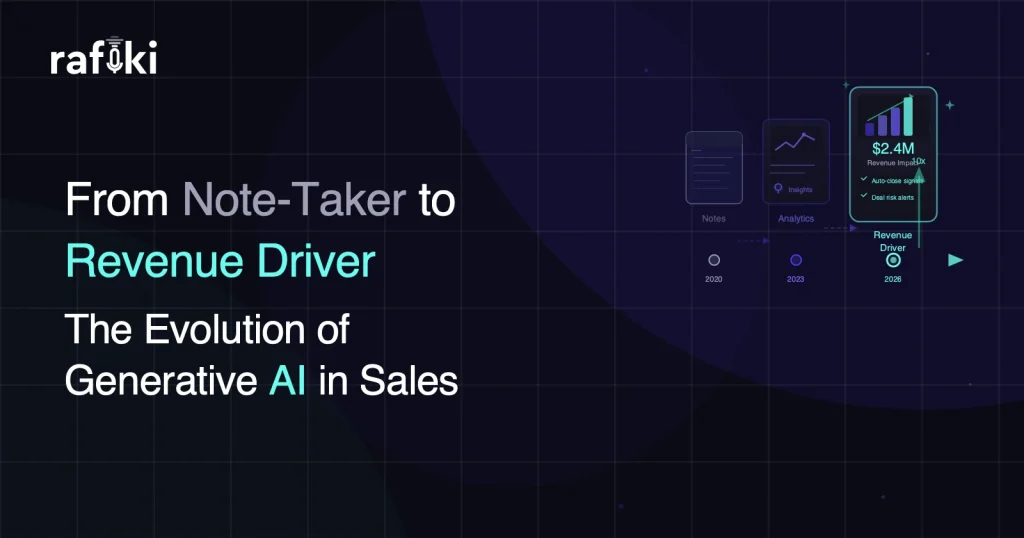
From Note-Taker to Revenue Driver: The Evolution of Generative AI in Sales
Jan 30, 2026
5 min read
The First Generation of AI in Sales Was Helpful.
The Second Is Transformational. When AI first entered sales, it solved a simple problem:
Reps hated taking notes.
Meeting bots emerged to:
It was useful.
It saved time.
It reduced admin.
But it didn’t fundamentally change revenue outcomes.
It made documentation easier.
It did not make decisions better.
In 2026, generative AI in sales has crossed a critical threshold.
It no longer just summarizes meetings.
It interprets them.
It structures them.
It connects them.
It predicts outcomes.
It guides execution.
The evolution from note-taker to revenue driver is not incremental.
It’s architectural.
And platforms like Rafiki are at the center of this shift.
The first wave of generative AI focused on productivity.
Meeting assistants:
The promise was clear:
“Reps spend more time selling.”
But three limitations quickly emerged.
A transcript is a wall of text.
Even a summary is still narrative.
Narrative is helpful for recall.
But it’s not structured intelligence.
Managers can’t forecast from paragraphs.
RevOps can’t analyze themes from prose.
Coaches can’t score methodology adherence from summaries alone.
Early AI operated at the single-call level.
It could summarize one conversation.
But it couldn’t detect:
Without cross-account intelligence, AI remained reactive.
Meeting bots stopped at the call.
They didn’t feed:
They were productivity tools — not revenue infrastructure.
The second wave of generative AI changes the role of conversation data entirely.
Instead of generating output for reps, it generates insight for the business.
This is where the transformation happens.
Modern generative AI in sales now:
The meeting is no longer an event.
It becomes a data node in the revenue engine.
The leap from note-taker to revenue driver happens when AI stops thinking in paragraphs and starts thinking in frameworks.
This is where Rafiki differentiates.
Rafiki doesn’t just summarize calls.
It extracts structured intelligence.
Every meeting contains signals that impact revenue.
Rafiki analyzes conversations and extracts:
This intelligence is not left as text.
It is mapped into structured, analyzable fields.
That’s the foundation of revenue-grade generative AI.
One call is anecdotal.
Fifty calls are data.
When structured correctly, conversation intelligence reveals:
Rafiki aggregates conversation-level intelligence across accounts and surfaces patterns in manager dashboards.
This moves AI from “meeting summary” to “strategic insight engine.”
Traditional forecasting relies on:
But deals rarely collapse overnight.
Warning signals appear in conversations first:
Rafiki continuously analyzes these signals across meetings.
Instead of waiting for stage movement, it identifies slippage risk early.
This enables:
This is generative AI influencing revenue predictability.
Coaching used to depend on:
Now, generative AI can guide coaching with structured insight.
Rafiki enables managers to see:
Instead of guessing where a rep struggles, managers coach from evidence.
Coaching becomes systemic — not sporadic.
The real transformation happens when conversation intelligence is integrated into operational dashboards.
With Rafiki, managers can view:
These dashboards are not static reports.
They are continuously updated by structured meeting intelligence.
This is the moment generative AI becomes part of the revenue operating system.
In 2023, AI sat at the edge of the stack.
In 2026, it sits at the center.
The modern stack looks like this:
CRM (system of record)
Conversation Intelligence (Rafiki)
Agent layer (forecasting, coaching, automation)
Orchestration layer
Human decision layer
Without structured conversation intelligence, agents operate on incomplete context.
With Rafiki, every agent in the stack operates on verified customer reality.
Companies that remain in the first wave of AI adoption get:
Companies that adopt the second wave get:
One is productivity improvement.
The other is revenue transformation.
Generative AI in sales has evolved.
The era of “AI note-taker” is over.
The era of “AI revenue driver” has begun.
Every meeting is now:
But only if it’s structured correctly.
Rafiki transforms raw conversation into structured pipeline intelligence.
It detects patterns across accounts.
It predicts deal slippage.
It guides coaching decisions.
It feeds revenue insights directly into operational dashboards.
The future of sales isn’t about recording what happened.
It’s about understanding what it means — and acting on it.
And in 2026, the companies that treat conversation intelligence as infrastructure — not a feature — will define the next decade of revenue growth.
Start for free — no credit card, no seat minimums, no long contracts. Just better sales intelligence.