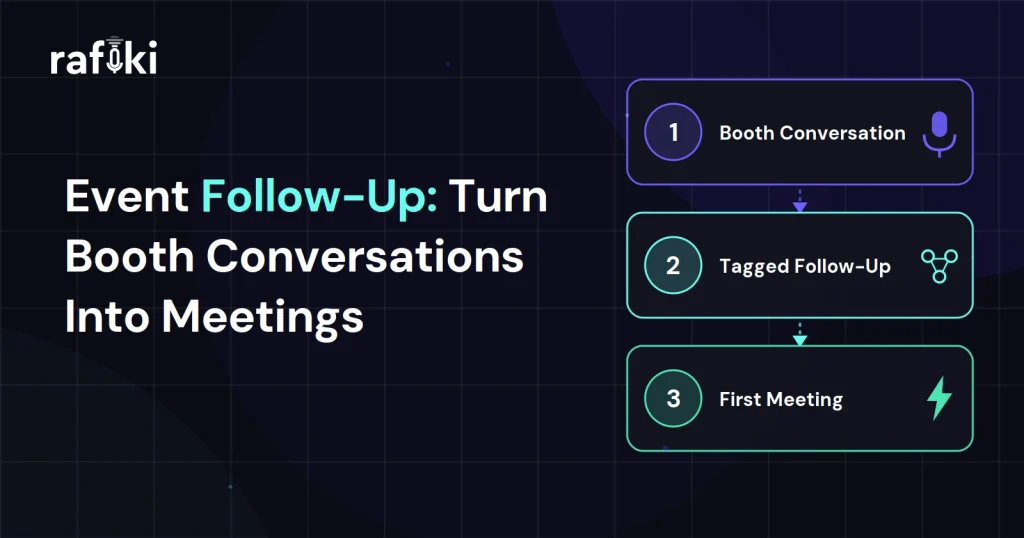
On the last afternoon of a fall conference, an SDR spends ten minutes at the booth with an operations director. Her team rolled out a call-coaching tool last spring, and by July her managers had stopped opening it. She names the manager who pushed back and the dashboard nobody opened, which is more discovery than most first calls ever get. Good event follow-up would start from that conversation, yet at most companies it never makes it past the airport.
On the walk back to the hotel, the SDR records a voice memo about her and never plays it again. Monday morning, marketing loads the badge scan spreadsheet with 400 rows into the CRM. Every row drops into the same five-touch "great to meet you" sequence, first line and all. The operations director gets the email written for the student who stopped by to charge a phone.
A month later, the marketing team asks for pipeline attribution from the show. The honest answer is a handful of meetings that nobody can trace back to a booth conversation. Most post-mortems blame the list or the show itself. The real loss happened on that first Monday, when the conversation stayed in a voice memo and one SDR's head.
Event follow-up is the work of turning conference conversations into first meetings, starting from what each person said. It covers the notes an SDR takes on the floor, the sort after the show, the first email, and the first call.
Most companies run event follow-up as a marketing task with a small sales tail attached. Marketing owns the list and the sequence, and an SDR only hears about a lead after someone clicks. That SDR then dials cold, with no idea the buyer spent ten minutes at the booth describing her rollout.
That split is fine for the people who walked past on their way to coffee. It wastes the ones who stopped and talked, because they already told someone what hurts. For that group, the SDR who stood at the booth should own both the email and the call. Marketing keeps everyone else, and a later section covers what to do with them.
A badge scan records that two people stood near each other for a few seconds. In the 400-row spreadsheet, the director with the failed rollout sits in a row that looks exactly like the passerby who wanted a pen. Both rows have the same columns, the same blank notes field, and the same event tag.
The standard post-event advice says to email everyone within 48 hours, before the leads go cold. That rule is right for a handful of rows and wrong for everything else in the file. Speed matters for the few who had a real conversation and still remember the details. The passerby with the pen will not notice whether the email arrives Tuesday or the following week.
Sorting by title fails too, because a VP title says who holds budget and nothing about the conversation. Senior people often walk the floor collecting ideas for a project someone on their team will run. The manager who owns that project is the one who stops for ten minutes and explains where it hurts. Her title puts her halfway down the spreadsheet, below executives who never said a word.
The operations director did not walk up to the booth cold. Before the show, she had likely asked an AI assistant about coaching tools and come away with a rough shortlist. She stopped to test that shortlist against a person who could answer her follow-up questions.
Gartner reported in a May 2026 press release that 69% of surveyed B2B buyers prefer to validate AI-generated insights with a sales rep. The finding describes B2B buyers in general, and the release does not tie it to trade shows. An SDR leader should read it as a signal about why buyers want to talk to reps at all.
Her booth conversation fits that pattern closely. She arrived with a failed rollout and her own theories about the cause, and the hall closed before she finished testing them. The first call is where she finishes, so the SDR should open with her question. A company overview can wait, and on a good call it never comes up.
Booth notes are only reliable until the SDR starts talking to the next person in line. Scanner apps have a notes field, and SDRs skip it because typing while a buyer waits feels rude. The fix is a thirty-second habit: after each real conversation, the SDR steps aside and records four things.
The voice memo on the walk back to the hotel is a decent backup, provided someone turns it into text that night. A week later, the SDR will hear "ops director, coaching tool, July" and have no idea which face goes with it.
Before dinner, the event team should spend fifteen minutes in the hotel lobby going through the day's notes. Each SDR reads their conversations out loud, and the manager marks the ones that need a call this week. The debrief also catches collisions, like two SDRs who each met someone from the same account and planned separate emails.
The SDR leader should run the sort once, on the first morning back, with everyone who staffed the booth in the room. What each person said is the main filter, and title and company size only break ties. Five groups cover almost every event list:
The first group is usually the smallest, and it produces most of the meetings the event will generate. On Monday, a short list pulled from 400 rows feels thin, and someone will push to add the VPs who scanned without talking. The SDR leader should refuse, because every name added without a conversation eats time the real conversations need.
The first email has to prove that the SDR remembers the conversation, and the buyer's own words do that fastest. For the operations director, the note could read like this:
"You mentioned at the booth that your managers stopped opening the coaching tool by July, and nobody could say why. A few questions about how the rollout ran might explain it. Could we take 20 minutes next Tuesday or Wednesday to go through them?"
Nothing in that email mentions the product, and the ask is a short call on two named days. It also gives her a reason to reply that has nothing to do with the vendor. She still wants to know why her managers quit the tool, and the SDR just offered to help her find out.
The generic "great to meet you" sequence fails for the opposite reason. Its first line could go to any of the 400 rows, and buyers spot a list email before they finish that line. Our earlier piece on outbound personalization makes a similar case for cold outreach. Events make that job easier, because the buyer already did the talking at the booth.
A subject line such as "The coaching tool your managers stopped opening" puts the problem up front. Leave the conference name out, since every other vendor from the show uses it in subject lines that week.
Both approaches send an email within days of the show, and both log a touch in the CRM. The differences sit in who writes the email and what it says. Those two choices decide what the AE inherits at handoff and what marketing can claim later.
| Part of the follow-up | Generic sequence | Conversation-based follow-up |
|---|---|---|
| Who writes it | Marketing, from a template | The SDR who had the conversation |
| Who receives it | Every row on the scan list | People who described a problem or asked a question |
| First line | "Great to meet you at the show" | The problem in the buyer's words |
| The ask | A calendar link | A 20-minute call on two named days |
| Timing | Same day for every row | Within the week, first group first |
| What the AE inherits | A name and an event tag | Booth notes plus the first call |
| Attribution | Event tag on the contact | The conversation that started the meeting |
The first call should happen in the same week the email goes out, while the problem still feels current. Four moves structure the call, and the first two together take about five minutes.
The SDR restates the problem in the buyer's words and asks whether it still describes her situation. She will often add something new, like a second team that dropped the tool or a budget review coming up. The SDR builds the rest of the call on that addition, since it is fresher than anything she said on the show floor.
A week gives a buyer time to raise the problem with her boss or hear pitches from other booths at the show. So the SDR asks what happened after the event and whether anyone else at her company has heard about it. Her answer tells the SDR who else needs an invite to the next conversation.
This is where many SDRs start pitching, and it wastes the best opening the booth gave them. She described a failed rollout, so the SDR asks how it ran and who chose the tool. The next question is what the managers said when they stopped logging in. Those answers qualify the deal better than a BANT checklist, because they show whether she has the standing to try again.
If the call surfaces a real problem and someone who can fund a fix, the SDR books the AE meeting. That afternoon, the SDR writes the handoff note and quotes both the booth conversation and the first call. Our guide to the SDR-to-AE handoff covers what that note needs so the AE does not rerun discovery.
Most of the spreadsheet belongs to marketing. These are people who saw the booth and maybe caught part of the demo looping on the big screen. A useful piece of content next quarter will reach them better than an SDR asking for 30 minutes.
The common mistake is dropping them into an SDR sequence anyway, because the booth cost so much that every row feels like it has to pay. Five emails to people who barely remember the booth teach them to ignore the company's domain. Those emails also drag down the reply rates the SDR leader uses to judge whether the show paid off.
Give marketing the sorted list with the booth notes attached, so nurture emails can match each group's interest. When someone from the nurture group replies months later, route the first call to the SDR who worked the booth. That SDR can at least place the company and the show, and sometimes the person's face.
A few weeks after the show, marketing asks how much pipeline the event produced, and next year's booth budget rides on the answer. Most teams answer from the event tag on the contact record. That tag counts any opportunity with someone from the scan list on it, including deals the AE opened before anyone booked a flight.
The tag-based number looks large and convinces nobody, least of all the CFO who signs off on event spend. She has watched marketing claim a renewal because someone from the account walked past a booth.
A better answer starts from the conversations themselves. The RevOps lead adds a field to each opportunity for the booth conversation that started it. SDRs fill it in when they book the first meeting, which takes about a minute.
At quarter end, marketing can show which meetings came from a real conversation and what those buyers said. This count comes out smaller than the tag-based one, and it holds up during 2027 budget planning. It also shows which kinds of conversations produced meetings, which helps decide whether to return to the same show.
An SDR leader can check event follow-up in an hour by listening to the week's first calls. The only question for each call is whether the SDR used what the buyer said at the booth.
A common pattern is a sharp first email followed by the standard pitch the moment the buyer picks up. The leader plays that opening back in a one-on-one and asks the SDR to rewrite the first two minutes. A second listen the following week shows whether the new opening stuck.
Before the next show, the leader should run a short role play of the booth conversation itself. One SDR plays a buyer with a failed rollout, while another practices asking what broke and taking notes. The rehearsal takes about twenty minutes, and it gets each SDR used to writing notes while a buyer is still mid-sentence.
Rafiki AI does not hear the booth conversation, so the notes and the voice memo still belong to the SDR. Its work starts with the first call, where a booth conversation either becomes a deal or goes quiet.
Rafiki AI records and transcribes those first calls on Zoom and Teams, and from Aircall and OpenPhone through native integrations. Its transcription covers more than 60 languages, which matters after an international show where some buyers would rather take the first call in their own language. As a conversation intelligence platform, it keeps the buyer's words from that call in a transcript the AE can read weeks later.
Smart Call Scoring scores every call against any methodology or against custom criteria the SDR leader writes. For event calls, the leader might check whether the SDR raised the booth conversation in the first two minutes. A second criterion could ask whether the SDR found out what changed since the show. After each call, Smart Call Summary summarizes it, so the AE reads the rollout story before the handoff meeting.
Smart CRM Sync fills in methodology fields such as BANT or MEDDIC from the call, plus any custom CRM fields. If the RevOps lead adds a custom field for the problem the buyer described, Smart CRM Sync fills it from the first call. That field sits next to the booth-conversation field the SDR entered at booking, so the attribution record carries both. Rafiki AI connects natively with Salesforce, HubSpot, Zoho, Pipedrive, Freshworks, and Monday.com.
After the first call, Smart Follow Up drafts the recap email, and the SDR edits it before sending. When a nurture contact books a call months later, Gen AI Search looks through the team's recorded calls for earlier conversations with that company. Ask Rafiki answers questions about those calls, such as what the buyer said about the last rollout. Before the next show, SDRs can also practice the first call with AI Role Play.
By Friday, October 30, the SDR leader should run the sort on every fall event list. Pull out each scan with a booth note, a voice memo, or a question attached. Each SDR then takes their own conversations and sends the quoted-problem email before the weekend.
If nobody has transcribed the voice memos yet, start there this afternoon. Some of them hold the best conversations of the season, and each week makes the mumbled names harder to decode. A three-week-old conversation still opens well with a plain line about the delay and the buyer's words.
The target for Friday, November 6, is that every person who described a problem has had a first call. Anyone who declined counts as done, and the SDR should log the reason they gave. On that same day, hand the remaining rows to marketing with the booth notes attached.
Rafiki AI's conversation intelligence records the first calls after a show and keeps each buyer's words in a searchable transcript. Plans start at $19 per seat per month, and the SDRs who worked the booth can start a free trial before they dial the October lists. An SDR leader who wants to check how event calls would fill the team's CRM fields can book a demo before the next show on the calendar.
The answers below cover the timing, note-taking, sorting, and measurement questions that come up in the weeks after a show.
Email the people who had a real conversation within two or three business days. Hold the first call within the week, while the booth conversation is still fresh. The rest of the list can go to marketing's nurture program, since speed matters less there.
Write down the problem the person described, in their words, and who else at the company is involved. Add any question the SDR could not answer and whether the person agreed to a call. If there is no time to type, a voice memo works as long as someone transcribes it that night.
No, because a scan only records that someone stopped at the booth for a moment. Sort the list by what people said and send personal emails to anyone who described a problem. Give the rest to marketing for nurture, and route existing customers to their account owners.
Count the opportunities that started from a specific booth conversation, and record that conversation when the SDR books the first meeting. That number comes out smaller than a tag-based count, and it holds up when finance reviews the event budget. It also shows marketing which conversations actually turned into meetings.
Start for free — no credit card, no seat minimums, no long contracts. Just better sales intelligence.