The week the AI tool rolled out, an account executive stopped typing call notes. Summaries landed in the CRM before she closed the video window, and a draft recap sat in her outbox with the buyer's pricing question already answered. Her manager put the AI time savings on the kickoff slide as several hours per rep per week, and the whole team nodded along.
By Friday her calendar had three new internal meetings on it. Enablement booked an hour of training on the tool, the deal desk added a recurring Wednesday sync, and a territory planning session ran long enough to eat her afternoon. At the Monday pipeline review, her first-meeting count matched the prior week, and the CRM activity report showed the same dials it always did.
Nobody stole those hours from her, and every one of those meetings had a reasonable owner and a real agenda. Saved time goes to whoever asks for it first, and inside a sales org the people asking are almost always internal. If the hours need to reach buyers, the sales leader has to name their destination before launch. After that, the manager checks the calls to see whether the hours arrived.
AI time savings are the hours a rep no longer spends on work that software now handles. In practice that means call notes, CRM field updates, recap emails, and a slice of call prep research. The figure usually comes from a vendor estimate or a quick survey of reps after the pilot. It measures what the tool freed up and says nothing about what the rep did next.
Split it into two numbers and the problem becomes easy to see. Gross savings is the admin time the tool removed from the week. Reinvested time is the portion of those hours that went back into work with buyers. A rep can post big gross savings with almost none reinvested, and no dashboard in the building will separate her from the rep who did the reverse.
Nearly every AI business case describes only the first number, which is why so many of them wobble at the first budget review. The CFO hears that reps saved a few hours each and asks the obvious follow-up about what those hours produced. Gross savings cannot answer that, so the sales leader ends up defending the renewal with anecdotes from two friendly reps.
Gartner put numbers on both halves of this problem in the spring. In a May 2026 press release, the firm shared results from a survey of 210 sales leaders. The group included chief sales officers and senior sales leaders, and Gartner ran the survey in January and February 2026.
According to the release, AI tools save sellers an average of 4.8 hours per week. The same survey found that 72% of sales organizations report low reinvestment of that time into high-value activities. Gartner also reported that organizations that do reinvest are 2.2x more likely to exceed their customer growth goals.
Read together, the findings say the tools deliver the hours and most teams let them leak away. Handle the 2.2x figure with care before it goes on a slide for the executive team. Gartner reports that reinvestment and growth travel together, and that falls short of proof that one causes the other. It still points at where growing teams part ways with teams that got faster at admin and stopped there.
None of this pressure on a rep's week is new. Our earlier piece on the selling-time deficit covered where the hours go before AI enters the picture. AI takes a bite out of that admin load, and in exchange it hands the manager a harder question about what fills the space.
Freed time drifts toward whatever already has a claim on the calendar. Anyone who has run a few rollouts can list the usual destinations without opening a report:
Only the last one deserves any sympathy, and after a brutal quarter a little slack is probably healthy. The other four share a flaw, since none of them puts the rep in front of a buyer who is already in a deal. So the sales leader who promised the CFO more selling capacity walks into the next review holding a vendor estimate and little else.
The standard advice after an AI rollout is to pour the saved hours into prospecting. It sounds sensible and it is easy to track, and on most B2B teams it is the wrong call. The CRM activity report improves within a week, while the pipeline a month later looks about the same.
Cold email is the part of the job AI made cheapest for everyone, including every vendor chasing your buyers. A rep who adds another block of cold sends is competing in the most crowded channel there is, with the same tools as everyone else. Her judgment is worth far more on deals where a buyer already engaged, because that is where one good question changes the outcome.
Activity targets also teach reps what the saved time is for. Raise the weekly dial target in the same month the tool goes live, and every rep concludes the company bought AI to squeeze more volume out of them. Hold activity targets flat through the rollout, and say plainly in the team meeting where the hours should go.
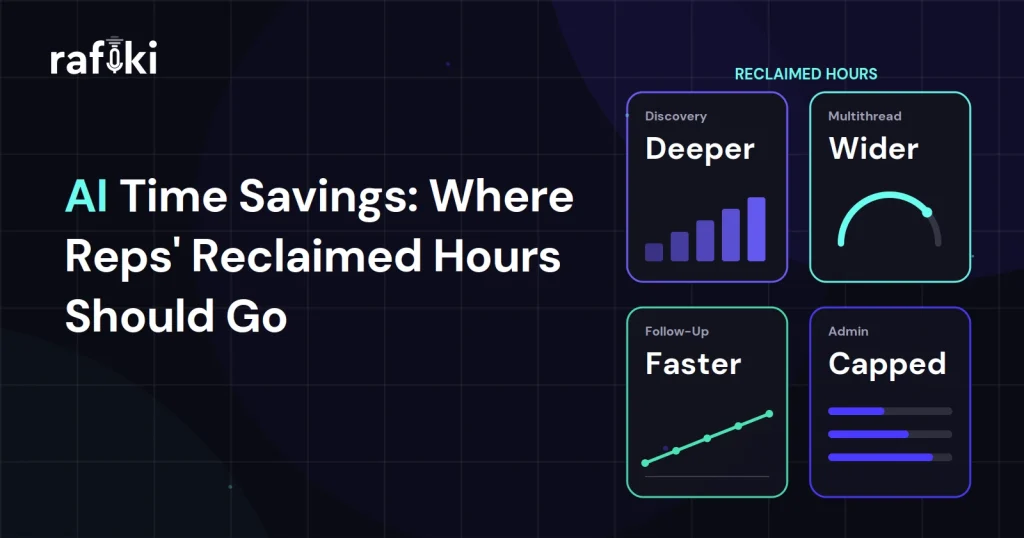
Decide where the hours go before the tool goes live, and put that decision somewhere reps see it every week, like the top of the pipeline review agenda. Four destinations earn the time on most B2B teams. Pick one or two per segment, because an enterprise AE and a transactional rep rarely need the same answer.
Most discovery calls end the moment the rep has enough to fill in the qualification fields. With an extra hour a week, the AE can run a second discovery conversation on each late-stage deal, aimed at business impact and the cost of waiting. MEDDIC and SPICED both reward this, since the real pain usually sits one layer below the buyer's first answer.
Single-threaded deals die when the champion changes jobs or loses a budget fight. The saved time can go into meetings with other stakeholders, such as the finance partner or the rollout owner. Before the proposal goes out, the AE can ask the champion who else will weigh in and request a short call with each of them. A thirty-minute call with the finance partner before pricing lands often surfaces an approval step nobody mentioned.
The AI draft of the recap takes minutes, which leaves the rep time to add what the draft cannot know. She answers the open technical question, attaches the customer story that matches the buyer's industry, and proposes a time for the next meeting. A recap that lands the same afternoon, in the buyer's own words, keeps a late-week call from going cold over the weekend.
A handful of calls carry most of the weight in a deal, like the first meeting with an economic buyer. The pricing conversation in the last week of a quarter belongs on the same list. Reps rarely prep for these properly, because prep is the first thing a crowded day cuts. Thirty minutes rereading the earlier calls on that account lets a rep walk in with a real agenda and the buyer's own objections in hand.
Calendars and activity reports cannot show whether reinvestment happened, but call recordings can. A meeting block shows that a buyer accepted an invite and says nothing about what the rep did once the buyer joined. Teams that record on a conversation intelligence platform already have that evidence sitting in last month's calls. A frontline manager can sample a handful of calls per rep and hear the pattern within an afternoon.
Pull a baseline from the month before rollout, then compare the same measures a month after. Each destination leaves a trace a manager can hear on the recordings:
If none of these moved, the hours went somewhere else, and the rep's calendar will usually say where. Frontline managers should walk each rep through the findings one on one, with the calls queued up. Reps are often as surprised as the manager, and the next coaching conversation gets far more specific than "use your time better."
Two teams can buy the same tool and save the same hours in the first month. The difference shows up in how each one runs the weeks after rollout.
| Part of the rollout | Default drift | Planned reinvestment |
|---|---|---|
| Where saved hours go | Whoever books the calendar first | One or two named destinations per segment |
| Activity targets | Raised to absorb the time | Held flat through the rollout |
| New internal meetings | Added with no end date | Owner and end date required |
| Monday pipeline review | Deal status and close dates | New stakeholders and discovery findings |
| Manager's evidence | CRM activity report | Call recordings against a baseline |
| What the CFO hears | Estimated hours saved | Hours saved and where they went |
The account executive from the opening lost her hours to meetings that each looked harmless on the invite. Internal requests win because they arrive with a sender, an agenda, and a deadline attached. Buyer work has none of those, so it waits until the rep happens to find a gap.
Two weeks after rollout, the sales manager should put each rep's calendar next to the month before. Any recurring internal meeting added since launch needs a named owner and an end date, and anything missing either one comes off. Tool training can fold into the existing team meeting, since reps learn the product faster on their own recorded calls anyway.
Generic "focus time" blocks rarely survive, and most managers have watched colleagues book right over them by the second week. A block tied to a named deal holds up much better, like "prep for the logistics account pricing call" on Tuesday afternoon. People schedule over "focus time" without a second thought, yet most hesitate before bumping a buyer's name off someone's calendar.
The Monday pipeline review teaches reps what matters, because the manager asks questions there in front of the whole team. If the review covers only close dates and stages, reps will spend their saved hours making those fields look tidy.
Swap two of the questions the manager asks on each late-stage deal. First, ask who the rep spoke with this week who was not on the deal last month. Then ask what discovery turned up that the team did not know before. A rep with no answer to either one figures out quickly, in front of peers, where the time should have gone.
Keep everything else in the review short, because a longer meeting just takes the hours back from a different direction. Sales leaders who run the review from call evidence can skip the status recital entirely. The recordings already show what happened on each deal, so the meeting can spend its time on what happens next.
Sometime in the fourth quarter, the sales leader will sit across from the CFO with AI results, often while the 2027 budget is still open. Leading with hours saved is a mistake, because the natural reply is to ask whether the team still needs every seat. The number that protects the budget shows where the hours went and what changed in the pipeline.
Four parts cover it, and each one answers a question the CFO would ask anyway:
Be honest about what the evidence can prove this early. A CFO trusts the leader who says behavior changed and revenue impact needs two more quarters to read, far more than one who declares victory in October. Our framework for measuring AI agent ROI covers how to separate early signals from outcomes in exactly that situation.
Rafiki AI covers both halves of the problem, because it takes admin off the rep's plate and gives the manager the calls to check where the hours went. On the admin side, Smart Call Summary summarizes each conversation after the call. Smart CRM Sync fills in methodology fields for MEDDIC, BANT, SPICED, and other frameworks. It also fills any custom CRM fields the team chooses.
For follow-up, Smart Follow Up drafts the recap email, and the rep adds what the buyer needs. Rafiki AI connects natively with Salesforce, HubSpot, Pipedrive, Zoho, and Freshworks, so fields land where reps already work. Phone-heavy teams get the same summaries and scoring on dialer calls through native Aircall and OpenPhone integrations. Transcription works in more than 60 languages, which matters for teams selling across regions.
On the evidence side, Smart Call Scoring scores every call against any methodology or custom criteria. With custom criteria, a manager can build a scorecard around the chosen destinations, like impact questions in discovery. Stakeholder participation mapping shows which stakeholders took part in the calls on a deal, so the manager can see whether multithreading actually happened.
To check a rep's discovery calls from the past month, a manager can use Gen AI Search across the recordings. Before the CFO meeting, RevOps leaders can use Gen AI Reports to build a team-level report from the same calls. That report belongs in the budget deck, right next to the gross-hours estimate.
This week, pick one or two destinations for each segment and write them into the Q4 plan. Then pull five discovery calls per rep from September as the baseline. For each call, note how many buyer-side stakeholders joined and how deep the impact questions went.
On Monday, November 2, open the pipeline review with the two new questions on every late-stage deal. In mid-November, run the calendar audit and cut any internal meeting that lacks an owner or an end date. By early December you will have a month of call evidence against the September baseline. That lands right when 2027 budget talks with the CFO get specific.
If you want to see on the calls where your reps' saved hours went, Rafiki AI's conversation intelligence platform starts at $19 per seat per month. Managers can open a free trial and score this month's discovery calls against the destinations you picked. If you want help deciding which destinations belong on the scorecard, book a demo and talk it through with our team.
Gartner's May 2026 survey of 210 sales leaders, cited above, found that AI tools save sellers an average of 4.8 hours per week. Your own figure depends on how much admin work the tools actually replaced on your team. Run a short time study before and after rollout, and treat any vendor estimate as a starting point.
Reps should spend it on buyer work that AI cannot do for them. On most B2B teams, that means deeper discovery, more of the buying group, and substantive same-day follow-up. Preparation for the calls that decide deals belongs on the list too, and leaders should pick one or two per segment.
Compare call recordings from the month before rollout with recordings from the month after. Listen for more impact questions in discovery, new buyer-side names on active deals, and same-day recaps. Calendar and activity data alone cannot show whether reps spent the hours well.
Managers should hold activity targets flat through the rollout. Raising dial or email targets tells reps the company bought AI to push more volume. It also sends saved hours into the most crowded channel, so set goals on the chosen destinations and check them in call reviews.
Start for free — no credit card, no seat minimums, no long contracts. Just better sales intelligence.