Every vendor deck promises the same thing in 2026: deploy our agents, watch productivity soar, and enjoy returns that would embarrass a hedge fund. Then the deck meets a skeptical CFO, and the math quietly falls apart. Nobody can say where the numbers came from, whose team produced them, or whether they would survive an audit. That gap between promised and provable is why AI agent ROI has become one of the most contested line items in the revenue budget.
The frustrating part is that the underlying question is entirely fair. Boards should ask what autonomous software is actually worth. Finance should refuse to fund tools on vibes. However, most buyers respond to vendor hype with either blind faith or blanket cynicism, when what they actually need is a measurement framework of their own.
This article offers that framework without the hype. You will find no invented multipliers here, no borrowed benchmarks, and no case-study math you cannot reproduce. Instead, we cover what to measure, how to baseline it, what agents really cost, and when to admit that one is not paying for itself.
Here is the uncomfortable rule that anchors everything else: discount every ROI figure in every vendor deck to zero. Not because vendors always lie, but because the numbers are structurally unverifiable. Three defects show up again and again.
This is not a niche complaint. McKinsey's ongoing State of AI research has consistently found that adopting AI is far easier than attributing enterprise value to it. Organizations deploy quickly, then struggle to trace impact to the bottom line. Consequently, the honest posture for a buyer is simple: treat published numbers as marketing, and build your own.
A CFO evaluating agent spend is not asking for a miracle. In practice, the ask is modest: show me a before, show me an after, show me the full cost, and show me the math in units I already trust. Revenue-adjacent teams often fail this test not because the value is absent, but because they never captured the before.
The good news is that finance already accepts operational metrics as evidence. We made this argument in Cost Per Booked Meeting Is the New CAC: when you express AI value in unit economics the CFO already tracks, the conversation stops being theological and starts being arithmetic. The same logic applies to AI agent ROI. Anchor the case in observable activity — hours, records, calls, response times — rather than in projected revenue influence, which no one can cleanly attribute.
There is also a structural reason to prefer operational evidence. As Harvard Business Review's reporting on how successful sales teams are embracing agentic AI emphasizes, the teams getting real value redesign workflows around agents rather than bolting tools onto old habits. Workflow change shows up in operational metrics first and financial statements later. Measure where the change actually happens.
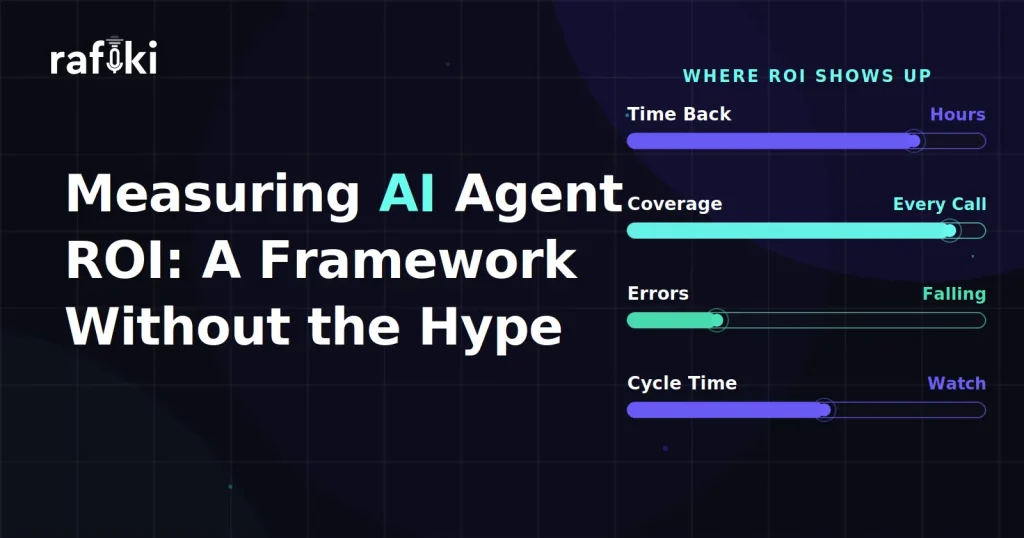
Strip away the hype and agent value flows through four measurable streams. Each one has an observable before and after, which is precisely what makes it defensible in a budget review.
The most direct stream is administrative work the agent now performs: writing call summaries, drafting follow-ups, updating records, assembling pipeline notes. Because this work is visible, you can measure it honestly. Sample how long reps spend on post-call administration during a normal week, deploy the agent, then sample again. The delta is yours — measured on your team, your calls, your tooling. No vendor benchmark required.
Be strict about what counts, though. Time is only "reclaimed" if it was genuinely being spent before, and it only becomes value if reps redirect it toward selling, coaching, or customer work rather than absorbing it as slack.
Before agents, most revenue organizations inspected a thin slice of their own activity. Managers reviewed a handful of calls, deal reviews touched the loudest opportunities, and everything else went unexamined. A conversation intelligence layer changes the denominator: every call scored, every deal inspected, every account monitored.
Coverage is beautifully easy to measure because it is a simple count. How many calls were reviewed per month before, and how many after? How many deals received a structured inspection? Expanded coverage is not automatically revenue, but it is real, countable, and impossible to fake.
Agents earn quiet value by preventing small failures: CRM fields left empty, follow-ups that never went out, next steps that evaporated after the call. These errors are auditable. Pull a sample of opportunity records before deployment and score their completeness and accuracy. Repeat the audit afterward on the same criteria. Similarly, track how often committed follow-ups actually happened within your stated window.
Error reduction rarely headlines a vendor deck because it lacks glamour, yet it is often the stream a CFO finds most credible — the evidence sits in your own database.
The fourth stream covers speed: response latency on inbound interest, time from call to follow-up, time from meeting to updated forecast. These are worth tracking, with a loud caveat. Faster follow-up correlating with better outcomes does not prove the agent caused the outcomes; deal quality, seasonality, and rep skill all move at the same time. Report cycle proxies as directional evidence, clearly labeled as correlation. Paradoxically, that restraint strengthens your case. A reviewer who catches you overclaiming once will discount everything else you present.
You cannot prove improvement without a before. This sounds obvious, yet it is the single most common failure in agent evaluation. Teams deploy first, feel a difference, and then discover they have no defensible way to show it — because the pre-deployment state was never recorded.
The fix costs one week. Before any agent touches your workflow, run a short measurement sprint:
None of this requires special software; a spreadsheet and some discipline suffice. What it requires is patience, which is why teams skip it — the tool is exciting and the measurement is not. Skip it anyway and you forfeit the entire ROI argument. Six months later, when finance asks what changed, "it feels better" is all you will have. In contrast, a team holding a one-week baseline can answer with its own before-and-after data, which no vendor claim can match.
Honest AI agent ROI math counts every cost, and the subscription is only the visible one. Four others routinely go missing.
Including these costs will shrink your computed return, and that is exactly the point. A smaller number that survives scrutiny is worth more than a large one that collapses under a single question. Moreover, when the honest math still comes out positive — as it often does when agents replace genuinely manual work — the case becomes unassailable.
The two approaches differ at every step, not just in the final number. Here is the side-by-side.
| Dimension | Vendor-Deck ROI | Self-Measured ROI |
|---|---|---|
| Data source | Self-reported customer estimates | Your own activity and CRM data |
| Baseline | Assumed or reconstructed after the fact | Measured before deployment |
| Sample | Happiest customers only | Your whole team, wins and misses |
| Costs counted | Subscription price, sometimes | Seats, rollout, oversight, adoption dip |
| Causation claims | Agent credited for revenue outcomes | Operational deltas; correlations labeled as such |
| Incentive | Close the sale | Make a sound budget decision |
| Survives CFO scrutiny | Rarely | By design |
Notice that the self-measured column demands more work upfront. That work is the price of a number you can defend in a board meeting — and it is far cheaper than renewing a tool for another year on faith. If you want to run this comparison on live data rather than in the abstract, start your free trial today, capture your baseline first, and let the before-and-after speak.
Measurement is not a launch activity; it is a cadence. Once the baseline exists and the agent is live, review the same four streams every quarter. The discipline matters more than the frequency: identical metrics, identical method, no swapping in flattering measures when the original ones stall.
A useful quarterly review answers four questions in plain language. What moved since last quarter? Which metrics stayed flat, and do we understand why? How does the full cost side look now, including oversight time? And finally, the question most teams dodge: if this agent disappeared tomorrow, what would we actually lose?
Then act on the answers. Agents that pay should get expanded scope. Agents that show partial value should get a specific fix and one more quarter. Meanwhile, agents that show nothing after two honest reviews should be killed, without sentiment.
A revenue organization that visibly retires underperforming AI earns something valuable: credibility for its next request. Finance funds teams that kill their own bad bets.
An honest framework also names the situations where the math will not work. Three patterns predict disappointment reliably.
Sparse call volume. Agents that analyze conversations need conversations to analyze. If your team runs a handful of meetings a month, the value streams above barely have raw material. The subscription may still be worth it for consistency, but do not expect a dramatic return, and do not promise one.
A broken upstream process. Automating a mess yields a faster mess. If your stages are undefined, your CRM taxonomy is chaos, and nobody agrees on what a qualified deal looks like, an agent will faithfully accelerate the confusion. Fix the process first; deploy the agent second.
No workflow owner. Tools bought by enthusiasm and owned by nobody decay within a quarter. Someone — usually in revenue operations — must own configuration, adoption, and the review cadence. Without that owner, the agent becomes shelfware with a renewal date. If ownership is ambiguous in your organization, settle it before the purchase, not after.
Some agent value genuinely cannot be measured, and the honest move is to name it without monetizing it. Three examples stand out.
First, institutional memory. When every customer conversation is captured, summarized, and searchable, the organization stops losing knowledge each time a rep leaves. Second, coaching coverage: managers can develop every rep from real call evidence instead of coaching only whoever they happened to shadow — a shift we explored in The Real ROI of AI Sales Coaching. Third, the data asset itself: a structured corpus of buyer conversations that compounds in value as the market shifts and new questions arise.
These are real advantages. Nevertheless, resist the temptation to assign them invented dollar values, because the moment you multiply "institutional memory" by a made-up coefficient, your entire model inherits the vendor-deck disease. Instead, list them in the review as unmeasured upside — a qualitative tiebreaker when the measured math is close. A CFO will respect "here is real value we choose not to quantify" far more than a hallucinated multiplier.
Everything above is vendor-neutral by design. Still, it helps to see how the framework maps onto an actual product. Consider how it applies to Rafiki AI's autonomous AI agents — a digital team that listens to calls, scores them, drafts follow-ups, and maintains the CRM around the clock.
Each value stream has a concrete counterpart. Time reclaimed shows up when agents take over summaries, follow-up drafts, and record updates. Coverage expands because every call gets scored against your methodology rather than the sampled few. Error reduction is directly auditable through Smart CRM Sync, which populates methodology-specific and custom CRM fields from the conversation itself — you can compare field completeness before and after deployment in your own reports. Cycle proxies, meanwhile, come from follow-up timestamps you already own.
The framework's demands cut both ways here, and that is deliberate. RevOps leaders running the evaluation should hold a revenue intelligence platform to the same standard as any other line item. That means baseline first, quarterly reviews, full cost accounting, and a willingness to kill what does not pay. A platform confident in its value should welcome that scrutiny. The ones that fear it are telling you something.
The AI agent market does not have an ROI problem; it has an evidence problem. Value exists — in reclaimed hours, expanded coverage, cleaner data, and faster follow-through — but almost none of it is provable through vendor math.
The teams that win budget in 2026 are the ones that stopped arguing with decks and started measuring. Their method is simple: a one-week baseline before deployment, four value streams tracked on their own data, every hidden cost counted, a quarterly review with honest verdicts, and unmeasured upside named rather than monetized. That framework is unglamorous, and that is precisely why it works. Discount the hype to zero, and build a number that is yours.
Build the measurement from your own operational data across four streams: time reclaimed from administrative work, coverage expanded (calls scored, deals inspected, accounts monitored), error reduction (CRM field accuracy, follow-up completion), and cycle proxies such as response latency. Each stream has an observable before and after inside systems you already own — calendars, CRM records, call logs, and timestamps. Capture a baseline before deployment, then remeasure the identical metrics afterward and compare. Because the evidence comes from your team and your data, it survives finance scrutiny in a way that published case studies cannot. Treat vendor figures as marketing context at most; they are self-reported, drawn from the happiest customers, and calculated by people with an incentive to find a large number.
Run a one-week measurement sprint before the agent touches anything. Have a sample of reps log time spent on post-call administration — summaries, CRM updates, follow-up drafting — during a normal week. Count current coverage: how many calls received manager review last month, and how many deals got structured inspection. Audit a sample of opportunity records for field completeness and accuracy, and pull timestamps showing how quickly follow-ups actually went out. A spreadsheet is enough; no special tooling is required. This single week of discipline is what separates a defensible ROI case from "it feels better." Without a recorded before state, no after state can prove anything. Teams that skip the baseline almost always regret it at renewal time.
Quarterly is the right cadence — frequent enough to catch decay, spaced enough for real change to register. The critical rule is consistency: review the same four value streams with the same method every quarter, and never swap in flattering metrics when the originals stall. Each review should answer four questions honestly. What moved? Which metrics stayed flat, and why? How does the full cost side look now, including oversight and review time? And what would we actually lose if this agent vanished tomorrow? Then act: expand agents that pay, give partial performers one specific fix and one more quarter, and retire anything showing nothing after two honest reviews. Killing underperforming tools builds credibility for your next budget request.
Four costs routinely go missing from vendor math. Seat costs are the visible one, but count every user who needs access — managers and operations staff included, not just quota carriers. Rollout time covers integration setup, CRM field mapping, scoring configuration, and team training. Review and oversight time is the human effort spent verifying agent output, especially writes to the CRM; it shrinks as trust builds but never reaches zero. Finally, rep attention during adoption: productivity dips for a few weeks while habits adjust, and honest math counts that dip. Including all four will shrink your computed return, which is the point — a modest number that survives a CFO's questions is worth more than an impressive one that collapses under the first challenge.
Rafiki AI's autonomous AI agents start at $19 per seat per month with no seat minimums and no annual commitment. That transparent per-seat pricing makes the cost side of your ROI math trivial to compute before you ever run the value side. Capture your one-week baseline, then start your free trial today and measure the difference on your own data, or book a demo to see how a digital revenue team earns its line in your budget.
Start for free — no credit card, no seat minimums, no long contracts. Just better sales intelligence.