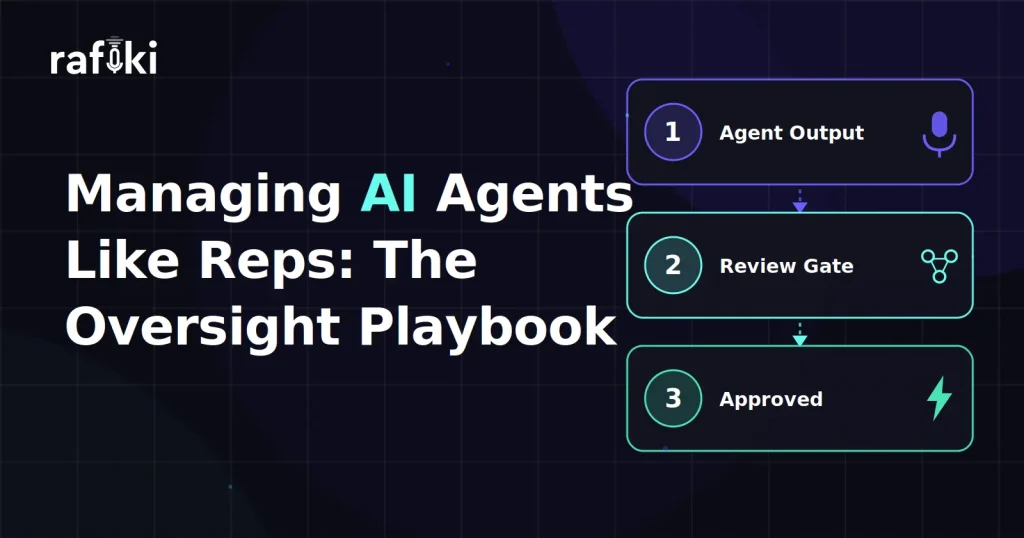
You would never let a new rep email customers unsupervised in week one. New hires shadow calls, draft messages a manager reviews, and earn autonomy one milestone at a time. Yet many teams hand an AI agent the send button on day one — and then act surprised when something goes sideways. AI agent oversight is the discipline that closes this gap, and in 2026 it is what separates teams scaling agents confidently from teams quietly switching them off.
The market narrative raced ahead to "agents that act." Vendors demo autonomy, boards ask about exposure, and reps wonder who answers for a bot that misfires. Meanwhile, the discipline that actually makes autonomy safe — review cadences, approval gates, performance standards — remains largely unclaimed territory.
Here is the good news: you already know how to do this. Managing an AI agent looks remarkably like managing a rep. This playbook translates the management instincts you already trust into an operating system for your digital team.
Most agent failures are not model failures. They are management failures — an agent granted write access to the CRM before anyone defined what good looks like, or handed customer-facing sends before anyone reviewed a sample of its drafts. In these cases, the technology performed exactly as configured; the configuration simply skipped every safeguard a sales organization applies to humans by default.
Think about what happens when a new account executive joins. They shadow calls for a stretch, their first emails get reviewed before anything reaches a prospect, and their CRM notes get spot-checked by a manager. Autonomy arrives gradually, deliberately, and reversibly. No sales leader calls this bureaucracy — it is simply management.
Agents skipped that entire ladder in many rollouts. As a result, the outcomes were predictable: either an early visible mistake froze the program, or reps quietly distrusted the agent and routed around it. Both failure modes trace back to the same root cause — autonomy granted before trust was earned.
AI agent oversight refers to the system of review cadences, approval gates, performance standards, and ownership structures that governs what autonomous software may do on your team's behalf. It is not a toggle in a settings menu. Instead, it is a management practice — the same one you apply to territories, discounts, and pipeline hygiene, extended to digital workers.
This framing matters because it changes who owns the problem. If oversight is a feature, it belongs to the vendor. If oversight is a discipline, it belongs to you — specifically to the sales and RevOps leaders who already know how to build trust ladders, run one-on-ones, and manage performance against a standard.
Consequently, the people best positioned to deploy agents are not the most technical leaders. They are the best managers. If you can onboard a rep, you can onboard an agent.
Graduated trust means an agent earns autonomy in stages — shadow, supervised, then autonomous with review — exactly like a new hire. As Harvard Business Review's reporting on how successful sales teams are embracing agentic AI suggests, the organizations getting real value treat agents as team members to be managed, not software to be installed.
During the shadow period, the agent produces outputs that nobody sends. It drafts follow-ups, proposes CRM updates, and summarizes calls — all into a review queue. Your job is comparison: hold the agent's work against what your best humans produce, and log where it diverges. Measure this phase in output volume reviewed, not weeks elapsed, because an agent generates a month of evidence in days.
Next comes supervision: the agent acts, but a human approves every action before it lands. CRM changes arrive as suggestions awaiting acceptance, and outbound drafts wait in the rep's queue. This stage builds two things at once — a documented accuracy record for the agent, and genuine familiarity for the humans who will eventually stop checking every item.
Finally, the agent earns autonomy for specific action types — never all at once. Low-risk actions flow through automatically while humans sample outputs after the fact, and the veto plus rollback path stays permanently available. Autonomy here is a scoped privilege tied to a performance record, not a personality trait of the software.
Blast radius is the scope of damage an agent action can cause before someone intervenes — and it should determine how much human review that action requires. In practice, the principle is simple: match the weight of the approval gate to the reversibility of the action. McKinsey's ongoing State of AI research consistently links value capture to governance and risk practices, not to model choice alone.
A workable hierarchy for revenue teams, from lightest gate to heaviest:
Notice what this hierarchy rewards: agents that show their work. We explored this pattern in depth in our guide to AI hallucination guardrails for CRM updates — the safest architecture is one where every proposed change carries its evidence with it.
Run a standing weekly review for each agent, exactly as you would for a rep. It takes a fraction of the time a human one-on-one does, yet most teams skip it entirely — and then wonder why quality drifted for a month before anyone noticed.
The agenda has three parts. First, sample outputs: pull a spread of the week's actions from your conversation intelligence layer, including routine ones, because agents fail quietly in the middle of the distribution rather than loudly at the edges. Second, check for drift: compare this week's quality against the baseline you logged during the shadow period. Third, review what the agent flagged as uncertain — a well-designed agent escalates low-confidence cases, and those escalations are a map of where your playbook itself is ambiguous.
That third item deserves emphasis. When an agent repeatedly hesitates on the same scenario, the problem is rarely the agent; more often, your team has never actually defined the rule. In this way, the agent 1:1 doubles as an audit of your own process clarity.
An error budget is a pre-agreed accuracy standard, per action type, that determines whether an agent's autonomy expands or contracts. Decide it before deployment, not during the post-mortem. Sustained performance inside the budget earns the agent its next privilege — say, moving a field type from suggestion mode to direct write. Breaching the budget triggers automatic demotion back to supervised mode for that action class.
Demotion is the half most teams forget, and it is the half that earns trust. Reps relax when they know a misbehaving agent loses privileges automatically instead of after an escalation fight. Boards relax for the same reason, because "our agents lose autonomy the moment they miss the standard" is a governance answer, not a hope.
Crucially, keep the budget per-action rather than global. An agent can be excellent at call summaries and mediocre at deal-stage inference, so treat those records separately — just as you would coach a rep who is strong on discovery and weak on negotiation.
Every agent action should satisfy three tests. It must be attributable — the record shows which agent acted, when, and under whose ownership. It must be reviewable — the action links to the evidence behind it, such as the call moment that justified a CRM change. And it must be reversible — a clear undo path exists, with one exception you already know about: customer-facing sends, which is precisely why they sit behind the heaviest gate.
This is where revenue intelligence platforms diverge sharply in quality. Some log that a field changed; the useful ones log why — which conversation, which sentence, which inference. When your CRO is asked in a board meeting how the company controls AI risk, "every agent action is attributable, reviewable, and reversible" is a complete answer in nine words.
Beyond governance, audit trails serve a coaching purpose. Reviewing an agent's reasoning chain is how you improve its instructions, in the same way reviewing a rep's call recording is how you improve their talk track.
Assign each agent a single named human owner, the way a manager owns a rep. Shared ownership is no ownership: if the answer to "who manages the follow-up agent?" is "the RevOps team," nobody is reading its output samples on Friday afternoon.
The owner's responsibilities mirror a manager's. They run the weekly agent 1:1, hold the error budget, approve promotions and demotions, tune the agent's instructions when drift appears, and answer for its actions in front of the wider team. For most sales leaders, this lands naturally with a frontline manager or a RevOps lead who already owns the adjacent process.
Ownership also settles the accountability question before it becomes political. When an agent errs, the inquiry is not "whose fault is the AI?" but "what does the owner change?" — the same constructive frame you would apply to any managed performer.
Put side by side, the two approaches barely resemble each other. One is a hope; the other is a system.
| Dimension | Ungoverned Agent Rollout | Managed Agent Rollout |
|---|---|---|
| Day one | Full autonomy, live sends | Shadow mode, review queue |
| Approval gates | None, or one global switch | Scaled by blast radius per action type |
| Review cadence | Only after incidents | Weekly agent 1:1 with sampling |
| Error handling | Debate, blame, shutdown | Pre-agreed budget, automatic demotion |
| Ownership | "The vendor" or "the team" | Named human owner per agent |
| Audit trail | What changed | What, why, by whom, with undo path |
| Rep reaction | Distrust and workarounds | Inspection, veto, growing confidence |
| Board conversation | "We think it's fine" | "Here is the control system" |
The managed column is not slower in any way that matters. Because trust compounds, teams running the managed rollout typically expand agent scope faster after the first quarter than teams that started with everything switched on. Want to see what the managed column looks like live? Start your free trial today and run your first shadow period this week.
Here is the contrarian part: AI agent oversight is not the tax you pay on autonomy — it is the mechanism that makes adoption happen at all. Reps trust systems they can inspect and veto, and they sabotage systems they cannot. Give a rep a queue of agent suggestions with an accept button, and within weeks they are approving in bulk because the record earned it. Give the same rep an agent that writes to their deals silently, and they will maintain a shadow spreadsheet forever.
The psychology matches how humans extend trust to other humans. Nobody trusts a new colleague because they were told to; they trust the colleague after watching them work. Oversight structures are how your team watches the agent work — visibly, repeatedly, with the power to say no.
There is a second acceleration effect at the executive level. A CRO who can describe gates, budgets, and audit trails gets budget approval for expansion; a CRO who says "the AI handles it" gets a risk review. In other words, governance is not the brake on your agent program — it is the funding case for it.
Some work should never enter the autonomy ladder, no matter how strong an agent's record becomes. Strategy stays human: which segments to pursue, how to position against the market, when to walk away from a deal. Relationships stay human, because trust between people is the product a sales team actually sells. Judgment calls stay human — pricing exceptions, escalations, anything where the right answer depends on context no system fully holds.
And the approval itself stays human. The entire architecture in this playbook rests on a person exercising judgment at the gates; automate the approval and you have merely hidden the ungoverned rollout behind a dashboard. We covered the mechanics of this boundary in our piece on AI agent handoffs — when bots pass to humans: great agents are defined as much by what they escalate as by what they complete.
Draw this line publicly and early. Reps commit to agent programs when leadership states plainly what will never be delegated, because the unspoken fear behind most resistance is not extra review work — it is replacement.
Everything above is tool-agnostic management. That said, your platform either makes the playbook easy or fights you on it, and this is where Rafiki AI was designed differently. Its autonomous AI agents operate as a digital revenue team built for supervision: outputs are queued for review, suggestions carry their supporting evidence, and humans hold the accept button at every gate you choose to keep.
The CRM Sync Agent is the clearest example. Rather than silently overwriting fields, it extracts facts from your calls, proposes updates mapped to your methodology — MEDDIC, BANT, SPIN, SPICED, or custom criteria — and shows the conversation moment behind each one. We walked through the full evidence-first design in Inside the Rafiki CRM Sync Agent: fields, facts, oversight. The pattern generalizes across the platform: attributable actions, reviewable reasoning, reversible changes.
For the weekly agent 1:1, the same conversation data that powers the agents powers your review. Sampling outputs, spotting drift, and tracing any suggestion back to its source call takes minutes, because the audit trail is native rather than bolted on. Oversight stops being a side project and becomes a view you open on Friday.
The teams winning with agents in 2026 did not discover better models. They applied better management — graduated trust instead of day-one autonomy, gates scaled to blast radius, a weekly review rhythm, error budgets with real demotion, audit trails that answer board questions, and a named owner for every agent.
None of this should feel foreign, because none of it is new. It is the discipline you already use to turn promising hires into trusted performers, pointed at a digital team that happens to work around the clock. The send button was never the hard part; earning it was. Treat your agents like reps, and they will earn it faster than any rep you have ever managed.
AI agent oversight is the management system that governs what autonomous AI agents may do on a revenue team's behalf. It combines graduated trust levels (shadow, supervised, autonomous with review), approval gates scaled to each action's blast radius, a recurring review cadence for sampling outputs and catching drift, error budgets that define promotion and demotion, audit trails that make every action attributable and reversible, and a named human owner per agent. The core idea is that oversight is a discipline, not a product feature: the same practices leaders use to onboard and manage reps apply directly to digital workers. Done well, oversight accelerates adoption rather than slowing it, because reps and executives extend trust to systems they can inspect and veto.
Measure shadow mode in reviewed output volume, not calendar time. An agent drafting follow-ups and CRM updates across a busy team generates in days the evidence a new hire would generate in a month, so a rigid "thirty days of shadowing" rule wastes time without adding safety. Instead, exit shadow mode per action type once two conditions hold: the owner has reviewed a broad sample that includes routine cases, and quality has held steady against the baseline without new failure patterns appearing. Low-blast-radius actions like internal summaries typically graduate quickly, while customer-facing drafts should accumulate a longer record. Importantly, shadow mode is re-enterable — if quality drifts later, demotion back to shadow or supervised mode should be automatic, not negotiated.
Assign one named human owner per agent — usually a frontline manager or RevOps lead who already owns the adjacent process. The owner of a CRM-updating agent should be whoever owns CRM hygiene; the owner of a follow-up agent should be whoever manages the reps it serves. Shared ownership fails in practice because sampling outputs, tracking the error budget, and tuning instructions are recurring weekly tasks that diffuse responsibility quietly kills. The owner runs the weekly agent 1:1, decides promotions and demotions against the pre-agreed budget, and answers for the agent's actions in front of the team. This mirrors how a manager owns a rep's performance, which is exactly why it works — the accountability model is already understood.
No — approval gates are temporary for most actions and permanent only where reversibility is lowest. During the supervised period, a human reviews everything, but that stage exists to build the record that justifies removing gates safely. Once an agent sustains performance inside its error budget, low-risk actions flow autonomously with after-the-fact sampling, which preserves nearly all the time savings. The heaviest gates remain only on irreversible actions like customer-facing sends, where a few seconds of human review is cheap insurance against an unrecallable mistake. In practice, teams that keep approval in the loop early expand agent scope faster later, because reps who could inspect and veto the system actually adopt it instead of routing around it.
Ready to run a managed rollout instead of a hopeful one? Rafiki AI's conversation intelligence platform starts at $19 per seat per month with no minimums and no annual commitment. Start your free trial today or book a demo to see how supervised, evidence-first AI agents earn their autonomy on your team.
Start for free — no credit card, no seat minimums, no long contracts. Just better sales intelligence.