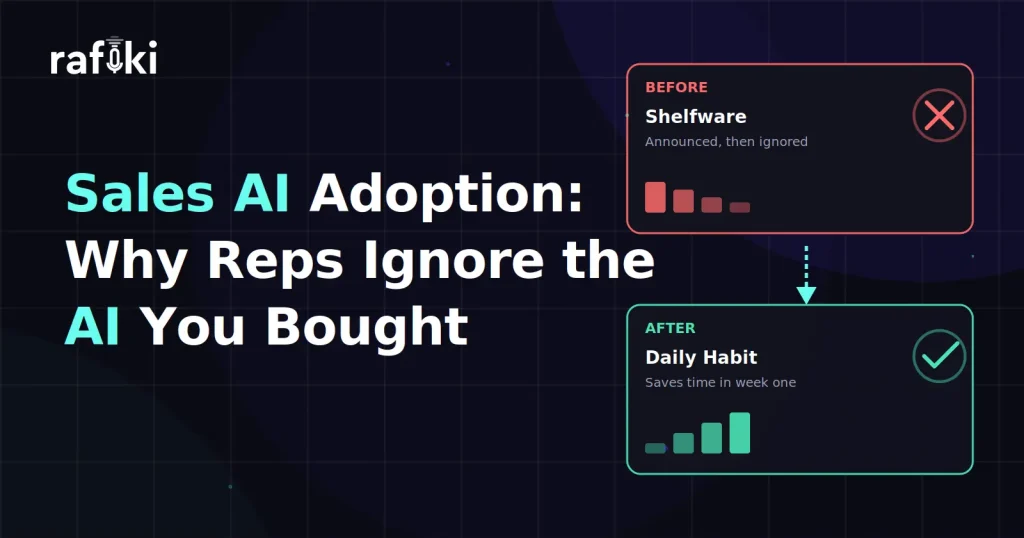
The demo was flawless. The business case sailed through procurement, and the CRO announced the platform at an all-hands. For two weeks, the login charts pointed up and to the right. Then usage flattened. By week six, reps had quietly drifted back to spreadsheets, sticky notes, and their own inboxes. The expensive new platform became a line item nobody wants to defend at renewal. That is the quiet story of sales AI adoption in 2026: the tools mostly work, and the rollouts mostly don't.
Here is the uncomfortable part for sales leaders, RevOps, and enablement teams: the reps aren't wrong. They have watched tool after tool arrive with the same promise — this one will finally save you time. Most of those tools delivered another login, another form, and another field to update. Skepticism isn't resistance to change. It's pattern recognition.
This article covers why reps rationally ignore the AI you bought. It maps the rollout patterns that guarantee abandonment, and the playbook that makes usage stick. None of it requires a better model. All of it requires a better rollout.
Sales AI adoption fails after the contract is signed, not before. The evaluation process is usually rigorous: demos, security review, pricing negotiation, a pilot with two enthusiastic managers. The rollout, by contrast, gets an afternoon. Bought top-down, configured by ops without a single rep in the room, and announced in one all-hands, the tool is then left to survive on its own.
Industry research keeps pointing at the same culprit. Salesforce's State of Sales research has consistently found that disconnected systems and weak change management block sales teams from getting value out of new technology. Model quality is rarely the barrier. The seams between the intelligence and the rep's actual working day are the problem.
Meanwhile, the buying side keeps accelerating. According to Gartner's research, generative AI has become the most frequently deployed AI solution in organizations. Deployment, in other words, is no longer the hard part. Adoption is. And adoption is a behavior-change problem wearing a software costume.
Ask a rep why they haven't opened the new platform and you'll hear some version of the same answer: I don't have time. That answer deserves to be taken literally. A rep's calendar is a zero-sum battlefield. Every new obligation competes with calls, follow-ups, and a quota due this quarter, not next.
Now add the history. Nearly every tool a rep was ever handed promised to save time, and most added administrative work instead. The forecasting tool needed fields updated. Engagement platforms needed sequences maintained. The enablement portal needed certifications completed. Each promised leverage; each quietly billed its cost to the rep's hours.
Seen from that seat, ignoring a new tool is not laziness. It's a rational bet with a strong track record. The learning curve is a guaranteed cost this week, while the payoff is speculative and probably lands on someone else's dashboard. Consequently, the burden of proof sits with the rollout, not the rep.
Enablement and RevOps leaders often miss this because they experience tools differently. For them, a new platform is a project with a budget and a success metric. For a rep, it is an unfunded mandate arriving mid-quarter, competing with the number that pays their mortgage. A launch plan that assumes goodwill is a launch plan that assumes away the last decade of the rep's experience.
Most failed rollouts aren't unlucky. They follow one of three recognizable patterns, and many follow all three at once. Each pattern fails for the same underlying reason: it asks reps to invest effort now in exchange for value that arrives later, elsewhere, or never. Spotting them early matters, because every failed pattern burns credibility you will need for the relaunch. Second launches are always harder than first ones.
In a dashboard-first rollout, the configuration effort goes into manager views: pipeline heatmaps, activity leaderboards, coaching scorecards. The value accrues to managers, while the work — recording calls, tagging outcomes, correcting fields — accrues to reps. That asymmetry is fatal. Reps quickly learn they are feeding a machine that reports on them rather than one that works for them. As a result, data entry gets minimal, the dashboards degrade, and managers conclude the tool "doesn't have good data." It never had a chance to.
The big-bang launch turns every feature on at once, schedules a single training day, and declares victory. Cognitive overload does the rest. Faced with a dozen new capabilities, reps adopt none deeply. There is no single habit to anchor to, so nothing survives contact with a busy Tuesday. Enthusiasm peaks at the all-hands and decays from there. Nobody designed for week three, when the novelty is gone and the muscle memory hasn't formed.
When adoption stalls, leadership often reaches for a mandate: log in daily, review your calls weekly, or it affects your comp. Mandates produce activity, not adoption. Reps open the tool, click enough to register, and close it again. That checkbox compliance pollutes every usage metric leadership relies on. Worse, the mandate reframes the tool as a compliance obligation. That framing is the exact opposite of the "this saves me time" belief real adoption requires. You can mandate logins. You cannot mandate belief.
The alternative is a workflow-first rollout. Start with one workflow that pays reps back immediately, prove it, and only then expand. Neither approach changes the software itself; both change what the team experiences in the first six weeks. The contrast is stark enough to put side by side.
| Dimension | Big-Bang Rollout | Workflow-First Rollout |
|---|---|---|
| Scope at launch | Every feature, every team, day one | One workflow, one team, week one |
| Who feels value first | Managers, via dashboards | Reps, via time saved |
| Training model | One all-hands demo | Habit built inside existing rituals |
| Champions | Assigned by leadership | Converted skeptics who volunteer proof |
| Success metric | Logins and seat activation | Workflow completion and time returned |
| Week-six outcome | Quiet abandonment | Requests to turn on the next workflow |
| Expansion trigger | The renewal date | The first workflow demonstrably sticking |
Every row reduces to one question. Does the rollout treat reps as beneficiaries of the tool, or as its data supply chain? Answer that honestly and the week-six outcome becomes predictable. Notably, the workflow-first column costs less to execute, because effort concentrates on one habit instead of spreading across a feature catalog.
The sales AI adoption playbook starts with a deliberately unambitious move. Pick the single workflow that saves reps time in their first week, and ship only that. Not analytics, not scoring, not forecasting — those are manager-value features, and manager value cannot carry a rep-facing rollout.
The best first workflows are the ones that delete work reps already resent:
This is exactly where modern conversation intelligence platforms have quietly changed the adoption math. Rafiki AI, for example, was designed around this rep-first sequence. Its Smart Follow Up capability drafts the recap email from the call itself, while Smart CRM Sync pushes methodology fields into the CRM automatically. The full workflow chain is laid out in the product overview. The rep's very first interaction with the platform is receiving time back, not surrendering it. That first impression is the whole ballgame; everything else in the playbook exists to protect it. Start your free trial today and run that exact week-one test with your own team.
Every rollout plan includes champions, and most plans pick them badly. The instinct is to recruit the early adopters — the reps who love every new tool. Resist it. Enthusiasts have no credibility with the skeptical majority, precisely because they like everything.
Instead, find your most respected skeptic — the senior rep who has seen every tool fail — and make one deal. Use the first workflow for two weeks, then say publicly whatever you honestly conclude. If the workflow genuinely saves time, the skeptic converts, and a convert is louder than any believer. "I thought this was another admin tax, and I was wrong" beats a quarter of enablement sessions.
There's a second benefit. If your best skeptic doesn't convert, you've learned something vital before the full launch: the workflow isn't good enough yet. Fix that before scaling. A rollout that can't win over one skeptic in a controlled setting will not win over forty in the wild.
Adoption dies when the tool is an extra place to go. It survives when the tool's output shows up inside rituals the team already runs. The goal is ambient usage — reps encountering the AI's work as part of the job, not as an additional job.
In practice, that means rewiring three ceremonies:
Notice what this changes. Nobody is asked to "adopt a tool"; the team simply runs its existing meetings with better inputs. Usage becomes a side effect of showing up. That is a far more durable foundation than willpower. It costs leadership nothing but the discipline to stop accepting the old artifacts.
Login counts are the vanity metric of sales AI adoption, and they are actively misleading once a mandate exists. A rep who opens the platform, stares at it, and closes it registers as active. So does a rep whose entire follow-up motion runs through it. If you steer by logins, you will congratulate yourself all the way to a failed renewal.
Measure workflow completion instead. Useful questions include:
Honest measurement also means honest subtraction. If a feature hasn't been touched in a month, turn it off. Every unused capability adds interface noise, dilutes training, and quietly signals that the platform is bloated. Killing features nobody uses is not an admission of failure. It keeps the surface area small enough for the habits that do exist to stay strong.
Even a perfectly sequenced rollout stalls if reps believe the tool is watching them rather than working for them. Trust questions are adoption questions. They deserve explicit answers before launch, not after the first awkward coaching conversation.
Reps need to know three things in plain language. First, what is recorded, and what happens to it. Second, who sees call scores — and specifically whether scores feed comp decisions or coaching conversations. Third, that AI coaching exists to develop them, not to build a case against them. We've argued before that trust objections in sales AI are usually rollout failures in disguise. The fix is transparency plus consistent managerial behavior, not better legal language.
Design choices matter here too. Platforms built on rep-first principles — evidence over inference, suggestions over verdicts, the rep always in the loop — earn trust structurally rather than rhetorically. Our piece on AI sales agent design principles goes deeper on those choices. They decide whether reps experience AI as a coach or a camera. If a rep's first exposure to call scoring is a manager quoting it against them, no enablement program will recover the rollout.
The hardest discipline in the playbook is patience. Once the follow-up workflow is working, everyone wants to turn on the rest: scoring, forecasting, coaching analytics, competitive tracking. Wait. Expansion before the first habit hardens re-creates the big-bang problem you just avoided.
"Sticking" has a testable definition. The workflow sticks when reps use it without reminders, when a converted skeptic recommends it unprompted, and when someone complains the moment it breaks. Complaints are the tell — nobody complains about losing a tool they never relied on.
Only then do you add the second workflow, and you add it the same way. One capability, framed around rep time, introduced inside existing rituals, measured by completion. Each successful layer buys credibility for the next. Sequenced this way, the same platform that would have died in a big-bang launch becomes indispensable one habit at a time.
Here is the variable that outweighs every other: what managers do in meetings. Watch what happens when managers run deal reviews from the tool — pulling up the account, citing conversation evidence, asking the questions it surfaced. Reps follow within weeks. If managers ask for the old spreadsheet "just this once," the tool dies. Reps optimize for what leadership actually inspects, not what it announces.
This is why sales leaders are the real adoption surface, not reps. A frontline manager who prepares 1:1s from AI call analysis is teaching adoption in every session without ever using the word. In contrast, a leader who demands that data re-typed into a slide deck teaches everyone the tool is optional theater.
Before launch, get explicit commitments: which meetings will run from the tool, starting when, with no parallel artifacts allowed. Then hold leadership to it more strictly than you hold reps to anything. Reps forgive a clunky feature. They never forget a leadership team that didn't use the thing it mandated.
Sales AI adoption is not a procurement problem, a model-quality problem, or a rep-attitude problem. It is a rollout problem — and rollout problems are fixable. Reps ignore new tools because ignoring them has historically been correct. Earn back that trust with a first workflow that pays them in time during week one. Skip the dashboard-first launch, the big-bang announcement, and the usage mandate. Instead, convert a skeptic and embed the output in rituals the team already runs. Measure workflow completion instead of logins, answer the surveillance question before it's asked, and expand only after the first habit sticks. Above all, make managers live in the tool. The AI you bought is probably good enough. The question 2026 will ask of your team is whether the rollout was.
Reps ignore new AI tools because experience has taught them to. Nearly every platform they've been handed promised to save time and instead added administrative work: fields to update, sequences to maintain, dashboards to feed. Given a finite selling day and a quota due this quarter, spending hours on a tool with speculative benefits is a poor trade. Skipping it is a rational decision rather than stubbornness. The pattern is reinforced when rollouts are dashboard-first, meaning managers get the insights while reps do the data entry. To break the cycle, the first workflow a rep touches must return time immediately — a drafted follow-up email or auto-filled CRM fields. That way, the tool's opening argument is a gift, not a chore.
The best first workflow is the one that deletes work reps already resent, in their very first week. In practice, that means automated follow-up drafts and auto-filled CRM updates generated from the call itself. Both replace tasks every rep performs and nobody enjoys. Analytics, call scoring, and forecasting are poor first workflows; their value accrues to managers, so they cannot create rep-side pull. A good week-one test: after a call, does the rep receive a usable recap draft and populated CRM fields without doing anything extra? If yes, the platform has made its case in the currency reps value most: time. Later capabilities inherit that credibility. If no, fix that before expanding anything.
Measure workflow completion, not logins. Login counts and seat activation are vanity metrics, and mandates make them actively misleading. Checkbox compliance looks identical to genuine use. Better questions: what share of calls produced a follow-up email sent from the AI draft? How often are AI-suggested CRM fields accepted rather than retyped? Do managers actually run pipeline reviews from the platform? Pair those metrics with honest subtraction. If a feature goes untouched for a month, turn it off before it dilutes training and clutters the interface. Adoption is proven by workflows that complete without reminders and by complaints when the tool breaks. Charts of daily active users prove nothing.
Expand only after the first workflow demonstrably sticks, and use a testable definition of sticking. Reps use it without reminders, a converted skeptic recommends it unprompted, and people complain immediately when it breaks. Silence is the warning sign — nobody complains about losing a tool they never relied on. Once those signals appear, introduce the second capability exactly like the first. Keep it to one workflow: framed around rep time, embedded in pipeline reviews and 1:1s, measured by completion. Expanding earlier re-creates the big-bang launch you avoided, splitting attention before any habit has hardened. Sequenced patiently, each successful workflow buys credibility for the next, and the platform becomes indispensable one habit at a time.
Rafiki AI's conversation intelligence platform was built for workflow-first rollouts: autonomous AI agents draft the follow-ups, fill the CRM, and surface deal evidence inside the meetings you already run. Plans start at $19 per seat per month with no seat minimums and no annual commitment. Start your free trial today or book a demo to see what week-one adoption looks like when the rollout is designed for reps.
Start for free — no credit card, no seat minimums, no long contracts. Just better sales intelligence.