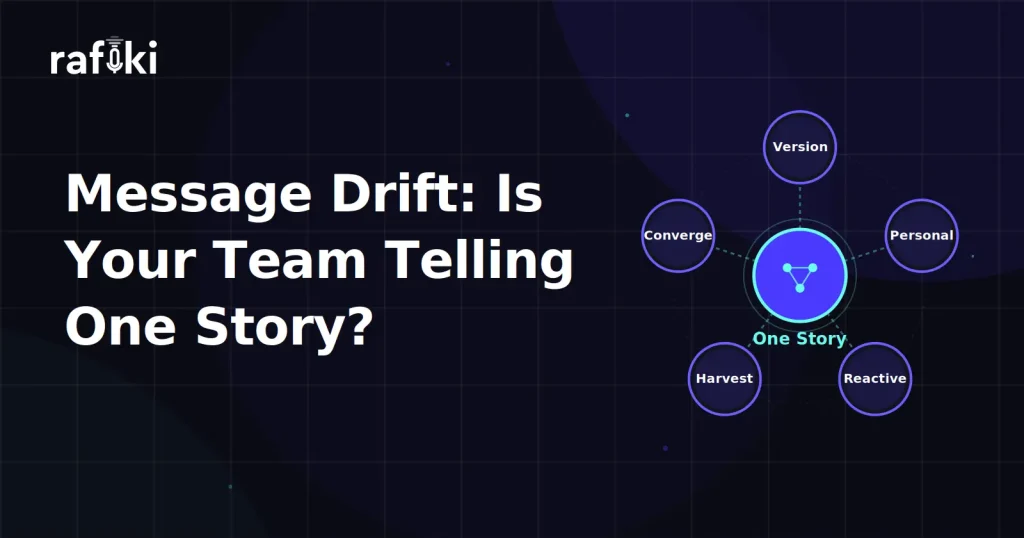
Marketing shipped the messaging doc in January. Enablement ran the training, and everyone nodded in the all-hands. Six months later, listen to five live sales calls and you will hear five different companies. One rep leads with the old positioning from two years ago. Another opens with a riff she invented because it "lands better." A third frames your product exactly the way your biggest competitor wants it framed. That is the language he absorbed from the deals he lost. This is message drift, and almost every revenue team has it without knowing.
The uncomfortable part is not that reps go off-script. It is that nobody notices, because nobody listens at scale. A messaging doc gets read once; a pitch gets delivered hundreds of times, and each delivery bends it a little. Meanwhile, your buyers are comparing notes, and when they hear three different stories from three different people, the conclusion is quiet but damaging: this company does not agree with itself.
In 2026, that excuse has expired. AI can now listen to every call and surface exactly how your value proposition is phrased across the whole team. This article covers what message drift is, why it is inevitable, how to audit it, and how to fix it without turning enablement into the messaging police.
Message drift is the gradual divergence between the story your company decided to tell and the stories your reps actually tell on live calls. It is not a single act of going rogue, but rather a slow accumulation of small substitutions: a softened claim here, a borrowed phrase there, an old differentiator that never got retired.
Drift is different from bad messaging. Your positioning might be sharp, validated, and well-documented. Drift happens after the doc ships, in the space between the written word and the spoken one. Because it happens one call at a time, no single conversation looks wrong. Only when you line up twenty calls side by side does the pattern appear: the same product, described five materially different ways.
For product marketers, drift means the positioning you fought for never actually reaches the market. Enablement leaders experience it as training that evaporates within weeks. And for sales leaders and founders, it shows up as a pipeline where win rates vary by narrative, not just by territory or skill.
Messages decay call by call, and the decay is structural rather than a discipline problem. The mechanics matter, because they explain why another memo will never fix it.
None of this is malicious; each behavior is a rational response to real conditions on live calls. That is precisely why drift cannot be trained away in a single session. As Harvard Business Review's analysis of gen AI myths in sales and marketing suggests, the highest-value use of AI in revenue teams is often not automating output but understanding what actually happens in the field. Drift is a visibility problem before it is a compliance problem.
Why does drift matter more than other messaging sins? Because buying committees compare notes. A modern B2B evaluation has multiple stakeholders talking to multiple people on your side: SDR, account executive, sales engineer, sometimes a founder. When each of them tells a slightly different story, the buyer experiences your company as incoherent.
Incoherence has specific consequences. First, it erodes trust: if the vendor cannot agree on what the product is for, the claims themselves feel negotiable. Second, it hands ammunition to competitors, who only need to attack the weakest version of your pitch. Third, it destroys your ability to learn: when every rep runs a different narrative, you cannot tell whether a losing streak reflects bad positioning or bad delivery.
Consistency across customer interactions is a recurring theme in McKinsey's growth, marketing and sales research. Growth leaders treat the commercial message as an asset to manage across every touchpoint, not a document to publish once. Drift is what happens when nobody manages that asset after launch day.
A drift audit is a structured comparison between your intended messaging and the language your team actually uses on live calls. It is the fastest way to make drift visible, and the results are usually humbling.
Here is the basic procedure:
Done manually, this takes days of listening, which is why it almost never happens. Done with a conversation intelligence platform, it takes an afternoon: AI that has already processed every call surfaces each rep's phrasing in seconds. The gap between the doc and the transcript stops being a suspicion and becomes evidence you can put on a screen.
Not all drift is the same, and the fix depends on the type. Most audits surface three distinct species.
Version drift is yesterday's positioning still circulating on today's calls. The company repositioned in Q1, but part of the team still opens with the framing from the previous era, because that version is wired into muscle memory. Old one-pagers linger in personal folders, and old phrases linger in personal pitches. Version drift is the easiest type to fix, since nobody is attached to it on principle; reps simply have not overwritten the old tape. The cure is repetition of the new language plus verification that the old language is actually gone.
Personal drift is language a rep created themselves: an analogy, a reordering, a different lead benefit. This is the most interesting category, because it splits into two populations. A small share consists of genuine improvements, phrasings that land better because the rep discovered something the messaging team missed. The rest is entropy: framings that feel smooth to deliver but blur the differentiation, overpromise, or bury the strongest claim. The audit's job is to separate the two, which is why personal drift should be judged against outcomes rather than against the doc.
Reactive drift is the most dangerous type, because it works for the other side. After enough competitive losses, reps unconsciously adopt the competitor's framing of the category, and then argue within it. They start conceding the premise ("yes, we're not as enterprise-grade, but...") instead of resetting the frame. Every call delivered in reactive drift reinforces the competitor's story at your expense, using your own payroll. Detecting it requires listening to competitive moments across calls, the discipline we described in our guide to AI battlecards built from live competitive intelligence. If your reps sound like they are playing defense in a stadium the competitor built, reactive drift has already set in.
Here is the twist that separates a useful drift audit from a compliance exercise: sometimes the drifted version is better. An improvised framing from a top rep may consistently produce engaged questions, faster next steps, and stronger late-stage momentum than the official language ever did. Punishing that rep for going off-script would be malpractice.
The goal of managing message drift is convergence on what works, not compliance with what was written. That distinction changes how you respond to an audit:
Handled this way, your field team becomes a distributed messaging lab. Every live call is an experiment; the tragedy of most teams is that the results are recorded and never read. Want to see what your own calls reveal? Start your free trial today and run the drift audit on your last month of conversations.
The traditional response to drift is a memo: a re-launch deck, a mandatory training, a Slack reminder. The evidence-based response differs at every step.
| Dimension | Messaging by Memo | Messaging by Evidence |
|---|---|---|
| Detection | Anecdotes and ride-alongs | AI search across every recorded call |
| Standard of truth | What the doc says | What demonstrably works on calls |
| Rep experience | Told they are off-message | Shown their own words next to the winning framing |
| Good drift | Suppressed as non-compliance | Harvested and promoted into the talk track |
| Verification | Assumed after training | Confirmed by scoring subsequent calls |
| Cadence | Once per launch | Continuous, with quarterly health checks |
The memo approach fails for a simple reason: it treats drift as a knowledge gap, when it is actually a feedback gap. Reps do not drift because they never read the doc. They drift because nothing in their daily experience ever shows them the divergence.
Nobody wants an enablement function that polices phrasing, and no rep changes behavior because of a compliance spreadsheet. The durable fix is enforcement through evidence: make the drift visible, make the better language available, and verify convergence on real calls. That loop has three steps.
Pull the actual clips. Rafiki AI's Gen AI Search finds them with a plain-language question, such as "how do reps describe our core value proposition to first-time prospects?" It returns the exact moments, quoted and linked to the recordings. In a coaching session, play the rep's own explanation next to the highest-performing framing from the team's calls. No memo can compete with hearing yourself drift. Because the comparison is concrete and outcome-linked, it lands as insight rather than criticism. Reps typically self-correct before anyone asks.
Rebuild the canonical talk track with the best language the audit surfaced, whether it came from marketing or a rep's improvisation. Pair it with real examples: the strongest live delivery of each message, clipped and organized so anyone can hear the standard. That is the approach we detailed in our playbook on turning top calls into a sales call library. A talk track backed by recordings of it working is a different artifact from one backed by a slide.
Finally, close the loop. Rafiki AI's Smart Call Scoring evaluates every subsequent call against custom criteria, including whether the current value proposition and approved competitive framing showed up. Convergence stops being a feeling and becomes a trend line per rep and per team. For sales enablement leaders, this is the difference between hoping the training stuck and knowing exactly where it did not. Follow-up coaching then targets only the calls that need it. Evidence in, evidence out; no police required.
If drift on mature messaging is a slow leak, drift at launch is a burst pipe. A new product or repositioning forces every rep to translate unfamiliar language in real time, under pressure, in front of live buyers. The first version of the pitch a rep delivers tends to become their permanent version. As a result, the first thirty days after launch determine whether the new story ever ships.
Message adoption tracking should therefore be part of every launch plan, alongside the deck and the training:
Skip this, and you discover the truth at the ninety-day retro, when the pipeline already reflects a narrative that never left the building. Track it, and the launch becomes a live experiment you can steer while steering is still cheap.
Drift never stops, so detection cannot be a one-time project. The sustainable answer is a lightweight quarterly ritual, owned jointly by product marketing and enablement, that takes hours because AI does the listening.
Run consistently, the health check changes the culture around messaging. Positioning stops being a launch artifact and becomes a living asset, maintained with the same rigor as pipeline hygiene. More importantly, reps start to see messaging as something they help evolve, because the ritual visibly harvests their best inventions.
Message drift is invisible for exactly one reason: nobody listens at scale. The doc says one thing, hundreds of calls say another, and the gap widens quietly until buyers hear a company that disagrees with itself. The fix is not louder memos or stricter scripts. It is listening: audit how the story is actually told, classify the drift, harvest the framings that outperform, retire the ones that do not, and verify convergence on real calls. Convergence on what works beats compliance with what was written, every time. Rafiki AI turns that loop into a standing capability, with autonomous AI agents that hear every call, surface every phrasing, and show your team the evidence that changes behavior. Your messaging deserves to reach the market. Go find out if it did.
Message drift is the gradual divergence between a company's intended messaging and the language sales reps actually use on live calls. It accumulates one conversation at a time: reps optimize phrases for smoothness, objections quietly reshape pitches, and new hires learn from whoever ramped them rather than from the messaging doc. Because no single call looks wrong, drift stays invisible until someone compares many calls side by side. The result is a team telling several versions of the company story, which erodes buyer trust when stakeholders compare notes. Message drift differs from bad messaging: the positioning itself may be excellent, but drift happens after the document ships, in the gap between the written word and the spoken one.
The fastest method is a drift audit. Write down the canonical phrasing of your value proposition and key differentiators, then search recent recorded calls to find how each rep actually explains them. A conversation intelligence platform makes this practical: AI-powered search across your call corpus can return every moment where reps describe the product, quoted and linked. Line the real phrasings up against the intended one and classify the differences into version drift (old messaging that never died), personal drift (rep-invented framings), and reactive drift (competitor framing absorbed from lost deals). From there, call scoring against custom criteria tracks whether the current messaging appears on subsequent calls, turning detection into ongoing measurement.
No, and treating it as purely a compliance problem wastes its most valuable output. Some drift is entropy: blurred differentiation, softened claims, or a competitor's framing repeated back to buyers. That drift should be corrected. However, some personal drift consists of genuine improvements, framings a rep invented because they land better on real calls than the official language does. A good drift audit evaluates divergent phrasings against outcomes, not against the document. When an improvised framing consistently outperforms the canonical one, the right move is to harvest it. Promote it into the official talk track, credit the rep who found it, and retire the weaker language explicitly. The goal is convergence on what works, not compliance with what was written.
A quarterly message health check is the right baseline cadence for mature messaging, since drift accumulates continuously but reveals meaningful patterns over a quarter of calls. Each quarter, re-run the core searches on how your value proposition and competitive responses are being phrased. Then classify the drift by type, harvest outperforming framings into the talk track, and update call scoring criteria to match the refreshed story. Launches are the exception. A new product or repositioning needs message adoption tracking in the first thirty days: search early to confirm the new story is appearing at all, compare phrasings in the following weeks to catch mutations, and score by day thirty to verify the new framing has become the team default.
Rafiki AI's conversation intelligence platform starts at $19 per seat per month with no minimums and no annual commitment. Start your free trial today or book a demo to hear the story your team is actually telling, and converge on the one that wins.
Start for free — no credit card, no seat minimums, no long contracts. Just better sales intelligence.