A talk track template is a structured conversation guide that gives sales reps a flexible framework — key talking points, qualifying questions, objection responses, and calls to action — without locking them into a rigid script. Unlike word-for-word call scripts, a good talk track template leaves room for personalization while ensuring every rep hits the high-value moments that move deals forward.
Below, you'll find a ready-to-use talk track template, a five-step framework for building your own, and the common mistakes that sink even well-intentioned talk tracks. Whether you're enabling a team of five or fifty, this guide gives you the blueprint to turn customer conversations into closed revenue.
A talk track is a conversation structure designed to help salespeople navigate calls with prospects and stakeholders. Its purpose is threefold:
According to Salesforce's State of Sales report, high-performing sales teams are 1.9× more likely to use guided selling frameworks — and talk tracks are the most common form of guided selling on live calls. When reps have a reliable structure, they spend less energy remembering what to say and more energy listening to what the prospect actually needs.
Use the template below as a starting point. Customize each section for your product, buyer persona, and deal stage.
| Section | Purpose | Example Cues |
|---|---|---|
| 1. Opening & Rapport | Set a collaborative tone; confirm the agenda | "Thanks for joining — I'd love to make sure this is valuable for you. Can you share what prompted you to take this call?" |
| 2. Discovery & Qualification | Understand pain, authority, timeline, budget | "Walk me through how your team handles [process] today. Where does it break down?" |
| 3. Value Bridge | Connect your solution to the prospect's stated pain | "You mentioned [pain]. Here's how customers in a similar situation use [product] to solve that…" |
| 4. Objection Handling | Address concerns with proof, not pressure | "That's a fair concern — [Customer X] felt the same way. Here's what changed after implementation…" |
| 5. Call to Action & Next Steps | Secure a concrete commitment before hanging up | "Based on what we discussed, the next step is [demo / trial / intro to stakeholder]. Does [date] work?" |
This template is intentionally concise. The sections are guardrails, not scripts — your reps fill in the substance based on real prospect signals. For a deeper dive into how conversation intelligence can surface those signals automatically, see the framework below.
Call scripts offer little flexibility for the salesperson to take control of the conversation. They take a one-size-fits-all approach — all reps must do is stick to the script no matter what prospects say, on the assumption that this script will yield the highest success rate.
Talk tracks, on the other hand, only give a direction for sales reps to follow. They are a set of conversational cues listed together to help salespeople set the tone and take control of the conversation. Reps can steer the discussion as they see fit after considering their prospects' inputs, enabling a far more customizable approach to selling.
| Talk Track | Call Script |
| A general outline of the conversation | Specific structure to a conversation |
| Offers freedom for reps to personalize | Generally rigid and offers little flexibility |
| Reps can handle outlier conversations since they don't rely on the track 100% | Inexperienced reps can get stuck with outlier conversations since the script has no "answer" |
| Best when the pitch is still evolving | Best when the pitch is locked in and you want to scale |
With the sales landscape shifting constantly, no company should rely on just one approach. Many high-performing teams use scripts for high-volume outbound and talk tracks for discovery, demo, and negotiation calls.
Good talk tracks rely on ground data, not assumptions. The first step is to listen to your team's calls with prospects, users, and other stakeholders. These calls will help you spot emerging patterns of objections, comments, and feedback from both successful and unsuccessful conversations.
If you are not already recording and transcribing your customer-facing conversations and syncing them with your CRM, you lack the foundation piece for building a successful talk track. Rafiki AI's conversation intelligence automatically captures and transcribes every call in 60+ languages, giving you a searchable library of real buyer signals.
Once you have reviewed conversation feedback, build talk tracks that address the pain points unearthed in step 1. Bucket those pain points into broader categories — budget, features, authority, competitors, timeline — and write conversation cues that help reps handle each category on a live call.
Take care to pre-empt questions or concerns a prospect may have while discussing your product. Also add open-ended questions that help reps uncover the prospect's real concerns. Here's a step-by-step video of how you can use insights from Rafiki AI to build data-backed talk tracks:
Once you have a talk track draft, discuss it with your team and iterate a couple more times. Don't over-specify — leave room for reps to adapt when the conversation goes off-script. The key is finding an optimal middle ground between reps "winging it" and following a rule book.
The talk tracks must have buy-in from your team. If reps aren't actually adopting them on their calls, the whole exercise is useless. Involve your top performers in the drafting process; their real-world instincts will make the template far more practical.
Don't rely solely on dry runs to coach. Monitor how reps are performing with the talk tracks on actual customer calls. Actively review conversation metrics such as:
Appreciate when reps execute the talk track well and give targeted feedback when they could improve. A conversation intelligence platform like Rafiki AI surfaces these metrics automatically so managers can coach with data, not gut feeling.
Getting out a successful talk track that wins demos and subsequent deals is commendable, but the dynamics of your market can change quickly. Build a cadence — monthly or quarterly — to review talk track performance against win rates and update accordingly.
Also, having talk tracks or email templates ready for following up post-meetings is critical to retaining prospect interest and seeing the deal through to close. Only about 1 in 4 demos result in a conversion. A deal failing one step away from purchase is still a lost deal.
Making talk tracks about features and product-specific jargon without leaving space to assess prospect needs or interest is detrimental to the entire exercise. The idea is to communicate value organically with use cases as the foundation, not product engineering.
If your reps have done solid prospecting, the talk tracks should tie value to the prospect's specific needs. Talking about multiple features to someone who came looking for a niche functionality may come off as tone-deaf and hinder purchase decisions.
Talk tracks should incorporate a call to action for both reps and customers. Whether it is setting up the next meeting, sharing collateral, or scheduling a follow-up, if talk tracks don't contain a clear next step, their purpose is defeated. The goal is for reps to take control of the conversation and steer it toward closing.
Talk tracks must be built on thorough research, data, and collaboration — not hearsay. According to McKinsey, B2B organizations that use analytics-driven sales approaches grow revenue 2–3× faster than peers. With conversation intelligence tools like Rafiki AI bringing enterprise-grade insights at accessible price points, not investing in data-backed selling is leaving money on the table.
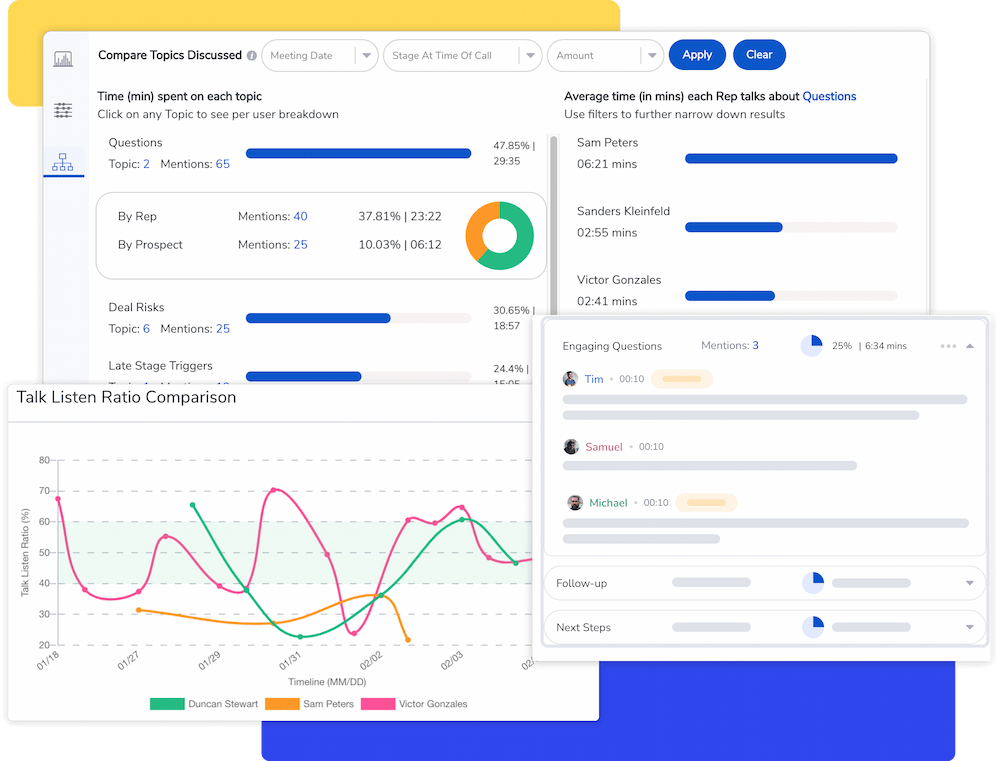
Rafiki AI acts as the intelligence layer between your conversations and your revenue decisions. It alerts you to deal risks — competitor mentions, ghosted accounts, single-threaded conversations, and more — so you can take corrective action and never miss a winnable deal.
Unlike legacy conversation intelligence solutions that stop at call analysis, Rafiki AI helps you contextually follow up with prospects post-demo and ensures that your deals close. Here's how:
A strong talk track template gives every rep on your team a repeatable framework for navigating B2B sales conversations — from opening rapport to securing the next step. But the best talk tracks are never static. They evolve with your market, your buyers, and your data.
The framework is straightforward: listen to real calls, draft a flexible template, iterate with your team, coach with conversation intelligence, and continuously improve. Skip any step — especially the data — and you're guessing instead of selling.
Rafiki AI's conversation intelligence platform starts at $19 per seat per month with no minimums and no annual commitment. Start your free trial today or book a demo to build deal-winning talk tracks backed by real buyer signals — in days, not months.
Start for free — no credit card, no seat minimums, no long contracts. Just better sales intelligence.