Negotiation, a month-end close, and a note reading "verbal yes, paper next week" were all the CRM held on a deal owned by Rafael, Claire's strongest AE. She stopped at that line on Thursday while building her Friday forecast, then found by hand the kind of risk deal intelligence is built to surface.
Claire replayed his last call and heard the champion say she had to bring in her CFO first. That call ended with no date for the CFO meeting, and nobody from finance had joined a call since. The champion had also left two of Rafael's emails unanswered for nine days.
Each fact sat in a different system, and the forecast template had room only for a stage and a date. Claire caught the gap because she replays the last call on every commit deal. That habit cannot cover the forty open opportunities on her team's board, which is the job deal intelligence takes over.
Deal intelligence combines conversation, activity, and CRM signals for one opportunity into a read on its risk and its next step. It answers the two questions a manager asks about every deal: is this real, and what has to happen next?
Vendors use the term loosely. One product calls any deal health number deal intelligence, even one built only from email counts and days in stage. Another attaches a raw transcript to the opportunity and leaves the reading to the manager. A useful system does the reading and puts what the buyer said next to what she did afterward.
In Claire's case, a working system would have put three facts on one screen. The champion named the CFO as a condition, the CFO never appeared on a call, and the replies stopped. Together they show a deal in Negotiation on paper whose buyer had not yet taken it to finance.
Deal intelligence works on one opportunity, conversation intelligence works on one call, and revenue intelligence works on the whole pipeline. One platform often sells all three, so separate them by the question each one answers.
Conversation intelligence records and analyzes individual calls for topics, questions, objections, and talk patterns. Revenue intelligence rolls deal data up into forecasts, coverage, and team trends. Deal intelligence sits in the middle, which is the layer Claire needed on Thursday.
| Layer | Unit of analysis | Question it answers | Typical user |
|---|---|---|---|
| Conversation intelligence | One call | What did the buyer say, and how did the rep respond? | Rep, coach |
| Deal intelligence | One opportunity | Is this deal real, and what has to happen next? | AE, frontline manager |
| Revenue intelligence | The pipeline | Will the team hit the number, and where is the gap? | Sales leader, RevOps |
Each layer inherits the errors of the one under it. A forecast built from deal reads that skip the calls carries every gap in the CRM straight into the number. When a vendor demo opens on the forecast roll-up, ask to see one deal and the evidence under it first.
A risk score tells a manager which deal to open, and the next step is what changes the deal. Reps quickly learn to ignore a number they cannot trace to a buyer. A score with no action attached rarely changes what anyone does on Monday.
Gartner's May 2026 survey release found that sales organizations providing AI-enabled next best actions are 2.6 times more likely to achieve commercial growth. The survey measured whether organizations provide next best actions and did not track whether reps followed them. As a result, it cannot prove that any single recommendation works. It does point a sales leader to where the return comes from, which is the action attached to each deal.
For Rafael's deal, a useful next step is specific and small. He should ask the champion whether the CFO has seen the proposal, then offer a 20-minute pricing walkthrough for finance. That step comes from the champion's own words, so Rafael can check it against the recording in a minute.
The signals that predict an outcome change as a deal moves, so a good system weights them by stage. An economic buyer who has not joined yet is normal in early discovery and a serious problem in negotiation.
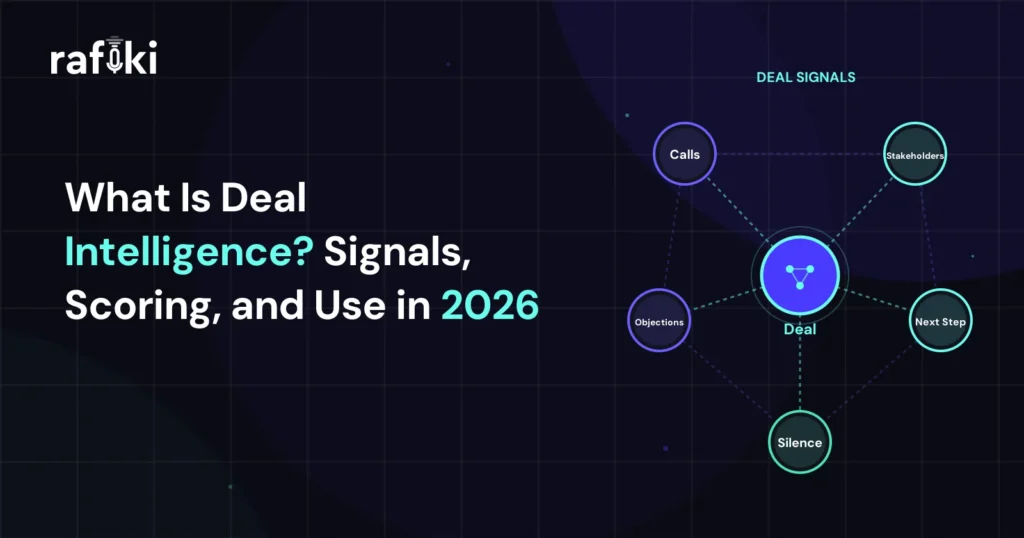
Five signals carry most of the weight, and most of them come from calls:
Early in a deal, buyer questions and next-step ownership tell you the most. A discovery call that ends with the buyer booking a technical session for her team beats an hour of polite interest. By evaluation, stakeholder count takes over, and our guide to mapping the buying committee shows how to find who is missing.
Late in a deal, unresolved objections and silence dominate. Rafael's deal showed both: the CFO condition was still open, and nine quiet days followed weeks of same-day replies. Neither signal lives in a CRM field unless the AE types it in. He has little reason to volunteer facts that weaken his own commit.
A deal intelligence system scores a deal by comparing its current signals with past wins and losses at the same stage. Some systems use explicit rules and some use trained models, and a good one combines both and shows its reasons.
Rules are easy to explain to reps. For example, a rule might subtract points when finance has not joined by the proposal stage. RevOps can read that rule, change it, and defend it in a forecast meeting.
Models find patterns nobody thought to write down, such as a drop in buyer questions two weeks before a loss. They also learn your own sales motion, which helps when your cycle looks nothing like a generic SaaS deal. The cost is explanation, because reps ignore a score that cannot name its reasons.
Say a team of eight AEs sells a mid-market product with a three-month cycle. In this hypothetical, a deal starts at 100 points and loses 20 if finance has not joined by the proposal. It loses another 15 if the last call ended without a dated, buyer-owned next step, plus 10 per silent week.
Rafael's deal loses 20 for the missing CFO, 15 for the open-ended last call, and 10 for the quiet week. That leaves it at 55, and the system flags it before anyone replays a call.
The exact weights matter less than one rule: every deduction must point to a specific call, email, or field. Ask any vendor to open a scored deal and click each reason through to its source. If a reason ends at a label like "engagement low," the score will not survive its first pipeline review.
When a deal turns red, the AE should confirm the risk, act on its main cause, and settle the category within a week. The worst response is to argue with the score in the forecast meeting and then leave the deal alone.
Open the calls and emails behind each risk reason and check whether the system read them correctly. The buyer may have said something off the recording, over dinner or at a conference, that the system never heard. Write that context into the opportunity so the next reviewer sees it.
A red deal often shows several warning signs, but one of them usually drives the rest. For Rafael, the missing CFO explains the silence. The champion most likely stopped replying while she worked out how to raise the purchase with her own boss.
Send the champion a short note that addresses the cause and gives her something she can use. For Rafael, that means asking whether the CFO has seen the proposal and attaching a one-page cost summary for her. The summary gives her a reason to reply and a document to bring to her own meeting.
If the AE has evidence the system missed, give the deal five business days to show progress. After that, it drops to best case. When the evidence already contradicts the category, as it did on Rafael's deal, move it now. Our framework for defining forecast categories by call evidence sets out what a deal needs to earn commit.
Managers use deal intelligence to choose which deals get time in pipeline review and to open each discussion with evidence. Green deals with clean evidence need no airtime, so the meeting gets shorter.
Before the meeting, the manager sorts open deals by the gap between the AE's category and the evidence. Rafael's deal topped Claire's list because it sat in commit with no CFO on any call and a stalled email thread. A weak best-case deal mattered less that week, since nobody was counting on it yet.
At Friday morning's review, Claire played the champion's quote and asked Rafael what the champion had said since. That question drew a more honest answer than asking for his confidence, because Rafael either had news or did not. He had none, so Claire moved the deal to best case before submitting the forecast. The team moved on in under five minutes.
Our earlier piece on AI-powered deal reviews walks through the full meeting format. For frontline managers, the habit worth copying is to ask about the evidence and never about the rep's confidence.
Deal intelligence can only read signals that someone captured, so it misses everything said off the record. A better model cannot fix that limit, because the data never existed.
The biggest blind spot is the buyer's internal conversation. Nobody records the champion's meeting with her CFO, so the system sees only what she reports back. A deal can look healthy right up until that internal meeting goes badly.
Unrecorded channels create a second blind spot. Text messages, personal calls, and conference dinners all shape deals, especially in relationship-heavy segments. If your team sells that way, ask AEs to log one line after each unrecorded touch. Otherwise the system will keep scoring those deals as quiet.
Recording coverage sets the third limit, because an AE who records half of his buyer meetings gets scores built on half the evidence. Coverage also varies by rep, so a team average can hide the AEs with the thinnest evidence. Before you trust any deal score, check what share of each AE's buyer meetings the system actually captured.
Test deal intelligence software on your own closed deals before you trust it on open ones. A demo on sample data shows the interface, while your own history shows whether the signals fit your sales motion.
Load the calls and CRM history of ten deals from last quarter, five won and five lost, into the trial. Then check whether the system flagged each lost deal at least two weeks before it died. A trial worth extending also leaves the won deals alone. Every flag it raises should cite a call moment or email you can open.
Ask about CRM coverage and language support early, since both decide how much of your pipeline the tool sees. A team selling in Brazil and Germany needs transcription in Portuguese and German. Teams on Zoho or Pipedrive need a native sync for the same reason. Seat minimums matter too, because a tool licensed only to managers never reaches the AE who has to act on a red deal.
Rafiki AI reads a deal from its calls first. The Notetaking Agent records, transcribes, and summarizes every sales conversation in more than 60 languages. That puts the champion's line about her CFO into searchable text the afternoon she says it.
Among Rafiki's autonomous AI agents, the Revenue Agent is the single source of truth for deal health and revenue analytics. That makes it Claire's starting point on Thursday, in place of the replay button.
Smart CRM Sync writes what the champion said into the opportunity after each call. Her CFO condition lands in the MEDDIC economic buyer field. A custom field such as "Finance engaged?" then gets its answer from the call itself instead of from Rafael's memory. The sync runs on Salesforce, HubSpot, Zoho, Pipedrive, Freshworks, and Monday.com, so Rafael's one-line note no longer carries the deal alone.
Smart Call Scoring grades Rafael's calls on MEDDIC, BANT, SPICED, or the team's own criteria. On this deal, the "economic buyer identified" criterion would read as missed on every call since discovery. That tells Claire the CFO gap is older than the nine quiet days.
Before the forecast call, Claire can put a question to Ask Rafiki: what has anyone at the account said about budget approval? She gets an answer drawn from the account's calls. Gen AI Reports then runs the question across the team, for example listing commit deals whose calls never mention budget approval.
Start by reading the last two calls of five deals your team lost last quarter. Write down what each buyer said that the CRM missed. The exercise takes one afternoon and produces a list of the warnings your own buyers gave before they walked away.
Compare that list with whatever your current tool scores. If the tool counts email opens while your lost deals died on pricing objections nobody answered, you know what to change first. Bring the list to the next pipeline review and ask each AE to check every commit deal against it.
For the first 30 days, track one number: how many commit deals drop a category before the final week of the quarter. Rafael sent the champion his one-page cost summary on Monday, and her CFO joined a call eight days later. When the close date slipped past month-end, Claire's forecast was already right because the deal sat in best case.
Rafiki AI's conversation intelligence platform starts at $19 per seat per month with no minimums and no annual commitment. Start your free trial today or book a demo to see which of your commit deals have no buyer evidence behind them before your next forecast call.
The answers assume your team already records its calls and runs a weekly pipeline review.
A deal health score is one output of deal intelligence, usually shown as a number or a color. Deal intelligence also covers the evidence behind the score and the recommended next step. A score without sources is the weakest version, since reps have no way to check it.
RevOps should own the setup, including which signals count and how much each one weighs. Frontline managers decide how the team uses it in pipeline review and one-on-ones. The response to a red deal belongs to the AE, because only the AE can act on it.
A system can read a single deal after a few calls, but scoring patterns need closed deals to compare against. With a quarter or two of recorded wins and losses, a team can test whether the signals match its outcomes. Teams with less history should rely on explicit rules until the data builds up.
No, because the forecast is a commitment a manager makes to her own leadership, and a score cannot carry that accountability. Use deal intelligence to set the call's agenda instead. Spend the time on deals where the evidence and the rep's category disagree, and skip the ones where they match.
Start for free — no credit card, no seat minimums, no long contracts. Just better sales intelligence.