Sales Forecasting

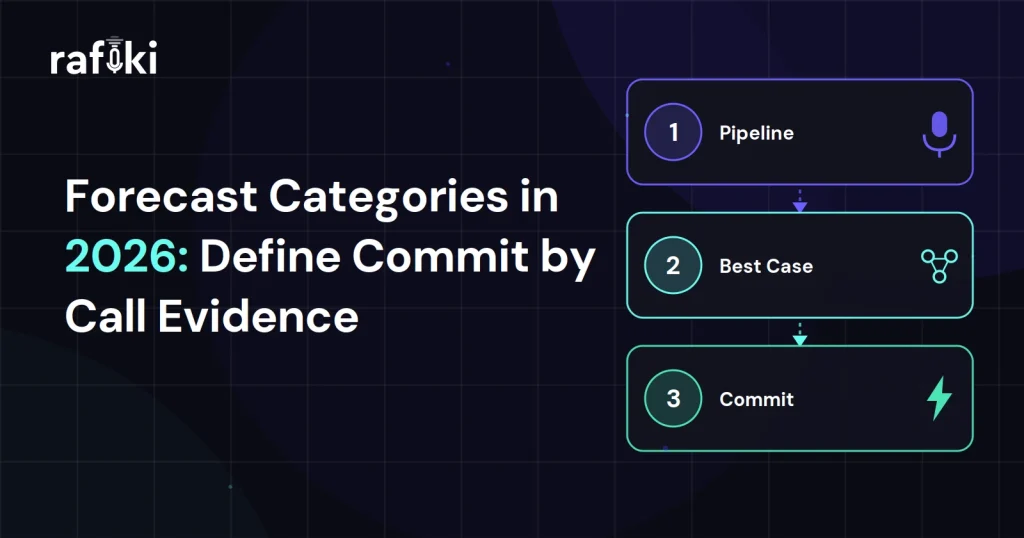
Forecast Categories in 2026: Define Commit by Call Evidence
Sep 8, 2026
13 min read
The Tuesday after Labor Day, the forecast call reconvenes and the number is due. Each rep scrolls through their pipeline and sorts deals into the familiar forecast categories: Commit, Best Case, Pipeline. One rep commits anything with a verbal yes. Another refuses to commit until the signature is in hand, then looks like a hero when the deal "surprises" everyone. A third has a deal in Commit that has been in Commit since June, because moving it out would mean admitting it slipped.
Roll all of that up and you get a Q4 number that is precise, confident, and made of three incompatible definitions.
This is the quiet failure of forecast categories. The labels look standardized because they appear in the same CRM dropdown for everyone. However, the meaning behind each label lives in each rep's head, shaped by their temperament, their manager's last reaction, and how close they are to quota. Optimists inflate Commit; conservatives hide upside in Pipeline. The forecast does not average out. It just becomes unreadable.
In 2026, forecast categories can finally mean something specific, because the evidence that should define them is recorded. Every buyer conversation captured what the customer actually said about timing, budget, authority, and process. This article shows how to define each category by that evidence, how to audit whether your team's categories hold up, and how to run the cadence that keeps them honest through the Q4 runway.
Forecast categories are the labels a sales team applies to open deals to express how likely each one is to close within the forecast period. Most teams use three or four: Commit (the rep is confident it closes this period), Best Case (it could close with favorable conditions), Pipeline (it is real but too early to call), and sometimes Omitted (excluded from the forecast entirely). The forecast is then the sum of Commit, with Best Case reported as upside.
The categories exist to separate probability from stage. A deal in the negotiation stage is not automatically a Commit, and a deal in discovery is not automatically Pipeline. Stage describes where the process is; category describes the rep's judgment about the outcome. That judgment is exactly where the trouble starts, because judgment is the one thing the CRM cannot standardize.
Well-run categories are supposed to give leadership a number they can act on: hire against it, spend against it, and report it upward with confidence. Poorly run categories give leadership a number that changes shape every week for reasons nobody can explain. The difference between the two is not the labels. It is whether the labels are backed by evidence or by feel.
Categories lose their meaning gradually, and the mechanisms are structural rather than a matter of rep discipline. Understanding them explains why another definitions document will not fix the problem.
The common thread is that categories are defined by rep sentiment, and sentiment is invisible. As Harvard Business Review's reporting on AI in sales and marketing decisions describes, the organizations getting faster, better commercial decisions are the ones grounding those decisions in observed customer behavior rather than internal opinion. Forecast categories are the most consequential decision a sales org makes every week, and most teams still make it on opinion.
A forecast built on inconsistent categories does damage in both directions, and the damage compounds as the quarter progresses. Why does it matter more in Q4? Because Q4 is when the number gets used for the most important decisions of the year.
First, planning breaks. Finance sets 2027 hiring and spend against the Q4 forecast, and a Commit number inflated by optimists or deflated by sandbaggers sends the plan in the wrong direction. Second, coaching breaks. When a manager cannot tell whether a slipped deal was misjudged or mislabeled, they cannot coach the underlying skill. Third, trust breaks.
After two quarters of forecasts that miss in unpredictable ways, leadership stops believing the number, and the sales org loses its most important voice in the room. We gave an honest account of what AI can and cannot do for accuracy in our piece on AI sales forecasting accuracy; category discipline is the part that no model can supply on its own.
Salesforce's State of Sales research has repeatedly pointed to disconnected data and low-quality pipeline data as the drag on sales organizations trying to operate with more precision. Forecast categories are where that data quality problem becomes a leadership problem, because the category is the one field that rolls all the way up to the board.
The fix is to define each forecast category by what the buyer has said and done, not by how the rep feels. A deal earns its category through observable conditions in the conversation record, and it loses the category the moment those conditions stop being true.
The following definitions are a starting template. Adapt the specifics to your motion, but keep the principle: every criterion must be something you could point to in a recorded call or a written exchange.
A deal belongs in Commit only when the buyer, not the rep, has stated the close intent. Specifically, the economic buyer has confirmed the decision on a call, the timeline they gave falls inside the forecast period, and the remaining steps (legal, procurement, security review) have been named by the customer with owners and dates. A Commit with an unmet condition is not a Commit; it is a Best Case with an optimistic label.
Best Case is the category for deals where the buyer has expressed clear intent but at least one material condition remains unconfirmed. The champion has said "we are moving forward," yet the economic buyer has not been on a call. Alternatively, the decision is made but the customer's own timeline is ambiguous, or a competing priority was mentioned and never resolved. These deals deserve upside reporting, but not the forecast.
Pipeline is for deals that have passed qualification and are actively progressing, where the conversation record shows a real problem, a real budget conversation, and a real evaluation process. What it lacks is any buyer statement about timing that would let you place it in the period. Many teams treat Pipeline as a dumping ground; in practice, it should be the healthiest category, because it is the one with the least pressure to lie.
Omitted holds deals that should not influence the forecast at all: stalled opportunities with no buyer contact in the recent window, deals the buyer has explicitly deferred to a later period, and anything a rep cannot defend with a conversation reference. Omitted is not a graveyard. It is where deals go to stop distorting the number until something changes.
A category integrity audit is a structured check that compares each deal's current forecast category against the evidence in its conversation history. It is the fastest way to find out how far your categories have drifted, and it makes a good first exercise for the week after Labor Day.
The procedure is simple, although it takes discipline to run honestly:
Teams that run this audit for the first time usually discover two things at once. Their Commit number was softer than reported, and their Pipeline contained deals that should have been in the forecast. The net can go either way. What matters is that the number now means one thing.
Evidence-based categories only work if you can find the evidence quickly. Reading every call for every deal before every forecast meeting is not feasible for a manager with a full team, which is why this discipline stayed theoretical for so long. That constraint is what has changed.
A conversation intelligence platform records and structures every buyer conversation, so the moments that define a category are searchable rather than remembered. For forecast categories, the useful signals cluster into a handful of types:
The sales forecasting workflow changes when these signals are available on demand. Instead of asking a rep "are you sure about this one?", a manager asks "show me where they said it," and the conversation shifts from confidence to evidence.
Rafiki AI is built to make evidence-based forecast categories practical for a team that does not have time to relisten to every call. It captures and analyzes every buyer conversation across meetings and phone calls, then surfaces the specific signals that define a category, linked to the moment in the recording where the buyer said it.
Specifically, Smart Call Scoring scores every call against your methodology, whether that is MEDDIC, BANT, SPICED, or custom criteria, so a manager can see at a glance whether the economic buyer, timeline, and decision process elements have actually been confirmed on a call rather than assumed in a CRM field. Those confirmations are the conditions for Commit, and they are now visible per deal without a manual review.
Smart CRM Sync then writes methodology fields back to Salesforce, HubSpot, Pipedrive, Zoho, or Freshworks from the conversation itself, so the CRM reflects what the buyer said rather than what the rep remembered to type. When a category depends on the customer naming a timeline, that timeline lands in the CRM with its source attached.
For the audit and the weekly cadence, Gen AI Search lets a manager ask in plain language which Commit deals lack an economic buyer on any call, or which Pipeline deals contain buyer timing statements inside the quarter, and get cited answers across the whole team's conversations. In addition, Gen AI Reports turns those queries into a standing category-integrity view for sales leaders and RevOps leaders who own the number. Rafiki AI's autonomous AI agents do the listening; the team keeps the judgment.
| Dimension | Feel-based categories | Evidence-based categories |
|---|---|---|
| What defines Commit | Rep confidence | Buyer statements on record |
| Who names the timeline | Rep proposes, buyer nods | Buyer states a constraint |
| Economic buyer | Named in CRM | Present on a call, quoted |
| Downgrading a deal | Feels like a confession | A condition stopped being true |
| Sandbagging | Invisible, often rewarded | Visible as hidden upside |
| Forecast meeting question | "Are you sure?" | "Show me where they said it" |
| Audit effort | Manual, rarely done | Searchable, weekly |
Definitions decay unless a ritual maintains them. The good news is that an evidence-based cadence is lighter than the feel-based one it replaces, because the argument about confidence disappears.
Run through the Q4 runway, this cadence produces something rare: a forecast that gets more accurate as the quarter progresses, because each week removes a little more feel and adds a little more evidence.
Forecast categories fail because they ask reps to express confidence and then treat that confidence as data. Confidence is not data. The buyer's words are. When Commit means "the economic buyer said it, named the timeline, and owns the next steps," and every one of those conditions can be found in the recorded conversation, the forecast stops being a negotiation between optimists and sandbaggers and becomes a summary of what customers have actually said. Rafiki AI makes that summary automatic, with autonomous AI agents that score every call against your methodology, sync the evidence into your CRM, and answer the only forecast question that matters: where did the buyer say it? Define your categories by evidence this week, before the Q4 number is due.
Forecast categories are the labels sales teams apply to open opportunities to express the likelihood each will close within the forecast period, independent of pipeline stage. The most common set is Commit (expected to close this period), Best Case (could close if remaining conditions resolve), Pipeline (qualified and progressing but not yet callable), and Omitted (excluded from the forecast). The forecast number is typically the sum of Commit, with Best Case reported as upside. Categories exist to separate the rep's judgment about outcome from the mechanical position of the deal in the sales process, which is also why they are so easy to apply inconsistently.
In an evidence-based system, the difference is whether every material condition has been confirmed by the buyer. A Commit deal has the economic buyer's stated decision on record, a customer-named timeline inside the period, and remaining steps that the customer owns with names and dates. A Best Case deal has clear buyer intent but at least one of those conditions still open, such as an economic buyer who has not yet been on a call or a timeline the customer described as a preference rather than a constraint. The moment a Commit condition stops being true, the deal moves back to Best Case, without drama.
Sandbagging survives because it is invisible and often rewarded. It becomes visible when categories are defined by buyer evidence, because a deal parked in Pipeline with strong buyer timing statements on record is a category error just like an inflated Commit. Run a category integrity audit that scores Pipeline deals for hidden upside as rigorously as it scores Commit deals for softness, and change the incentive: celebrate accuracy rather than beats. When a manager can search every conversation for buyer intent, "I did not want to over-promise" stops being a defense for hiding a deal the customer has already decided on.
Weekly, aligned to the forecast call, with a lightweight monthly retrospective. Each week, reps attach the conversation evidence for every Commit and Best Case deal before the call, and the manager spends discussion time only where evidence and category disagree. Each month, review slipped and lost deals by the category they held at the time, looking for the specific condition the team keeps skipping. A quarterly recalibration session is worthwhile at the start of Q4, when the number carries the most weight for the following year's plan.
Rafiki AI's conversation intelligence platform starts at $19 per seat per month with no minimums and no annual commitment. Start your free trial today or book a demo to see how evidence-based forecast categories change your Q4 number.
Start for free — no credit card, no seat minimums, no long contracts. Just better sales intelligence.