On the discovery call, the controller at a regional distributor asked the AE exactly one question. Her branch managers approve expenses over email, and month-end close stalls for days while she chases them. She wanted to know whether the software could route approvals by branch without a separate rule for every manager. The AE typed that question into his notes and booked a demo for the following week, but what she saw on that call looked nothing like a discovery-led demo.
The sales engineer (SE) opened his standard demo environment, a made-up company with tidy data and a familiar dashboard. He covered reporting, the mobile app, the integrations page, and the admin console while her team nodded politely. At minute 38 of a 45-minute slot, the controller unmuted and asked, "Can you show me how that works for us?"
The SE built a routing rule live with six minutes left, and the sample data threw a validation error on screen. Strong SEs run this exact demo every week, because discovery and the demo sit with two people who rarely compare notes before the call. The AE heard the controller's question and the SE knows which screens behave, yet nobody on the deal owns the gap between them. Fixing it takes a demo built from her own sentence and cut down to the workflows she asked about.
A discovery-led demo is a product demonstration that shows only the workflows the buyer described during discovery. It opens with the AE restating her problem in her words before anyone shares a screen. From there the SE shows the two workflows tied to that problem, occasionally a third. Halfway through, the AE stops to ask whether the demo is answering her question, and everything else waits for a later session.
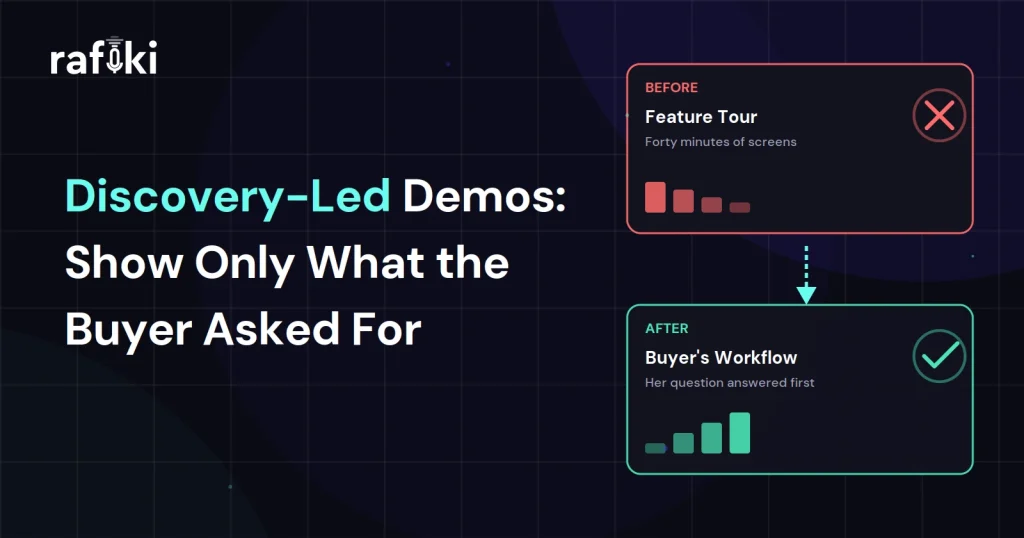
Most teams already call their demos tailored, but that label usually means the SE swapped in the buyer's logo. The tour underneath keeps the same length and order, and it ends on the same roadmap slide. A discovery-led demo changes the order and the length, and it leaves most of the product off the call.
A quick test tells the two apart before the call even starts. If the SE could run the same session for the next prospect after swapping only the logo, the discovery call had no influence on what the buyer will see.
The feature tour survives because it is the safest demo for the people giving it. Over months of repetition, the SE has rehearsed every click and learned where the sample data stays clean. He also knows which screens load slowly on a shared connection. A custom demo carries real risk for him, since a record he edited that morning can break on screen.
The standard coaching line tells sellers to show the breadth of the platform so the buyer sees what she is paying for. On a first demo, that line works against the AE. Each extra feature hands her team something new to evaluate, and it gives procurement another line item to question. A buyer who came for approval routing does not need the mobile app yet, and showing it early can start a debate about device policy.
The handoff between AE and SE makes the problem worse. By the time the notes reach the SE, the controller's sentence has often shrunk to a CRM field. That field reads "Pain: approval delays," and it drops the detail that mattered most, which was routing without per-manager rules. With nothing specific to build toward, the SE falls back on the demo he knows.
AEs carry their own fear, which is skipping the one feature that would have won the deal. In practice, the check-in question halfway through catches that risk better than a 40-minute tour does. If a feature matters to her, she will ask about it once the AE gives her room.
A buyer who asked one question in discovery spends the whole demo waiting for the answer. She watches the dashboard load, then the integrations page, and her eyes drift to the clock in the corner of her screen. By minute 20 she is wondering whether the AE wrote her question down at all. When the answer finally arrives near the end, she has little time left to probe it.
In a May 2026 press release, Gartner reported on surveys of 227 chief sales officers and 645 B2B buyers. According to the release, buyers working with sales reps were 39 percentage points more likely to say the rep understood their needs. Those buyers were also 28 points more likely to advance to the next purchase step. The research did not study demos, so treat it as a general signal about what buyers reward in a seller.
Discovery cannot prove that understanding, since any AE can nod along and type notes while the buyer talks. She has no way to tell whether those notes will change anything. The demo is the first time she sees the result. Within the opening minutes, she judges it by whether her own problem appears on the screen.
A discovery-led demo takes about an hour of prep, split between the AE and the SE. Most of that hour goes into the buyer's words and the demo data, and very little goes into slides. The four steps below work best when the team recorded the discovery call.
The AE goes back to the discovery recording and finds the moment the buyer asked her question. Next, he copies it word for word to the top of the demo plan, with the reason she gave. Our guide to sales meeting prep covers how to gather this context before any call. For a demo, the sentence itself is the useful part, because the SE will build the sample data around its nouns.
Most discovery calls surface one main question and one or two smaller ones. The AE ranks them by how much time the buyer spent on each and how frustrated she sounded. If the ranking is unclear, he emails the champion to ask which one the controller would pick first.
An SE with a standard demo environment does not need a full custom build for this. What he needs are her nouns: the branch names and approval limits she mentioned, plus some expense reports that look like the ones her managers submit. Half an hour of edits to the sample records usually covers it. Those edits spare the buyer from translating a fictional company into her own.
The AE writes two or three sentences that restate the problem the way the buyer described it. A day before the demo, he sends them to the champion and asks whether anything has changed. Champions often reply with news, such as a second department that wants in. With that reply in hand, the AE adjusts the plan before the call starts.
Book 30 minutes, even when the buyer offers a full hour. A shorter slot forces the AE and SE to cut, and it leaves the buyer asking for a second session. The five steps below fit inside that half hour with a little room to spare.
The AE opens the call while the SE keeps his screen closed. After reading the restatement, the AE asks whether it still describes the biggest issue. If new people joined, such as her CFO, the restatement brings them up to speed in about two minutes.
The SE shows the workflow tied to her main question, from the first click to the finished result. For the controller, that means one expense report routing to the right branch manager and landing in the ledger. He narrates in her terms and skips any screen the workflow does not touch.
Around minute 12, the AE stops the demo and asks a real question about what the buyer just saw. The next section covers how to phrase it, because a weak check-in wastes the most useful minute of the call.
Her answer tells the SE where to go next. If she wants more depth on routing, he goes deeper, and if she seems content, he moves to her second question. Sometimes the SE never reaches the workflow he planned, and the AE should let that happen.
With five minutes left, the AE names what the demo skipped and offers a second session to cover it. He books that session while everyone is still on the call, with a date and the right attendees. Booking it live saves a week of back-and-forth email with her assistant about open times.
The weakest check-in is "Any questions so far?" because it invites a polite no. Buyers rarely admit confusion in front of their own team, and that question gives them nothing specific to react to. So the AE hears silence and assumes the demo is working.
A better check-in names what the buyer just saw and asks her to compare it to her own process. For example, the AE might point to the report that just routed from the Dayton branch to its manager. Then he asks how close that is to the way approvals move for her today. Her reply usually exposes an exception, such as a manager who covers two branches, and that exception fills the next five minutes.
Sometimes the answer comes back flat or distracted. When that happens, the AE should ask directly whether the demo is spending time on the right problem. Newer AEs avoid that question because it sounds like an admission, yet it gives the buyer permission to redirect the call before the half hour runs out.
During the check-in, the SE should keep his hands off the mouse. A moving screen pulls the buyer's eyes away, and she answers in a few distracted words. When the screen stays still and the AE waits a few seconds after asking, she often starts describing the exceptions her team handles by hand.
This sentence is the clearest buying signal a demo produces, and in a feature tour it tends to arrive with only minutes left. It means she has stopped judging the product in general and started picturing it inside her operation. With a discovery-led demo, the same request often comes in the first 15 minutes, while the SE still has time to answer it on screen.
When it comes, the SE should answer live if the demo data allows, even if that means abandoning the plan. Some questions depend on something the environment cannot show, such as her real ERP connection. In that case, the AE should say so plainly and put a specific date on the calendar. An SE who improvises on unsuitable demo data risks the same validation error the controller watched.
The AE should also write down her exact phrasing on the spot. That sentence often becomes the success criteria for a trial, because it describes in her words what working looks like. It belongs in the follow-up email and in the CRM, where the next person on the deal can find it.
Cutting features feels risky to SEs who built their reputation on knowing the whole product. Even so, the demo should drop anything the buyer did not ask about. Each of those features has a place later in the deal, when a specific person asks for it.
SEs sometimes worry that a short demo makes the product look thin. The controller in the opening scene was judging the product on one routing rule, and a clean answer would have outweighed every screen she sat through. Our earlier piece on what AI can't do in a discovery call explains why the rep still has to ask those discovery questions well.
Both versions below fill the same calendar slot and show up in the CRM as a completed demo. What separates them is who decides the content and what the buyer leaves with.
| Part of the demo | Feature tour | Discovery-led demo |
|---|---|---|
| Length | The full calendar slot | 30 minutes |
| Opening | Company slides | Buyer's problem in her words |
| Demo data | Standard sample company | Her branches, roles, and terms |
| Order | Product menu, top to bottom | Her ranked questions |
| Midpoint | "Any questions so far?" | Specific check-in on what she saw |
| Her main question | Final few minutes | First 15 minutes |
| Ending | Pricing overview | Booked follow-up session |
Most demo coaching focuses on the SE's delivery, such as pacing and screen hygiene. Frontline managers get more from coaching the handoff, since that is where the buyer's question usually disappears. The best place for that coaching is a 20-minute review the day before a large demo.
In that review, the manager asks the AE to state the buyer's main question without looking at notes. If the AE describes a product area, the two of them listen to the discovery recording until they find her actual words. After that, the manager asks the SE which screens he plans to show. He then cuts any screen that does not trace back to something she said.
Once the demo is over, the manager listens to the recording for one thing: the minute the buyer's main question first appeared on screen. When that timestamp lands past minute 30, the manager and the account executive trace it back to the handoff notes before the next demo. The same recording also tells the manager whether the buyer answered the check-in with detail or with a single word.
A discovery-led demo depends on the buyer's exact words, and a conversation intelligence platform keeps them on file after the AE's notes shrink to a single CRM field. Rafiki AI transcribes each recorded discovery call and demo, and its transcription covers more than 60 languages. It also categorizes topics and detects the blockers a buyer raised on each call.
When the AE preps the demo, he can use Gen AI Search to find the moment the controller asked about branch routing. The SE can use Ask Rafiki to check what she said about approval levels, without replaying the full recording. After each call, Smart Call Summary summarizes the conversation, so both people start prep from the same page.
Smart Call Scoring scores every call against any methodology or against custom criteria. A manager can add criteria such as restating the problem before screen share and asking a specific check-in question, then see which demos met them. Stakeholder participation mapping shows which people on the buyer's side took part in each call, so the AE can check whether the controller spoke up after the first workflow.
After the demo, Smart Follow Up drafts the follow-up email, and the AE edits it to quote the buyer's request. Smart CRM Sync fills in methodology fields from the calls, including any custom CRM fields for demo notes. For practice before a large demo, AEs can run through the check-in question in AI Role Play.
Before October ends, each AE should pick one demo booked for the first week of November. He listens back to that deal's discovery call and copies the buyer's main question to the top of the plan. Then he sends the restatement to the champion, and the SE spends half an hour putting her terms into the demo data.
After that demo runs, the manager checks a single number on the recording: the minute her main question first appeared on screen. Compare it with the last feature tour the same AE and SE ran. If the buyer's question moved into the first 15 minutes, repeat the process on every demo booked for November.
Before the SE opens the standard demo environment again, hand him the discovery transcript to build from. Rafiki AI's conversation intelligence platform costs $19 per seat per month, and a team can start with seats for just the AE and SE on one deal. Register for a free trial and record the discovery calls behind the demos you plan to rebuild in early November. If the AE and SE want to put their questions to a person first, book a demo and bring the question list from your last discovery call.
Plan for 30 minutes, even when the buyer offers an hour. That leaves time to restate the problem, show two workflows, and run a check-in without rushing. Anything more fits better in a scheduled follow-up with the right people attending.
The AE should open, because the AE ran discovery and heard the buyer describe the problem firsthand. A restatement lands better from the person she already told. Once the buyer confirms the problem still holds, the SE takes over the screen.
In that case the team is not ready for a discovery-led demo, and a longer feature tour will not fix it. The AE should book a short second discovery call or ask the champion what the buyer cares about most. A demo built on a guess usually wastes the buyer's time and the SE's prep.
One planned check-in around the halfway point is enough for a 30-minute demo. Beyond that, the AE should stop whenever the buyer's reaction changes, such as a long silence or a sudden question. A check-in works best when it asks about something specific she just saw on screen.
Start for free — no credit card, no seat minimums, no long contracts. Just better sales intelligence.