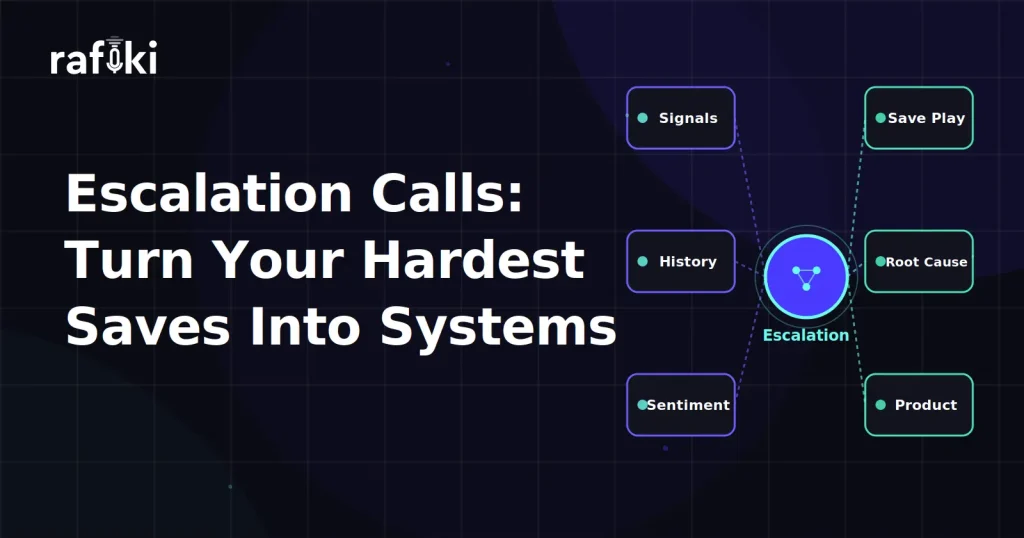
Your team runs churn post-mortems on the customers you lost. But the richest retention data in your business lives somewhere else: in escalation calls with the customers you almost lost. Every escalation is a customer telling you, in detail and under pressure, exactly what nearly broke the relationship. Every save is a CSM improvising a play worth keeping. Yet in most customer success organizations, both evaporate the moment the ticket closes.
Think about the last major escalation your team handled — someone senior on a call with an angry champion or an exasperated sponsor. The customer laid out every grievance — the product gap, the broken promise, the onboarding shortcut that came back to haunt them. Your CSM listened, apologized, offered something, and pulled the account back from the edge. Then everyone exhaled, marked the ticket resolved, and moved on to the next fire.
That exhale is where the value leaks out. The escalation contained a root-cause diagnosis spoken aloud by the customer. Meanwhile, the save contained a playbook demonstrated live by your best people. Neither was captured, tagged, or turned into anything repeatable. This article is about closing that gap — treating every escalation as raw material for systems that prevent the next one.
Escalation calls are the most information-dense conversations your customer success team will ever have. Three things happen on them that happen almost nowhere else.
First, candor is forced. On a routine check-in, customers soften their complaints to avoid confrontation. On an escalation call, that filter is gone. The customer has already decided the relationship is at risk, so honesty costs less than politeness. As a result, you hear the real grievance in the customer's own words.
Second, the stakes are explicit. Customers on escalation calls tell you what happens next if nothing changes: "We're evaluating alternatives." "My CFO is asking why we renewed." In contrast, ordinary calls make you infer risk from tone and hesitation. Escalations state it outright — the cleanest labeled data your retention motion will ever get.
Third, the fix requirements are spoken aloud. A customer deep in an escalation doesn't just complain — they negotiate. They tell you what would restore trust: a working integration by a date, an executive sponsor, a named support contact. Consequently, every escalation call contains a customer-authored specification for what "saved" looks like.
Research points the same direction. Salesforce's State of Service research shows service organizations racing to treat support interactions as strategic intelligence rather than cost-center transactions. Similarly, Forrester's customer experience analysts have long argued that moments of high friction reveal more about loyalty than any survey. Escalations are those moments, live and unfiltered.
Most CS organizations treat an escalation as an incident to resolve, not an asset to mine. The workflow reflects it: the escalation gets a ticket and an owner, who works it until the customer calms down. Then the ticket closes with a one-line note, and everyone feels relief.
Here's what that workflow silently discards:
That knowledge lives in one person's memory, and it walks out the door when they change roles. New CSMs then relearn escalation handling the expensive way — live, on your most fragile accounts. That is the ticket-closed trap. The organization pays full price for the crisis and collects almost none of the education.
The first system to build is root-cause classification. One escalation is an anecdote; ten tagged to their true origins are a diagnosis of your business. In practice, nearly every escalation traces back to one of four upstream failures.
The customer needs a capability that doesn't exist, doesn't work at their scale, or doesn't integrate with their stack. These escalations are the customer doing your product discovery for you. Under pressure, they articulate the exact workflow they need and where it breaks. Their routing deserves its own system — more on that below — because the fix lives outside CS entirely.
Someone in the sales cycle promised — or let the customer believe — something the product couldn't deliver. The tell is language like "we were told this would" or "your rep said." These aren't really CS failures — they're sales-process failures that detonate on the CS team's watch, months after signing. Our guide to running a churn post-mortem from lost-customer calls shows how the same misalignment surfaces when the save fails.
The implementation was rushed, a key workflow was never configured, or the champion's team was never trained. Onboarding debt tends to surface months later, when a renewal forces the customer to evaluate value they never received. The complaint sounds like a product problem. However, the transcript usually reveals a setup problem that compounded quietly.
The original issue was solvable, but the path to resolution failed. Tickets bounced between queues, responses lagged, or the customer re-explained their problem to every new agent. In these escalations, effort — not the defect itself — broke the relationship. They pair naturally with our post on the customer effort score and measuring friction, because rising effort is visible in conversations long before the blow-up.
Classification only works if it's honest, and honesty means separating the presenting complaint from the true origin. A customer screaming about a missed SLA looks like a support breakdown. However, if the transcript shows they were sold a response-time commitment their plan never included, the true origin is the sale. Tag it wrong and you'll fix the wrong process.
A workable tagging discipline looks like this:
Within months, the tag distribution becomes one of your most decision-ready artifacts. It shows where to invest, which team owns the fix, and whether last quarter's process change moved anything.
Root causes explain why escalations happen. The save playbook captures what makes them survivable — knowledge that probably lives in the instincts of two or three senior people. When your best CSM rescues a furious account, they improvise a sequence worth studying. What did they acknowledge first? What did they refuse to promise, and what did they offer?
To extract the playbook, study saved escalations the way a sales team studies closed-won calls. Look for:
Codify these into a one-page save play per escalation type — a product-gap save and a broken-promise save require different moves. Then rehearse them. A playbook that exists only as a document is barely better than none. One your CSMs have practiced changes outcomes on the next hard call.
Product-gap escalations deserve their own routing system, because the standard path destroys most of their value. On that path, the CSM condenses the complaint into a feature-request ticket that joins a backlog of hundreds. Eventually a product manager reads a two-line paraphrase stripped of urgency, context, and revenue stakes — and deprioritizes it.
Now compare that to routing the escalation with call evidence attached. Instead of "customer wants better reporting," product hears the champion say their executives nearly cancelled over a missing board-ready report. Attached: the account's renewal value and other escalations tagged to the same gap. The persuasive force is entirely different — the request didn't change, the evidence did.
The routing discipline has three parts. First, every escalation tagged "product gap" generates an evidence package: the transcript excerpt, the account context, and the customer's stated fix requirement. Second, recurring gaps get aggregated, so product sees one missing capability across several escalated accounts rather than disconnected tickets. Third, product's decision — build, defer, or decline — flows back to the CSMs on those accounts. That stops implied promises the roadmap can't honor. That closed loop turns CS from a complaint forwarder into a genuine voice-of-customer channel.
Every escalation has a prequel. Go back and listen to the calls from the six weeks before your last blow-up. The warning signs are almost always sitting in plain sight — unflagged, because nobody knew to treat them as signals. Mining that prequel is how escalation calls stop being surprises and start being predictions.
Three patterns recur in pre-escalation conversations:
Once you know your escalations' common prequel, define these patterns as explicit risk triggers. Then you can act at the whisper stage instead of the scream stage. We covered the broader taxonomy in our post on renewal risk signals and conversation red flags for 2026. The escalation prequel is that same discipline, pointed at your own historical near-misses.
The shift this article argues for is a single change of posture: from resolving escalations to mining them.
| Dimension | Ticket-Closed Mindset | Systemized-Save Mindset |
|---|---|---|
| Goal | Make the customer stop being angry | Capture why they got angry and what worked |
| Record kept | One-line resolution note | Transcript, root-cause tag, fix commitments |
| Root cause | Assumed from the symptom | Tagged to its true upstream origin |
| Save knowledge | Lives in one CSM's head | Codified into rehearsed save plays |
| Product feedback | Paraphrased ticket in a backlog | Call evidence with revenue context |
| Early warning | None — next escalation surprises everyone | Pre-escalation patterns become risk triggers |
| Review cadence | Never revisited after close | Monthly cross-functional escalation review |
| Outcome over time | Same escalations recur | Each escalation class gets engineered away |
Neither column describes effort — left-column teams often work harder, because they fight the same fires repeatedly. The right column describes leverage: each escalation makes the next one less likely or less severe.
Systems need a forcing function; for escalations, that's a monthly review. Not a blame session or metrics readout, but a working meeting that examines the month's escalations as evidence. Three design rules make it work.
Make it cross-functional. CS runs the meeting, but product, support, and a sales leader attend, because the root-cause tags will implicate all of them. A CS-only review becomes a support retrospective; sale-stage and product-gap origins never get confronted by the teams that own them.
Make it evidence-first. Every escalation discussed comes with its call evidence — the moment the customer named the origin, the moment the save turned. Playing ninety seconds of a real customer saying "this is why I almost left" changes a meeting in ways no slide can.
Make it produce artifacts. Each review should update three living documents: the root-cause distribution, the save playbook, and the early-warning trigger list. In addition, every product-gap escalation gets a routing decision on the record. If the meeting ends without changing at least one artifact, it was a status update wearing a ritual's clothes.
Held consistently, this one hour compounds. Six reviews in, you have a tagged corpus of near-losses, a rehearsed playbook, and a trigger list tuned to your customers' pre-escalation language.
Everything above is doable manually — and almost nobody sustains it. Relistening to tense calls, tagging origins, and clipping evidence is the work deferred during a busy renewal quarter. This is where conversation intelligence changes the economics. When every customer call is automatically captured, transcribed, and analyzed, the escalation-mining system stops depending on anyone's spare time.
Rafiki AI was built for precisely this pattern of work. Its Smart Call Summary capability structures every escalation call as it happens: grievances raised, commitments made, fix requirements stated aloud. The record exists before the CSM has caught their breath, and the customer's own words survive intact.
The mining layer comes from Gen AI Search, which lets you interrogate your entire call history in plain language. Ask "show me every escalation where the customer mentioned a promise from the sales cycle." Or "find calls where champions described workarounds before escalating." Consequently, root-cause tagging and prequel analysis collapse from days of relistening into minutes. Meanwhile, autonomous AI agents monitor conversations for the early-warning patterns you've defined — effort language, sentiment shifts, unanswered commitments. The next brewing escalation surfaces as a risk signal instead of a surprise. Ready to see it on your own escalations? Start your free trial today.
For individual CSMs, escalation mining makes hard calls less lonely: they arrive with a rehearsed play instead of improvising. For CS leaders, however, the stakes are structural. Escalations are where team skill gaps, product weaknesses, and sales promises all become visible at once.
A leader who systemizes them gains three things no dashboard provides. First, defensible cross-functional influence. Walk into product prioritization with an entire quarter's tagged call evidence and you present customer testimony, not anecdotes. Second, faster ramp: new CSMs inherit a save playbook and a library of real escalation calls instead of learning by fire. Third, a leading indicator for retention itself. The mix of pre-escalation signals across your book reads NRR risk earlier than any lagging health score.
Modern customer success software should serve exactly this. Not another place to log activities, but an intelligence layer that turns your hardest conversations into your most durable systems. That's the standard worth holding your stack to in 2026.
Escalation calls are the only conversations where customers tell you the whole truth and name their price for staying. They're also where your best people demonstrate saves under pressure — all on a single recording. Treating them as tickets to close is like running experiments and discarding the results. The alternative isn't complicated. Tag every escalation to its true origin and extract the save moves into rehearsed plays. Route product-caused escalations with evidence attached. Then define early-warning triggers from the prequels and review everything monthly with the teams that own the fixes.
Do that consistently and the shape of your escalations changes. Recurring classes get engineered away. Survivable ones get handled by playbook instead of heroics, and the next near-loss announces itself weeks early in effort language and cooling sentiment. Your hardest saves stop being war stories. They become systems — and systems are what retention compounds on.
Three things, in order. First, capture the record while it's fresh — ideally from a structured call summary rather than memory. That means the grievances raised, the root cause described, and every commitment your team made. Second, tag the escalation to its true origin — product gap, sale-stage failure, onboarding debt, or support breakdown — from the transcript, not the ticket symptom. Third, convert the customer's stated fix requirements into tracked commitments with owners and dates. Unanswered commitments are themselves a leading cause of the next escalation. The whole ritual takes minutes when calls are summarized automatically — and it's the difference between an escalation you survived and one you learned from.
Listen for the customer's narrative of how things went wrong, not just what is broken today. The presenting complaint is usually a symptom; the origin sits upstream in the story. Phrases like "we were told this would" point to expectation-setting failures in the sales cycle. "We never got that configured" signals onboarding debt. Repeated re-explaining, bounced tickets, and slow responses indicate a support process breakdown. A clearly articulated missing capability is a product gap. Force yourself to assign one primary origin per escalation, and tag from the transcript rather than the ticket. Over time, the distribution of tags tells you which upstream process to fix first.
The most reliable predictors are conversational, and they appear weeks before the blow-up. Rising effort language is the big one: customers narrating workarounds, chasing support, or abandoning features. Unanswered commitments come next. When a customer must chase the same promised follow-up on consecutive calls, trust is actively eroding. Finally, watch for sentiment shifts in your champion: shorter meetings, fewer roadmap questions, and a tone that moves from collaborative to transactional. None of these appear in usage dashboards, which is why telemetry-only teams get surprised. Reviewing the calls that preceded your own past escalations is the fastest way to calibrate these signals to your customer base.
AI removes the labor that makes escalation mining unsustainable by hand. A conversation intelligence platform like Rafiki AI captures and transcribes every customer call. Smart Call Summary then structures each escalation automatically — grievances, commitments, and fix requirements. Gen AI Search lets CS leaders interrogate the full call corpus in plain language. Root-cause patterns and pre-escalation prequels then surface in minutes, not days. Autonomous AI agents monitor ongoing conversations for the patterns you've defined. They flag rising effort language or cooling champion sentiment before it hardens into a crisis. As a result, the monthly review runs on evidence that's already assembled. The save playbook grows with every escalation.
Rafiki AI's revenue intelligence platform starts at $19 per seat per month with no seat minimums and no annual commitment. Start your free trial today or book a demo to see how your team's hardest saves become the systems that protect every renewal after them.
Start for free — no credit card, no seat minimums, no long contracts. Just better sales intelligence.