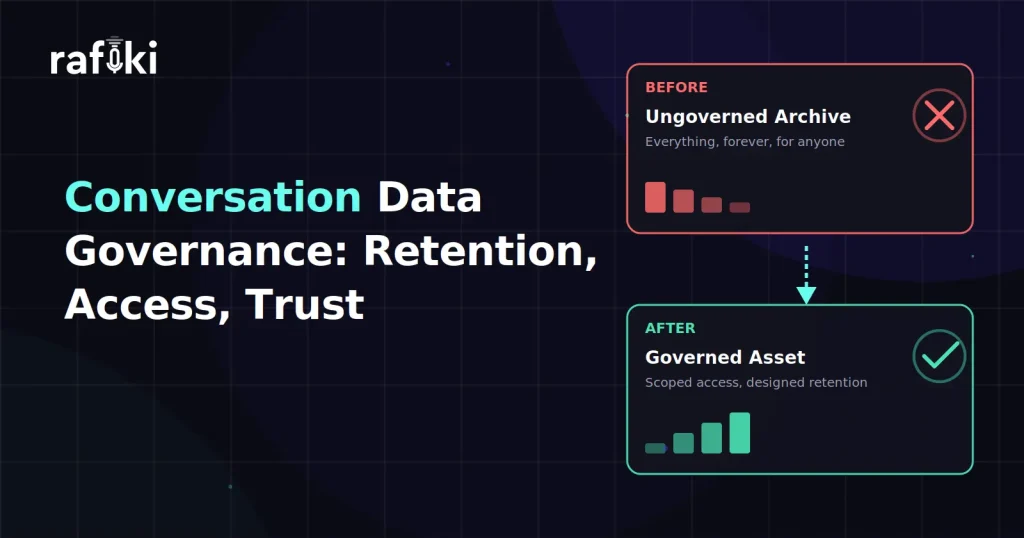
Your company has been recording customer calls for years. Every discovery conversation, demo, pricing negotiation, and renewal check-in now lives in a searchable archive that grows by the day. That archive is one of the most valuable assets a revenue organization owns — we have called it the conversation data moat — but value and risk travel together. Conversation data governance is the discipline that keeps them apart: the rules that decide who can listen to what, how long recordings live, what happens when a customer asks for deletion, and which conversations should never be captured at all.
Most revenue teams cannot answer those questions today. Access has sprawled since the recording tool was first switched on, retention defaults to "forever," deletion requests trigger a scramble, and nobody has written down which meetings are off-limits. In other words, the archive grew faster than the rules around it.
This guide lays out a practical governance framework for RevOps leaders, IT and security-adjacent buyers, and CROs who field security questionnaires. One caveat before we start: governance intersects with privacy regulations that vary by region and industry, so involve legal counsel before you finalize any of the policies described below.
Conversation data governance is the set of policies and controls that determine how recorded customer conversations are accessed, retained, deleted, and excluded from capture. It rarely gets the spotlight. Vendors demo coaching dashboards and deal signals; almost nobody demos a retention policy. Yet the same corpus that powers conversation intelligence and revenue intelligence also carries some of the most sensitive material in your company.
Consider what a typical quarter of recordings contains. There are customer names, contact details, and voices — personal data by almost any definition. Pricing discussions and discount concessions sit alongside them, as do candid assessments of competitors, product roadmap hints, and occasionally a customer's own confidential information shared in trust. As a result, a call library is simultaneously a coaching goldmine and a concentrated pool of risk.
The adoption curve makes this urgent. As McKinsey's ongoing State of AI research shows, organizations keep expanding AI use across functions, and revenue teams are among the fastest movers. Governance, however, tends to lag adoption. The gap between "we record everything" and "we govern what we record" is where liability lives — and closing it is the unglamorous half of the conversation-data story.
Start with a simple principle: access should follow role, not curiosity. A sensible default model gives each person the narrowest access that still lets them do their job, then expands by explicit grant rather than by default.
Two categories deserve special handling. HR-adjacent recordings — a call where a rep discloses a health issue, or a conversation that later becomes part of a performance dispute — should be restrictable to a small named group the moment they are flagged. Legal-adjacent recordings, such as calls touching an active dispute or a contract negotiation under privilege review, need the same treatment. Because these situations are rare but high-stakes, the mechanism must exist before you need it.
Trust is the payoff. Forrester's customer experience research consistently frames trust as an accelerant of business relationships, and the same logic applies internally: reps speak more candidly on recorded calls when they know exactly who can hear them. An access model that people understand is an access model they will not try to evade.
A retention policy answers one question per call type: how long does this recording earn its keep? Different conversations have different useful lives, and your policy should reflect that instead of applying one rule to everything.
Automatic expiry is the mechanism that makes any of this real. A policy that depends on someone remembering to delete things is not a policy; it is a hope. Configure the platform to expire recordings on schedule, with a documented exception path for legal holds and flagged calls.
Above all, resist the gravitational pull of "keep everything forever." Indefinite hoarding feels safe because deletion feels irreversible, but it is a liability posture, not a data strategy. Every recording you hold is discoverable, breachable, and in scope for any deletion request. Meanwhile, the analytical value of a five-year-old cold call rounds to zero. If a recording no longer informs coaching, forecasting, or the account relationship, its remaining function is risk.
Deletion is where governance gets tested in public. When a customer asks you to erase their data, the clock starts, and improvisation shows. A workable deletion workflow has four parts.
First, intake and identification. Someone must own the request, and the platform must be able to find every conversation involving that customer — across reps, teams, and years — without a manual hunt. Search that spans the whole corpus is a governance feature, not just a productivity one.
Second, scope. "Deleted" must mean more than hiding the recording from the library. Transcripts, AI-generated summaries, embeddings, coaching snippets, and CRM-synced notes all derive from the same conversation; a credible workflow addresses derived artifacts, not just the source file. Ask your vendor to spell out exactly what their deletion covers and on what timeline backups age out.
Third, offboarding. When a rep leaves, their calls typically remain company assets, but their access should end the same day. Departed-employee access is one of the most common gaps an access audit finds, precisely because nobody's job description includes checking for it.
Finally, evidence. Log what was deleted, when, at whose request, and under which policy. The log is what turns "we handled it" into something you can show a buyer or an auditor.
Good governance is as much about what you refuse to record as what you retain. Some conversations should stay out of the archive entirely.
The design challenge is friction. If pausing or excluding a recording takes six clicks and an admin ticket, people will route around the system: they will move sensitive conversations to personal phones, unrecorded channels, or hallway chats. That workaround culture is worse than the risk it avoids, because it is invisible. Make exclusion a one-click act — pause buttons, calendar-keyword rules that skip certain meeting types, and per-meeting opt-outs anyone can trigger without justification.
Consent sits underneath all of this. Recording disclosure expectations differ by jurisdiction, and we covered the practical side in our guide to call recording consent rules. The governance takeaway is simple: disclosure should be automatic and consistent, never left to each rep's memory.
Your governance is only as strong as the platform holding the recordings. Whether you are evaluating a new tool or re-reviewing an incumbent, four posture questions matter most.
Insist on posture evidence rather than slogans — architecture descriptions, written commitments, and documented practices you can attach to your own security responses. We published a fuller procurement checklist in our AI conversation intelligence security review guide, which pairs well with this article.
This is also where platform choice becomes a governance decision. Rafiki AI, for example, is designed for data isolation, maintains a no-training-on-customer-data posture for its customers' conversations, and supports export of recordings and transcripts — you can see how the pieces fit in the product overview. Evaluate any platform, ours included, against the four questions above rather than against its marketing page. If you want to test how a governed platform feels in practice, Start your free trial today and walk through the access and retention settings before you ever upload a call.
The difference between an archive and an asset is not the recordings — it is the rules around them. The contrast is easiest to see side by side.
| Dimension | Ungoverned Call Archive | Governed Conversation Asset |
|---|---|---|
| Access | Everyone sees everything by default | Role-based defaults; cross-team access by grant |
| Sensitive calls | Mixed into the general library | Flagged and restricted to named groups |
| Retention | Everything kept forever | Expiry windows by call type, enforced automatically |
| Deletion requests | Manual scramble, uncertain scope | Owned workflow covering derived artifacts, with logs |
| Departed reps | Access lingers indefinitely | Access revoked at offboarding |
| Exclusions | Ad hoc; people route around the tool | One-click exclusions and automatic disclosure |
| Vendor posture | Unknown; never asked | Isolation, training, export, and subprocessor answers on file |
| Security reviews | Each questionnaire is a fire drill | Documented answers ready to attach |
Notice that nothing in the right-hand column reduces the value of the data for coaching or forecasting. Governance constrains access and lifespan, not insight. In practice, the governed corpus is more useful, because people trust it enough to record consistently.
Here is the part most teams miss: governance is not just risk hygiene. It shows up in revenue, on both sides of your sales motion.
On the buying side, your prospects' security teams increasingly ask how you handle recorded conversations — where they live, who hears them, how deletion works, and what your vendors do with the data. A CRO who can answer in one email, with policy documents attached, keeps the deal moving. One who has to convene an internal investigation to find out adds weeks of drag and plants a seed of doubt. Clean answers are a closing asset.
On the selling side, governance protects the candor that makes conversation data valuable in the first place. Customers who trust your recording practices speak more openly; reps who trust the access model perform more naturally. Consequently, the governed corpus is richer than the ungoverned one, not just safer.
There is an internal dividend, too. When access is clean and retention is intentional, teams stop relitigating who may see what, and analytics work proceeds without a privacy debate blocking every project. Governance, done once and done well, removes a recurring tax on every downstream use of the data.
Policies decay without a rhythm. A quarterly review — an hour with RevOps, IT or security, and a sales leadership representative — keeps the paper policy and the lived practice from drifting apart. Three checks cover most of the ground.
Close each review by updating the policy document and noting what changed. That running record becomes your evidence trail for security reviews — and it is far easier to maintain quarterly than to reconstruct annually.
The conversation corpus your team has built is genuinely a moat — but only governance makes it defensible in every sense of the word. Role-based access with deliberate grants, retention windows that match each call type's useful life, a deletion workflow that covers derived artifacts, one-click exclusions people actually use, vendor posture answers on file, and a quarterly review to keep it all honest: that is the whole framework. None of it is glamorous, and all of it compounds. The teams that treat conversation data governance as a first-class RevOps discipline get both halves of the prize — the insight that wins deals and the trust that survives scrutiny.
Conversation data governance is the set of policies and controls a company applies to its recorded customer conversations. It covers four core areas: access (who can listen to which calls, under what defaults and grants), retention (how long each type of recording lives before automatic expiry), deletion (how customer requests and employee offboarding are handled, including derived artifacts like transcripts and summaries), and exclusion (which conversations should never be recorded at all). Good governance also extends to vendor posture — data isolation, training commitments, export rights, and subprocessor transparency for any platform that stores the recordings. The goal is to preserve the coaching and forecasting value of conversation data while containing the privacy, competitive, and legal risks that come with holding it. Teams should involve counsel when formalizing these policies.
There is no single correct number — the right answer depends on call type, industry, and the privacy regulations that apply to your business, which is why retention decisions belong in a written policy reviewed with legal counsel. The design principle is that retention should match useful life. Prospecting and discovery calls lose coaching value as messaging and pricing evolve, so they suit shorter windows. Closed-won deal cycles inform onboarding and renewals, justifying longer retention. Customer success calls often matter for the life of the account plus a buffer. Whatever windows you choose, enforce them with automatic expiry rather than manual cleanup, and maintain a documented exception path for legal holds. "Keep everything forever" is the one answer that is almost always wrong, because it maximizes exposure while adding little insight.
Default access should follow role. Reps see their own calls plus shared best-call libraries; managers see their team's calls for coaching and deal review; cross-team users — enablement, product, marketing — receive scoped, deliberate grants rather than blanket visibility; and admin rights stay with a small, regularly reviewed group. Two categories need tighter handling: HR-adjacent recordings, such as calls that become part of a performance dispute, and legal-adjacent recordings connected to disputes or privileged matters. Both should be restrictable to named individuals the moment they are flagged. Finally, revoke access at offboarding — departed employees retaining access to the call library is one of the most common findings in an access audit, and one of the easiest to prevent with a checklist step.
Four questions cover the essentials. First, data isolation: how is your tenant's data separated from other customers' data in storage and processing? Second, training: does the vendor commit in writing that your conversations are not used to train models serving other customers? Third, portability: can you export recordings, transcripts, and metadata in usable formats if you leave the platform? Fourth, subprocessors: which third parties touch your data, for what purpose, and how are changes communicated? Ask for posture evidence — architecture descriptions and written commitments — rather than certification slogans, and keep the answers on file so your own security-review responses stay fast. Our security review procurement checklist walks through the full questionnaire, including contract language worth requesting.
Rafiki AI's conversation intelligence platform pairs autonomous AI agents with governance controls — role-based access, retention settings, and export paths — starting at $19 per seat per month with no minimums and no annual commitment. Start your free trial today or book a demo to see how a governed conversation asset strengthens both your coaching and your security reviews.
Start for free — no credit card, no seat minimums, no long contracts. Just better sales intelligence.