Every AI feature you shipped this year, your competitor shipped too — sometimes the same quarter, on the same underlying model.
This is the uncomfortable arithmetic of building in 2026. Foundation models have become strategic commodities: the weights are licensable, the capabilities converge, and any credible team with funding can wire the same intelligence into a similar interface. The AI-powered differentiation that looked like a moat in 2024 turned out to be a head start measured in months. Feature parity is now the default state, arriving faster every cycle.
So the strategy conversation has moved. The question boards are asking is no longer "what is our AI strategy?" but "what do we have that AI makes valuable — and that nobody else can get?" For most B2B companies, the most underpriced answer is sitting in their meeting recordings: the accumulated record of what their buyers and customers actually said, across thousands of conversations, in their own words. That record is a conversation data moat — if it is captured, governed, and put to work.
The pattern is familiar from every previous platform shift, accelerated. Capability that was scarce becomes abundant; abundance collapses pricing power; advantage migrates to whatever remains scarce. As McKinsey's State of AI research tracks year over year, adoption of generative AI has spread across functions and industries at remarkable speed — which is precisely why adoption itself no longer differentiates anyone.
Run the audit on your own stack and the conclusion is hard to avoid:
What does not diffuse is data that only you possess. Not purchased intent feeds or enrichment records — competitors buy those too — but data generated by your own customers interacting with your own company, accumulating daily, annotated by outcomes only you can see. In revenue organizations, the densest deposit of that data is conversations.
A conversation data moat is the durable competitive advantage a company builds by systematically capturing, structuring, and activating the record of its own customer conversations — sales calls, QBRs, renewals, escalations — at a depth competitors cannot replicate, because the underlying conversations only happened with you.
The definition has three load-bearing words:
Notice what the moat is not: it is not the AI. The same commodity models your competitors use become differentiated the moment they run over your corpus, because the inputs — your buyers' objections, your customers' outcomes, your market's actual language — exist nowhere else.
Plenty of data assets decay. CRM contact data rots as people change jobs; intent data goes stale in weeks. Conversation data has unusual compounding properties:
This is the flywheel logic that strategy work in 2026 keeps circling: usage generates data, data improves the system, the system improves outcomes, outcomes drive usage. Conversations are where revenue teams already have the flywheel spinning — most just haven't connected it to anything.
| Property | Purchased contact data | Intent signals | Your conversation corpus |
|---|---|---|---|
| Who else has it | Everyone who pays | Everyone who pays | Only you |
| Decay rate | Fast — people move | Very fast — weeks | Slow — outcomes add value back |
| Acquisition cost | Recurring spend | Recurring spend | Generated by operating |
| Specificity to your market | Generic | Topic-level | Your buyers, verbatim |
| Compounds with use | No | No | Yes — outcome labels accumulate |
Purchased data has real uses — targeting, enrichment, timing. But notice which column describes an asset and which columns describe subscriptions. Strategy gets built on the column competitors cannot rent.
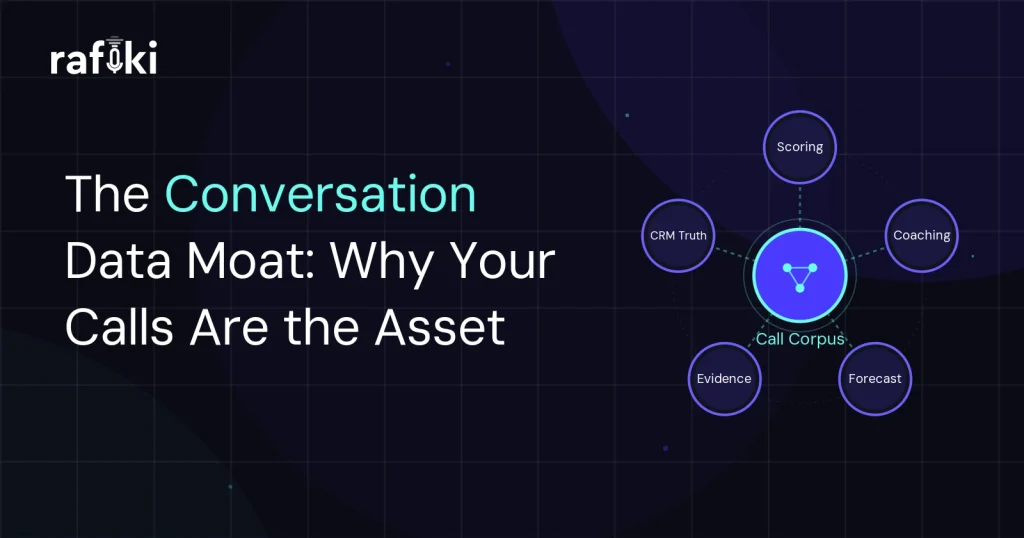
A recorded-but-inert call archive is storage, not strategy. The moat materializes through activation — the daily work the corpus powers. In a revenue organization, four activations carry most of the value:
Each activation is useful alone. Together they describe a company that learns from every conversation while its competitors learn from none of theirs — a gap that widens quietly, every week, as Harvard Business Review's reporting on AI-accelerated commercial decision-making suggests is already separating leaders from laggards.
A moat you don't control is someone else's asset. As conversation data becomes strategically valuable, the governance questions stop being procurement checkboxes and become board questions:
We covered the evaluation checklist from the buyer's chair in our AI conversation intelligence security review. The strategic framing belongs here: those questions are not compliance hygiene — they decide whether the compounding asset compounds for you.
Three pushbacks deserve straight answers, because the moat thesis is sometimes oversold.
"Data without activation is just storage cost." Correct — and most call recording deployments prove it. A moat requires the activation layer; companies that record everything and act on nothing have built a swamp, not a moat. The strategy is capture-plus-activation or it is nothing.
"Moats decay." Also correct. Conversation data from three years ago describes a different market. The defense is the flywheel itself: a corpus that grows weekly is always majority-fresh, while the historical layer keeps its value as outcome-labeled training signal for what predicts wins and churn. The moat is the motion, not the pile.
"We're too small for this to matter." Inverted, this is the strongest argument for starting now. A startup's corpus is small but so is its history — the founder's five hundred calls are the company's entire commercial memory, which makes them proportionally more valuable, not less. And the compounding favors early starters: the corpus you begin building today is the one your Series C competitors cannot buy in three years. It is the same logic we laid out for the first sales hire — instrument before you need the asset, because the asset cannot be backfilled.
Rafiki AI is an AI-native revenue intelligence platform designed around exactly this thesis: one conversational source of truth, captured completely, governed as your asset, and activated by autonomous AI agents.
Mapped to the moat's three requirements:
On the governance side, Rafiki AI's posture is the one the moat requires: your conversation data stays isolated and is not used to train models for anyone else. The corpus you build is yours — that is the product's premise, not a feature toggle. And because plans start at $19 per seat per month with no seat minimums, the capture habit can start at founder scale, where the compounding clock matters most.
For a leadership team convinced by the thesis, the opening sequence is short:
Ninety days in, the moat is shallow — and dug. Everything after is compounding.
Recording is the first of three requirements. A recorder gives you audio files; a moat requires structure (scoring, summarization, outcome-linking that makes the corpus queryable) and activation (the daily coaching, forecasting, and evidence work the corpus powers). Companies with five years of recordings and no activation layer have a storage bill. The moat is what the data does, not what it weighs.
The activations pay back at different speeds. Coaching and CRM truth improve within weeks — they need only current calls. Pattern-level advantages — objection maps by segment, churn early-warning signals, outcome-labeled win patterns — emerge over quarters as volume and outcomes accumulate. The strategic point is that the clock only runs while you capture: a competitor who starts two years later is two years of unrepeatable conversations behind, permanently.
Yes — in fact that is when it matters most. Universal adoption commoditizes the tooling, not the data: every company's moat is its own corpus, and the competition shifts to who captures more completely, structures more usefully, and activates more aggressively. The losers in that world are not companies with small corpora; they are companies whose conversations were never captured at all, who arrive at the AI era with nothing for the commodity models to be smart about.
Strategy in the AI era has a strange shape: the technology everyone can buy matters less than the inputs only you possess. For revenue organizations, the most valuable proprietary input is generated automatically, every day, by the ordinary act of talking to buyers and customers — and at most companies it still evaporates the moment each call ends.
The conversation data moat is not a product you purchase; it is a discipline you start. Capture completely. Structure relentlessly. Activate daily. Govern like the asset it is. Begin now, because the only thing about this moat that cannot be accelerated is time.
Rafiki AI's autonomous AI agents turn your conversations into your most defensible asset — captured, isolated, and working for you from day one. Plans start at $19 per seat per month with no seat minimums and no annual commitment. Start your free trial today or book a demo — the corpus only compounds from the day you start it.
Start for free — no credit card, no seat minimums, no long contracts. Just better sales intelligence.