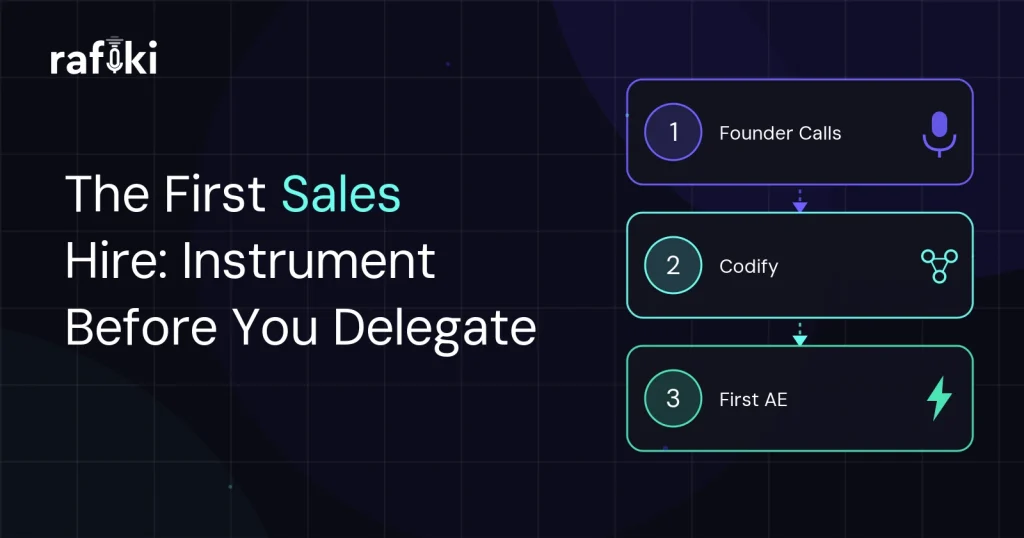
Your first sales hire isn't inheriting a territory. They're inheriting everything you never wrote down.
Founder-led sales works for reasons that are hard to see from inside it. The founder knows every customer's origin story, every objection and its best answer, every pricing conversation that worked and the three that didn't. None of it is documented, because it never needed to be — the entire go-to-market lived in one head that was present for every deal.
Then the first sales hire arrives, and the invisible becomes expensive. The new AE gets a CRM with sparse notes, a deck, a few shadow calls, and a founder who is already overdue on twelve other jobs. Six months later the board asks why the hire isn't ramping, and the honest answer is uncomfortable: the company hired someone to run a playbook that exists only as the founder's instincts. The hire didn't fail; the transfer did. The fix is to instrument founder-led sales before delegating it — so the first sales hire onboards against a record, not against recollection.
The post-mortems on failed first AEs converge on familiar phrases: "wasn't a fit for our stage," "couldn't sell a technical product," "needed more structure than we could give." Occasionally true — and usually downstream of one structural cause. The founder sold from knowledge the hire never received, because the company had no mechanism to transfer it.
Consider what the founder actually knows that the hire needs:
Handed all of that, a competent AE ramps. Handed a deck and goodwill, the same AE spends two quarters rediscovering it deal by deal — at full salary, with live prospects as the tuition. That rediscovery cost is what instrumentation eliminates.
Instrumenting founder-led sales means capturing and structuring the founder's selling conversations while the founder is still doing the selling, so the knowledge exists as an inspectable record before anyone tries to inherit it. It is the difference between asking a departing employee to "document everything" in their last two weeks and having the documentation accumulate automatically for a year.
In practice, instrumentation has three layers:
This is precisely what conversation intelligence does, and the economics that once reserved it for fifty-rep teams no longer apply — which matters, because the highest-leverage moment to start is before the first hire, when the founder is the entire sales team. As McKinsey's growth and sales research consistently finds, commercial knowledge compounds when it is captured at the customer-interaction level rather than reconstructed afterward — and nowhere is that gap starker than in a company whose entire commercial memory is one person.
Founders sometimes resist the idea on instinct — "our sales motion is still changing, why document it?" That objection gets the causality backwards. A changing motion is precisely what deserves capture, because the record shows the evolution: which framing replaced which, what stopped working as the ICP sharpened, where the pricing posture firmed up. A static playbook written once goes stale; a corpus that accumulates with every call cannot, by construction.
Ideally, instrumentation starts a quarter or two before the hire. (Started later is still better than never — the corpus just starts smaller.) The plan is light because the founder's calendar is the constraint:
The contrast at handoff time is stark:
| Asset | Founder memory | Instrumented record |
|---|---|---|
| ICP definition | Instinct, retold differently each time | Pattern visible across won and lost calls |
| Objection answers | Improvised live, lost after | Mapped, with linked real examples |
| Winning narrative | In the founder's head, evolving silently | Documented as delivered, version by version |
| Onboarding material | Shadow calls when calendars align | Best-call library, available day one |
| Quality bar | "You'll know it when you see it" | Scored rubric the hire can self-check against |
The right-hand column is also what protects the company in the scenario nobody plans for: the first hire who doesn't work out. With an instrumented record, the second hire inherits everything the first one did — the knowledge transfer survives the personnel change, which is exactly the property founder-memory transfer lacks.
With the corpus in place, the first AE's ramp looks fundamentally different from the shadow-and-hope default:
The pattern compounds with every subsequent hire. By rep three, the company has something most startups never build: an actual selling system, owned by the company rather than borrowed from whoever happens to be selling. It is the same instrumentation that later powers forecasting — as we covered in the founder's forecast — but the knowledge-transfer payoff arrives first.
Even with a solid record, the delegation itself has failure modes. The recurring four:
The common thread: instrumentation buys the founder leverage, and each mistake above is a way of declining to spend it.
There is a second audience for all of this. When a seed or Series A board hears "we're making our first sales hire," the sophisticated follow-up question is no longer "who?" but "what are they inheriting?" A founder who can answer with an instrumented motion — scored calls, a documented narrative, an objection map with evidence — is describing a company that has converted founder magic into organizational capability.
That answer de-risks the exact thing early-stage investors fear about GTM: dependence on the founder's personal selling. It also sharpens the next fundraise's story, because repeatability claims come with receipts — conversion patterns and call evidence rather than assertions. In contrast, "we hired a great AE and we'll see" is a sentence boards have learned to discount. The instrumentation costs almost nothing; the credibility it buys compounds.
Rafiki AI is an AI-native revenue intelligence platform, and it is deliberately built to make sense at founder scale — not just at the team size where enterprise tools start paying attention.
For the instrument-then-delegate motion specifically:
At $19 per seat per month with no seat minimums and no annual commitment, the math works when "the team" is one founder — which is the whole point. The record has to start before the hire does. For startup founders, that is the difference between delegating a system and delegating a hope.
The honest prerequisite is repeatability evidence, not revenue alone: the founder can point to multiple closed deals that followed a recognizably similar path, and the record shows why they closed. If every win so far is a bespoke heroic effort, a hire inherits chaos. Instrumentation helps answer the timing question itself — the call corpus shows whether a repeatable motion actually exists or just feels like it does.
The instrumented record changes this calculus more than founders expect. Without a record, you need someone senior enough to build their own playbook — expensive, and they often rebuild it in their previous company's image. With a record, a hungry mid-level AE can inherit the existing motion and run it faithfully, which is usually what the company actually needs at this stage. Hire for evidence of coachability and judgment; the playbook transfer is already handled.
Almost none beyond selling itself — that is the entire design constraint. Capture and structuring are automatic once recording is on; scoring runs against every call without intervention. The founder's active contribution is roughly ninety seconds of tagging after notable calls and an hour a month distilling artifacts. Compare that with the alternative: several hours a week of live shadowing and repeated retellings during a ramp, multiplied by every future hire. Instrumentation is the lazy founder's option, in the best sense.
No — instrument both sides immediately. Capture the founder's remaining deals and the hire's calls under the same scoring rubric, and the gap between them becomes specific and coachable within weeks: it is almost never "can't sell" and almost always two or three identifiable differences in discovery depth, narrative, or objection handling. Specific gaps close; vague disappointment doesn't.
Founder-led sales ends one of two ways. In the common version, the founder hands a new hire a deck and a quota, hopes instinct transfers by proximity, and learns two quarters later that it didn't. In the better version, the founder spends their final selling months building — automatically, while doing the job anyway — the record that makes their knowledge inheritable.
The first sales hire is the single highest-leverage personnel decision an early company makes, and its success is mostly determined before the job posting goes up. The companies that get it right treat the hire as the second step of a transfer that began months earlier — quietly, automatically, one recorded conversation at a time. Instrument first. Then delegate something worth inheriting.
Rafiki AI's autonomous AI agents turn founder-led selling into a transferable system — starting at $19 per seat per month, no seat minimums, no annual commitment. Start your free trial today or book a demo before you write the job description.
Start for free — no credit card, no seat minimums, no long contracts. Just better sales intelligence.