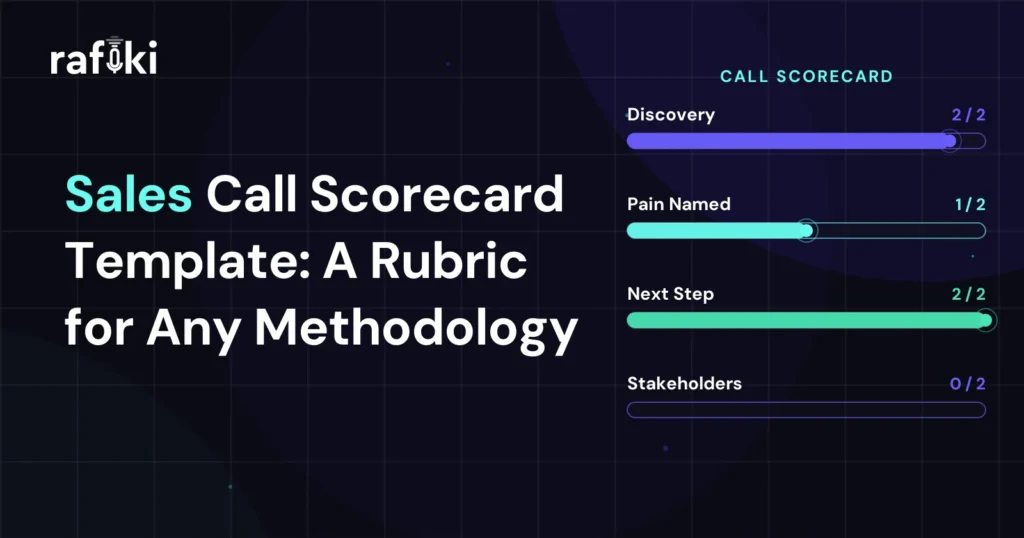
Ruth marked Zoe "strong" on discovery, and Diego marked her "needs work" on the same criterion of the same call. The two frontline managers were testing their team's new sales call scorecard before it went live. Zoe, an AE, had run the call with a VP of operations at a logistics company. Each of them could point to a moment in the call that proved their case.
Ruth heard Zoe ask about the buyer's biggest problem and get a clear answer about missed delivery windows. Diego heard Zoe accept that answer and move straight to the product, without asking why the windows were slipping or what they cost. Both readings were fair, because the scorecard said "uncovers pain" and nothing about what counted as uncovering it.
A criterion without an evidence definition turns into a vote, so Zoe's score depended on which manager pulled the call. Writing down what counts as evidence for each criterion closes that gap for discovery and demo calls, whatever methodology your team already runs. Once two managers calibrate on those definitions, the scores can feed one coaching item per rep each month.
A sales call scorecard is a rubric for grading one type of sales call against a short list of behaviors. Each behavior has a definition of the evidence, a score, and a weight. Managers, peers, or software use it to grade recorded calls the same way every time.
It differs from a call checklist on one point. A checklist asks whether something happened, while a scorecard asks how well it happened and how much it counts. Take a rep who asks about budget in the last minute of the call. She checks the checklist box, but on a scorecard she earns a 1 out of 2 because the buyer had no room to answer.
Each call type needs its own sales call scorecard, because a discovery call, a demo, and a negotiation ask different things of a rep. A single rubric for all three ends up docking the demo for discovery questions it should not need to ask.
Every working sales call scorecard has four parts: criteria, an evidence definition for each criterion, a scale, and a weight. Leave out any one of them and the scores stop meaning the same thing from one manager to the next.
Criteria are the behaviors you score, and fewer is better. Six to eight criteria cover a discovery call, and past ten the scorecard becomes a checklist that no manager finishes. Each criterion should describe something the rep does, such as "confirms the decision process," and never a trait like "confident."
The evidence definition says what a listener must hear for the criterion to count. "Uncovers pain" is a criterion, and "the buyer names a specific problem and explains why it happens" is its evidence. This part settles arguments like Ruth and Diego's, and their first draft did not have it.
Keep the scale short. A 0, 1, 2 scale works because each point has a plain meaning. Zero means the behavior did not happen, 1 means it happened partly, and 2 means it happened fully with buyer evidence. On a 1 to 10 scale, nobody can say what separates a 6 from a 7, so the rep has nothing to act on.
Weights reflect what matters most for winning the deal at that stage. On a discovery call, the buyer's pain and its business impact deserve more weight than the opening agenda. Set weights so they add to 100, which lets everyone read the total as a percentage of a complete call.
A sales call scorecard fails early when managers lack the time to use it and nobody designed it to save them time. Any rubric that asks a manager to replay every call in full competes with everything else in her week.
Manager workload leaves little slack for that. In an April 2026 survey, Gartner found that 47% of managers say they are working harder than a year ago. A scorecard that adds review hours to that week is an easy task to drop.
The other common failures come from the design itself:
The last failure does the most damage. When reps never hear about their scores, they assume the scorecard exists to build a case against them. Every later rollout then starts with that suspicion. Our post on AI call scoring vs manual reviews covers why spot-checking a few calls a month leaves most reps unscored.
This template scores a first discovery call on eight criteria, each on a 0, 1, 2 scale, with weights that add to 100. Swap in your own methodology's language, but keep the evidence column specific enough that two managers would score the same moment the same way.
| Criterion | What counts as evidence | 0 / 1 / 2 | Weight |
|---|---|---|---|
| Agenda and time check | Rep states the purpose and the buyer confirms time and attendees early | 0 no agenda; 1 rep states one; 2 buyer confirms or edits it | 5 |
| Current situation | Buyer describes the current process or tool in their own words | 0 rep assumes it; 1 one-line answer; 2 buyer walks through it | 10 |
| Pain and its cause | Buyer names a specific problem and explains why it happens | 0 no problem named; 1 problem only; 2 problem plus cause | 20 |
| Business impact | Buyer ties the problem to a cost, a risk, or a target | 0 not discussed; 1 vague impact; 2 buyer quantifies it or names the goal | 15 |
| Decision process and people | Buyer names who decides, who else weighs in, and the steps to a decision | 0 not asked; 1 one name; 2 people and steps | 15 |
| Timing and critical event | Buyer names a date or event that drives the timeline | 0 none; 1 rep suggests a date; 2 buyer states the event | 10 |
| Follow-up questions | Rep asks at least two follow-ups that build on the buyer's answers | 0 none; 1 one follow-up; 2 two or more | 10 |
| Next step | Buyer agrees on the call to a dated next step with an owner on their side | 0 none; 1 vague "let's reconnect"; 2 date and buyer owner | 15 |
To get the total, divide each criterion's score by 2, multiply by its weight, and add the results. Say Zoe earns a 1 on pain and a 1 on business impact. Pain then contributes 10 of its 20 points and impact 7.5 of its 15, while a full set of 2s would add up to 100.
Notice where the weight sits: pain, impact, decision process, and the next step carry 65 of the 100 points. Those four decide whether the deal has a reason to exist and a path forward. The agenda carries only 5 points, enough to reward the habit without letting a tidy opening rescue a shallow call.
A demo scorecard needs only five criteria, because discovery should already be done. The heaviest weight goes on whether the rep tied what she showed to the pain the buyer named earlier.
| Criterion | What counts as evidence | 0 / 1 / 2 | Weight |
|---|---|---|---|
| Recap of the buyer's pain | Rep restates the problem in the buyer's words and asks what changed | 0 no recap; 1 recap only; 2 recap and buyer confirms | 20 |
| Demo tied to stated pain | Each workflow shown maps to a problem the buyer named | 0 generic tour; 1 partly tied; 2 every section tied | 30 |
| Buyer participation | Buyer asks questions or describes how their team would use it | 0 silent buyer; 1 one question; 2 several questions or use cases | 15 |
| Objections answered | Rep answers or schedules a follow-up for each concern raised | 0 ignored; 1 some answered; 2 all answered or scheduled | 15 |
| Next step | Buyer agrees to a dated step, such as a technical review or pricing call | 0 none; 1 vague; 2 date and buyer owner | 20 |
The recap carries 20 points because a rep short on time is most tempted to skip it. Opening a demo by restating the buyer's problem tells the buyer the rep listened. It also catches a shifted priority before the rep spends half the call showing the wrong workflow.
To adapt the template, map each element of your methodology to a criterion and write its evidence in the buyer's words. The scale and weights work the same way, so managers learn one way of scoring even when the criteria change.
For MEDDIC, the discovery template already covers metrics through business impact, plus the decision process and pain. Add rows for the economic buyer, the decision criteria, and the champion. To stay at ten criteria or fewer, drop the agenda row and fold current situation into pain, then rebalance the weights to 100.
SPICED needs less work, because the existing rows already map to Situation, Pain, Impact, Critical Event, and Decision. The main change is renaming the rows in SPICED terms so reps hear the same words in training and in their scores.
Teams with a homegrown method should resist forcing it into a famous acronym. Write criteria for the five or six moments your best reps never skip, then define the evidence for each. Our post on custom call scoring walks through how teams outside MEDDIC build those criteria from their own won deals.
In calibration, two or more managers score the same call separately and compare their scores criterion by criterion. They rewrite every evidence definition they disagree on, before the sales call scorecard touches a rep's record and again each quarter.
Ruth and Diego did exactly that with Zoe's call, and their whole disagreement sat in one criterion. A 2 on pain now requires the buyer to explain why the problem happens. Under the new wording, a named problem with no cause earns a 1. When they rescored the call, both gave Zoe a 1 on pain, which handed her a clearer coaching point than either of their first labels.
Pick three calls for the first session: one strong, one weak, and one in the middle. Managers agree easily on the extremes, and the middle call exposes the definitions that need work. On a 0 to 2 scale, any gap between two managers on a criterion means its evidence definition needs another pass. Our guide to call scoring calibration covers how to run the session once AI scores enter the mix.
Reps game a scorecard when the score affects pay or rank and the criteria reward the right words over real answers. Fix both before launch, because a gamed scorecard is harder to repair than a late one.
Write evidence definitions around what the buyer says, and never around what the rep says. A rep can recite "what's the business impact of that?" on every call, but only real discovery gets the buyer to name a cost. Criteria built on buyer evidence resist gaming, since the only way to score well is to run a better call.
Share the scorecard with reps before the first scored call, and let each rep score one of her own calls first. Wherever her self-score and the manager's score differ, you have the agenda for the first one-on-one. Keep scores out of compensation and stack rankings for at least the first quarter, while reps learn to trust them.
Each rep should get one coaching item a month from the sales call scorecard. It is the criterion with the biggest weighted gap, backed by a clip from a real call. A rep handed three items at once tends to try all three on the next call and do none of them well.
The selection takes a few minutes per rep. Pull the rep's scored calls for the month and average each criterion. For each one, take the gap between that average and a full 2, halve it, and multiply by the weight. The criterion with the biggest result becomes the focus.
Say Zoe averages 1.0 on business impact, weighted 15, and 0.5 on the agenda, weighted 5. Impact's weighted gap is 7.5 points and the agenda's is 3.75, so impact becomes her coaching item even though her agenda score is lower. Diego found two calls where a buyer mentioned missed delivery windows and Zoe moved on without asking the cost. He played both clips in their next one-on-one.
Track the same criterion the following month, and move to the next gap once the average rises. If it stays flat, the rep may need practice off-call, where a failed attempt costs nothing. For frontline managers, the payoff is a one-on-one agenda built from one criterion and two clips, with a score to beat next month.
Automated call scoring applies your sales call scorecard to every recorded call. The first 30 scored calls tell you whether the setup matches your evidence definitions, so check these before any rep sees a score:
When the tool and a manager disagree, check the wording of the evidence definition before you blame the tool. Rewrite the definition the way Ruth and Diego did, then rescore those calls. Once the hand-scored sample and the automated scores agree on most criteria, managers can stop replaying full calls and spend the time on coaching.
Smart Call Scoring accepts custom criteria like the eight in the discovery template, as well as MEDDIC, SPICED, Challenger, Sandler, and other methodologies. Ruth can enter the eight criteria and their evidence definitions, then run step 1 of the 30-call check against her own hand scores. Step 5 is simpler too, because Rafiki AI transcribes calls in more than 60 languages. A rep selling in Spanish or German faces the same eight criteria as Zoe.
Among Rafiki AI's AI sales agents, the Coaching Agent scores every call against your scoring criteria. That turns the monthly coaching item into a short calculation. Diego takes Zoe's scored calls for the month, averages each criterion, and runs the weighted-gap math without replaying a call. Our look inside the Rafiki Coaching Agent covers what it scores for each rep.
To check whether coaching worked, Diego can ask Gen AI Reports for Zoe's business-impact average by month. The two clips come from Gen AI Search, which pulls her calls where a buyer mentioned missed delivery windows. For the decision-process criterion, Smart CRM Sync can also write the people and steps the buyer named into the matching opportunity fields.
This week, run the calibration session on three recent discovery calls: one strong, one weak, and one in the middle. Have two managers score them separately with the template, then spend 30 minutes on the criteria where they differ. Rewrite those evidence definitions before any rep sees a score.
Within 30 days, every rep should have scored calls and one coaching item tied to your sales coaching cadence. Expect the first month's averages to look low, since the evidence definitions are stricter than the gut calls they replace. Treat that month as the baseline, and judge the scorecard by whether the weighted gaps shrink in month two. Ruth and Diego's team stopped debating scores after about a week, and their one-on-ones turned to what the buyer said in each clip.
Rafiki AI's conversation intelligence platform starts at $19 per seat per month with no minimums and no annual commitment. Start your free trial today or book a demo to see last week's discovery calls scored against the eight criteria in this template.
Settle these questions with the managers who will do the scoring, before any rep sees a score.
Managers own the official score, but peer scoring teaches the standard well, because reps learn the evidence definitions on a colleague's call. Self-scoring works best before a one-on-one, when the gap between the rep's view and the manager's view sets the agenda. Keep peer and self scores out of any formal record.
Revisit it at each quarterly calibration, and again after any change to pricing, packaging, or your target buyer. Retire a criterion when nearly every rep scores 2 on it for a full quarter, since it no longer separates good calls from weak ones. Replace it with the behavior your next coaching push targets.
No, because a cold call has a different job from a discovery call. An SDR scorecard needs about five criteria of its own. Score the opener, a reason for the call that fits the prospect, one qualifying question, and the response to the first brush-off. The fifth criterion is a dated meeting, and it should carry the most weight.
No public benchmark applies across teams, because every scorecard uses different criteria and weights. Score a set of calls from your top performers and use their median as the bar for the team. Rising averages matter more than any single number, so track each rep against her own previous month.
Start for free — no credit card, no seat minimums, no long contracts. Just better sales intelligence.