Every quarter, a well-meaning sales leader announces a new call review session, and what follows is familiar. A manager plays a recording while the team watches a colleague fumble an objection. Everyone tries not to look at the rep, and someone offers feedback that is really a critique. As many teams run it, the sales film room is a gotcha session with a friendlier name.
The rep on the recording explains what they were thinking, and the session ends with a vague promise to "do more of these" soon. By the third week the ritual has quietly died, because nobody wanted to be next on the screen.
Call review does not have to work that way, and sports show why. Athletes treat film review as routine because their coaches build the session around the play on the clip. Everyone watching wants to get better at that same play.
Recording tools now capture and index every call, so sales teams have the same raw material. Most of them still lack a ritual that turns the footage into skill.
This article starts with what a sales film room is and why most call reviews fail. Next come the four rituals that make reps volunteer calls and the rules that keep the room safe. The final sections show how AI finds clips and lay out a Q4 launch plan. Right now, the turn from Q3 to Q4 gives managers their best window to start the habit.
A sales film room is a recurring team session where reps and managers review short segments of real sales calls. Each clip shows a specific play, such as how a rep handled an objection, framed a question, or set up a close. This format borrows from sports, where players expect to review game film and mostly welcome it as part of practice.
What separates a film room from an ordinary call review is its unit of analysis. Most call reviews judge a whole call, and by extension the rep who made it. A film room studies a moment of a few minutes at most, which the rep picks because it shows a play the team runs.
In the room, the team assesses the play on the clip and leaves the rep out of it. That shift from person to play is what lets reps bring their own worst moments without dread.
A well-run film room is where a team's skill compounds over time. Each session adds shared vocabulary for what good looks like and more examples for the library. Every rep also leaves with one small commitment for next week's calls. A badly run one turns into a monthly reminder that someone is recording their calls and watching them.
Why does a practice with such obvious value collapse so reliably? The causes come from how teams set up the session, so managers can design every one of them out.
The common thread is that teams design these rooms to evaluate reps, when reps need a place to practice. McKinsey's people and organizational performance research keeps pointing out that AI rollouts depend on trust and on redesigning how people work. A coaching ritual needs the same thing, so managers should treat the film room as a trust exercise first.
A team without a working film room learns one rep at a time. Each rep improves, or does not, in private one-on-ones with a single manager, and the team's best moments stay locked in the calls where they happened. Leaders tend to miss these costs because nothing visibly breaks, and the team simply goes without something it never had.
Top performers' techniques never spread, and that is the clearest cost. The rep who handles the pricing objection beautifully does it on their own calls, where nobody else hears it. Without a shared library of good calls, every manager also coaches to their own instincts, and the team's skill drifts apart over time.
New reps ramp slowly too, because they learn a play fastest by watching several colleagues run it. Only a film room puts those colleagues in front of each other.
Harvard Business Review looked at why some sales teams are actually growing alongside AI. Its thriving teams use AI to sharpen what their people do and keep those people at the center of the work. The film room applies that idea most directly, because AI finds the moments and people study them together.
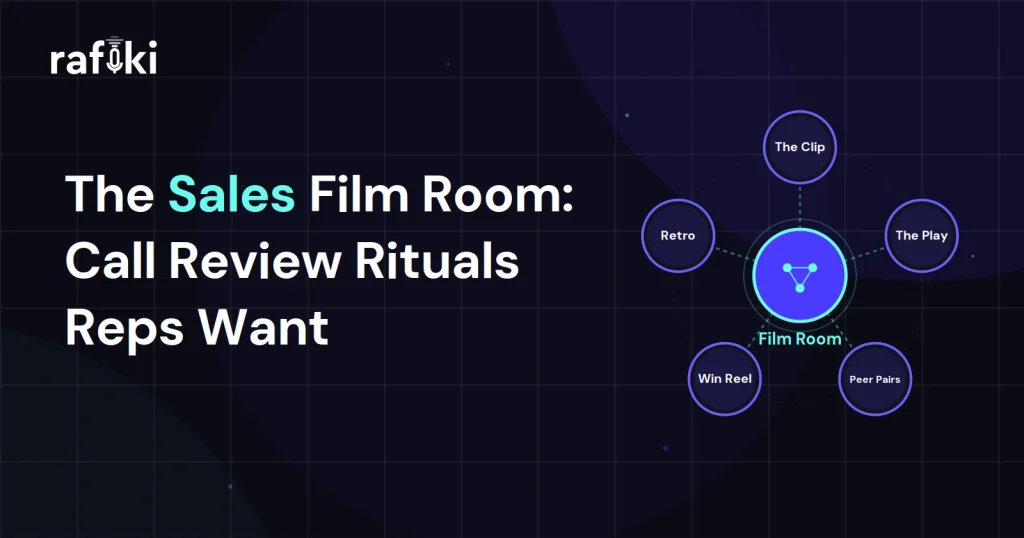
A single monthly session is an event, and a film room needs a steadier rhythm than that. It works best as a set of small recurring rituals with different shapes. That way the team covers the whole skill loop without overloading any one meeting.
The whole team meets for thirty minutes and watches three clips, each two to four minutes long, of the month's play, such as the budget question. Before each clip plays, the rep who owns it introduces it in one sentence.
The room then talks through what worked in the play and how the buyer responded. People also suggest what the rep could try on the next call. Every session ends with each rep naming one thing they will try on their calls that week.
Two reps spend fifteen minutes together with one clip each and no manager present. Each brings a moment they feel unsure about, and the pair talks it through. With the hierarchy gone, these pairs produce some of the most candid conversations a team has. They also give every rep a reason to search their own calls for something worth sharing.
Once a month, the team stitches the best moments from its calls into a five-minute reel that nobody critiques. The reel adds to the library of what good looks like and gives the team a public moment to celebrate. Reps who watch it start wanting their own moments in next month's cut. In practice, the reel is one of the most effective ways to get reps volunteering clips.
When the team loses a big deal or a call goes badly, the rep involved can bring the decisive moment to a small group. Everyone agrees on the premise up front: this play did not work, and the group will figure out what would have. Participation is optional and rep-initiated, so a manager never holds a retro for a rep who does not want it. Reps who bring their hard calls tend to improve fastest, and the room learns to respect them for it.
The rituals only work if reps bring clips willingly, and reps do that when the manager states the rules and visibly keeps them. In most teams, five rules do most of the work.
These rules echo the principles of the rebuilt sales one-on-one, where the rep chooses the call. That coaching looks at patterns and at follow-through on later calls. The film room brings that same discipline to the whole team.
Before recordings became searchable, film rooms were rare for a simple reason: finding three good two-minute clips a week across a team's calls took hours. Conversation intelligence software removes that cost by recording, transcribing, and scoring every call, and it also changes who can find the clips.
A film room costs little to run on Rafiki AI. The platform captures every meeting and phone call, supports transcription in 60+ languages, and lets anyone search for any moment.
Reps and managers find clips with Gen AI Search. A rep can ask for calls where a buyer raised pricing and the rep held the line, and the search returns the cited moments. Managers can ask which reps handled the multithreading ask well this month and get back the candidates for the win reel.
Smart Call Scoring checks calls against the team's methodology or custom criteria to surface the weakest play. Managers can then pick the week's theme without listening to every call.
For frontline managers running the rituals, Gen AI Reports produces a weekly view of the team's play-by-play performance. Reps can then use AI Role Play to rehearse the room's play against a simulated buyer before a live call. Because all the team's calls sit in one place, new reps can use the library from day one.
With Rafiki AI's autonomous agents doing the searching and scoring, the people in the room can spend their thirty minutes discussing the plays.
| Dimension | Traditional call review | Sales film room |
|---|---|---|
| Who picks the recording | Manager | Rep |
| Unit of review | The whole call | A two-to-four-minute clip |
| Subject of feedback | The rep | The play |
| Manager's role | Evaluator | Participant who brings clips too |
| Cadence | Starts occasionally, then stops | Weekly room, peer pairs, monthly reel, optional retros |
| Output | Generic feedback | One commitment per rep, checked next week |
| Link to performance review | Implicit and feared | Explicitly none |
The quarter turn is a good time to start, because Q3's losses already exposed the weakest play. A light launch works better than a grand one, so managers should keep the first month simple.
By the end of October, the room has a rhythm and a small library, and the team has started watching its own calls without flinching. From there the film room stops feeling like an initiative and turns into the normal way the team practices.
Most sales teams already have the film sitting in their recording tool, and what they lack is the room. The rooms that last study plays, and in them the rep picks a short clip and every session ends with something to try.
Before the quarter turns, block thirty minutes on the team calendar for the first weekly room and pick the play that Q3's losses exposed. Open with a clip from one of your own calls, after asking two reps privately to bring a moment of their own. Rafiki AI's agents can find the clips and score the plays for you.
A sales film room is a recurring team session, borrowed from sports, where reps and managers watch short clips of real calls. Each clip runs two to four minutes and shows a specific play, such as handling an objection or setting up a close.
Like athletes with game film, the team treats the review as a normal part of practice. The room studies each moment for what everyone can learn and leaves the rep out of any evaluation. Over the weeks, that lets the team's skill compound.
Start by letting reps pick their own clips every time. Review moments instead of whole calls, and keep feedback on the play and the buyer's response. The manager should bring clips too and say often that nothing from the room goes into a performance review.
Keep each session short and focused on one play, and end it with a single thing every rep will try. A monthly win reel that celebrates the best moments without critique also gives reps a reason to want their calls in the room.
The first ritual is the weekly film room, where the whole team spends thirty minutes on three clips of one play. In peer pairs, two reps spend fifteen minutes on one clip each with no manager present. That setup opens up the candid conversations that hierarchy suppresses.
The monthly win reel is a five-minute, critique-free compilation of the team's best moments, and it makes reps want to contribute. Finally, a rep can call a hard-call retro, where a small group asks what would have worked in a lost deal.
AI mainly removes the cost of finding clips, which is what kept film rooms rare. Once a platform records and scores every call, a rep can search for their best objection handling in seconds. Call scores show managers which play is weakest across the team and which reps run it best, and the weakest play becomes the theme. Each reviewed clip joins a growing library for new reps, and managers can check commitments against next week's calls.
Rafiki AI's conversation intelligence costs $19 per seat per month with no annual contract required. Because there is no seat minimum, a manager can pilot the film room with just a few reps. Start your free trial today to pull clips for your first session, or book a demo if you want a walkthrough of the product first.
Start for free — no credit card, no seat minimums, no long contracts. Just better sales intelligence.