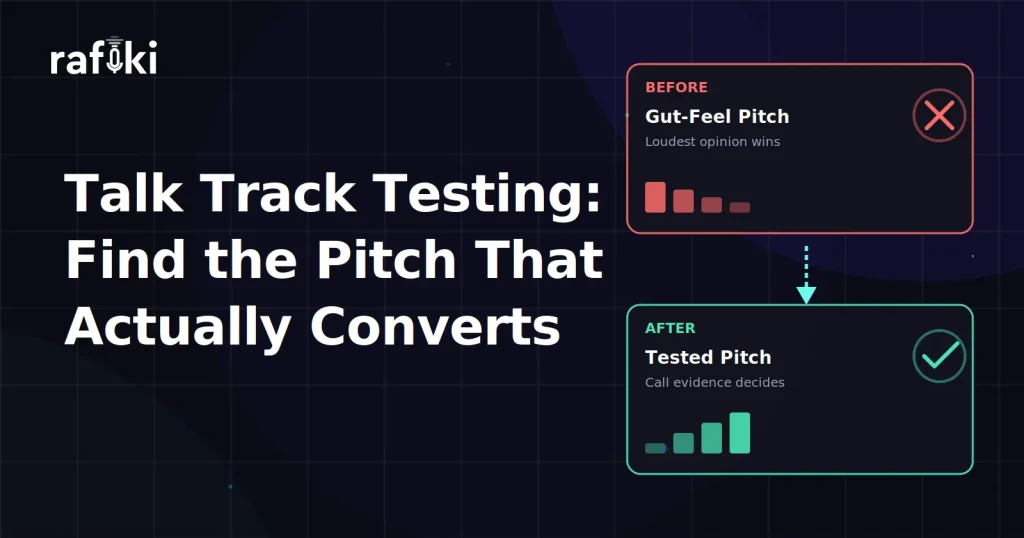
Every messaging debate ends the same way. The founder loves the vision-led opener, the top rep swears by the pain-first version, and product marketing defends the narrative it shipped last quarter — so the loudest voice wins, and the argument resurfaces in three months. Talk track testing breaks that cycle. Instead of debating which pitch should work, you measure which pitch actually moves deals forward on real buyer calls, then keep the language that wins.
Here is the part most teams miss: the test is already running. Reps deliver competing versions of the pitch to live buyers daily, and nearly all of those conversations are recorded. In other words, the experiment happens whether you design it or not. Nobody keeps score, however, so the evidence evaporates and the opinion war continues.
This guide shows enablement, sales, and product marketing leaders how to keep score in 2026 — defining variants as testable hypotheses, tagging calls, comparing progression outcomes, promoting winners into the playbook, and testing honestly at modest call volume.
Messaging decisions in most revenue organizations are settled by hierarchy, tenure, or volume — whoever argues longest wins. As a result, the playbook gets built on anecdotes: a deal someone remembers, a phrase a champion once repeated back. Without evidence, every stakeholder's story carries equal weight, so the debate never closes.
The cost goes beyond meeting fatigue. When messaging changes with every leadership shuffle or rebrand, reps stop trusting the playbook and start improvising. Consequently, ten reps deliver ten different pitches, and the organization learns nothing from any of them because there is no baseline to compare against.
Product marketing feels this most acutely. A new narrative ships, enablement trains it, and six weeks later a sales leader declares it "isn't landing" — based on two calls and a gut feeling. Because nobody kept a scoreboard, the narrative gets rewritten before it was ever fairly tested. That rewrite then faces the same fate.
Talk track testing is the practice of treating each version of your pitch as a hypothesis, tracking which version each call uses, and comparing deal-progression outcomes across versions so the strongest language earns its place in the playbook. It borrows the logic of A/B testing from marketing, but applies it to live sales conversations instead of landing pages.
A talk track here means any repeatable segment of the sales conversation: the discovery opener, the pricing rationale, the response to a security objection, the way reps frame a competitive alternative. Each segment can exist in several versions, and each version can be measured. That granularity matters, because "the pitch" as a whole is too big to test — but a specific opener or objection response is not.
If your team has not yet formalized its tracks, start with our guide to building talk tracks that win in B2B sales. That piece covers the template layer; this article adds the layer most teams never build — the evidence loop that shows which template actually converts.
The uncomfortable truth is that talk track testing does not require you to start an experiment. It requires you to start observing one. Every recorded discovery call is a trial of some version of your messaging, delivered to a real buyer, with a real reaction and a real outcome. Multiply that by every rep and every week, and a sizable running experiment appears.
Most organizations treat those recordings as an archive rather than a dataset. Calls get reviewed for coaching, and almost never for messaging evidence. Meanwhile, the pitch debate continues in conference rooms, detached from the hundreds of trials happening in the field.
The broader shift toward evidence-based selling makes this gap harder to excuse. Harvard Business Review has described how sales teams use generative AI to discover what clients actually need from the language of their own conversations. If AI can mine calls for buyer needs, it can certainly mine them for which framing of your value proposition buyers respond to.
A test starts with a falsifiable statement, not a preference. "I like the ROI opener" is an opinion. In contrast, "For mid-market CFO-influenced deals, opening with cost-of-inaction will produce more second meetings than opening with product capabilities" is a hypothesis — it names a segment, a variant, a comparison, and an observable outcome.
Write each variant down before testing begins — the setup line, the core claim, the proof point, and the intended buyer reaction. If two variants differ in five ways at once, you will never know which difference mattered, so change one variable at a time.
Discipline here mirrors what strong commercial organizations do elsewhere. For instance, McKinsey's growth, marketing and sales research consistently emphasizes structured, data-backed commercial decision-making over instinct. Your messaging deserves the same rigor your pricing and territory decisions get.
A few hypothesis patterns worth stealing:
You cannot compare tracks if you do not know which track each call used. This is where most testing attempts quietly die, because the tagging step feels like administrative overhead. Three approaches exist, in ascending order of reliability.
First, rep self-reporting: a simple picklist field on the meeting record where the rep marks which opener or framing they used. It is cheap, but memory is unreliable and reps often blend tracks without realizing it. Second, manual call review: a manager or enablement lead samples recordings and tags them. This is accurate but slow, and it rarely survives a busy quarter.
Third, and most sustainably, automated detection. Modern conversation intelligence platforms transcribe every call and categorize it by topic and language, so the phrases that distinguish track A from track B surface without anyone lifting a finger. In practice, teams get the best results by combining a lightweight self-report with automated tagging as the source of truth — the mismatch between the two is itself a coaching insight.
With calls tagged, the scoreboard becomes possible. Resist the urge to jump straight to win rate; deals take months to close, and a dozen other variables intervene between first call and signature. Instead, compare leading indicators that sit close to the conversation itself.
The most useful progression outcomes to compare:
Watch for confounders before declaring a winner. For example, if your strongest rep happens to favor track A, it will look better regardless of merit. Similarly, a track used mostly in enterprise deals will show slower progression than one used in mid-market, for reasons that have nothing to do with the language. Compare like segments with like, and read results across multiple reps before concluding.
A test that never changes the playbook is theater. When a track shows a consistent edge across enough calls and reps, promote it: make it the default in the playbook, update onboarding materials, and refresh the templates reps reference before calls. More importantly, attach the evidence — reps adopt language far faster when they see the pattern behind it.
The most persuasive artifact is not a memo; it is the calls themselves. Pull three or four recordings where the winning track landed visibly well and make them required listening. Our guide to building a sales call library covers how to turn those winning calls into a durable teaching asset instead of a one-time Slack link.
Retiring losers matters just as much, and teams skip it constantly. An underperforming track left in the playbook will keep getting used, dragging down results. Announce the retirement, explain what the calls showed, and remove the track from templates entirely. That said, archive it with its results rather than deleting it — losing language sometimes wins later in a different segment.
Not every team runs hundreds of discovery calls a month, and pretending otherwise produces false precision. At twenty or thirty relevant calls a month, you will not reach statistical significance in any formal sense — say so out loud. Small-sample talk track testing is still enormously valuable, but it is qualitative research with a scoreboard, not a controlled trial.
A minimum viable test: pick one track segment and two variants, run them for four to six weeks, and aim for at least ten to fifteen tagged calls per variant. Rather than leaning on percentages, read the calls: how did buyers react in the thirty seconds after the track was delivered? Did they lean in with questions, go quiet, or redirect? Did they echo the framing later in the call or in their follow-up email?
Treat the numbers as directional and the buyer reactions as the primary evidence. Furthermore, be explicit about uncertainty: "track B produced visibly stronger buyer engagement in twelve of fifteen calls" is honest and actionable, while "track B converts better" overstates what a small sample can support. Sequential testing also helps at low volume — run variant A for a month, then variant B, accepting some seasonal noise in exchange for cleaner tagging.
The difference shows up everywhere, from how meetings end to how fast new hires ramp. Here is the contrast side by side.
| Dimension | Opinion-Driven Messaging | Evidence-Tested Messaging |
|---|---|---|
| How debates end | Seniority or persistence wins | Call evidence settles the question |
| Source of truth | Anecdotes and remembered deals | Tagged calls and progression outcomes |
| Playbook updates | Rewritten with each rebrand | Winners promoted, losers retired on evidence |
| Rep adoption | Low — reps improvise around the playbook | High — reps hear the winning calls themselves |
| Product marketing loop | "It isn't landing" gut feedback | Specific buyer reactions, track by track |
| New-hire ramp | Learns whichever pitch their pod uses | Learns the tracks proven on real buyers |
| Losing language | Lingers in decks for years | Explicitly retired and archived with results |
Everything above can be done manually — and the manual cost is exactly why nobody did it. Tagging calls, scoring delivery, and compiling comparisons used to consume an analyst's week. This is the layer where Rafiki AI changes the economics: its autonomous AI agents record, transcribe, and categorize every call automatically, so the experiment that was always running finally gets a scorekeeper.
Two capabilities do the heavy lifting. Smart Call Scoring scores every call against any criteria you define — not just MEDDIC or SPICED, but custom scorecards like "delivered the cost-of-inaction opener" or "used the new competitive framing." Consequently, every call gets tagged and graded for track adherence the moment it ends, with zero rep effort and no sampling bias.
Gen AI Search then handles the comparison layer. Ask questions in plain language — "show me discovery calls this quarter where reps opened with the ROI narrative, and how buyers responded" — and get answers drawn from the full call corpus rather than a hand-picked sample. For enablement teams, that turns the monthly messaging review from an archaeology project into a fifteen-minute query session.
Ready to see your own pitch data? Start your free trial today and run your first talk track comparison on this month's calls.
Talk track testing fails as a project and succeeds as a rhythm. One-off experiments produce one-off insights; a standing cadence, by contrast, produces a compounding messaging advantage.
A workable operating rhythm for enablement leaders looks like this:
This cadence also changes what your sales enablement stack is for. Instead of a static content library, it becomes a living lab where messaging enters as a hypothesis and exits as a proven standard or a documented lesson. That shift — from publishing content to certifying language — is what separates enablement teams that influence revenue from those that distribute PDFs.
Most testing programs that stall hit one of a few predictable walls, and knowing them in advance is the cheapest insurance available.
Testing everything at once. Five simultaneous tests across three segments produce noise, not knowledge. Start with the single highest-stakes track — usually the discovery opener — and expand only after the first promote-or-retire decision ships.
Declaring winners too fast. A track that looks dominant after six calls often regresses by call twenty. Set the evaluation window before the test starts, and hold to it even when early results look decisive.
Ignoring delivery quality. A great track delivered badly will lose to a mediocre track delivered well. Therefore, check adherence and delivery before blaming the language — sometimes the fix is coaching, not copy. Finally, beware the silent playbook drift: if nobody verifies which tracks reps actually use, your "control" group is a fiction.
Pitch debates persist because opinions are free and evidence used to be expensive. That equation has flipped. Every version of your pitch is already being tested on real buyers in recorded calls; the only missing ingredient is the scoreboard. Define your variants as hypotheses, tag the calls, compare progression outcomes honestly — including the limits of small samples — and let winners into the playbook while losers retire with dignity.
Teams that adopt this loop gain something more valuable than a better opener. They gain a messaging organization that learns, where product marketing hears real buyer reactions, enablement certifies language instead of guessing, and reps trust the playbook because they have heard it win. In 2026, the pitch that converts is not the one that wins the meeting. It is the one that wins the calls.
Fewer than most teams assume, provided you stay honest about what the results mean. With ten to fifteen tagged calls per variant, you can read buyer reactions qualitatively — engagement, questions, echoed language — and form a directional view. With fifty or more per variant, progression comparisons like second-meeting rate become meaningfully stable, although still short of formal statistical significance. The key is matching your confidence to your sample: small samples justify "track B is showing visibly stronger buyer engagement," not "track B converts better." Start small, state your uncertainty explicitly, and let the sample grow as the cadence continues quarter over quarter.
Win rate is the outcome everyone cares about and the worst one to test against, because months of unrelated variables sit between a discovery call and a signature. Instead, compare leading indicators close to the conversation: second-meeting rate, stage conversion within a defined window, whether new stakeholders joined subsequent meetings, buyer talk-time and question depth, and the objection profile each track provokes. In addition, watch for buyers repeating your framing in their own words — verbatim echo is one of the strongest signals that language landed. These indicators respond within weeks rather than quarters. Once a track has won on leading indicators, you can then sanity-check its cohort's downstream win rate over time.
Three methods exist, and the reliable answer combines two of them. Rep self-reporting through a CRM picklist is cheap but inaccurate, because reps blend tracks without noticing. Manual review by a manager is accurate but rarely survives a busy quarter. Automated detection through a conversation intelligence platform is the sustainable option, because every call gets transcribed and categorized automatically. In practice, pairing a lightweight self-report with automated tagging works best — the automated layer serves as the source of truth, while mismatches between what reps think they said and what they actually said become useful coaching conversations in their own right.
Run on a quarterly decision rhythm: every active test ends with an explicit promote, retire, or extend call, stated with its reasoning. Between those decision points, resist mid-test rewrites — changing the language halfway through invalidates the comparison. Outside the testing cadence, two events justify an immediate update: a material product or pricing change that makes a track factually wrong, and a competitive shift that changes what buyers ask about. When you retire a track, archive it with its results instead of deleting it; language that failed in one segment sometimes succeeds in another, and the archive prevents your team from unknowingly re-testing an idea that already lost.
Rafiki AI's conversation intelligence platform gives your team the scoreboard this whole system depends on — every call scored, every track tagged, every comparison a question away — starting at $19 per seat per month with no seat minimums and no annual commitment. Start your free trial today or book a demo to find the pitch that actually converts.
Start for free — no credit card, no seat minimums, no long contracts. Just better sales intelligence.