It's the Thursday forecast call in mid-October, and an account executive keeps her biggest deal in commit for December 18. Her manager asks who signs the order form, and she names the VP of operations who runs every meeting. Last week's call recording says otherwise, because the VP mentioned in passing that the CFO signs anything above her limit. Nobody has built a holiday close plan for this deal, so the December date rests on a guess.
According to the VP, procurement stops reviewing new vendor contracts in mid-December. She also mentioned that the CFO usually takes the last two weeks of the year off. If the paperwork misses the CFO in early December, the deal lands in January. The AE finds out around December 20, when her own VP sends a Slack asking what happened to the big one.
Anyone who has run a Q4 forecast has carried this deal, and blaming rep optimism misses the real failure. Forecast calls ask whether the buyer wants to buy, and almost nobody asks whether the approvers will be at their desks. By mid-October, buyers know their holiday plans, so there is still time to reorder the approvals and move the dates that won't hold.
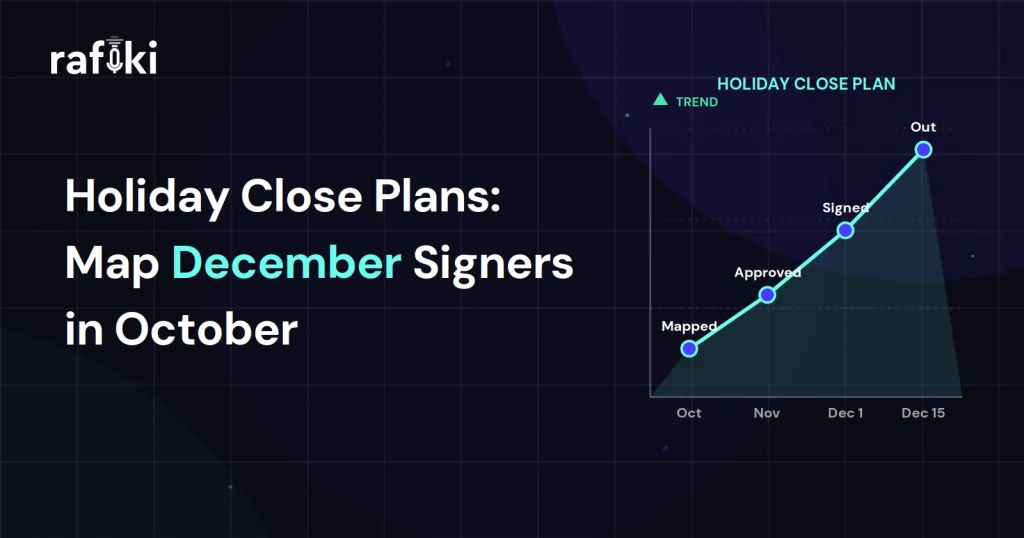
A holiday close plan is a dated schedule for a December deal, built around when each approver is at work. It lists the signer, the other approvers, the dates each person is out, and the buyer's year-end deadlines. From there, the AE and the buyer count backward to the last day each handoff can happen.
You already run close plans, and the holiday version differs in one way: the calendar sets the dates. A missing approver in March costs you a few days of slip. That same gap in late December pushes the signature into next quarter, since few companies let a deputy sign for an absent CFO.
We covered the general version in the Q3 close plan, which runs a quarter's last 30 days on call evidence. The holiday version has to start in October, because December's last useful working week ends well before the quarter does.
The champion is rarely the problem. Most champions want the deal done before their budget resets, and they'll tell you so on every call. The delay comes from people whose names never made it into the CRM. Think of the CFO who signs above a threshold, or the attorney reviewing paper for every vendor closing that week.
Executives with signing authority often take the last two weeks of the year off. Legal and procurement lose those same days while their queues grow with every vendor who waited until December. Your redline sits in that queue with everyone else's, and your champion can't move it up.
Then there's the buyer's fiscal year, which cuts both ways. If it ends in December, finance may push teams to spend what's left of the budget. Other finance teams freeze new purchases until the board approves next year's plan. Companies on a different fiscal year may treat December like any other month, so the AE has to ask.
Forecasts almost never account for your own side slowing down. Your deal desk and legal counsel take holidays too, and each day legal holds your redline is a day the signer loses. Salesforce's State of Sales research tracks how much of a rep's week goes to work other than selling. In December, chasing late signatures piles onto that load for every AE with a year-end deal.
A December deal stays in commit only when the AE can answer five questions about it. Each answer has to trace back to a buyer's call or email, and a rep's hunch about who signs doesn't qualify.
Most AEs have already heard some of this and never wrote it down. A champion mentions the CFO's ski trip while everyone waits for a late joiner on the call. Or a procurement lead says, almost as an aside, that the vendor portal closes on December 15. Those comments sit in recordings the forecast never sees, so the plan's first job is digging them back out.
You don't need a new round of discovery, because the recordings your team already has cover most of it. Every AE should work through these steps for each December deal, new logo or expansion, before October ends.
Pull every open deal with a December close date, including the ones sitting in best case. Add anything dated late November, since a one-week slip puts it in the holidays. Next to each one, write down the current close date and the forecast category.
The list will run longer than you expect. Reps set December dates in July as placeholders, and nobody touches them until the quarter gets tight.
Search each deal's calls for mentions of signing, budget, procurement, legal, and time off. A conversation intelligence platform makes this fast, because you can search every transcript on the account at once. Without one, skim the latest discovery and pricing calls, where buyers usually describe their approval process.
For every mention, note the speaker, the call date, the exact words, and any date the buyer gave. A line like "our CFO signs anything over the threshold" goes into the plan with its call date. When your manager asks how you know, you point to the call and the conversation moves on.
You'll have gaps at this point, and the next scheduled call is where you fill them. Mention that December gets busy on both sides, then ask who signs and when each of those people is out. Buyers answer easily in October because it sounds like planning, while the same question in December sounds like pressure.
If the champion doesn't know the signer's schedule, ask them to find out by a specific date. How they handle that request shows how much access they have to the signer, and the forecast should reflect it.
Start from the signer's last day at work before the holidays and count backward through each approval step. Use how long each step took this buyer last time, which you'll often have from the calls. You end up with a date for every handoff, and the earliest is usually the day legal needs the redlines.
If that first handoff date is already behind you, the December close date is gone. Flag it to your manager that week, and don't hold it for Thursday's call where the team talks past it.
Send the schedule to the champion and ask them to correct anything that's wrong. A deal stays in commit only after the buyer agrees to the dates. Our mutual action plan template works well for this, with an owner and a date on every line.
Champions often forward the schedule straight to their procurement team, which saves you a round of emails. It also gives the champion a reason to raise the deal with the CFO before the holiday rush.
Good calendar questions ask about names and dates, so they sound like project planning to the buyer. Most champions want their project live in January, and they're glad when a vendor plans around the holidays. Four questions cover what most December deals are missing:
If you only get to one, ask the last, because buyers answer questions about history with confidence. A champion who guesses at next month's timeline can often walk you through last year's contract review, step by step. Whichever step dragged last year will probably drag on your deal too.
When you ask matters as much as what you ask. Raise these while you're pushing for a verbal commit, and the calendar question starts to sound like a closing tactic. Save it for the end of a working call, framed around the buyer's own start date.
When a December date fails the backward count, move it that same week. If the accelerator resets on January 1, nobody wants to be the rep who pulled the number down in October. Managers make it worse by treating an October push as bad news and a December 22 push as bad luck. Reps notice that within a quarter and start holding dates they know are dead.
Some deals can still make December with a change in scope or sequence. The buyer might sign a smaller first phase that falls under the VP's own approval limit. Legal could also start review before final pricing, so the paper is ready when the numbers are.
Offer these only when they fit what the buyer needs. A scope cut made only to hit a date tends to come back at renewal, when the customer realizes they bought less than they needed.
The usual fix is a year-end discount, which rarely works because the CFO still has to be at work to sign. A price cut offered after procurement's mid-December cutoff also reaches a buyer with nobody left to review the contract. Discounts also teach buyers to wait for the last week of December, which makes next year harder.
Moving dates early protects the AE, too. In October, the manager can still adjust the commit number before it goes to finance. A push on December 22 reaches the manager after that number has already left the building.
Both views start from the same pipeline, then split on the questions that decide whether a deal signs in December. On a forecast call, the row that matters most is the last one.
| Question | Standard Q4 forecast | Holiday close plan |
|---|---|---|
| Who signs? | The champion, by assumption | A named signer the buyer confirmed |
| Other approvers | Not listed | Each approver with a handoff date |
| Time off | Not considered | Out-of-office dates for each person |
| Buyer deadlines | Unknown | Budget cutoff and vendor freeze dates |
| Source of the close date | Rep's estimate from the summer | Backward count from the last signing day |
| When slips appear | The last week of December | October, while options still exist |
Frontline managers don't need a new meeting, since the review fits inside the forecast call they already run. From mid-October to early December, give each December deal a two-minute check against the five facts.
Ask the AE to name the signer and point to the call where the buyer confirmed it. With no source, the deal leaves commit until a buyer call fills the gap. Expect to hear that the CFO "always signs before the break," and hold the line, because last year's habit says nothing about where this contract sits in the signing queue. Once the signer checks out, move to the next handoff date and ask whether it's on track.
Do this for two weeks and patterns show up across the team. If several reps lack budget cutoff dates, add that question to the team's call plan. When one rep has no confirmed signers, use the next one-on-one to practice the calendar question.
Write the rule down, or it will erode by mid-November. One version: no deal stays in December commit after November 1 without a confirmed signer. Some teams also require a schedule the champion has seen.
RevOps leaders can make holiday close plans visible with a few fields on the opportunity record. A signer name and a last signing date cover most of it. Some teams add a "schedule shared" checkbox plus a link to the call where the buyer named the signer. With those fields, RevOps can report how many December dollars rest on a confirmed signer.
That number matters to the CFO, who uses the Q4 forecast to set cash plans and early 2027 hiring. A deal moved to January in October gives finance time to adjust. The same move in late December lands while finance is closing the books.
Sales leaders can use the same report to decide where their own November goes. An executive call to a buyer's CFO in early November can keep a deal on schedule. On December 19, that same call usually reaches an out-of-office reply.
Most of what a holiday close plan needs, from the signer's name to the CFO's time off, first comes up on buyer calls. Rafiki AI records those calls on video meetings, Aircall, and OpenPhone, and it transcribes them in more than 60 languages. A buyer's offhand comment about a signer or a holiday ends up in a transcript the AE can search.
For step two, Gen AI Search lets an AE search an account's calls with a plain question about who signs. After each call, Smart Call Summary writes up the discussion and next steps, so nobody has to replay the recording. Account executives can then let Smart Follow Up write the first version of the post-call email, then attach the dated schedule and read it over.
Stakeholder participation mapping shows which people from the buying side have joined calls, so a manager can spot a CFO who never has. Blocker detection flags obstacles the buyer raises on a call, such as a pending legal review or a spending freeze.
On the CRM side, Smart CRM Sync fills in methodology fields from each call, such as MEDDIC's economic buyer. It also fills in custom fields RevOps adds. Before the weekly review, a manager can ask Gen AI Reports for a report on December deals in plain language. You can see how these pieces fit a forecast process on the sales forecasting software page.
This week, ask each AE to list their December deals and write the signer's name next to each one. Beside each name goes the call where the buyer said it. Any deal without a sourced name goes on a short list for the next buyer call. The team has until October 30 to fill those gaps.
On November 2, run the backward count on every deal that still carries a December date. Move the ones that fail to their real month in the CRM that day, and tell finance what moved. Your November forecast will shrink, and your AEs get to spend December on deals whose signers will be at work.
Rafiki AI's conversation intelligence platform starts at $19 per seat per month, and a team of any size can buy just the seats its December sellers need. Sign up for a free trial and search your own December deals for signer names before October ends. If you would rather watch the signer search on your own pipeline first, book a demo with the December deal that worries you most.
A holiday close plan is a dated schedule for a deal that needs a December signature. It names the signer and every other approver, lists when each person is out, and records the buyer's year-end deadlines. The AE works backward from the last signing day to set a date for each handoff.
Build them in October, while buyers know their holiday plans and the schedule can still change. By late November, legal and procurement queues are already full. An October plan also gives the manager time to move dates before the forecast goes to finance.
Start with the call recordings, because buyers often describe their approval process on discovery and pricing calls. Then ask the champion directly who signs and who has to approve first. If the champion isn't sure, ask them to confirm by a set date, which also tests their access.
Tell the manager that week and move the close date to the month the buyer can actually sign. Sometimes a smaller first phase or an early start on legal review can keep December possible. A discount rarely helps, because the signer still has to be at work to approve the contract.
Start for free — no credit card, no seat minimums, no long contracts. Just better sales intelligence.