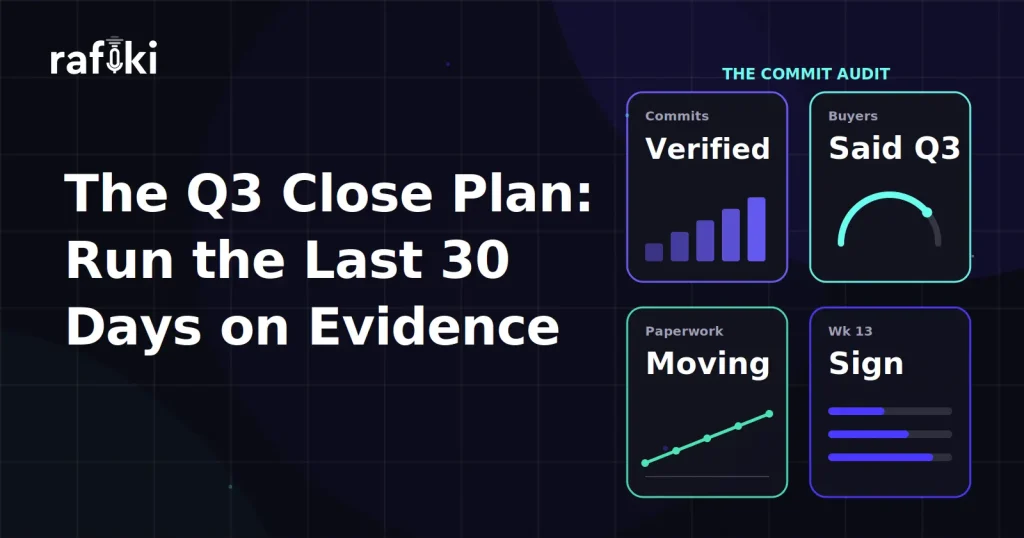
September decides Q3. The deals that will close, slip, or quietly vanish in the last thirty days of the quarter are already visible in late August — the difference between teams that finish strong and teams that get surprised is whether anyone actually looks. A Q3 close plan built on evidence starts now, with a full month of runway, not in the final week when the only levers left are discounts and desperation.
Most close plans, if we are honest, are hope with a spreadsheet: a list of committed deals assembled from rep self-reports, a pile of discount approvals held in reserve, and an unspoken bet that a heroic final week drags everything over the line. That approach works right up until it doesn't. When it fails, it fails on September 29, with nothing left to do but revise the number down and rehearse the explanation.
The alternative is not more effort. It is a different raw material. Instead of building the close plan on what reps say about their deals, you build it on what buyers actually said in the calls. This guide walks through that evidence-based approach: the commit audit, the week-by-week sequence, the mid-September re-forecast, discount discipline, the daily close room, and the guardrails that protect Q4 while you close Q3.
A hope-based close plan has three ingredients. First, a commit list built from CRM stages and rep conviction. Second, a discount reserve that leadership plans to deploy whenever a deal stalls. Third, a final-week sprint in which managers parachute into every stuck negotiation at once.
Each ingredient hides an assumption that rarely survives contact with September. The commit list assumes close dates reflect buyer commitments rather than quota math. The discount reserve assumes price is what stands between you and a signature, when the real blocker is usually an unmapped approver or an unstarted security review. Moreover, the final-week sprint assumes that executive attention can compress a procurement process that runs on the buyer's clock, not yours.
Sales research published by Gartner has consistently pointed to the same underlying issue: seller judgment, on its own, is an unreliable input for revenue decisions. Buyers do most of their evaluating away from your reps, so a forecast built on seller impressions inherits those blind spots. If you ran a disciplined mid-year pipeline review in July, you have already seen the daylight between the pipeline on paper and the pipeline in reality. The Q3 close plan is where that discipline either compounds or evaporates.
The commit audit is the foundation of an evidence-based close. For every deal in commit, someone — the rep, the manager, ideally both — goes back to the call record and answers a short set of questions with citations, not vibes.
Any commit that fails two or more of these questions is not a commit. It might still close, but it belongs in a category that reflects the evidence. As Harvard Business Review has reported, companies are increasingly using AI to make faster decisions in sales and marketing — but speed only compounds the damage when the underlying record is wrong. Audit first, accelerate second.
The gap between what reps report and what buyers actually said is your surprise inventory — the stock of bad news currently scheduled for delivery in the last week of September. Every unverified close date, every assumed budget, every procurement process described as "should be quick" is a surprise in the queue, waiting to do maximum damage.
Running the commit audit converts that inventory into a manageable list. A deal where the buyer never confirmed the date is not doomed; it is a deal with a known gap and four weeks to close it. In contrast, the same deal left unaudited becomes a September 28 fire drill, and fire drills at quarter-end get resolved with concessions rather than evidence.
Push risk follows recognizable patterns, and most of them are audible in calls weeks before the slip shows up in the CRM: single-threaded relationships, vague next steps, buyer language that hedges on timing. We covered how to catch these signals early in our deal slippage playbook. The Q3-specific point is timing — in late August, a detected slip is a recoverable event. Detected on September 25, it is just a smaller quarter.
An evidence-based close plan treats the last thirty days as three distinct phases with different jobs. Blending them is how quarters die: teams that are still negotiating scope in the final week were, in effect, still verifying in week three.
The first week is for the commit audit and for closing the gaps it reveals. Missing stakeholders get meetings booked now — an economic buyer you have never spoken to cannot be summoned on September 29. Unsent paperwork goes out this week, because security reviews and legal queues run on the buyer's calendar. Unscheduled signature steps get dates: who signs, when, and what has to be true first. The output of week one is a mutual close plan per deal, agreed with the buyer, with owners and dates on both sides.
The middle two weeks are pure execution. Every activity maps to a step in a mutual plan; every completed step is confirmed against the record rather than assumed. When a step slips — the buyer misses a legal review date, a stakeholder goes quiet — the plan gets renegotiated that day, not silently absorbed. This is also when managers do their most valuable work: multi-threading accounts where the audit exposed single-threading, and joining calls where the economic buyer is finally in the room.
The last week of September has one job: converting agreed deals into signed deals. No new negotiation, no new discounts, no scope changes. If a deal still requires substantive negotiation in the final week, the evidence is telling you it is a Q4 deal, and treating it that way — calmly, with the relationship intact — is worth more than a coin-flip attempt to force it.
The two approaches diverge on every dimension that matters at quarter-end. The table below summarizes the contrast.
| Dimension | Hope-Based Close | Evidence-Based Close |
|---|---|---|
| Commit list | Rep conviction and CRM stage | Verified against the call record |
| Close dates | Set by quota math | Confirmed by the buyer on a call |
| Urgency | "This quarter" said only by sellers | Timeline stated by the buyer |
| Discounts | Triggered by the calendar | Tied to stated budget constraints |
| Final week | Heroic negotiation sprint | Signatures only |
| Re-forecast | Refreshed optimism | Category moves on new evidence |
| Blockers | Discovered at the deadline | Owned daily in the close room |
| Q4 pipeline | Raided for pull-forwards | Protected as next quarter's asset |
Nothing in the right-hand column requires more talent or longer hours — only a different source of truth, buyer behavior captured in real conversations, and the discipline to act on it in time.
Halfway through September, run a formal re-forecast with one rule: a deal changes category only when new evidence exists. A move up requires something the buyer did — a confirmed signature date, a completed security review, an executive sponsor joining a call. Conversely, a move down is triggered by what the buyer stopped doing: a missed mutual-plan step, a gone-quiet champion, a rescheduled legal review.
What never justifies a category change is renewed conviction. "The rep feels good about it" was not evidence in August, and it is not evidence in September. This is where conversation intelligence earns its place in the close process — when every call is recorded, transcribed, and searchable, the re-forecast becomes a review of buyer behavior rather than a second round of the same opinions.
The mid-September re-forecast also resets the team's attention. Deals that moved down stop consuming close-room minutes as commits and start getting honest Q4 treatment, while deals that moved up earn concentrated executive attention. Modern sales forecasting practice treats the forecast as a living document that updates on signal — the mid-quarter re-forecast is simply that principle applied at the moment it matters most.
Quarter-end discounting deserves its own discipline, because it is where hope-based closing gets expensive. The rule is simple: a concession is justified by what the buyer said about budget, not by what the date says about your quota.
If a buyer stated on a call that their approved budget sits below your proposal, a concession negotiated against that stated constraint is a rational trade. However, if the discount exists only because it is September 26 and the deal is stuck, you are not solving the buyer's problem — you are paying to avoid diagnosing it. Stuck deals at quarter-end are usually stuck on process or people, and no price cut unsticks an unmapped approver.
There is also a compounding cost. A panic discount teaches buyers to wait for September, forever. Procurement teams talk, calendars repeat, and a team that visibly folds at quarter-end will negotiate every future deal against its own deadline. Reps and managers should walk into the final weeks with language ready for the calendar-citing discount request: anchor on the value case, the buyer's stated priorities, and the mutual plan — not the date.
For the final two weeks, run a daily close room. Fifteen minutes, same time every day, leaders and deal owners present. The format is strict, because the meeting exists to move blockers, not to re-tell deal stories.
Run this way, the close room replaces the traditional quarter-end anxiety broadcast with a short, factual operating rhythm. As a result, leadership attention — the scarcest resource of the final two weeks — lands where it changes outcomes.
The most seductive move in a tight September is the pull-forward: take a deal naturally landing in October, offer a discount to sign it by September 30, and book the win. It feels like closing. In reality, it is usually a transfer — revenue moved from a stronger quarter into a weaker one, minus the concession you paid to move it.
Consider what the trade actually buys. The deal was already won; the discount purchased only its timing. Q4 now starts with a hole where its most mature deal used to be, raising the odds of a more desperate December. Worse, the buyer just learned that your quarter-end is worth money, an expensive lesson to have taught before their renewal.
Evidence provides the test here too. If the buyer's own record shows a genuine reason for September — budget expiring, a project start date, an executive mandate — then accelerating the deal serves both sides, and it belongs in the close plan. If the only September argument is yours, leave the deal where the buyer put it. A close plan that protects Q4 belongs to a team managing a business; one that raids it, to a team managing a scoreboard.
The last act of the quarter takes an hour and pays for itself in Q4. On September 30 — not in mid-October, when memory has already been rewritten by the outcome — capture the postmortem seeds for every late-quarter deal.
For each deal that slipped, record what the call history showed and when. Was the missing procurement step visible in an August call? Did the buyer ever say "this quarter," or did we only hear ourselves saying it? For each deal that closed with a concession, note what the buyer had actually said about budget, so discount patterns can be examined honestly. Furthermore, flag every commit-audit question that nobody could answer in week one — those are your discovery and qualification gaps, and they belong in Q4 coaching plans.
These seeds turn the Q4 kickoff from a ritual into an adjustment. The teams that improve quarter over quarter are not the ones with the best excuses in October; they are the ones with the best notes from September.
Everything above can be done manually — leaders have scrubbed call notes and re-listened to recordings for years. The problem is cost: with thirty days on the clock, few teams can afford to spend a week of manager time reconstructing what buyers said. This is exactly the burden Rafiki AI removes.
Rafiki AI's autonomous AI agents analyze every sales call and turn the raw record into close-plan fuel. The platform detects blockers as they surface, maps stakeholder participation so single-threaded commits stand out immediately, and tracks sentiment and timeline language — including whether "this quarter" came from the buyer's side or only yours. With Smart CRM Sync, methodology fields and custom close-plan fields update automatically from what was actually said, so the commit audit starts from a CRM that already reflects buyer-said rather than rep-said. During the daily close room, Ask Rafiki Anything answers questions like "which committed deals have no buyer-confirmed date?" in seconds, from the record.
For sales leaders and frontline managers, this changes the economics of the evidence-based close: verification becomes continuous instead of heroic. We explored where this is heading in our post on agentic forecasting — forecasts that update themselves on conversation evidence. The Q3 close plan is the same idea compressed into thirty high-stakes days. Start your free trial today and run your commit audit on evidence this week, while the runway still exists.
A Q3 close plan is a bet on where your effort goes. The hope-based version spends the month waiting and the final week sprinting; the evidence-based version spends week one verifying, weeks two and three executing, and the final week signing. Same team, same deals, radically different September 30.
The mechanics are not complicated. Audit every commit against the call record and treat the rep-said versus buyer-said gap as your surprise inventory. Sequence the thirty days so that verification, execution, and signatures never blur. Re-forecast mid-month on new evidence, hold the line on calendar-driven discounts, run a fifteen-minute exceptions-only close room, refuse the pull-forward trap, and write the postmortem while the quarter is still warm. None of it requires heroics — only the discipline to let what buyers actually said outrank what everyone hopes.
September will decide Q3 either way. The question is whether it decides based on evidence you gathered in time to act, or surprises you stored up all quarter.
Thirty days before quarter-end — in practice, the last week of August. The reason is mechanical: the actions that rescue a Q3 deal all have lead times you cannot compress. Booking a first meeting with an economic buyer, starting a security review, or getting into a legal queue each runs on the buyer's calendar, and no amount of September urgency accelerates them. Starting thirty days out means week one can be spent on verification and gap-closing while gaps are still closable. A close plan that starts in mid-September is really a triage plan; the only levers still available by then are concessions and escalations, which is precisely the hope-based pattern an evidence-based Q3 close plan exists to replace.
A commit audit is a structured review that verifies every committed deal against the actual call record instead of the rep's summary. For each deal, the auditor confirms four things: the buyer stated the close date themselves, procurement and legal steps are mapped with named contacts, urgency language ("this quarter") came from the buyer's side, and paperwork such as security reviews or redlines is verifiably in motion. Deals that fail the audit are recategorized based on evidence, and each failed question becomes a gap-closing action with an owner and a date. The audit's real output is the difference between rep-said and buyer-said — the surprise inventory that would otherwise be delivered as bad news in the final week of the quarter.
Anchor every concession to something the buyer actually said about budget, and never to the date on the calendar. If a buyer stated a genuine budget constraint on a call, negotiating against that constraint is a legitimate trade. If the only pressure is your own deadline, a discount does not solve the deal's real blocker — stuck quarter-end deals are usually stuck on process or people, not price. It also creates a lasting cost: a panic discount teaches buyers to wait for September on every future deal and every renewal. Practical safeguards include a final-week rule of signatures only with no new negotiation, and close-room review of any late concession against the buyer's recorded budget statements.
AI removes the labor that makes evidence-based closing expensive: reconstructing what buyers actually said. A platform like Rafiki AI records and analyzes every call, so the commit audit starts from searchable transcripts rather than memory. Its autonomous AI agents detect blockers as they surface, map which stakeholders are actually engaged, and flag whether timeline urgency came from the buyer or only from your team. Smart CRM Sync writes what was said into methodology and close-plan fields automatically, keeping the CRM aligned with buyer-said reality throughout the month. During the daily close room, leaders can query the record directly — for example, "which commits have no buyer-confirmed signature date?" — and get answers grounded in calls, which keeps every next step tied to evidence.
Rafiki AI's revenue intelligence platform gives your team the evidence layer a real Q3 close plan runs on — every call analyzed, every commit verifiable, starting at $19 per seat per month with no seat minimums and no annual commitment. Start your free trial today or book a demo to see how autonomous AI agents turn your final thirty days from hope into execution.
Start for free — no credit card, no seat minimums, no long contracts. Just better sales intelligence.