Half the deals in your H2 forecast were qualified by a CRM dropdown, not by anything a buyer actually said.
The last week of June is when that gap stops being theoretical. Boards want an H2 number. Finance wants to know whether the annual plan still holds. Meanwhile, your pipeline is carrying every optimistic stage label, every "verbal commit," and every stale opportunity that accumulated across six months of selling. A mid-year pipeline review is supposed to fix this — yet most teams run it as a spreadsheet exercise that recycles the same unreliable inputs that built the problem in the first place.
The result is predictable. Leaders walk into July defending a forecast built on stage archaeology: when a deal was created, when it last moved, what the rep felt during the last update. None of that reflects what the buyer said on the most recent call. Until the review interrogates conversation evidence, the H2 number is a guess wearing a spreadsheet costume.
Pipeline problems rarely announce themselves in January. They build quietly: a champion who stopped joining calls in March, a budget owner who said "next fiscal year" in April, a procurement step nobody logged in May. By the time those signals show up as slipped deals, the quarter is already lost — and the annual plan absorbs the damage.
This is a visibility failure, not an effort failure. Consider what a frontline manager can actually inspect:
Every one of those inputs is a proxy. The primary source — what the buyer committed to, objected to, or went silent on — lives inside sales calls that almost nobody reviews at scale. As Harvard Business Review's reporting on how successful sales teams are embracing agentic AI describes, the teams pulling ahead are the ones putting AI to work on exactly this kind of unstructured evidence, while everyone else keeps inspecting proxies.
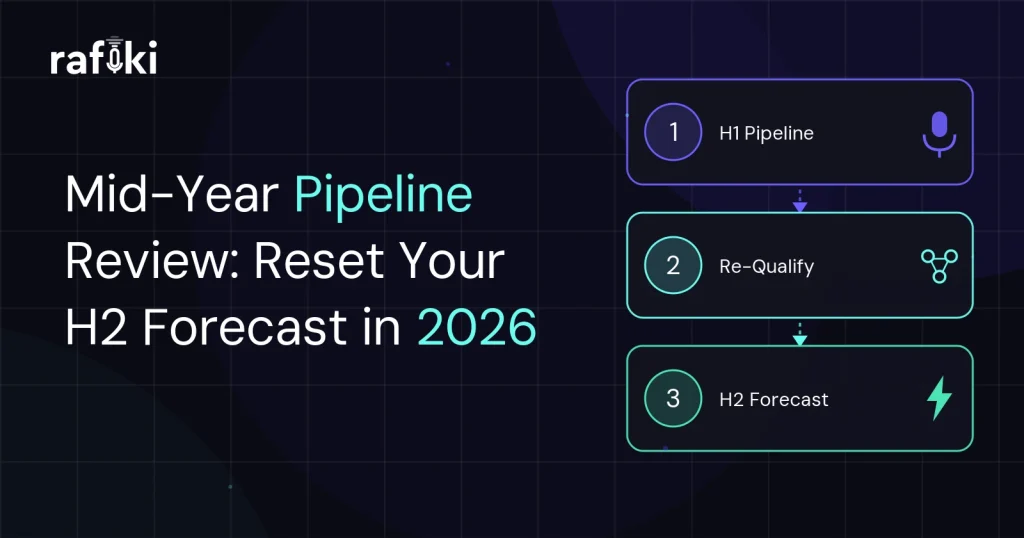
A mid-year pipeline review is a structured re-qualification of every open opportunity at the midpoint of the fiscal year, with the goal of resetting H2 coverage, forecast assumptions, and resource allocation on verified evidence. It differs from a weekly pipeline meeting in scope and in standard of proof: instead of asking "what changed this week," it asks "would we still call this a real deal if we qualified it from scratch today?"
Done well, the review produces three outputs:
Most importantly, the review defines what counts as evidence. That single decision separates resets that hold up in October from resets that quietly fall apart by August.
Ask a revenue team where pipeline truth lives and most will point to the CRM. In practice, the CRM stores conclusions — stage, amount, close date — while the reasoning behind those conclusions evaporates after every call. Salesforce's ongoing State of Sales research has tracked for years how much seller time disappears into manual data entry and administrative reconciliation; the more painful finding for forecasting is what that manual process leaves out of the record entirely.
Buyer-side evidence is specific and checkable. For example:
Stage labels compress all of that into one optimistic word. Consequently, two deals marked "Negotiation" can carry completely different realities: one has a signed-off business case and an active procurement thread, while the other hasn't heard from its champion in five weeks. A mid-year pipeline review that cannot tell those two deals apart is not a review — it is a formatting exercise.
The reset works deal by deal. Rather than debating the forecast top-down, re-qualify each open opportunity against five questions, answered with conversation evidence instead of rep recollection.
Not a title on the contact list — a person who has spoken in a call and addressed budget ownership. If the economic buyer has never appeared in a conversation, the deal is earlier-stage than the CRM claims.
Renewal dates, compliance deadlines, headcount plans, and system migrations are real. "They seem motivated" is not. Deals without a stated compelling event belong in H2 pipeline only at a discounted weighting.
Engagement is measured in buyer-side actions: documents shared, stakeholders added, security reviews started. A deal where all recent activity is seller-side is drifting, however warm the last call felt.
Every stalled deal has an unresolved objection somewhere in its call history. The review should surface the last objection raised and ask what happened to it. Deferred objections almost always resurface in legal or procurement — at the worst possible time.
If the close date cannot be traced to a buyer-confirmed step — a contract review meeting, a board date, a go-live target — it is a hope, not a forecast input. Reset it or discount it.
Deals that fail two or more questions move out of the forecastable pipeline. That feels brutal in June; it is far cheaper than discovering the same truth in November.
Coverage math only works when the numerator is real. After re-qualification, rebuild H2 coverage from surviving pipeline, and treat the difference between "reported" and "re-qualified" as your true generation gap. We covered why blanket multipliers fail in our guide to pipeline coverage ratio in 2026 — the mid-year reset is where that segment-level thinking gets applied to a live book.
| Input | Traditional mid-year review | Evidence-based reset |
|---|---|---|
| Deal status | CRM stage label | Re-qualification against call evidence |
| Close dates | Rep-set, quarter-end clustered | Traced to buyer-confirmed steps |
| Coverage target | One blanket multiplier | Built from surviving, weighted pipeline |
| Slippage risk | Discussed anecdotally | Flagged per-deal from engagement signals |
| Generation gap | Discovered in Q4 | Quantified in the first week of July |
Two practices keep the rebuilt number honest. First, weight surviving deals by evidence strength rather than stage — a deal with a confirmed compelling event and active economic buyer deserves more H2 credit than one that merely survived. Second, run slippage detection continuously through H2 so the reset doesn't decay; the warning signs are catalogued in our deal slippage playbook.
A single company-wide coverage number is where mid-year resets go to die. Aggregate coverage can look healthy while one segment quietly starves, because strong SMB volume papers over a hollowed-out enterprise book. The reset has to read segment by segment before it reads company-wide.
At minimum, split the re-qualified pipeline three ways:
For each cut, ask the same question: if this segment's re-qualified coverage is below target, is the answer more generation, better conversion, or a smaller H2 commitment? Different segments will return different answers, and that is precisely the insight a blanket number can never give you. More importantly, segment-level findings convert directly into July action — territory shifts, campaign briefs, and coaching focus — while company-level findings convert mostly into anxiety.
Everything above has a practical objection: nobody has time to re-listen to six months of calls. A re-qualification standard built on conversation evidence collapses without a way to extract that evidence at scale. This is exactly the problem conversation intelligence exists to solve.
Modern AI platforms transcribe, structure, and score every customer conversation as it happens. In a mid-year context, that means:
In contrast to a manual review, the evidence base updates itself. The five reset questions stop being a once-a-year ritual and become queries you can run any week of H2.
Rafiki AI is an AI-native revenue intelligence platform built for exactly this workflow: it sits between your conversations and your revenue decisions, and turns six months of calls into a re-qualified pipeline in days rather than weeks.
In practice, the reset maps to specific capabilities:
Rafiki AI transcribes in 60+ languages and integrates with Salesforce, HubSpot, Zoho, Pipedrive, and Freshworks, which matters for global teams running one reset across regions. For sales leaders, the practical difference is simple: the mid-year review stops depending on whether reps remember their deals accurately, because the platform surfaces what was actually said. Our sales forecasting software page shows how the same evidence layer feeds continuous forecasting after the reset is done.
The reset does not require a quarter-long project. A focused team can complete it in the first week of July:
By Friday, the team enters H2 with a number it can defend line by line — and a standing answer to the board question every leader dreads: "How confident are you in that forecast?"
A QBR looks backward at performance and forward at account plans; a mid-year pipeline review re-qualifies the open book itself. The QBR asks "how did we do and what's the plan?" The reset asks "which of these deals would survive qualification if we ran it from scratch today?" Both matter, but only the reset changes what is in the forecast. Teams that merge the two usually end up doing the QBR and skipping the re-qualification.
Failing deals get one of three verdicts, not deletion by default. Recycle deals with genuine fit but no current compelling event into nurture, with a trigger to re-engage. Discount deals with partial evidence and keep them visible at reduced weighting. Close-lost deals where the buyer has disengaged entirely — and capture the reason from the call history while it is still retrievable, because that record feeds win-loss learning and future targeting.
The mid-year reset is a floor, not a cadence. Once conversation evidence is captured automatically, re-qualification becomes continuous: engagement decay, unresolved objections, and missing stakeholders surface as they happen rather than at the next review. In practice, leaders keep a weekly slippage scan and a monthly evidence-standard check, and reserve the full deal-by-deal walk for mid-year and annual planning.
A mid-year pipeline review is only as good as its evidence standard. Reviews built on stage labels and rep recollection produce H2 plans that decay by September, because they recycle the same proxies that inflated H1. Reviews built on what buyers actually said produce smaller, harder numbers — and numbers that hold.
The teams that win H2 2026 will not be the ones with the biggest reported pipeline in July. Instead, they will be the ones who knew, deal by deal, which pipeline was real — and started generating against the gap while there was still time to close it.
Rafiki AI's autonomous AI agents turn every sales call into the evidence layer your reset needs — scoring, structuring, and syncing what buyers say into the systems your forecast runs on. Plans start at $19 per seat per month with no seat minimums and no annual commitment. Start your free trial today or book a demo to run your mid-year pipeline review on what buyers actually said.
Start for free — no credit card, no seat minimums, no long contracts. Just better sales intelligence.