Sales Forecasting

Quota Attainment: Formula, Benchmarks, and Why Reps Miss in 2026
Nov 6, 2026
11 min read
Team quota attainment read 97% when Owen, a VP of Sales with ten account executives, refreshed the quarter-end dashboard one last time on September 30. The CRO sent him a thumbs-up in Slack before he opened the rep-level tab. That tab looked worse, because two reps had carried most of the bookings and four finished below 70%.
Owen knew the 97% would go into the board deck, and that nobody would ask about the four reps until January. One of the four had also run more discovery calls than anyone else on the team that quarter. Effort was plainly not her problem, and the attainment number gave Owen no way to see what was.
Quota attainment tells you who missed and by how much, but it says nothing about why. The reasons usually show up on recorded calls weeks before the number turns red. You hear them in deals with a single contact, or in discovery that never found a deadline. A sales leader who wants fewer misses next year has to read both the number and the calls behind it.
Quota attainment is the percentage of an assigned sales target that a rep, team, or company closed in a period. Say a rep carries a $300,000 quarterly quota and closes $240,000 in bookings. That rep finished the quarter at 80% attainment.
The definition sounds settled until two people in the same company compute it and get different answers. Finance may count recognized revenue while sales ops counts signed bookings. The comp plan may count only first-year contract value, with multiyear deals capped. Before anyone compares reps or quarters, write down what counts as closed, which date counts, and whose quota sits in the denominator.
Our guide to sales quota definitions and types covers the target itself, from activity quotas to profit quotas. Attainment is the measurement that comes after the target exists, when someone has to judge whether the team hit it.
The basic quota attainment formula divides closed value by quota and multiplies the result by 100. Every argument about the number comes down to which closed value and which quota go into it.
Period choice can hide a miss. A rep who closes 40% of quota in Q1 and 160% in Q2 sits at 100% for the half. An annual comp plan may pay her as if Q1 never happened. Track quarterly attainment next to year-to-date, because the quarterly view shows when the slide began.
Ramping reps need their own line. If a new hire carries a reduced quota for two quarters, use that ramped quota in the denominator. Then report ramping reps separately, since mixing them with tenured reps drags the median down.
Attainment looks back at what closed, while both coverage metrics look forward at whether the plan can still happen. If you blur the three, the forecast call ends up arguing about the wrong number.
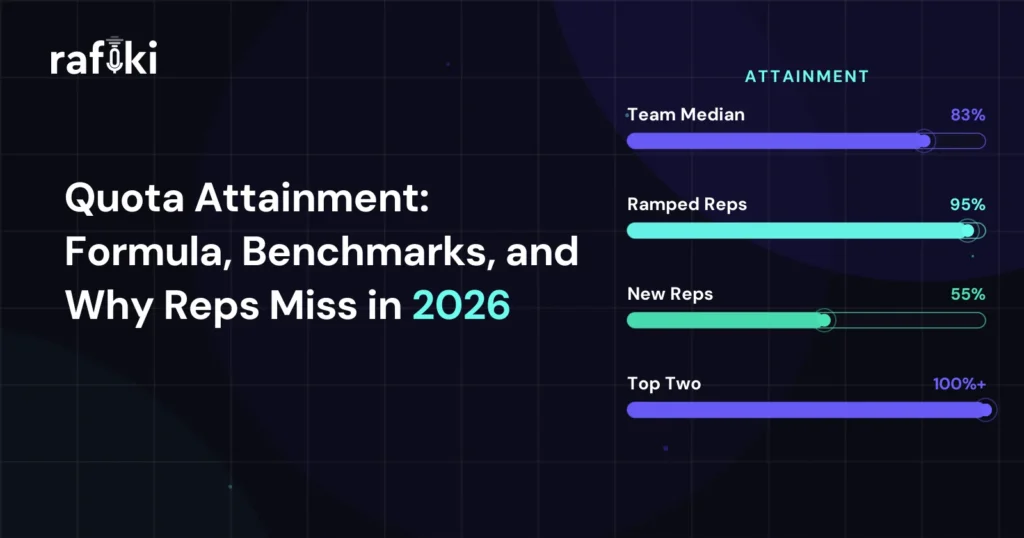
Quota coverage, which some finance teams call over-assignment, compares total rep quotas with the number the company committed to its board. If the board number is $10 million and reps carry $12 million in quota, coverage is 120%. In that case the company makes plan with team attainment around 83%. So a quarter where most reps miss can still be a quarter the CFO calls fine.
Pipeline coverage divides open pipeline for the period by the quota still left to close. The old rule of thumb asked for three times coverage. Our analysis of why 3x pipeline coverage no longer works explains why a fixed multiple breaks when win rates move.
| Metric | Formula | Question it answers | When to read it |
|---|---|---|---|
| Quota attainment | Closed value ÷ quota × 100 | Did the rep or team hit the target? | End of each month and quarter |
| Quota coverage | Total rep quotas ÷ company plan × 100 | How much cushion did leadership build in? | When setting the annual plan |
| Pipeline coverage | Open pipeline for the period ÷ remaining quota | Is there enough in play to close the gap? | Weekly during the quarter |
| Median rep attainment | Middle value of all ramped reps' attainment | How did a typical rep do? | Each quarter and at annual planning |
Team quota attainment is a weighted total, so one big deal can lift a team past a number most reps missed. Owen's 97% rested on one large expansion deal and a second rep's strong quarter.
A simple example shows how far apart the two views can sit. Say five reps each carry a $200,000 quarterly quota, for a team quota of $1 million. They close $420,000, $260,000, $140,000, $100,000 and $80,000, which adds up to exactly 100% team attainment. Individually, they finished at 210%, 130%, 70%, 50% and 40%. So the median rep sits at 70%, and three of the five missed.
A leader who reports only the total loses sight of the reps in the middle, and those reps decide next year's number. The top two will not repeat a lucky quarter every time. Report the median and the share of ramped reps at or above 100% next to the team total, on the same slide.
Selling time can explain part of the spread. Salesforce surveyed 4,050 sales professionals for its State of Sales 2026 announcement. It found that the average seller spends 40% of their time selling, and Gen Z reps 35%. That gap matters on a team like Owen's, where three of the four reps below plan joined straight from college.
Leaders who bought AI tools to win back selling time then have to prove the tools worked. In a May 2026 survey, Gartner found that 31% of chief sales officers cited difficulty proving the ROI of AI-driven tools as a top challenge. Owen's 97% could not settle that question, because a team total hides which reps the tools helped.
No public quota attainment benchmark holds up well enough to set your targets. Each published figure measures a different population with a different definition. The honest benchmark is your own history, computed the same way every quarter.
Several forces push published numbers apart, starting with quota inflation. A company that over-assigns quota, say by 20%, expects lower attainment by design. Its reps will look weak beside reps at a company that sets quota equal to plan. Survey samples also differ on whether they include ramping reps or reps who left mid-year.
Comp design changes the number as well. One plan credits bookings on signature, another waits for the first invoice, and a third caps multiyear deals. The same deal can then produce three attainment figures. Deal size adds noise too, since an enterprise rep with four deals a year can swing from 60% to 140% on one signature.
Survey figures also depend on who chose to respond, and a leader coming off a bad year has less reason to answer. Keep outside attainment figures out of the board deck and out of the comp committee's spreadsheet.
Your own benchmark is a distribution of rep attainment across recent quarters, with the median as the headline number. Owen's RevOps lead, Sana, built the first version in an afternoon from the CRM and the comp system, using these steps.
Say a team of 12 ramped reps shows a median of 78% over the last four quarters. If the company over-assigned by 20%, that result sits close to the roughly 83% leadership planned for, so coaching should focus on the bottom quartile. When quota equals plan, the same 78% means the targets or the pipeline were wrong, which makes it a planning problem.
In my experience, quota misses trace back to a handful of deal patterns a manager can hear on recorded calls. These five are the easiest to spot in one listening session, and each has a fix a manager can coach.
A single-threaded deal has one buyer contact on every call, and that contact cannot sign alone. Owen listened to the late-stage calls of his busiest discovery rep in October. The same operations manager appeared on all of them, and nobody from finance or IT ever joined. Her champion liked the product but still could not get finance to release the budget. The fix is a stakeholder count on every deal past discovery, with the manager asking who else needs to say yes.
Some reps run thorough discovery and never find out why the buyer has to act this quarter. You hear it when a rep asks about pain and process but never asks what happens if nothing changes. Deals without a date-driven reason drift, and drifting deals miss the quarter. Coach reps to ask for the event that forces a decision, such as a contract renewal or a board meeting.
Security reviews, legal redlines and budget questions often appear for the first time right before the close date. The earlier recordings usually contain a hint the rep let pass. For example, a buyer might say procurement "has a process" without anyone asking what it involves. Reps who ask about the approval path on the second call find these objections while there is still time.
A close date that moves twice without a new buyer statement is a guess, and guesses pile up at quarter end. Compare the date in the CRM with what the buyer actually said on the last call. If the buyer never named a date, the rep picked one, and the deal belongs in upside.
One of Owen's top two reps finished above plan because a single large expansion closed. The same pattern can sink that rep next quarter. When two accounts make up most of a rep's forecast, a delay in either one decides the quarter. You can hear the warning on pipeline calls when the rep talks about the same two names every week. Push that rep to build smaller deals in parallel before the big one slips.
Set 2027 quotas from rep capacity and from the pipeline your calls show is real. Dividing the company number by headcount fails, because it assumes every rep can sell what last year's best rep sold.
Start with capacity per segment. Say your ramped mid-market reps closed a median of four deals a quarter last year, at an average of $50,000 each. That puts a typical rep's capacity at roughly $200,000 per quarter. A quota far above that figure needs a reason, such as a new product or a larger territory.
Then check how much of last year's pipeline held up on calls. Suppose deals with a confirmed decision date and more than one stakeholder closed far more often than the rest. In that case, weight that kind of pipeline most heavily when you size next year's targets. Our piece on 2027 sales comp plans covers how to pay for those behaviors once the quotas exist.
Last, share the median from your own benchmark when you hand out quotas. A rep who sees that the median ramped rep hit 78% last year understands what the new number asks of her. Hiding that context invites the rumor that leadership made the quota up.
Owen found the single-contact pattern in October, one call at a time, after the quarter had closed. Rafiki AI records and transcribes those calls during the quarter, while the rep can still change the outcome. That is the job conversation intelligence should do for quota attainment.
The Revenue Agent, one of Rafiki AI's autonomous AI agents, is the single source of truth for deal health and revenue analytics. In August, that view could have shown Owen the health of each late-stage deal behind his busiest rep's forecast. There was still time then to bring finance onto a call.
The miss patterns above can become custom criteria in Smart Call Scoring. Examples include "rep asked what event forces a decision" and "rep confirmed who else signs" on late-stage calls. With those scores, Owen would see by week three of the quarter which reps skip the questions.
For the benchmark, Sana can ask Gen AI Reports to set each ramped rep's attainment beside that rep's scores on those criteria. A sales leader can then see whether the reps below plan share a pattern. If every rep in the bottom quartile scores low on confirming who else signs, Owen knows what to coach in Q1.
Before the 2027 planning meeting, pull every ramped rep's attainment for the last four quarters and compute the median. Put it on the first slide, above the team total, so the room argues about the typical rep instead of the best one.
Next, take the four reps furthest below the median and listen to two late-stage calls from each. Owen's October session followed this pattern, and it gave him one coaching item for November in place of a vague push to work harder. Expect the first pass to take an afternoon, and expect it to change at least one quota in the plan.
Rafiki AI's conversation intelligence platform starts at $19 per seat per month with no minimums and no annual commitment. Start your free trial today or book a demo to see which deals behind your quota attainment number have only one buyer talking.
These answers assume you report the rep-level median next to the team total, the way Owen did after the 97% quarter.
A good rate is one your median ramped rep can reach without an outlier deal, judged against how much quota you over-assign. Companies that set quota equal to plan should expect more reps near 100% than those that build in a cushion. Over four quarters, the trend in your median and bottom quartile tells you more than any outside figure.
The two terms name the same metric unless your comp plan says otherwise. Some comp teams reserve "achievement" for the credited number after caps and splits apply. Pick one term, define it in the comp plan, and use it in every report.
Measure rep attainment on bookings, since reps control the signature but not the billing schedule. Finance may still track revenue-based attainment for the board. If you report both, label each one clearly and never put them in the same chart.
Review attainment monthly with each rep and quarterly with the full distribution. A weekly look adds noise in a B2B cycle measured in months, because one signature can swing the number. Spend the weekly slot on pipeline evidence from calls, which moves before attainment does.
Start for free — no credit card, no seat minimums, no long contracts. Just better sales intelligence.