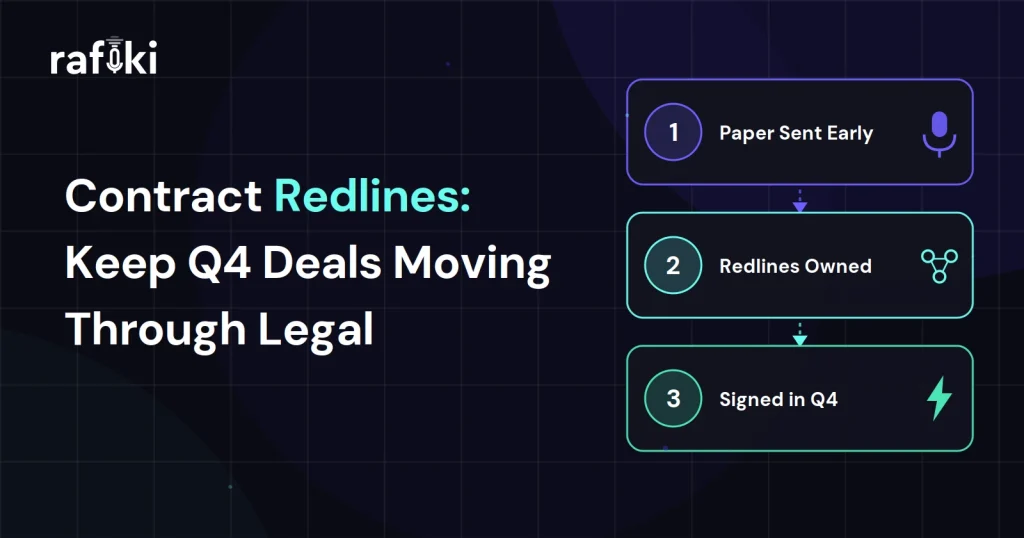
The AE emailed the MSA to the buyer's legal team in mid-October, one day after the champion said yes. Three weeks later, the document still sits in a legal queue that nobody on the selling side can see. He refreshes the email thread every morning, but no contract redlines have come back, and the CRM still shows a close date before Thanksgiving.
When the markup finally lands, it touches almost every page of the agreement. Their counsel struck the limitation-of-liability clause and asked for unlimited liability on data breaches. The data processing addendum came back on the buyer's own template, with questions about every subprocessor. By the time his own legal team works through its stack of Q4 contracts and replies, the close date has moved to January.
Most sales teams treat legal review as a black box that opens after the verbal yes, and that habit is the real problem. Almost everything that slowed this deal was knowable by the second discovery call. The AE only had to ask who reviews contracts and which clauses that person usually fights. He could have asked both questions in September and walked into October with the liability fight already scoped.
Contract redlines are the tracked edits a buyer's lawyer makes to your agreement before anyone signs it. The name comes from the red markup that change tracking shows in a Word document. Each edit deletes your language, adds the buyer's language, or leaves a margin comment asking for an explanation.
One markup can cover the MSA, the order form, a data processing addendum, and a security exhibit. On larger deals, those documents often go to different reviewers on the buyer's side. Outside counsel might take the MSA while an internal privacy lead handles the DPA. Two reviewers means two queues, and their questions will arrive on different days.
A heavy markup rarely means the buyer wants out, and AEs who panic at a page full of red misread it. Most of the comments are boilerplate asks that their counsel sends back on every vendor contract, from notice addresses to venue. The real risk sits in a handful of clauses and in the calendar. Each round trip between two legal teams can eat a week, and Q4 has few weeks to spare.
Q4 piles the whole year's late deals into the same few weeks, and every vendor sends paper to the same lawyers at once. A legal team that handled a steady trickle of contracts in the spring now faces its own company's renewals on top of every new vendor agreement.
Budget pressure on corporate legal teams can stretch the wait even further. In its October 2025 CFO survey release, Gartner shared results from 142 CFOs it surveyed in August and September 2025. According to the release, 40% of those CFOs target cost reductions in Legal and Compliance for 2026. The same release says 64% plan to grow SG&A more slowly than revenue.
Put those findings next to a Q4 calendar, and the buyer's contract reviewer looks stretched before your paper arrives. A lawyer with more work and no new headcount reviews contracts in the order her internal clients push. So your contract moves up her pile when your champion walks over to legal and asks about it by name.
Your own side adds delay too, and sales leaders rarely count it when they build the Q4 plan. The vendor's legal team faces the same year-end rush, usually with fewer lawyers than the sales team would like. Vendor counsel also works in the order that sales leaders escalate, so an AE who never flags his Q4 contract internally waits behind every colleague who did.
The best time to learn the buyer's contract process is weeks before the proposal, while the champion still wants to help. Few AEs ask, because legal questions feel premature before the buyer agrees to anything. That instinct gets the timing backward, because a champion still selling the project inside her company answers these questions freely. Three weeks into a stalled markup, the same champion is much harder to reach.
Ask these on the second or third call, once the champion confirms a real project with budget behind it:
The third question does the most work, because it tells the AE which fight is coming. If the champion says legal always rewrites the liability cap, the AE can take that to the deal desk early. The deal desk can then decide how far to move on the cap before buyer counsel sends a single comment.
Our piece on the proposal dead zone covered deals that go quiet after the quote. Legal review is where a lot of those quiet deals actually sit, with a champion who assumes someone else is chasing.
Standard sales advice says to hold the contract until the buyer gives a verbal commit. The idea is to avoid wasting a legal review on a deal that might not happen. For a Q4 deal that advice is wrong, since a wasted review costs an afternoon and a late one costs the quarter.
Send the MSA and DPA as soon as the champion confirms the project and the budget. Label them as documents for early review, so nobody on her side reads them as pressure to sign. Early paper lets the buyer's counsel start on boilerplate while the business side still evaluates, so legal review runs alongside the evaluation.
Sending early also surfaces the hard clauses sooner, since a lawyer flags an unacceptable liability cap on the first read. If the buyer insists on their own template, the AE learns that in October. The deal desk then has time to review that template before the holidays compress everyone's calendar.
Tie the early send to a deadline the champion already gave you on a call. A line like "you said the budget expires in December, so here's the agreement for legal to start on" connects the paper to her goal. Most champions forward it the same day, and the AE should ask on the next call whether legal opened it.
Buyer-side counsel tends to mark up the same few sections of a software agreement. When the AE and the deal desk know where contract redlines cluster, they can prepare answers before the markup arrives.
| Clause | What buyer counsel often asks for | Who decides on the vendor side |
|---|---|---|
| Limitation of liability | A higher cap, or carve-outs for data breach | Legal, with finance on the cap amount |
| Indemnification | Broader coverage for IP and data claims | Legal |
| Data processing addendum | The buyer's template and a shorter breach notice window | Security or privacy lead |
| Payment terms | Longer payment windows, such as net 60 | Finance or the deal desk |
| Auto-renewal | Removal, or a longer notice period | Deal desk |
| Termination for convenience | A right to exit before the term ends | Sales leader and finance |
| Governing law | The buyer's home state or country | Legal |
On most software deals, the limitation-of-liability clause causes the longest delay. Buyer counsel wants a cap high enough to cover a data breach, while vendor counsel wants it tied to fees paid. That gap rarely closes over email. When one paragraph comes back twice with fresh tracked changes, the AE should book a call for the lawyers.
The DPA runs on its own track, and AEs often forget it until the main agreement looks close. A privacy reviewer may ask for your subprocessor list, data residency options, breach notice timing, and where your support staff sit. If your security team keeps a standard packet with those answers, send it with the paper so the privacy lead has nothing to wait on.
Once the markup arrives, the AE's job is to turn a page of red into a list of open items. Each item needs a name next to it and a date when that person will answer. Most teams skip this step and forward the file to their own counsel with a note saying "need this ASAP."
That request tells your lawyer nothing about which items the buyer cares about. It also leaves the AE with nothing specific to report when his manager asks about the deal. A simple tracker fixes both problems, whether it lives in a shared spreadsheet or a custom CRM object. Start each row with these fields:
That last field takes the most effort, because only the champion can fill it in. Buyer counsel often marks items that the business side would drop in a minute, and the champion usually knows which ones. So the AE should get her on a short call and ask which items her lawyer would walk away over. The list often shrinks before either legal team spends an hour on it.
The tracker also gives sales leaders something better to ask in pipeline reviews than whether the contract is still with legal. They can ask how many items remain open and who owns the oldest one. When the answer is an unread markup from three weeks ago, the manager should pull the deal out of commit that day.
Your legal team almost certainly keeps fallback language for the common redlines, usually in a playbook the AE has never opened. Picture the buyer asking for a higher liability cap on a Tuesday call. The AE should already know whether your side accepts a higher multiple of fees or a separate cap for breaches.
Getting that answer takes one meeting with your own deal desk and legal team in October. Pre-approve fallbacks for the clauses in the table above, and write down who can agree to what. Payment terms up to net 45 might sit with the AE, while any change to the liability cap goes to legal and then the CRO.
Our guide to the AI deal desk looked at approvals when the desk can see the full deal history. That context matters here, because a fallback on payment terms looks different on a multi-year deal.
The AE should still wait for the buyer to ask before offering any fallback. Pre-approval exists for speed, so he can accept a reasonable payment terms request the same afternoon and skip a week of internal email.
Escalation works when the AE starts it early and aims it at the item that blocks the deal. Most AEs wait until the close date has already moved, and then they email a VP with no pull over buyer counsel. The steps below keep each escalation specific and on a schedule the whole team can see.
On the day the AE sends the MSA, he should add a date in the CRM for the first markup. He can base it on what the champion said about her company's past contracts. If that date passes with no response, he moves straight to the next step instead of sending another polite nudge.
A champion can message her counsel and learn in five minutes what the AE cannot learn in two weeks. Ask her whether legal has opened the document, who has it, and when they plan to respond. If she doesn't know and won't ask, treat that as a warning about her influence and about the deal itself.
When the redlines come down to a few hard items, a short call between the lawyers usually beats another week of email. The AE sets up the call, sends the tracker ahead of time, and joins to answer business questions. On legal points he stays quiet, since an AE who debates liability language tends to concede terms the deal desk never approved.
If one clause still blocks signature, your CRO can call the buyer's economic buyer about the business stakes. That conversation should focus on a deadline the buyer cares about, such as a January launch. The executive asks the buyer to push the item through their own legal team and leaves clause language to the lawyers.
Some deals will not clear legal this year, and the forecast should say so well before the last week of December. If the buyer's counsel has not opened the MSA by early December, the AE and his manager should move the deal to Q1. The sales leader can still defend a deal pushed on December 5, but a commit that misses on December 31 leaves a hole in the number.
Waiting on legal breeds bad habits, and the check-in email tops the list. A note asking "any update from legal?" gives the champion nothing to act on. After the third one, she stops opening them, so every message during legal review should carry a specific question or answer.
A discount to speed things up does even more damage. Plenty of AEs offer a price break for signing by month end, but a lawyer reviewing a liability clause does not care. The offer trains the buyer to wait for a better number. It also hands procurement a new reason to reopen terms that legal already settled.
Stop refreshing the email thread, too, since the markup arrives on the buyer's schedule either way. Spend that time on the tracker, or on a short call with the champion about the item blocking the next round. Frontline managers can help by asking each AE what they did on each contract this week.
Rafiki AI records and transcribes sales calls, so what an AE heard about legal in discovery stays findable in November. On a Q4 deal, the champion's line that "our counsel always rewrites the cap" comes weeks before anyone needs it. Transcription covers more than 60 languages, and Rafiki AI connects natively with Salesforce, HubSpot, Pipedrive, Zoho, and Freshworks.
Conversation intelligence also catches legal risk that never reaches the CRM. Blocker detection surfaces obstacles buyers raise on calls, which on a Q4 deal often means legal review or procurement. Stakeholder participation mapping shows which buyer contacts have joined calls, including whether anyone from legal ever did. Before the markup arrives, an AE can use Gen AI Search to find the calls where the champion mentioned counsel or the DPA.
Smart CRM Sync fills in the fields your team chooses, including custom ones like contract reviewer or paper type. The discovery answers about legal then show up on the opportunity without the AE typing them. Smart Call Scoring scores every call against your methodology or custom criteria. With a legal question in the criteria, a manager can see which AEs skip it.
After a champion call about open redlines, Smart Call Summary summarizes what she said about each item. Smart Follow Up drafts the follow-up email, which the AE trims into a note she can forward to counsel. Account executives juggling several contracts can use Ask Rafiki to ask plain questions about a deal's past calls. For a quarterly view, RevOps leaders can run Gen AI Reports on which legal concerns buyers raised most often.
This week, list every Q4 deal that has paper out or should have paper out by mid-November. For each one, note the buyer's contract reviewer, the date the AE sent the MSA, and any open redlines. Leave a field blank when nobody knows the answer, and then count the blanks.
Next, ask each AE to fill those blanks on the next champion call, using the discovery questions above. Before November 1, book one meeting with your deal desk and legal team to agree on fallbacks for liability and the DPA. Then put a trigger date on every open contract, so November starts with a short list of escalations.
When a champion explains her legal team on a recorded call, Rafiki AI's conversation intelligence keeps it in the transcript for the week the markup lands. Pricing begins at $19 per seat per month. Open a free trial account before your next discovery call and put the legal questions from this article on the record. If you want a walkthrough of Gen AI Search and Smart CRM Sync first, book a demo with our team.
Contract redlines are the tracked edits a buyer's lawyer makes to a vendor's agreement before signing. They usually cover the MSA, the order form, and the data processing addendum. The AE's job is to turn those edits into a list of open items with owners and dates.
Legal review time depends on the buyer's legal staffing, the deal size, and whose paper the parties use. The fastest way to estimate it is to ask the champion how long her last software contract took. Build that answer into the close date, and add extra time in Q4.
The AE owns the process, and the vendor's legal team owns the language. In practice, the AE tracks every open item and gets a committed date from each owner. He also learns from the champion which items the buyer actually cares about.
No, because a discount does nothing for a lawyer reviewing a liability clause. It also teaches the buyer that waiting produces a better price. The AE gets further by sending paper early and asking the champion to push the contract through her own legal team.
Start for free — no credit card, no seat minimums, no long contracts. Just better sales intelligence.