Sales Strategy

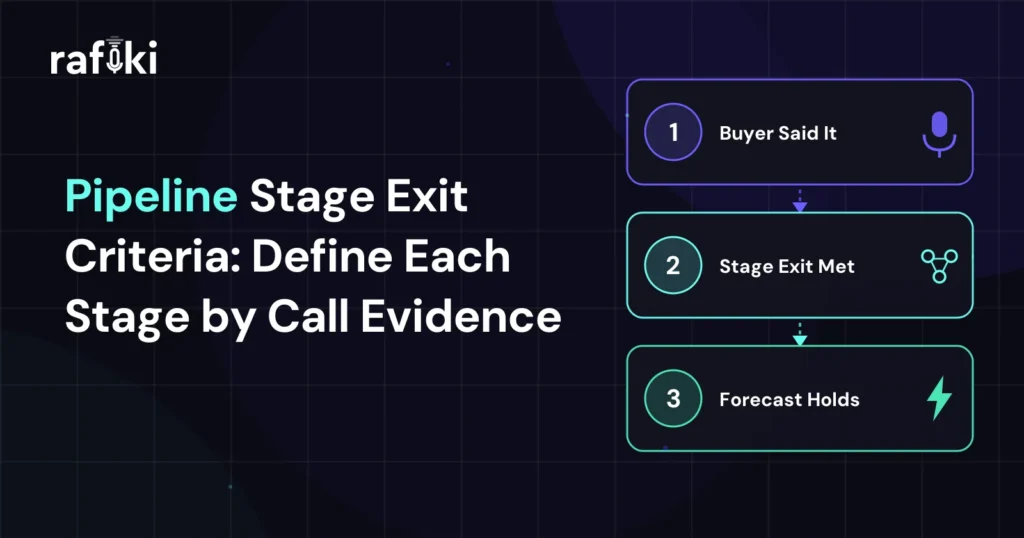
Pipeline Stage Exit Criteria: Define Each Stage by Call Evidence
Nov 2, 2026
12 min read
At 4:10 on a Thursday afternoon, Nadia runs pipeline review for her six AEs and stops on the largest deal in Ethan's Proposal column. Ethan moved it there on Monday, the day he emailed pricing. Nadia asks what the buyer said that put the deal in Proposal, and Ethan answers with a list of things he did. Nobody in the room can name a single buyer statement, and that silence is the problem pipeline stage exit criteria exist to fix.
Nadia opens the recording of Monday's call while the team waits. The buyer's operations director said, "Send me something with numbers and I'll take a look," and then spent ten minutes on an unrelated vendor problem. Nobody from the buyer's side mentioned a budget owner, an evaluation, or a second reader for the proposal. By the evidence, the deal had not finished discovery. The Proposal label described Ethan's week and told Nadia nothing about the buyer's.
The stage definitions in Nadia's CRM read the way Ethan's answer did, as a list of tasks the seller completed. A stage is a claim about where the buyer stands, and the only proof is something the buyer said or did. This guide defines six sales pipeline stages by the buyer statements that move a deal in and out. It then walks through an audit of your own pipeline against recorded calls.
A pipeline stage is a label on an opportunity that says how far the buyer has moved toward a decision. Each stage needs one shared definition, so that "Evaluation" means the same thing on every rep's deals.
In my experience, sales pipeline stages usually start life as the seller's process: book a meeting, run discovery, give a demo, send a proposal. That order helps a rep plan the week, because each stage names the next task. It also lets a deal advance whenever the rep finishes a task, whether or not the buyer moved. Ethan sent pricing, so the CRM let him pick Proposal, and nothing in the system asked whether the buyer wanted one.
A buyer-side definition flips the test. The deal belongs in Proposal when the buyer has asked for a proposal and said who will review it. Seller activity still matters for coaching, but it no longer decides when a deal crosses a stage line. Our guide to the seven sales stages covers the seller's side of the process, and the criteria here sit on top of it.
Pipeline stage exit criteria are the conditions a deal must meet before it leaves one stage for the next, written as evidence someone can check. The strongest versions name a type of buyer statement and point to the call where the buyer said it.
Entry and exit evidence describe the same boundary from two sides. The statement that lets a deal leave Discovery is the statement that lets it enter Evaluation. Write each boundary once and use it in both places. If you keep separate entry and exit lists, the two drift apart and leave a gap where a deal can sit for weeks without failing either test.
Before you adopt any criterion, put it through these tests:
Buyer behavior has also changed what strong evidence looks like in the middle of the funnel. In a May 2026 press release, Gartner said 69% of B2B buyers rely on sales reps to validate AI-generated insights. That habit gives you a new kind of Evaluation evidence: a buyer who reads you an AI-written comparison and asks which parts are wrong is already choosing between options.
Stage dates record when a rep changed a dropdown, and that click can land weeks away from the moment the buyer moved. A deal can reach Evaluation on a call two weeks before the CRM shows it. It can also show Evaluation in the CRM without ever getting there.
After that Thursday meeting, Nadia pulled her team's stage history. Most stage changes landed on Thursday mornings, an hour or two before pipeline review. Her reps were tidying the CRM for the meeting, which is normal, and the timestamps measured the tidying. Any velocity report built on those dates told her how often the team prepared for review.
Nadia's stage history showed a second pattern, with 61 forward moves and two backward moves in a full quarter. Her reps avoided backward moves because they look like failure on the dashboard. A stalled deal keeps its advanced stage while its age keeps growing. Average time in Proposal then climbs for reasons nobody can see in the report.
Stop reporting stage-to-stage velocity until each stage change links to the evidence behind it. The number looks precise, and leadership will build hiring plans on it. Once every stage move cites a call, the dates start to mean what the dashboard claims.
The table below defines six stages by the buyer evidence that brings a deal in and the evidence that lets it out. Its last column names the false positive that most often fools a manager at each stage, so you know where to look first in an audit.
| Stage | Entry evidence (buyer statement) | Exit evidence (buyer statement) | Common false positive |
|---|---|---|---|
| Qualification | Names a problem they own and agrees to discuss it | States what the problem costs and who decides on a fix | Took the meeting to learn about the market |
| Discovery complete | States the cost of the problem and names the decision maker | Asks to evaluate a solution and names criteria and evaluators | Rep filled discovery fields from his own assumptions |
| Evaluation | Names decision criteria and the people evaluating | Says you meet the criteria and asks for commercial terms | One attendee said "this looks great" after the demo |
| Proposal | Asks for a proposal and names who will review it | Reviewer responds with specific changes or confirms budget | Rep sent pricing the buyer never requested |
| Negotiation | Reviewer engages on terms and names procurement or legal | Confirms the signer and the signing date | Discount talks with a champion who cannot sign |
| Closed | Confirms the signer and the signing date | Signed contract, or a stated decision to go another way | A verbal yes logged as Closed Won |
The table gives the rule, and the notes below cover the judgment calls. Managers make these calls when a rep argues that a deal belongs one stage higher. Each note includes the sort of sentence you should be able to find in a transcript.
A buyer in this stage owns a problem and says so out loud, with a line like "renewals in our SMB book are my number this year" on the call. Curiosity about your category does not count. Neither does a meeting the buyer took as a favor to a former colleague. If nobody on the call can describe a problem in their own words, keep the deal in prospecting.
Discovery ends when the buyer has put a cost on the problem and named the person who decides. The cost can be rough, like "if this keeps up we miss the retention target," as long as the buyer said it. At this stage, the most common false positive is a long call where the rep did most of the talking. Afterward he fills the CRM fields from his own notes, and the record looks complete.
A deal enters Evaluation when the buyer names how they will judge options and who will do the judging. "IT needs single sign-on, and our two support leads will run the trial" is enough. A great demo with one enthusiastic attendee falls short, since enthusiasm without criteria gives you nothing to meet.
Proposal starts when the buyer asks for pricing and tells you who will read it. Ethan's deal fails this test, because the operations director asked for "something with numbers" and named nobody else. Unrequested pricing was the false positive Nadia found most often in her own Proposal column, and each of those deals sat one stage away from Best Case.
Negotiation needs someone with signing authority, or their delegate, talking about terms. Procurement joining a call is a strong signal, and so are redlines from the buyer's legal team. A champion asking for a discount is a weak one. That champion may be testing your floor before going to a boss who has agreed to nothing.
Closed Won means a signed contract, and nothing short of it. Lost deals deserve the same discipline: log the loss when the buyer states a decision, including a decision to do nothing. Capture the reason in the buyer's words. A deal that simply stopped replying belongs in a stalled status with a revisit date, so the lost-reason report stays honest.
You can audit a team's open pipeline in one afternoon if you limit it to late-stage deals and cap the time per deal. Say a team of eight reps has 40 open deals in Evaluation or later. At five minutes per deal, the audit takes a little over three hours, which fits between lunch and the end of the day.
Nadia ran this audit the following Tuesday. Ethan's deal went back to Discovery, and he booked a call with the operations director's manager to find out who owned the budget. He grumbled for a day. Then he pointed out that two of his other deals sat a stage too low, because those buyers had already named the signer.
That second finding matters as much as the first, because reps trust an audit once they see it cut both ways. Keep an eye on the middle category too, the deals supported only by an older call. Those deals were real when the evidence came in and may have cooled since. Our deal slippage playbook covers what to do when a deal's newest evidence is going stale.
Exit criteria give each forecast category a test a manager can check against a call. A deal earns Commit once the buyer has confirmed the signer and the date. It earns Best Case once the reviewer has responded to the proposal with specific changes.
Without that link, forecast categories become a second layer of opinion on top of the first. A rep calls a deal Commit because it feels close, and the manager trims it because the rep runs optimistic. The CRO then adjusts the total because managers tend to sandbag. Each adjustment is a guess about another person's guess, and the buyer is absent from all of them.
With stage exit criteria in place, the category follows the evidence. Pipeline holds deals in Evaluation or earlier, Best Case holds deals that have cleared Proposal, and Commit holds deals that have cleared Negotiation. Managers can still override, but each override needs a written reason. Those reasons make the overrides easy to review at quarter end. Our guide to defining Commit by call evidence goes deeper on the category side.
For frontline managers like Nadia, the practical change shows up in the forecast call. She stops asking how a rep feels about a deal and asks where the buyer confirmed the signer. Within a few weeks, her reps arrive with the call timestamp ready.
Seller activities make bad exit criteria because the rep controls them completely. "Demo delivered" and "proposal sent" will always be true on the day a rep needs them to be.
The usual objection is that activity criteria are easier to enforce, since the CRM can check whether a demo meeting exists. That convenience is exactly why they fail. An automated check on rep activity produces a clean report that measures effort and labels it progress. A manager reading that report learns how busy the team was and nothing about the buyers.
Seller tasks still belong in your process, just in a different place. Keep a rep checklist for each stage, such as sending a recap or mapping the buying committee, and coach to it in one-on-ones. Leave that checklist out of the stage definition, and the two stop competing in pipeline review.
The second mistake is a criterion that sounds like buyer evidence but rests on the rep's interpretation, such as "buyer sees value." Ask whose words the criterion needs. If the answer is the rep's, rewrite it until the answer is the buyer's.
The audit above works, but no manager runs it every week by hand. Rafiki AI records the calls behind each open deal and transcribes them in the language the buyer spoke. Nadia can then search a Proposal deal for the moment someone named a reviewer, without replaying 40 minutes of audio. That record of what buyers said, call by call, is what conversation intelligence adds to a pipeline review.
RevOps can turn each row of the stage table into a custom criterion in Smart Call Scoring. The Proposal entry criterion might read "buyer asked for pricing and named a reviewer," while the Negotiation exit criterion checks that the buyer confirmed the signer and the date. Rafiki AI scores each recorded call on those criteria, and Nadia can see which Proposal deals have at least one call that passes the Proposal test. A team that already qualifies with MEDDIC or SPICED can score those letters on the same calls.
When a call passes, Smart CRM Sync writes what the buyer said into CRM fields you pick, such as a custom "Proposal reviewer" field beside the stage. Ethan would stop typing "pricing sent" into a notes box, since the reviewer's name (or the lack of one) would come straight from the call.
The Revenue Agent, one of Rafiki AI's autonomous AI agents, is the single source of truth for deal health and revenue analytics. With deal health and stage in one view, Nadia could have seen Ethan's mismatch on Monday afternoon: a Proposal stage beside a call that named no reviewer. RevOps leaders can use the same view to find the stage whose definition reps misread most often.
Start with Proposal, because a rep can put a deal there with one action of his own (sending pricing), and the next stage feeds Best Case. This week, write a single entry test, such as a buyer request for pricing with a named reviewer. Share it with the team before the next forecast call.
Then run the afternoon audit on Proposal deals only. Expect the column to shrink, and warn your CRO before the numbers move so nobody reads the drop as a bad month. Over the first 30 days, the Proposal total will fall and then settle at a level you can plan around. Once Proposal holds up, move on to Evaluation, where the "this looks great" false positive lives.
Rafiki AI's conversation intelligence platform starts at $19 per seat per month with no minimums and no annual commitment. Start your free trial today or book a demo to see which of your Proposal deals include a call where the buyer actually asked for pricing.
Use as many stages as you have distinct buyer statements that a manager can tell apart on a call. If two stages share the same buyer evidence, merge them, because the difference between them is a seller task. An enterprise team might split Negotiation into commercial review and legal review, and a transactional team selling in two calls might need only four stages.
Yes, a deal should move back whenever the evidence changes, such as a new decision maker joining or a budget freeze. Track backward moves as information and keep them off any rep scorecard, or reps will stop making them. If your team never moves a deal backward, read that as a sign the stages run ahead of the buyer.
A framework like MEDDIC lists what you need to learn about a deal, and exit criteria decide which items the buyer must confirm before each stage. For example, you might require an identified pain to leave Qualification but a named economic buyer to leave Evaluation. The framework supplies the fields, and the exit criteria set the order in which they fill.
RevOps should write and maintain the definitions, the head of sales should approve them, and frontline managers should enforce them in pipeline review. Revisit the wording once a quarter, starting with the stage that had the most unsupported deals in the audit. Avoid mid-quarter changes, because they make this quarter's forecast hard to compare with last quarter's.
Start for free — no credit card, no seat minimums, no long contracts. Just better sales intelligence.