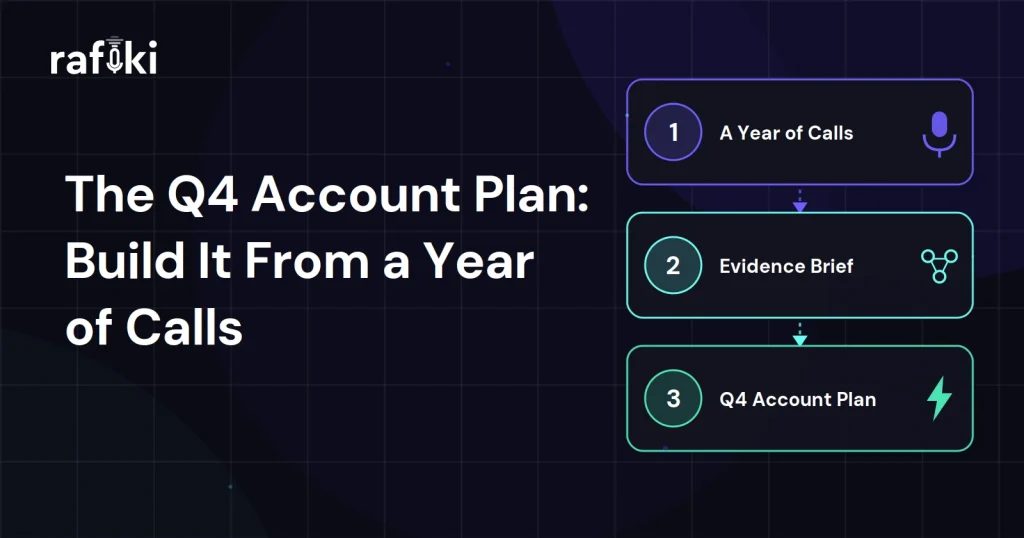
The account plan template arrives in the first week of October, as it does every year. Reps open the CRM, copy last year's plan, and update the revenue number. Then they list the stakeholders they remember and write objectives that sound strategic. Managers review the plans in a single meeting and file them in a folder until next October brings the ritual around again.
Meanwhile, the customer spent the year telling the vendor what it wanted and who felt frustrated. It also said what was changing and where the next opportunity sat, across forty recorded conversations that nobody opened while writing the plan.
The account plan is supposed to be the vendor's strategy for its most important relationships. In practice, reps build it from the CRM's opinion of the account and their own memory, both thinner than the account's own words. Reps know this and treat the plan as a compliance exercise, and leaders know it too, so most stop reading by November.
The customer is the one party who would recognize a good plan, yet the customer never sees it. This article rebuilds the account plan from the conversation record, starting with what the plan is for and why the annual version keeps failing.
From there it sets out the five sections a year of calls should supply and how to write them well. A final section shows how to keep the plan alive through Q4 instead of filing it. The timing matters, because Q4 is when reps write their plans while the customer sets next year's budget.
An account plan is a structured document that sets out the vendor's understanding of a strategic account. It also lays out how the vendor intends to grow and protect the relationship over a defined period, usually a year.
A typical plan covers the account's business context, stakeholder map, and current footprint. It then sets the goals for the period, the risks, and the actions the vendor will take. The account team uses it to agree on one approach and to plan its moves with the customer ahead of time.
The plan is only as good as the understanding behind it. A plan becomes a genuine strategy when it captures the customer's goals, who inside the customer cares, and what they have said about the vendor. If it holds only the CRM's view and the rep's assumptions, it is a form with a strategy-shaped hole in it. The template looks identical in both cases, and only the input differs.
For most accounts, the vendor has already recorded that input. Every sales call, QBR, executive sponsor meeting, support escalation, and renewal conversation from the past year is a primary source on the account. The plan should draw on all of them, and reading every one is no longer as impractical as it used to be.
Why does a document that so many enterprise sales organizations require produce so little? The reasons are structural, and each one points to the same missing ingredient.
The common thread is that reps build the plan without evidence and then cut it off from the evidence that piles up afterward. McKinsey's growth, marketing and sales insights have long treated customer understanding as the foundation of commercial performance. The account plan should hold that understanding, and too often it does not.
A plan built on assumption costs the vendor at the account's most important moments. The team consults it exactly when it matters and finds it wrong.
First, the vendor pursues expansion in the wrong place. Its plan targets the team the vendor wants to sell to, while on the calls a different team has asked for help all year.
Second, the vendor discovers risk late. A stakeholder who went quiet in June still appears as a champion in the October plan. Nobody checked who actually attended calls, because the rep built the plan from the CRM's contact list.
Third, the executive conversation falls flat. Before the exec call, the vendor's executive sponsor reads the plan and learns only the vendor's objectives. What the customer's executive said last time would have made the call useful, and it appears nowhere in the plan. We covered that specific failure in our guide to executive sponsor programs.
Salesforce's State of the Connected Customer research keeps returning to one expectation, which is that customers want vendors to understand them. The account plan is the internal document that decides whether the vendor actually does.
The rebuilt account plan keeps the familiar structure and changes the source. Each section draws on the account's conversations from the past year, which the team's conversation intelligence software has already captured. The rep writes each section so that the customer would nod while reading it.
Skip the vendor's summary of the customer's industry. This section holds the goals and pressures the customer's own people described on calls this year, quoted and dated wherever possible. Suppose the customer's VP said in March that the year was about consolidating tools. If the same VP said in August that it had become about headcount, both statements belong here with a note on the shift.
This stakeholder map comes from call attendance instead of the CRM's contact list. It records who joined calls, how often, and what they said. Just as useful, it shows who the customer named but never brought to a call, and who has been absent since spring.
No org chart the rep can draw is this honest, and the map tells the team which relationships to rebuild before it needs them.
This section collects praise, frustration, unresolved requests, and open commitments, all taken from the record. If the plan skips the three complaints from Q2, the rep has no answer when the customer raises them again. The vendor's own promises live here as well, so the plan's first job is to close them.
This section gathers mentions of other teams, adjacent problems, upcoming projects, and "could this also" questions. It draws on every conversation, including the ones the account executive did not join. The plan should target the places the customer has already pointed to, ranked by how often and how recently they came up.
Budget pressure someone mentioned in passing belongs here, along with a competitor a buyer named on a call. So does a leadership change or a failed rollout elsewhere in the company. These risks will shape the renewal, and the customer stated them months before anyone sat down for the renewal conversation. The plan lists each one with its source and the vendor's response.
The test of a rebuilt account plan is simple to state. After reading the first three sections, would the customer's executive sponsor agree that the vendor understands them? Passing that test takes a few disciplines in the writing.
A plan written this way usually comes out shorter than the template and far more useful. The team can check every line of it against a conversation.
The rebuilt plan stays out of the folder, because the account team treats it as a living brief. As the account's conversations accumulate, the team updates it. That habit matters most in Q4, when the customer sets next year's budget and the vendor pursues expansion.
No rep with a dozen strategic accounts can read a year of transcripts for each one by hand. Rafiki AI is what makes the evidence-based plan realistic for that rep. It captures every meeting and phone call with each account and produces transcripts in 60-plus languages. Because Rafiki AI structures that record, the rep can query a year of calls in minutes.
Gen AI Search builds each section by answering the rep's questions about the account. A rep might start by asking what the customer has said about its priorities this year, and who has attended calls or gone quiet. Later questions can cover praise and complaints, mentions of other teams or projects, and the risks the customer named.
Each answer cites the moment and its date, which keeps the plan's trajectory visible. Stakeholder participation mapping produces section two without anyone counting attendees, and blocker detection and competitive signal tracking fill in section five.
Gen AI Reports turns the plan into a standing account brief for account executives and sales leaders. They can refresh it monthly and read it before every call, in the same format for every strategic account. Smart CRM Sync keeps the account record's methodology fields current from the conversations, so the CRM and the plan stop disagreeing. Rafiki AI's agents gather the evidence autonomously, and the account team still decides the strategy.
| Dimension | Template-driven plan | Evidence-driven plan |
|---|---|---|
| Primary source | CRM record and rep memory | A year of the account's conversations |
| Customer's goals | Vendor's summary | Customer's words, dated |
| Stakeholder map | CRM contact list | Who actually attended, and who went quiet |
| Expansion targets | Where the vendor wants to sell | Where the customer has already pointed |
| Risks | Generic | What the customer named, with source |
| Cadence | Annual, then filed | Refreshed monthly, read before calls |
| Test of quality | Template completed | Customer would recognize it |
Reps write account plans at the quarter turn anyway, and a searchable record makes the rebuilt version faster than the template. In the first two weeks of October, pick the strategic accounts and run the five queries for each one. Draft the five sections from the cited answers, apply the recognition test, and put the first refresh on the calendar for November.
Two practical notes make the first pass easier. Start with the accounts renewing or up for expansion in Q1. The team will read those plans soonest, and a wrong assumption in them costs the most.
Then write the first plan with the account team in one working session over the conversation record. The CSM and the executive sponsor have heard things the rep missed. Reps who work this way walk into their Q4 QBRs and executive calls knowing more about the account than the account expects.
A year of the customer's own words already holds everything the annual account plan needs, so the next step is small. Pick one strategic account renewing in Q1 and run the five queries against its conversation record this week.
From the answers, draft the customer's goals, the stakeholders who attended, and the risks they named. Then bring that draft to a working session with the CSM and the executive sponsor before the account's next QBR.
Rafiki AI makes the same work practical across a whole book of strategic accounts. Its agents pull together a year of evidence in minutes and keep each brief current.
An account plan needs five sections, and the account's conversations over the past year should supply each one. It starts with what the customer is trying to do, in their own words, quoted and dated to show how it has shifted. The stakeholder map comes second, showing who actually attended calls, who the customer named but never brought, and who went quiet.
The third section covers what the customer has said about the vendor, from praise and frustrations to unresolved requests and the vendor's open commitments. Next come the places where the customer has already signaled expansion, including other teams, adjacent problems, and upcoming projects. Finally, the plan records the risks the customer has named, with the source and the vendor's response. The vendor's own objectives follow in a separate section.
Most fail because the input is thin and nobody refreshes it. Reps write plans from the CRM record and memory and skip what the customer said across dozens of calls. Reading those calls used to take days.
The team writes the plan once a year, so it is out of date by the following quarter. It also describes the vendor's ambitions for the account and ignores the customer's stated priorities, which turns its expansion targets into guesses. Because the plan does not change the next call, reps treat it as a filing exercise and leaders stop reading it.
Query the account's conversation record once for each section. To capture goals and how they have moved, ask what the customer has said about their priorities this year, with dates. Then pull attendance across calls to map who has really been in the room.
Searching for praise, complaints, requests, and promises shows what the customer said about the vendor and what the vendor owes. Mentions of other teams, projects, and "could this also" questions point to expansion. Budget pressure, competitor mentions, and leadership changes reveal the risks the customer has named. Throughout, quote before summarizing, date everything, and flag any gap, such as an economic buyer who has not joined a call.
Update it monthly from the conversation record. Once the record is searchable, new conversations add to each section and the plan's owner only reviews what changed. The account team should read the plan before every significant call, including QBRs, executive sponsor meetings, and renewal conversations.
A plan that nobody opens before calls has stopped working as a plan. Q4 is the most important quarter to keep it current, because the customer sets next year's budget and the vendor pursues expansion. Both depend on knowing what the customer said most recently.
For teams that want this year's account plans built from what customers said on calls, Rafiki AI's conversation intelligence costs $19 per seat per month. You can start your free trial today with one strategic account, or book a demo to talk it over with our team first.
Start for free — no credit card, no seat minimums, no long contracts. Just better sales intelligence.