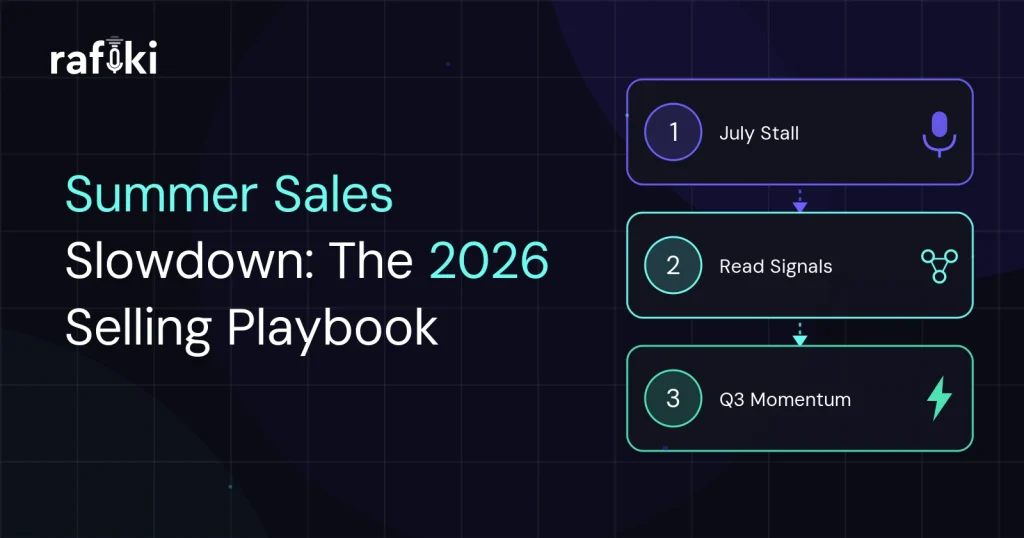
Half the deals that "die in the summer" were killed by the seller's assumption that nothing happens in July.
Every revenue team knows the feeling. The calendar turns to late June, out-of-office replies multiply, and a quiet fatalism settles over the pipeline: buyers are at the beach, decisions are frozen, see you in September. The summer sales slowdown becomes self-fulfilling — sellers stop pushing because they expect silence, and the silence confirms the expectation.
The slowdown is real, but it is also routinely misread. Some deals genuinely pause for vacations and budget timing. Others are quietly dying for reasons that have nothing to do with the season — and the summer narrative gives those losses a comfortable alibi. Meanwhile, a third group of buyers keeps working straight through July, evaluating vendors on lighter calendars with more attention to give. Treating all three the same way is how teams arrive in September behind plan and surprised about it.
The standard reading of a July stall is built on the weakest possible evidence: silence. A prospect goes quiet, the rep checks the calendar, and "summer" becomes the explanation of record. However, silence has at least three different causes, each demanding a different response:
Misdiagnosis is expensive in both directions. Pressing a healthy-but-paused deal annoys a buyer who told you they'd be back August 4. In contrast, politely waiting out a masked stall donates ninety days to a competitor — or to the status quo. The fix is not a better seasonal attitude; it is better evidence about which stall you are looking at.
The distinction is almost always present in the conversation record. A deal pausing for the calendar sounds different from a deal losing conviction, and the differences are specific:
This is where conversation intelligence earns its place in a seasonal playbook. With every call transcribed, scored, and searchable, the question "is this deal paused or dying?" stops being a mood and becomes a query across the deal's actual record — who said what about timing, what commitments are open, and whether buyer engagement was trending down before anyone mentioned a vacation.
Side by side, the two stall types look like this:
| Signal | Calendar stall (healthy) | Masked stall (at risk) |
|---|---|---|
| Timing language | Named return date | "After the summer," unspecified |
| Buyer activity between calls | Continues — docs, intros, answers | Seller-only motion |
| Coverage during PTO | Stand-in delegated by name | No one left behind |
| Last substantive call | Ended with agreed next step | Ended with unresolved objection |
| Engagement trend pre-June | Stable or rising | Declining for weeks |
No single row is conclusive; the pattern across rows almost always is. A deal showing two or more right-column signals was in trouble before anyone packed a suitcase — and deserves a July intervention, not a September check-in.
Before the holiday week scatters everyone, run a triage across every open opportunity. Each deal gets one of three labels, assigned from conversation evidence rather than rep optimism:
The triage echoes the deal-by-deal logic of our pipeline coverage ratio work, compressed into a seasonal pass. Teams that do it report the same surprise: the summer pipeline is smaller than reported and stronger than feared — and the July work plan writes itself.
July's real operational challenge is rotation. The stakeholders in a deal rarely vacation at the same time, so for six weeks the room keeps changing shape — which punishes teams whose deal knowledge lives in one rep's memory and rewards teams whose deals carry a portable, written record.
Four practices keep deals moving through the rotation:
Within the broader season, holiday weeks like July 4 behave differently — they are cliffs, not slopes. Attention drops to near zero for three or four days, then partially recovers. Pretending otherwise produces the classic seller mistake: the carefully crafted proposal sent July 2, buried under two hundred unread emails by July 6, never to surface again.
Working around the cliff is mostly sequencing:
The same logic scales to August's vacation peak in EMEA and other regional rhythms — a global team's "summer" is really a rolling sequence of cliffs, which is one more reason deal records need to be legible to whoever happens to be at their desk.
The teams that arrive in September with momentum spent July differently. Lighter calendars cut both ways: your buyers have fewer meetings, but so do you — and those recovered hours compound if they go somewhere deliberate.
Three investments pay off disproportionately in the back half:
As Harvard Business Review's reporting on sales teams growing alongside AI observes, the compounding advantage goes to teams that pair human attention with systems that never take PTO — and summer is the season that tests exactly that pairing.
Frontline managers face their own version of the season: half the team is out at any given moment, the weekly pipeline meeting keeps losing quorum, and inspection quietly lapses until September's unpleasant surprises. The answer is not more meetings across fewer people — it is shifting the cadence from synchronous to evidence-based.
A summer cadence that holds up:
Managers who run this cadence describe the same September difference: no re-onboarding week, no archaeology, no "what happened with the Hendricks deal?" — the record kept the team aligned while the calendar did its worst.
Rafiki AI's autonomous AI agents are, practically speaking, the part of your team that doesn't go on vacation. Applied to the season:
For sales leaders, the net effect is that the team's knowledge stops being seasonal. Deals carry their own memory through August, and September starts from the record instead of from reconstruction.
Yes — with adjusted expectations and a longer fuse. Response rates dip, but the buyers who do engage are often planning H2 initiatives and have more attention to give than they will in October. Summer outreach is a familiarity investment that converts in September; teams that pause prospecting entirely simply move their slow quarter to Q4.
Ask for the handoff before they leave — who covers, what's delegated, what can advance without them — and get the re-engagement meeting on the calendar for their first week back. A champion who declines to name a stand-in or book the return meeting is telling you something that has nothing to do with vacation; treat that as triage evidence.
Shift the mix from volume to precision. Connect rates drop when targets are out of office, so blanket sequences waste effort and burn goodwill. Instead, prioritize accounts showing live engagement signals, lead with H2-planning relevance rather than urgency, and expect the payoff window to be September. Summer is also the best season for SDR call-skill coaching — lighter calendars on both sides make practice and review actually happen.
Both, which is the problem. Vacation schedules and budget-cycle timing genuinely slow many B2B decisions in July and August. At the same time, the season becomes the default explanation for every silent deal, including ones that were dying in May. The only way to keep the real effect from laundering the fake one is deal-level evidence — which is the entire argument of this playbook.
The summer sales slowdown punishes two teams: the one that pushes every deal as if it's March, and the one that quietly gives up until Labor Day. Both are operating on assumption. The teams that win the season are the ones that can tell, deal by deal, what the silence actually means — and act on the answer with the hours everyone else writes off.
That capability isn't seasonal at all. The same evidence layer that sorts a July stall from a dying deal runs the February pipeline review and the November close push. Summer is just the quarter that makes its absence most expensive.
Rafiki AI's autonomous AI agents keep your deals' memory working straight through vacation season. Plans start at $19 per seat per month with no seat minimums and no annual commitment. Start your free trial today or book a demo before the out-of-office replies start.
Start for free — no credit card, no seat minimums, no long contracts. Just better sales intelligence.