The most important meeting of your deal is one you will never attend. Your champion walks into a conference room, pulls up a slide you have never seen, and pitches your product to the person who controls the budget. Whether that pitch lands depends almost entirely on how well you prepared them for it. Champion development is the discipline of turning an internal believer into a capable inside seller — someone who can present your business case, defend the budget line, and answer procurement's questions without you in the room.
Most account executives treat champions as contacts to update. They send recaps, share decks, and check in on "where things stand." Meanwhile, the actual selling — the steering-committee debate, the hallway conversation with the CFO, the pushback from IT — happens with no rep present and no preparation behind it. The deal's fate gets decided by an amateur presenter armed with a forwarded PDF.
That gap is fixable. This guide covers how to tell a real champion from a friendly coach or an enthusiastic fan, how to arm your champion like you would enable a new hire, how to rehearse the internal pitch, and how to spot champion risk before it quietly kills the deal.
In any meaningful B2B purchase, the buying committee spends far more time discussing your deal internally than they ever spend talking to you. Budget reviews, prioritization meetings, security discussions, executive check-ins — these conversations shape the outcome, and you are absent from every one of them.
Consequently, your real sales team includes people who don't work for you. The question is whether you have developed them or merely updated them. A rep who sends a recap email has transferred information; a rep who has rehearsed the CFO presentation with their champion has transferred capability. Only one of those survives contact with a skeptical executive.
This is why champion development deserves the same rigor you apply to discovery or negotiation. It is not relationship maintenance. It is enablement, aimed at the one seller who can access rooms you cannot.
A champion is a stakeholder who has access to power, a personal stake in the outcome, and a demonstrated willingness to spend political capital on your behalf. Miss any one of those three, and you have something else — useful, perhaps, but not a champion.
Apply the tests explicitly:
A coach gives you information — org charts, process details, honest read-outs — but won't advocate. A fan loves your product and tells you so, yet has no access, no stake, or no appetite for risk. Both are valuable. Neither will sell for you when it matters, and confusing them with a champion is one of the most expensive misreads in sales.
You rarely need to ask "are you my champion?" — the answer is already in how they talk on your calls. Language is the cheapest, most reliable diagnostic you have.
Listen for these signals:
Review your last three calls on any strategic deal and score your presumed champion against these markers. If the transcript shows enthusiasm without ownership, you have a fan, and your close plan is standing on air.
Here is the reframe that changes everything: champion development is sales enablement with an audience of one. Everything your company does to make a new rep effective — messaging, objection handling, proof points, practice — your champion needs a lightweight version of, because they are about to perform a rep's job without a rep's training.
As Harvard Business Review notes in its analysis of how generative AI will change sales, sellers are increasingly freed from mechanical work to focus on exactly this kind of high-judgment activity: preparing people, not just paperwork. The reps who win complex deals in 2026 spend that reclaimed time coaching their inside seller.
Consider what your champion actually faces: executives who ask harder questions than prospects ever ask vendors, plus objections from finance, security, and rival budget owners — often in the same meeting. Furthermore, they carry personal risk you never carry. If the project fails, you lose a deal; they lose credibility they spent years building.
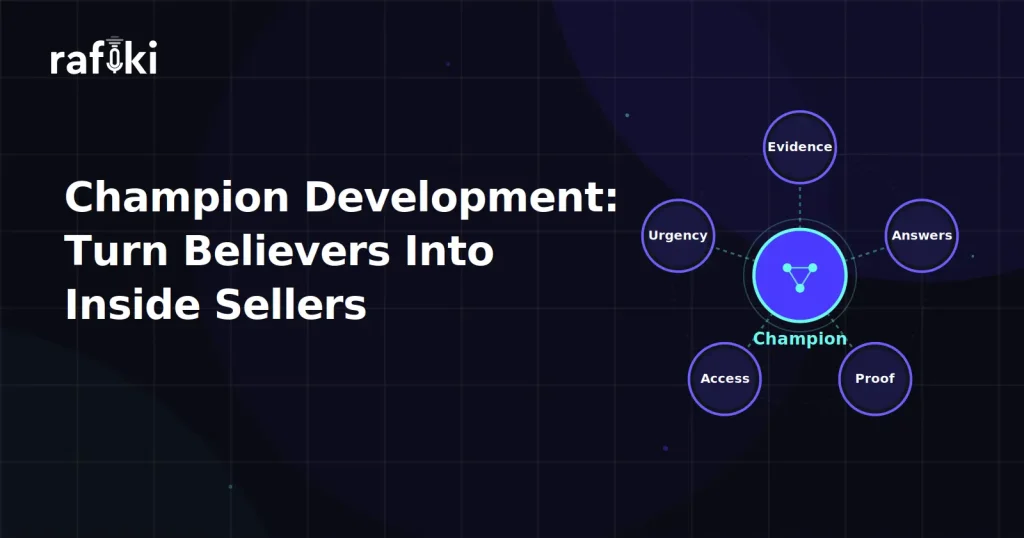
Enablement for one person means giving them three things: a business case in their company's own vocabulary, anticipated objections with ready answers, and proof they can point to. The next sections take each in turn.
Your pitch deck is written in your language. Your champion needs one written in theirs. If their leadership talks about "operational resilience," a slide about "productivity gains" will land sideways — same idea, wrong dialect, diminished force.
Build the internal business case around three components:
Keep the whole package short. Your champion gets minutes on an executive agenda, not an hour. One page they can defend beats ten pages they must summarize badly.
The single highest-leverage question in champion development is disarmingly simple: "Would it help if we prepped that meeting together?" Most champions say yes with visible relief, because presenting an unfamiliar business case to their own executives is genuinely stressful.
Run the rehearsal like a dry run, not a briefing:
Anchor the rehearsal to a shared timeline. A mutual action plan that names the internal presentation as an explicit milestone — with a prep session scheduled before it — turns rehearsal from a favor into a standard step in the process.
The difference between updating a contact and developing a champion shows up in every interaction. Use this comparison to audit how you are actually operating on your top deals:
| Dimension | Contact You Update | Champion You Develop |
|---|---|---|
| What you send | Recap emails and your standard deck | A business case in their company's vocabulary |
| Objection handling | They improvise when challenged | Anticipated objections scripted with answers |
| Proof | Generic logos and claims | Specific evidence from similar customers |
| Internal meetings | You hear about them afterward | You rehearse them beforehand |
| Language on calls | "We're discussing it" | "I'm presenting it Thursday — help me prep" |
| Your visibility | Status updates, filtered and late | Named obstacles, real timelines, honest reads |
| Deal risk | Invisible until the "we went another way" email | Surfaced early, worked jointly |
If the left column describes your biggest deal, the deal is not being sold right now — it is being summarized. There's a difference, and buying committees can feel it.
Champions weaken quietly. Nobody announces, "I've stopped fighting for this." Instead, the signals leak out on calls, and reps who aren't listening for them get blindsided weeks later. This is where conversation intelligence earns its keep: the evidence of champion decay is almost always in the recordings before it shows up in the forecast.
Watch for four patterns:
None of these signals appears in a CRM field. All of them appear in conversation. Reps who review their calls for champion language — or better, whose tools surface it automatically — see the risk while it is still workable.
Even a superb champion is a single point of failure. People change roles, lose internal battles, go on leave, and leave companies — frequently at the least convenient point in your deal cycle. Single-threaded champion dependence is the quiet deal killer precisely because everything looks healthy right up until it isn't.
The insurance policy is deliberate multithreading. As we covered in our deep dive on multithreading in sales, building relationships across the buying committee protects the deal and improves it: more perspectives surface more requirements, and more advocates create more internal momentum.
Apply multithreading specifically to champion development:
The goal is simple: no deal in your pipeline should die because one calendar invite said "Farewell happy hour."
Everything above depends on one raw material: an accurate memory of what was actually said across months of calls — the exact phrase your champion's CFO used for the problem, the objection the IT director raised in week two, the moment your champion quantified the cost of doing nothing. Human memory drops most of this within days; your recordings keep all of it.
This is where Rafiki AI turns champion development from an art into a system. Its autonomous AI agents analyze every recorded conversation, so the evidence your champion needs is already indexed when the internal presentation gets scheduled. In practice, that looks like this:
The compounding effect is what matters. Every call you record makes the next champion easier to arm, because the proof points, objections, and vocabulary are already captured. Start your free trial today and see what your existing call history already knows about your champions.
Champion development is the difference between hoping someone sells for you and making sure they can. Real champions pass three tests — access to power, personal stake, willingness to spend capital — and their language on calls tells you which one you have long before the deal does. Once you have found one, treat them like the seller they are about to become: give them a business case in their company's vocabulary, script the objections they will face, hand them proof from similar customers, and rehearse the meeting where they present you.
Then protect the investment. Listen for cooling passion, slipping meetings, and "we" turning into "they." Build a second champion before you need one. Above all, mine your conversation history — the exact evidence and language your inside seller needs was almost certainly said out loud on a call you already recorded.
The rooms you never enter will keep deciding your deals. The only question is whether the person speaking in them is prepared.
Champion development is the deliberate practice of equipping an internal advocate to sell on your behalf inside their own organization. A champion is a stakeholder with access to power, a personal stake in the outcome, and a willingness to spend political capital to get your deal done. Developing that person means treating them like a new seller who needs enablement: a business case written in their company's own vocabulary, anticipated objections with prepared answers, proof points from similar customers, and rehearsal before the internal meetings where they present your solution. The discipline matters because most of the real selling in a complex deal happens in internal meetings the vendor never attends, so the champion's ability to argue the case largely determines the outcome.
Apply three tests. First, access: can they book time with the economic buyer and be taken seriously? Second, stake: does the outcome affect a metric, project, or career goal they personally own? Third, capital: have they visibly taken a risk for you, such as arguing for budget or putting their name on the recommendation? A coach shares useful information but won't advocate; a fan is enthusiastic but lacks access or appetite for risk. Their call language is the fastest diagnostic. Champions say "I" and speak in specifics — naming objectors, asking for materials tailored to their audience — while fans offer general enthusiasm. If recent calls show excitement without ownership, assume you have a fan and keep looking.
First, don't panic — but do move fast, because momentum decays quickly once an advocate exits. Reconnect with the other relationships you built (this is exactly why multithreading is champion insurance) and identify the person inheriting your champion's responsibilities, since they inherit the problem your solution addresses. Bring the successor up to speed using your conversation history: summaries of key calls, the business case in the company's own language, and the evidence already gathered make re-onboarding dramatically faster than starting discovery over. Also, follow your departed champion — they often become a buyer at their next company. If one departure could kill the deal, the deal was under-threaded from the start.
Conversation intelligence gives you a searchable record of everything said across an account, which is precisely the raw material champion development runs on. It lets you retrieve the exact ROI language and problem descriptions stakeholders used, so the internal business case echoes the company's own words. Call summaries give your champion an accurate, structured briefing to adapt for internal circulation instead of reconstructing months of discussion from memory. Meanwhile, analysis of tone, participation, and phrasing across calls surfaces champion risk early — cooling enthusiasm, "we" becoming "they," or mentions of role changes — while there is still time to respond. For sales leaders, reviewing real calls shows whether reps are genuinely testing for access, stake, and capital, which turns champion development into a coachable team skill.
Rafiki AI's conversation intelligence platform starts at $19 per seat per month with no minimums and no annual commitment. Start your free trial today or book a demo to see how autonomous AI agents help you find, arm, and protect the champions who close your deals.
Start for free — no credit card, no seat minimums, no long contracts. Just better sales intelligence.