Nine meetings booked in two weeks was more than Aisha's newest rep had booked all of last month. That count sat in the top tile of her new AI SDR agent's dashboard when Aisha, an SDR manager at a cybersecurity software company, opened it on Monday. Later that morning she learned that three of those meetings came from one account. The agent had emailed four directors there in the same week, with nearly identical opening lines.
At that account, the VP of IT forwarded the thread to the assigned AE with a one-line note. He asked whether anyone at the vendor read these emails before sending them. By Wednesday, two of the three meetings had cancelled. Noah, Aisha's strongest human SDR, had worked that account for a month, and his own call with the VP disappeared too.
The agent wrote competent emails, and the dashboard counted correctly. Nobody had told the agent that Noah was already working the account, and nobody reviewed drafts going to senior titles. The dashboard also counted meetings booked, while the number that pays an AE is meetings held. Those are evaluation and management questions, yet Aisha's team had spent its evaluation comparing sample emails in vendor demos.
An AI SDR agent is software that does parts of a sales development rep's job under rules a person sets. Those parts usually include research, outreach, reply handling and booking. The agent works from the signals and data you give it, produces messages or calls, and hands interested prospects to a human.
Products sold under the label work in different channels. Some write and send email, some work inside a social network, and some place outbound phone calls with a synthetic voice. Because the label covers so much ground, first ask which parts of the SDR job a product does alone. Then ask which parts it hands back to your team.
An AI SDR agent differs from a sequencing tool because it makes decisions on its own. A sequence sends step three on day five, whatever the prospect said. An agent reads the reply, picks a response, and chooses whether to send, wait or hand off. When one of its rules is wrong, the agent applies that rule to every account it touches. That is how four directors at one company got the same opener in a single week.
An AI SDR agent handles the repeatable, high-volume parts of prospecting well. It struggles with judgment, especially in discovery, account politics and knowing when to stop. Here is the work it can take on:
Discovery judgment is where agents fall short. Noah knew the VP of IT had just finished consolidating vendors and wanted fewer tools. He heard that on a call and never typed it into the CRM. An agent cannot act on context that lives only in a rep's head, and it has no instinct to hold back when an account feels sensitive.
Agents also struggle with ambiguous replies. Suppose a prospect writes, "interesting timing, we just signed with someone." That line might close the door, or it might open a renewal conversation for next year. Noah would answer by asking when the new contract comes up for renewal. By contrast, an agent running a default rule tends to push for a meeting or mark the contact as lost.
The Salesforce State of Sales 2026 announcement drew on a survey of 4,050 sales professionals. It found that 87% of sales organizations use some form of AI and that 54% of sellers have used agents. The survey also showed that top performers are 1.7 times more likely to use prospecting AI agents.
Read that last figure with some care. It shows that top performers use prospecting agents more often, but it cannot show that the agents made them top performers. In my experience, strong reps also pick up useful tools earlier than their peers, which would produce the same gap. For an SDR leader, the safer reading is that prospecting agents already sit in the workflow of your best reps. The open question is how to run one without a Monday like Aisha's.
Forrester predicts that AI agents will influence 75% of B2B purchase decisions in 2027. It also expects buyers to double their human interactions to validate AI-generated recommendations. The same release predicts that two-thirds of providers will lose deals because buyers cannot verify claims.
For an outbound program, the two-thirds prediction is a warning about the agent's copy. An invented customer name or an unsupported savings figure in a first email is exactly the kind of claim a buyer cannot verify. Meanwhile, the prediction about human interactions shows where human SDRs should add hours. Those hours belong on the calls where a buyer checks what an AI told them. Harvard Business Review's piece on how successful sales teams are embracing agentic AI looks at teams putting agents to work alongside people.
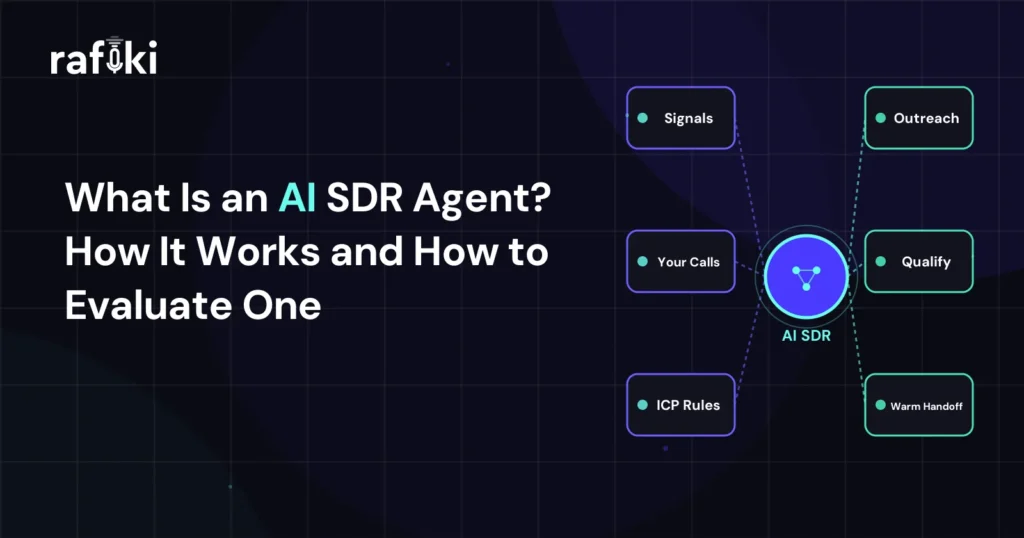
An AI SDR agent runs a loop that starts with a signal and produces a draft or a call. The draft passes whatever approval you require, then ends in a handoff or a logged outcome. Each step has a setting you control, and Aisha's Monday traced back to one step left on its default.
Step two is the one Aisha's team skipped. Their agent could read contacts but not opportunity ownership, so it treated Noah's active account as a cold one. Ask every vendor to show you, live, what the agent does with an account that has an open opportunity and an active owner.
Step four deserves a deliberate plan. Start with approval on every message for the first two weeks, then relax it for low-risk segments once the drafts hold up. Keep approval permanent for executive titles and your named strategic accounts. One bad email to a VP cost Aisha a meeting that Noah had spent a month earning.
Evaluate an AI SDR agent on how it behaves in your pipeline, with your data, under your rules. A polished demo on sample accounts proves only that the vendor can demo well. Bring this checklist to every evaluation call and ask to see each answer live in the product.
| Criterion | Question to ask | What good looks like |
|---|---|---|
| Account awareness | What does the agent do with an account that has an owner and an open deal? | It skips the account or routes the signal to the owner |
| Approval controls | Can we require approval by title, segment, or account list? | Rules you set per campaign, with a log of every approval |
| Data sources | What does the agent read before it writes? | Your CRM, your recorded calls, and your messaging, each one cited |
| Claim accuracy | How does it avoid invented customers, numbers, or features? | Claims come only from a knowledge base you control |
| Reply handling | What happens with referrals, objections, and "not now" replies? | Referrals become new contacts, and objections go to a human |
| Handoff quality | What does the AE receive with a booked meeting? | The thread, research notes, and the prospect's stated reason to meet |
| CRM logging | Does every touch and outcome land on the record? | Activities and next steps written without rep data entry |
| Measurement | Can it report meetings held and pipeline created? | Reports by held meeting, opportunity, and cost |
| Exit terms | What happens to our data if we cancel? | A full export of contacts, messages, and outcomes |
Weight the first two rows above the rest. An agent that passed on account awareness would have skipped Noah's account. Likewise, an approval rule on director titles would have put all four emails in front of a person. No reporting feature makes up for failing either row.
An AI SDR agent needs clean account ownership, accurate contact data and the language your buyers use for their problem. That language lives in your recorded discovery and sales calls, and a generic persona shipped with the product cannot supply it.
A generic persona says the VP of IT cares about security, cost and efficiency. Every VP of IT reads some version of that email each week. Your recorded calls say something narrower. For example, IT leaders in your mid-market segment may keep raising audit preparation time and tool sprawl after an acquisition. An agent that opens with that problem, in roughly the words those buyers used, sounds like someone who has talked to their peers.
Mining that corpus takes work, and our piece on outbound personalization from your call corpus walks through the process. Start with last quarter's discovery calls in one segment and pull the problems buyers raised in their own words. Then turn the top few into campaign angles.
Account ownership data decides how often the agent collides with live deals. Every account with a missing or wrong owner in the CRM is an account where the agent can email into an active opportunity. Fix ownership and opportunity status before launch, because the agent will trust whatever the CRM says.
Measure an AI SDR agent by meetings held that AEs accept as qualified, and by the full cost of each one. Emails sent and open rates describe activity, and an agent can produce unlimited activity.
Cost per booked meeting is the right starting formula: total monthly cost divided by meetings booked. Total cost has to include the license, any data subscriptions and the human time spent reviewing drafts and handling handoffs. Then run the same math on meetings held, because no-shows hide inside the booked number.
Say a team pays $4,000 a month for the agent and its data. One SDR also spends 20 hours a month reviewing drafts, at a loaded cost of $50 an hour. That brings the monthly total to $5,000. If the agent books 40 meetings and 26 of them happen, the team pays $125 per booked meeting and about $192 per held meeting. These numbers are illustrative, so run the same calculation on your human SDRs before you compare. Our guide to cost per booked meeting covers how finance teams fold it into CAC.
Track two guardrail metrics alongside cost. Account collisions count how often the agent contacted an account with an active owner, and the target there is zero. AE acceptance rate shows what share of booked meetings the AE agrees were worth taking. If that rate falls, the agent is booking for the dashboard.
Once an agent handles research and first touches, the human SDR moves to judgment work. That means high-intent inbound, named accounts, real replies and supervising the agent. Answer the headcount question after you see which of those jobs fills the week.
Inbound is the clearest case for a human. When a qualified prospect fills out a demo form, a fast call from a person wins the first conversation, as our guide on speed to lead explains. The agent can route and research that lead in seconds, while the human makes the call.
Noah's new week at Aisha's company looks different from his old one. He works the top fifty accounts by hand and reviews every agent draft going to a director or above. Any thread where a prospect asks something the knowledge base cannot answer now lands with him. If Forrester is right that buyers will double their human interactions, that last job will grow.
SDR leaders also pick up a new management task, because an agent needs the same oversight as a new rep. In practice, that means a weekly sample of sent messages, a review of every account collision and a clear owner for the agent's campaigns. Our playbook on managing AI agents like reps lays out that cadence.
Rafiki AI's AI SDR is its Voice Agent, which the AI sales agents page lists as Coming Soon with a waitlist. It works the phone channel only and places outbound voice calls. Because it does not write or send email, an email collision like Aisha's falls outside what it does. Even so, the account-awareness and approval rows of the checklist still apply to a calling agent.
The part you can use today is the groundwork from the data section. Rafiki AI's Notetaking Agent records and transcribes your human team's calls in more than 60 languages. That includes dialer calls through Aircall and OpenPhone. With Gen AI Search, Aisha can pull last quarter's calls where mid-market IT leaders talked about audit preparation. Their wording then becomes the opening line of Noah's next campaign.
Step two of the loop, checking ownership and open deals, only works when the CRM is current. Smart CRM Sync captures data from Noah's calls and syncs it to Salesforce, HubSpot or Zoho. As a result, an account he is actively working carries a recent next step that any outbound agent can check first. Run the evaluation checklist against Rafiki AI the same way you would against any other option.
Before any AI SDR agent touches your full target list, run it for two weeks on one segment with no active owners. Require approval on every message during that time. Give a human SDR a matched list of similar accounts over the same two weeks, then compare held meetings, AE acceptance and cost on both sides.
Aisha restarted her pilot this way after the Monday surprise. She limited the agent to accounts with no open opportunity and sent every director-level draft to Noah. Her dashboard's top tile now shows meetings held where it used to show meetings booked. The first week produced fewer meetings, and none of them cancelled.
At the end of the two weeks, decide which segments the agent earns on its own and which stay with people. Write that split down and revisit it after one full sales cycle. By then, the held meetings have had time to turn into pipeline or fall away.
Rafiki AI's conversation intelligence platform starts at $19 per seat per month with no minimums and no annual commitment. Start your free trial today or book a demo to search last quarter's discovery calls for the phrases your next outbound campaign should open with.
Put each of these to a vendor during the demo, and ask to see the answer working on a live account where you can.
For narrow, high-volume segments with simple products, an agent can handle most first touches with light human review. Complex deals, named accounts and high-intent inbound still need people. Plan for a smaller human team doing different work, and size it after the pilot shows where the agent holds up.
Rules on automated calling, email and disclosure differ by country and state, so have counsel review any autonomous outreach program before launch. Beyond the legal minimum, a buyer who later discovers an undisclosed agent has a reason to doubt everything else you told them. That risk matters more now that buyers are checking vendor claims more closely.
Give the SDR leader ownership of campaigns, messaging and approval rules, since those are sales judgment calls. RevOps should own the data the agent reads, especially account ownership and opportunity status. When a collision happens, both owners review it together, because the cause can sit in either a rule or a stale record.
It can run without them, but its messaging will then sound like everyone else's generic persona copy. Recorded calls give it the problems and phrases your buyers actually use. Confirm that your recording consent notices and retention policy cover this use before you connect the two systems.
Start for free — no credit card, no seat minimums, no long contracts. Just better sales intelligence.