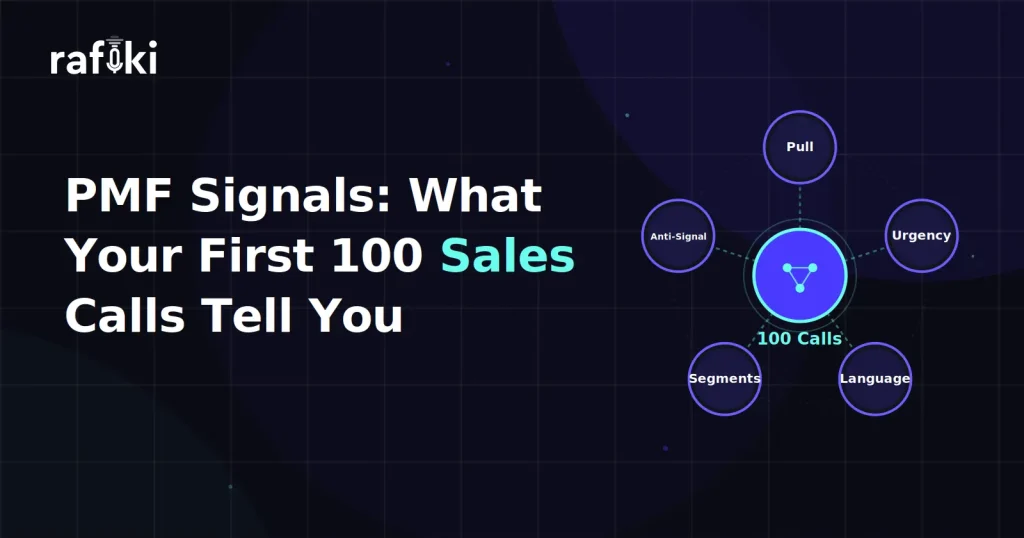
Every founder knows the ritual. You open the dashboard, squint at the activation curve, re-slice the retention cohorts, and ask the same question as last week: do we have product-market fit yet? Meanwhile, the strongest PMF signals your company will ever generate happened on Tuesday afternoon. They were spoken out loud, on a sales call, by a prospect who described your problem better than your landing page does. Then the call ended, and the evidence evaporated into memory.
That is the quiet tragedy of early-stage go-to-market. Founders treat product-market fit as a metrics question when, across the first hundred conversations, it is fundamentally a listening question. Dashboards need volume before they mean anything. Conversations reveal the truth one prospect at a time, starting with call one.
What follows is a field guide to reading those hundred calls: the pull signals that indicate genuine fit, the anti-signals founders rationalize away, and the practical system for capturing all of it before it disappears.
PMF signals are the observable pieces of evidence — behavioral, verbal, and emotional — that indicate a product is solving a problem people urgently want solved. Product-market fit signals come in two families. The first is quantitative: activation rates, retention curves, organic referral patterns, expansion behavior. The second is conversational: what prospects actually say, ask, and do when a founder shows them the product for the first time.
The quantitative family gets all the attention because it feels rigorous. However, quantitative signals are lagging indicators. A retention curve only describes fit months after the buying decision, and it needs a meaningful user base before its shape is trustworthy. During a founding team's first hundred sales calls, the dashboard is mostly noise.
Conversational signals are the opposite: they are leading indicators, available from day one, and richest exactly when the quantitative data is thinnest. The catch is that they only exist if someone captures them. Memory is not capture. By call forty, no founder accurately remembers what the prospect on call seven said about their workflow — and that prospect may have handed you your positioning.
Surveys measure what people are willing to claim. Sales calls measure what people are willing to do. That gap is where most false positives about product-market fit are born.
Buyers perform in surveys. Ask a friendly design partner "would you pay for this?" and social dynamics push them toward yes. The question costs them nothing, so the answer carries almost no information. In contrast, a sales conversation has stakes. The prospect is spending real time, weighing real budget, and imagining a real rollout inside their own company. When they push back, negotiate, or lean in, they are revealing rather than performing.
Urgency, in particular, is audible in a way no survey can capture. It shows up in interruptions, in a prospect finishing your sentences, and in how quickly they volunteer their current painful workaround. Research published by Harvard Business Review makes a similar point about discovery: the richest insight into what clients actually need lives inside sales conversations. Modern AI now makes that insight extractable rather than trapped in sellers' heads.
None of this means quantitative validation is worthless. It means the sequence matters. Conversations tell you where fit might be; metrics later confirm whether you were right. Founders who skip the listening phase and go straight to dashboard-watching are trying to read a book by weighing it.
Pull is the defining sensation of product-market fit. Instead of pushing the product uphill, you feel the market dragging it out of your hands. Analysts at McKinsey have long argued that growth leaders separate themselves by reading customer signals earlier and acting on them faster than their peers. On early-stage sales calls, pull has four unmistakable sounds.
The strongest pull signal is a prospect who narrates the pain unprompted, in vivid, specific language. You ask an open question and they pour out the story: the spreadsheet held together with duct tape, the deal that died because nobody caught the warning sign. Vivid language matters because people only develop rich vocabulary around problems they live with daily. A prospect who describes the pain in generic terms probably read about it; one who describes it in war stories is bleeding from it.
Listen to the grammatical tense of the questions. Low-fit prospects ask present-tense feature questions: what does it do, how does it work, what integrations exist. High-fit prospects skip ahead to future-tense implementation questions: when can we start, how long does onboarding take, who on my team needs access. Implementation questions mean the prospect has already bought the premise and is mentally deploying the product. That leap — from evaluating to imagining ownership — is fit announcing itself.
Genuine urgency is social. When a problem truly hurts, the prospect shows up to the second call with a teammate, a manager, or the budget owner — without you asking. Internal evangelism this early is precious because it costs the prospect something: they are spending their own credibility inside their company. Nobody stakes reputation on a nice-to-have.
Early products are janky, and prospects know it. The revealing question is how they respond to the jank. A low-urgency prospect uses a missing feature as a polite exit. A high-urgency prospect negotiates around it: "we can live without that for now," "can we do that part manually until you ship it." Tolerance of rough edges directly measures pain intensity, because people only accept an imperfect solution when the status quo hurts more than the imperfection.
False positives kill more startups than silence does, because silence at least tells the truth. The dangerous calls are the pleasant ones. Four anti-signals show up constantly in first-hundred-call transcripts, and founders explain every one of them away.
The pattern across all four is comfort. Each anti-signal lets the founder end the call feeling encouraged, which is precisely why they compound unchecked. The discipline is to treat pleasantness as data about the prospect's manners, not about your product.
Both families of evidence matter over the life of a company, but they answer different questions on different timelines. The comparison below shows why conversation-based PMF signals dominate during the first hundred calls.
| Dimension | Dashboard PMF Signals | Conversation PMF Signals |
|---|---|---|
| What they measure | Aggregated behavior after adoption | Live buyer reactions before and during the sale |
| When they become useful | Months in, once volume accumulates | From the very first call |
| Nature of the indicator | Lagging — confirms past fit | Leading — predicts future fit |
| Typical examples | Activation curves, retention cohorts, NPS | Unprompted pain stories, "when can we start," colleagues joining call two |
| Main failure mode | Averages that hide winning subsegments | Founder memory bias when calls go unrecorded |
| How urgency appears | Slowly, as a flattening retention curve | Audibly, in tone, tense, and follow-up speed |
| Best used for | Confirming and scaling fit | Finding fit and writing positioning |
The takeaway is not that dashboards lie. It is that at low volume they whisper ambiguously, while conversations speak plainly — provided someone is systematically listening.
Here is the situation most founders actually face after a hundred calls: the evidence is mixed. Some prospects leaned in hard, others drifted away, and the aggregate picture feels like a coin flip. Mixed evidence is rarely a verdict of "no fit." More often, it means product-market fit exists but is hiding inside a subsegment, diluted by everyone else.
The fix is archaeology. Instead of averaging the hundred calls, sort them. Put every conversation on a spectrum from "pulled hard" to "politely passed," then examine what the pullers have in common. The dimensions worth digging through include:
Almost always, a pattern emerges that the aggregate concealed. The ideal customer profile stops being a whiteboard guess and becomes an empirical artifact — the ICP quite literally writes itself from the transcripts. This is also the moment to resist ego. Founders often discover that the segment pulling hardest is not the glamorous one they pitched investors, and the honest move is to follow the pull anyway.
Buried in your best calls is a copywriting asset no agency can produce: the exact words high-urgency prospects use to describe their pain. Founders spend weeks inventing messaging, debating adjectives, and testing taglines. Meanwhile, prospect after prospect has already said the resonant version out loud.
The practice is simple: stop inventing, start transcribing. When a prospect says the problem in a way that makes your other prospects nod, that phrasing belongs everywhere:
Language extracted this way also compounds the segment work above. Different subsegments describe the same problem differently, so vocabulary itself becomes a segmentation key. When your messaging speaks the winning segment's dialect, qualified buyers self-select in and poor-fit prospects self-select out — which quietly improves every call that follows.
Everything above depends on one operational decision: treating the first hundred calls as a dataset instead of a blur. In practice, that means three habits, started before call one rather than after call fifty.
Record everything, with consent. Ask permission, then capture every discovery call, demo, and follow-up. The founder who records from the beginning owns a searchable archive of market truth; the founder who does not is running the company on vibes and recollection. This is where a conversation intelligence platform earns its place in an early-stage stack — it turns raw recordings into structured, queryable evidence rather than a folder of files nobody revisits.
Tag reactions while they are fresh. After each call, label it: pull or push, which pain language surfaced, which anti-signals appeared, what segment the prospect belongs to. Rafiki AI automates most of this grunt work for startup founders. Its Smart Call Summary captures the moments that matter from every conversation without anyone typing notes. Meanwhile, Gen AI Search lets you interrogate the whole archive in plain English — "show me every call where the prospect brought a colleague," for example. Questions that once required re-listening to dozens of recordings now take seconds. Start your free trial today and your very next call becomes part of the dataset.
Review monthly as a founding-team ritual. Once a month, the founding team sits down with the strongest and weakest calls and asks the archaeology questions: who pulled, what did they say, what changed since last month. We covered the mechanics of this discipline in our guide to instrumenting founder-led sales before the first sales hire. The same instrumentation that de-risks your first hire also makes PMF signals legible. As the pipeline grows, that call archive feeds directly into the prediction habits we described in the founder's guide to forecasting with a three-person sales team.
There is a longer-term payoff too. When you eventually raise a priced round, investors will probe your product-market fit story hard. A founder who answers with organized call evidence — real prospects, real language, real pull — walks into diligence with receipts instead of anecdotes. Your future fundraising self will thank your present recording self.
Sometimes the hundred calls deliver a verdict nobody wants. No segment pulls, the vivid pain stories never come, and every conversation ends in polite interest or a redesign request. Founders in this position face two kinds of pain. There is the sharp pain of admitting the thesis missed, or the long dull pain of grinding against a market that has already answered.
The honest read has a few markers. First, exhaust the segment archaeology — a pivot decision made on aggregate data alone is premature, because fit so often hides in a subsegment. Second, distinguish between "wrong product" and "wrong market": if one segment described a burning problem your product almost solves, the move may be a narrow repositioning rather than a full pivot. Third, look at trajectory. If calls ninety through one hundred sound exactly like calls one through ten despite everything you changed, the market is not warming up; you are just getting used to the cold.
Paradoxically, this is where a recorded call archive is most valuable. Pivoting founders who kept transcripts do not start from zero. Instead, they start from a hundred documented conversations full of adjacent problems, rejected hypotheses, and needs prospects mentioned in passing. Many strong pivots are discovered, not invented, sitting in the transcript of a call that felt like a failure at the time.
Product-market fit does not announce itself in a chart first. It announces itself in a voice — a prospect describing your problem in their own vivid words, asking when they can start, and dragging a colleague into the next call. They shrug off your rough edges because the pain is real. Those are the PMF signals that matter in the first hundred calls, and they are perishable. Unrecorded, they decay into founder folklore within weeks.
The founders who find fit fastest are not the ones with the best dashboards. They are the ones who treat every early conversation as evidence: captured with consent, tagged while fresh, sorted by segment, mined for language, and reviewed as a team ritual. Do that, and the hundred calls stop being a blur of meetings and become the most honest instrument your company owns. The market is already telling you whether you have fit. The only question is whether anyone is writing it down.
There is no magic threshold, but the first hundred calls is a useful working target because it forces enough volume to separate patterns from personalities. A handful of enthusiastic calls can be luck, charisma, or friendly design partners telling you what you want to hear. Across a hundred conversations, however, consistent pull from a definable segment is very hard to fake. The more important variable is not the count but the capture: ten well-recorded, well-tagged calls teach you more than a hundred that live only in memory. In addition, reliability improves when the calls span segments deliberately — different company sizes, roles, and workflows — so that when pull appears, you can say precisely where it came from and where it did not.
PMF signals are the broad family of evidence that fit exists, while product-market fit metrics are the quantitative subset — retention curves, activation rates, NPS, expansion behavior. The practical difference is timing and volume. Metrics are lagging indicators that need months of usage data before they stabilize. Conversational signals, in contrast, are leading indicators available from the very first sales call. Early on, metrics mostly reflect noise, whereas the way prospects talk — unprompted pain stories, implementation questions, colleagues joining the second call — reflects genuine demand. The healthiest sequence uses conversational signals to locate probable fit, then uses metrics later to confirm it and to guide scaling. Treating either family as sufficient on its own leads founders astray.
Partially, but the error rate is high. Founders are the most motivated listeners in the company and also the most biased — every ambiguous reaction gets remembered charitably, and painful anti-signals fade first. Without recordings, segment archaeology becomes impossible because nobody can re-sort a memory by who leaned in. The language goldmine disappears too: positioning built from paraphrased recollection loses exactly the vividness that made the prospect's words powerful. Recording with consent, paired with a conversation intelligence layer that summarizes and tags each call, removes the bias without adding workload. As a bonus, the archive becomes an onboarding asset for the first sales hire and a diligence asset for future fundraising.
Follow the pull, even when it contradicts the original thesis. A single segment leaning in hard is not a disappointing partial result — it is the most common shape genuine product-market fit takes at the start. The practical moves: rewrite the ideal customer profile around that segment's observable traits, rebuild outbound and landing-page messaging using their exact vocabulary from the transcripts, and fill the pipeline with lookalike prospects to test whether the pull repeats. Meanwhile, deprioritize the segments that produced polite interest and redesign requests; serving them now dilutes the roadmap. Narrowing feels like shrinking the market, but in practice it concentrates scarce founder time on the buyers who are already reaching for the product.
Rafiki AI gives founding teams enterprise-grade revenue intelligence built for startups, powered by autonomous AI agents and startup-friendly pricing that starts at $19 per seat per month with no seat minimums and no annual commitment. Start your free trial today or book a demo to see how your first hundred calls become the dataset that finds your product-market fit.
Start for free — no credit card, no seat minimums, no long contracts. Just better sales intelligence.