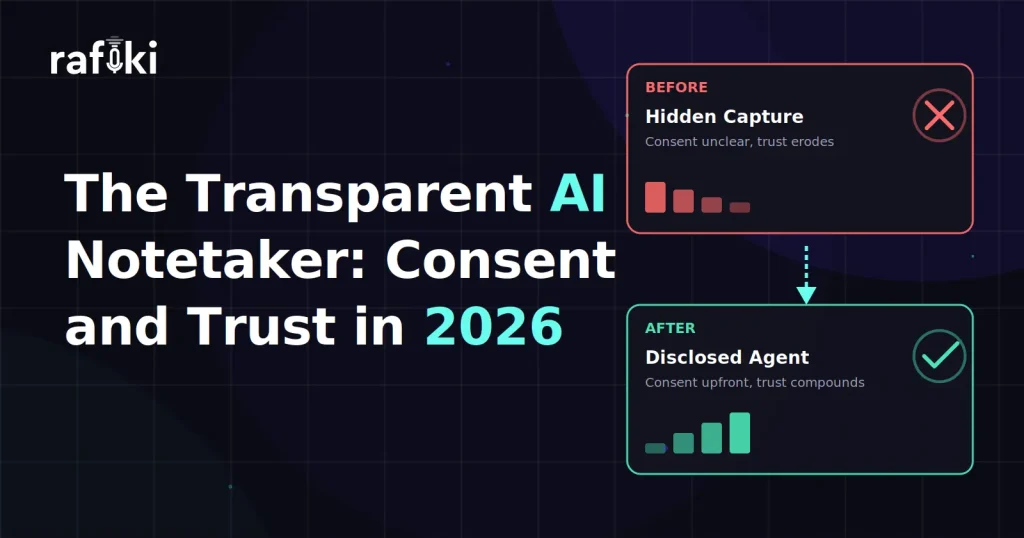
The question lands in the first ninety seconds of almost every sales call now: "Is this being recorded?" How your team answers it says more about your company than the demo that follows. In 2026, AI notetaker consent has shifted from a checkbox buried in a calendar invite to a live moment of truth, because buyers know an AI is listening and want to know what happens next. Teams that treat that moment as an awkward formality lose a little trust every time. Teams that treat it as an opening move gain some.
The stakes are easy to underestimate. A recording disclosure feels like housekeeping, so reps mumble it or skip it and hope the bot in the participant list goes unnoticed. Meanwhile, nothing sours a relationship faster than a buyer discovering a conversation was captured without a clear heads-up. The deal may survive; the trust rarely does.
There is a better way, and it costs nothing. Disclosure, done well, is not a legal chore. It is a trust asset — a repeatable, thirty-second ritual that signals professionalism, invites reciprocity, and sets up every downstream benefit of conversation intelligence without a shadow hanging over the relationship. This guide covers how consent expectations changed, exact disclosure wording that improves rapport, the internal policy your team needs behind the script, and why transparent capture beats invisible capture for long-term account trust.
AI notetaker consent is the practice of clearly telling every meeting participant that an AI assistant is capturing the conversation, explaining what happens to that capture, and giving them a genuine chance to object. That definition sounds simple. In practice, however, most teams only handle the first third of it.
A few years ago, recording required deliberate effort, so consent conversations were rare. Today the default has inverted: AI assistants join automatically, capture continuously, and feed summaries into systems the buyer never sees. As a result, the consent question stopped being "may I record this call?" and became "what standing permission do you have to capture, store, and analyze everything I say to you?"
That is a bigger question, and buyers know it. Procurement teams now ask about recording practices during vendor evaluation, and executives decline meetings when an unfamiliar bot appears in the lobby. Consequently, sales leaders who once delegated this topic to legal are discovering it is really a revenue topic — one that shapes win rates, references, and renewals.
Human note-taking never required a disclosure, because everyone could see the notebook. AI capture differs in three ways buyers intuitively grasp. First, it is total: every hesitation, aside, and offhand remark is preserved verbatim rather than filtered through a person's attention. Second, it is durable and searchable — a candid comment made in March can resurface in a negotiation in November. Third, it is analyzable: the conversation becomes structured data about sentiment, objections, and intent.
Because of this, the social contract of a meeting changed. Buyers now assume capture is happening and judge vendors on how honestly they acknowledge it. Research on buyer expectations keeps pointing the same direction: customers reward companies that are transparent about how their information is used, and they disengage from companies that are not, as Salesforce's State of the Connected Customer research explores in depth.
In other words, the bar moved. Silence about the AI in the room used to read as neutral; now it reads as concealment, even when nothing improper is happening. That gap between expectations and habits is where trust quietly leaks out of accounts.
Invisible capture rarely blows up on the call itself. The damage shows up later, and it compounds. A champion forwards a recording link to a colleague who never knew the call was captured. A verbatim quote in a follow-up email makes the buyer wonder what else was transcribed. An executive spots the bot in a second meeting and realizes the first one had it too.
Each of these moments plants the same thought: what else aren't they telling us? This kind of erosion is hard to reverse, because the buyer rarely raises it directly. Instead, they hedge — sharing less in discovery, looping procurement in earlier, and negotiating harder. Furthermore, they hesitate to act as references, since they no longer know what candid things they said on tape.
Customer-experience analysts have long argued that trust is the multiplier on every other investment a company makes in its buyers, a theme Forrester's customer-experience research returns to constantly. Invisible capture spends that multiplier down for a benefit — slightly less friction at the top of a call — that transparent teams get anyway, with interest.
Seen side by side, the trade-off is lopsided. Hidden capture saves thirty seconds of perceived awkwardness, while disclosed capture converts those same seconds into a credibility deposit. The comparison below shows how the two approaches diverge across the moments that matter.
| Moment | Hidden Capture | Disclosed Capture |
|---|---|---|
| Call opening | Bot appears unexplained; buyer wonders silently | Clear heads-up; buyer relaxes and engages |
| Discovery depth | Guarded answers, hedged pain points | Candid answers once ground rules are explicit |
| New stakeholders join | Awkward discovery of prior recordings | Consistent ritual repeats; no surprises |
| Follow-up accuracy | Precise recall feels unsettling | Precise recall feels professional |
| Procurement review | Recording practices become an objection | Recording practices become a proof point |
| Renewal and expansion | Residual suspicion taxes the relationship | Accumulated transparency compounds trust |
Notice that disclosed capture is not merely "less risky." It performs better at every stage, because the same precision that feels invasive when hidden feels impressive when announced.
Good disclosure has a shape: state it plainly, explain the benefit to the buyer, and offer a real exit. Delivered with confidence, it takes under thirty seconds. Here is wording your team can adapt:
"Before we dive in — you'll see our AI assistant in the participant list. It takes notes so I can stay fully present with you instead of typing. You'll get a copy of the summary and action items after the call. If you'd rather we not record today, just say the word and I'll drop it right now — happy to take notes the old-fashioned way."
Every clause earns its place. "You'll see" acknowledges what the buyer already noticed, which reads as candor. "So I can stay fully present" reframes the notetaker as a service to the buyer, not surveillance of them, and offering the summary makes them a beneficiary of the capture rather than its subject. Most importantly, the opt-out is specific and immediate — not "let me check with my manager," but "I'll drop it right now."
Tone carries the message. Reps who rush the disclosure signal that they hope nobody objects, which invites objection. In contrast, reps who deliver it at conversational pace, with a genuine pause afterward, signal that either answer is fine. Paradoxically, the more comfortable you are with someone saying no, the less often anyone does. Confidence in the ritual communicates that your team has nothing to hide.
Sometimes the buyer asks before you disclose — often with an edge in their voice. Treat the question as a gift, not a challenge. It tells you exactly what this stakeholder needs before they will open up, and it hands you a stage to demonstrate transparency.
The answer should be immediate and complete: yes or no, what the recording is for, who can access it, and what their options are. For example: "Yes, our assistant is capturing the call so we have accurate notes — the recording stays within our account team, and I can turn it off right now if you prefer." Never deflect with "don't worry, it's just for notes," because vague reassurance amplifies the concern it tries to soothe.
Afterward, honor whatever they chose without ceremony. Buyers remember how their boundary was treated far longer than they remember the boundary itself, and a boundary honored gracefully often relaxes on its own a few meetings later.
A great script without a policy behind it is theater. Buyers increasingly probe past the disclosure — "who exactly hears this recording?" — and reps need true answers, not improvised ones. Your AI notetaker consent policy should be short enough to memorize and firm enough to audit. At minimum, it needs to answer four questions.
Write the answers down, train every customer-facing hire on them, and revisit them quarterly. Additionally, make sure your recording platform can enforce what the policy promises — a retention rule nobody configured is a broken promise on a delay. Our AI sales tool security review checklist walks through the platform-side questions in detail.
Everything above is about trust, which is deliberately a higher bar than compliance. Recording and call recording laws vary by jurisdiction, they turn on details like where each participant sits, and they change — so this article stays qualitative on purpose. For the state-by-state layer, our guide to call recording and two-party consent states covers the fine print; this is general guidance, not legal advice, and your team should consult counsel to set its own compliance floor.
The useful reframe: teams that build their disclosure habit around trust rarely have compliance problems, because clear, affirmative, every-call disclosure comfortably exceeds most consent standards. The reverse is not true — a team engineered to the legal minimum can be fully compliant and still feel sneaky to buyers. Aim at trust, and compliance largely comes along for the ride, with counsel confirming the edges.
Trust in B2B relationships is built through repeated, predictable behavior. Transparent capture gives your team a ritual that recurs on every call — dozens of small proofs per quarter that your company does what it says, even when it would be easy not to. No campaign or gift basket delivers that cadence.
The compounding shows up in specific ways. Champions introduce you upward more readily, because they know the executive will not be ambushed by an unexplained bot. Procurement conversations shorten, since your recording practices arrive pre-answered. Moreover, renewals start warmer, because no residue of feeling watched has built up in the relationship.
There is a defensive benefit too. When something goes wrong in an account — a missed commitment, a disputed scope — a disclosed capture history is a shared, neutral record both sides trust, and consulting it feels like due diligence. Hidden recordings deployed in the same dispute feel like an ambush and escalate it.
Disclosure earns permission; value earns enthusiasm. The strongest consent cultures close the loop by making the buyer a direct beneficiary of the capture they agreed to. Send the summary and action items within hours, not days. Reference their exact words accurately in follow-ups, so precision reads as attentiveness. When a new stakeholder joins mid-cycle, use the record to onboard them without making your champion repeat the whole story.
This is where the quality of your meeting transcription layer stops being an internal concern and becomes part of the buyer experience. A sloppy summary shared externally undermines the "this helps you too" promise at the heart of your disclosure script. Conversely, a crisp recap that captures the buyer's priorities in their own language makes them glad the AI was in the room — which is the emotional endpoint every consent ritual should aim for.
Rafiki AI was designed around the assumption that capture should be visible, valuable, and governed — not smuggled in. Its AI assistant joins meetings as a clearly identified participant, so the disclosure script above matches exactly what the buyer sees on screen.
Behind the visible layer, Rafiki AI gives ops the controls a real consent policy requires. Admins define who can access recordings by role, set retention windows that actually execute, and remove recordings when a buyer opts out — so the promises reps make on calls are enforced by the platform rather than by memory. Its autonomous AI agents then turn permitted capture into value for both sides: Smart Call Summary produces the buyer-shareable recap that makes disclosure feel like a favor, while multi-language transcription keeps global teams consistent in one governed system. Start your free trial today and see how transparent capture changes the tone of your calls.
Culture change sticks when it is sequenced, so treat the rollout as a month-long project rather than a memo. Week one is for drafting the policy: access roles, retention window, opt-out mechanism, deletion workflow. In week two, write and role-play the disclosure script until every rep can deliver it conversationally, including the "is this recorded?" variant under pressure.
Next, configure the platform to match the policy — permissions, retention, buyer-facing summaries — and audit a sample of live calls for disclosure quality, not just disclosure presence. The final week closes the loop with buyers: add recording language to meeting invites, brief customer success on the same ritual for QBRs, and give managers a coaching rubric for the opening minute. Skeptics on your own team deserve the same transparency, incidentally; our take on AI trust as a sales barrier digs into why internal conviction precedes external credibility.
Every team with an AI notetaker makes a choice on every call: treat consent as friction to minimize, or as trust to compound. The mechanics are almost embarrassingly simple — a thirty-second script, a four-question policy, a platform that enforces what the policy promises. What separates transparent teams is not sophistication; it is the decision to stop hoping nobody asks and start being glad when they do.
The payoff runs through the whole revenue cycle. Candid discovery, faster security reviews, warmer renewals, and champions who introduce you upward all trace back to the same opening minute handled well. In 2026, buyers assume the AI is listening. The only question left is whether your team says so first — and what that answer earns you over the life of the account.
Yes — consistency is the point. A standing relationship makes disclosure easier, not optional, because familiar buyers are exactly the people who feel most betrayed by a surprise. That said, the ritual can shrink with familiarity: after the first few calls, a brief "usual setup — our assistant is on to take notes" keeps the practice alive in seconds. New stakeholders reset the clock, however. Whenever someone joins who has not heard the full disclosure, deliver the complete version, including the opt-out. The habit protects you precisely because it never has exceptions; the first skipped disclosure is the one a buyer eventually notices.
Stop the capture immediately, confirm it out loud, and move on without a beat of visible disappointment. The moment should feel unremarkable: "Done — it's off. Where were we?" Afterward, the rep takes manual notes and logs the buyer's preference at the account level, so no teammate re-triggers the issue on the next meeting. Do not ask again on subsequent calls unless the buyer raises it, and do not treat the declined recording as lost intelligence to reconstruct through back-channel debriefs. In practice, an opt-out honored well is itself a trust-building event, sometimes more powerful than the recording would have been.
There is no universal number, so anchor retention to business purpose rather than habit. Ask what each recording is for — coaching, deal continuity, dispute resolution, onboarding new account team members — and keep it only as long as that purpose is live. Many teams tie the window to the deal lifecycle plus a buffer, with shorter windows for sensitive commercial detail. Whatever you choose, three things matter more than the specific duration: the window is written down, the platform enforces it automatically, and reps can state it plainly when a buyer asks. Because legal requirements vary by jurisdiction and industry, have counsel review your retention schedule before committing it to a customer-facing policy.
Usually the opposite, once the initial novelty passes. Guardedness comes from uncertainty — a buyer who suspects capture but was never told operates with a low-grade wariness that flattens the whole conversation. Explicit disclosure removes the ambiguity: everyone knows the ground rules, the opt-out is real, and the summary benefits both sides. Consequently, buyers tend to settle within minutes and speak normally. A few topics do get deliberately taken "off the record," and that is healthy; a buyer who asks you to pause the recording is demonstrating trust in your ritual, not undermining it. The candor lost in rare sensitive moments is repaid many times over by the openness a transparent process earns everywhere else.
Rafiki AI's conversation intelligence platform starts at $19 per seat per month with no minimums and no annual commitment. Start your free trial today or book a demo to see how transparent, governed capture turns every disclosure into a deposit of buyer trust.
Start for free — no credit card, no seat minimums, no long contracts. Just better sales intelligence.