Somewhere in a conference room this August, a leadership team will pick a sales kickoff theme off a whiteboard. It will sound inspiring, and by February almost nobody on the sales floor will remember it. Sales kickoff planning fails this way every year, and the failure has little to do with the venue, the keynote speaker, or the budget.
The problem is the source material. Most SKO themes come from the executive offsite — a few strongly held opinions about what the team "needs to hear" in the year ahead. Meanwhile, a far better source has been talking to your company all year: your buyers. Every discovery call, every stalled negotiation, every objection that killed a deal in H1 is sitting in your call recordings, waiting to tell you exactly what your reps need to practice.
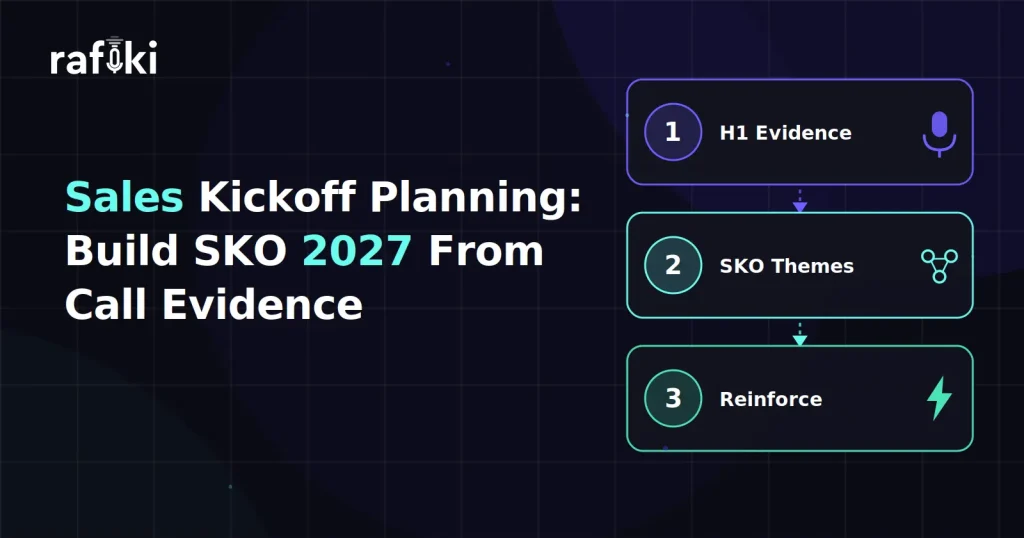
This playbook shows you how to build SKO 2027 from that evidence. Specifically, it covers mining H1 and Q3 calls for the skill gaps worth a training track, turning those gaps into role-play scenarios reps actually feel, and reinforcing the training so it survives past January. Start in August, and you will walk into January with an agenda no offsite whiteboard could produce.
Ask any tenured rep what last year's SKO theme was, and you will usually get a pause, a guess, and a shrug. That amnesia is not a rep problem. It is a design problem with three consistent causes.
First, themes get chosen by opinion. A senior leader decides the team needs to be "more strategic," and the entire event gets built around a phrase no one validated against a single real deal. Because the theme never touched the actual reasons deals were lost, reps experience it as motivational wallpaper rather than help.
Second, the training is disconnected from real deals. Generic negotiation workshops feel productive in the moment. However, when a rep gets back to their desk and faces the exact pricing objection that stalled four of their deals last quarter, nothing from the event maps onto it. The training answered questions nobody was asking.
Third, there is zero reinforcement. The event ends, the slides go into a shared drive, and managers return to pipeline reviews that never reference the skills taught on stage. Without call scoring or a coaching cadence tied to the SKO content, forgetting is the default outcome. An event is not a program, and most companies only build the event.
Here is the reframe that changes everything: sales kickoff planning is a research project before it is an event-production project. The research question is simple. What, specifically, is costing us revenue in live conversations, and what would skilled reps do differently?
Your call recordings answer that question with unusual precision. Across H1 and Q3, your team ran hundreds or thousands of buyer conversations containing every stall pattern, every objection sequence, and every moment where a top performer navigated something the rest of the team fumbled. In contrast, the executive offsite contains recollections of those calls, filtered through memory and bias.
Research supports the instinct to ground enablement in real buyer behavior. As Harvard Business Review's analysis of why some sales teams are actually growing alongside AI shows, the teams pulling ahead are the ones using AI to understand their conversations more deeply — not to replace selling skill, but to sharpen it against reality. Similarly, McKinsey's work on people and organizational performance consistently emphasizes that capability building sticks when it is anchored to real work, practiced deliberately, and reinforced by managers. An SKO built from call evidence checks all three boxes. An SKO built from an offsite checks none.
You do not need twenty themes. You need the three recurring skill gaps that cost the most revenue, because three gaps translate cleanly into three SKO tracks. This is where conversation intelligence earns its keep — analyzing quarters of calls by hand would take months, while AI analysis surfaces patterns across the whole corpus in days. Either way, the questions are the same.
Start with the stage-by-stage picture. Look at deals that entered the pipeline in H1 and then stopped moving, and trace back to the last meaningful conversation before the stall. Patterns emerge quickly. Perhaps deals consistently freeze after the technical evaluation because reps never built a business case with an economic buyer, or discovery calls end with enthusiasm but no agreed next step. Each recurring stall point is a candidate skill gap — not "reps need better discovery" in the abstract, but "reps consistently fail to convert technical wins into executive-sponsored business cases."
Next, rank objections by revenue impact, not frequency. A pricing pushback that appears on every call but rarely kills deals matters less than an integration concern that precedes most of your competitive losses. For each high-impact objection, pull the transcripts and study how reps responded. In most teams, the same weak pattern repeats — a defensive answer, a premature discount, a promise to "get back to you" that resets the deal clock. That repeated weak response is your second candidate track.
Finally, compare your best closers' calls against the team average on those exact moments. The differences are rarely mystical. Top performers ask one more clarifying question before answering an objection, name the risk of doing nothing before the buyer raises budget, and set multithreaded next steps while everyone else settles for a follow-up email. Because these behaviors are observable in transcripts, they are teachable — and "the delta between our top quartile and everyone else on this moment" is the most credible training brief an enablement team can write. We covered curating these examples in our guide to building a sales call library from your top calls.
A skill gap becomes an SKO track when you can name the moment, show the evidence, and rehearse the alternative. That structure matters more than any production value.
For each gap, build the track in three layers. Open with the evidence: anonymized call excerpts showing the pattern, ideally including a lost deal the team remembers. Then teach the contrast — how the average call handled this moment versus how our best call handled it. Close with rehearsal: reps practice the moment repeatedly, against scenarios built from the real calls.
The role-play scenarios are where most SKOs go generic, and where yours should not. Do not hand reps a fictional prospect with invented objections. Instead, script scenarios directly from anonymized transcripts — the actual objection sequence a real buyer raised, the moment the economic buyer went quiet, the competitive comparison that surfaced in the third call. When a rep practices against a situation that genuinely killed a deal last quarter, the training stops feeling like theater and starts feeling like film study before a rematch.
One practical note on track design: cap it at three. Every additional theme dilutes the others, so if the evidence surfaces five worthy gaps, rank them by revenue impact and save the rest for mid-year enablement sprints.
The contrast between the two approaches shows up at every stage, from theme selection to what happens in February. Here is the side-by-side view.
| Dimension | Opinion-Driven SKO | Evidence-Driven SKO |
|---|---|---|
| Theme source | Executive offsite and gut feel | H1 and Q3 call analysis |
| Training content | Generic workshops and keynotes | Tracks built on real stall points and objections |
| Role plays | Fictional prospects, invented objections | Scenarios scripted from anonymized real calls |
| Agenda balance | Mostly stage time, little practice | Mostly rep practice, few keynotes |
| Reinforcement | Slides in a shared drive | Call scoring and manager coaching tied to themes |
| February outcome | Theme forgotten, behavior unchanged | Skills visible in live calls and scorecards |
| Measurement | Event satisfaction survey | Behavior change measured in real conversations |
Notice that the budget line is absent. An evidence-driven SKO does not cost more — it simply spends the same money on rehearsal instead of spectacle.
Once the tracks exist, the agenda almost designs itself, provided you hold one line: reps should spend most of the event practicing, not listening. The test for every agenda block is blunt — is a rep performing a skill here, or watching someone talk about one?
In practice, an evidence-based day looks like this. Mornings open with a short evidence briefing per track — the anonymized calls, the pattern, the cost. The bulk of the day then goes to rotating practice pods, where small groups of reps run the role-play scenarios while a manager or top performer observes and debriefs. Late afternoons close with "game film" sessions, replaying the strongest practice rounds so the whole team hears what good sounds like. Keynotes still exist, but they shrink to bookends: one opening the event with the revenue story behind the themes, one closing it with commitments.
This is also where a modern sales enablement platform changes what is possible at the event itself. Rafiki AI, for example, brings the actual evidence into the room — its AI Role Play capability lets reps rehearse the scripted scenarios against an AI buyer before performing in front of peers. Practice stops being limited by how many facilitators you can staff. Every rep gets unlimited at-bats.
Want to see what your own H1 calls would say about your SKO themes? Start your free trial today and run the analysis before the August planning window closes.
Everything before this point determines whether the SKO is good; everything after it determines whether it mattered. The highest-leverage move in the program is deciding, before the event, how you will observe the taught skills in live calls afterward.
Call scoring is the mechanism. Take the behaviors each track taught — say, "quantifies cost of inaction before discussing price" or "multithreads next steps beyond the champion" — and turn them into explicit scoring criteria. Rafiki AI's Smart Call Scoring evaluates every recorded call against custom criteria like these automatically, alongside any methodology you already run, whether that is MEDDIC, SPICED, or a homegrown framework. As a result, by mid-February you are not wondering whether the training stuck. You are looking at scores showing exactly which behaviors transferred to live conversations.
Reinforcement also needs a practice loop, not just a measurement loop. Reps who score low on a taught behavior should be routed back into the same AI Role Play scenarios from the event, rehearsing until the live scores move. This mirrors the approach in our 30-day ramp playbook for new sales hires — the same rehearse-then-verify loop that ramps a new hire keeps a tenured rep from regressing.
Managers decide whether reinforcement survives contact with the quarter. If February pipeline reviews never mention the SKO behaviors, reps correctly conclude the event was ceremonial. Consequently, the coaching cadence needs designing in December, not improvising in February.
The cadence itself can be simple. Each manager runs one coaching conversation per rep per week, and for the first quarter it anchors on the SKO themes: review one scored call together, replay the moment tied to a taught behavior, and rehearse the improvement on the spot. To make this sustainable, arm managers with evidence rather than homework. Gen AI Reports can deliver each manager a weekly digest of how their team scored on the SKO criteria, which reps are trending up, and which calls deserve review in the next session.
Enablement's job in this phase shifts from content production to cadence protection. For sales enablement leaders, that means auditing whether coaching conversations actually happen, keeping scoring criteria stable long enough to show trend lines, and surfacing wins loudly — a rep whose objection-handling score keeps climbing is your best internal marketing for next year's program.
Evidence-driven sales kickoff planning runs on a six-phase timeline. Each phase has one job, and the whole sequence fits comfortably between now and the event.
Run the call analysis across H1 and early Q3. Identify stall points, rank objections by revenue impact, and isolate top-performer behaviors. By month's end, you should have three named skill gaps backed by anonymized call excerpts, plus executive sign-off on the tracks. This is also the moment to pressure-test whether the gaps are skill problems or hiring problems — a distinction we explored in Hire for Judgment, Not Pipeline.
Turn each gap into a full track: evidence briefing, contrast teaching, and role-play scenarios scripted from real anonymized calls. Draft the post-SKO scoring criteria at the same time, because writing them clarifies what the training must change. Pilot the role plays with a few managers, then revise anything that feels fictional.
Handle the venue, travel, and agenda mechanics — deliberately placed here so content decisions drive logistics rather than the reverse. More importantly, train the managers. They will facilitate practice pods in January and carry the coaching cadence afterward, so December is their rehearsal window.
Run the event with the practice-heavy agenda: evidence briefings, rotating role-play pods, game-film reviews, and bookend keynotes. Capture the strongest practice rounds as coaching assets.
Watch the scores. Compare live-call performance on the taught behaviors against the pre-SKO baseline, review the trend in coaching sessions, and publish a simple readout to leadership. February's data becomes the opening slide of next August's planning cycle — the program becomes a loop instead of an annual gamble.
Even with the right timeline, a few predictable failure modes drag programs back toward opinion. Watch for these while you plan.
None of these traps requires heroics to avoid. They require deciding, in writing, before the event — exactly what the August start makes possible.
The best sales kickoff theme for 2027 is not waiting to be invented at an offsite. It is already recorded, sitting in the H1 calls where deals stalled, objections landed, and your best reps quietly did something different. Evidence-driven sales kickoff planning simply has the discipline to go listen.
The playbook is compact. Mine your calls in August for the three skill gaps costing the most revenue, build tracks around real anonymized scenarios in the fall, and run a January event where reps practice against the situations that actually killed deals. Then reinforce relentlessly — score every call against the taught skills, tie manager coaching to the themes, and measure behavior change in February instead of applause in January.
Teams that run this loop stop treating SKO as an annual morale expense and start treating it as the year's highest-leverage training intervention. By next August, the question is no longer "what should our theme be?" It becomes "what does the evidence say we fix next?"
Start in August — roughly five months out. The reason is sequencing: evidence-driven planning front-loads a research phase that opinion-driven planning skips entirely. August gives you time to analyze H1 and early Q3 calls, identify the recurring skill gaps, and get executive alignment on themes before any content gets built. September and October then go to building tracks and role-play scenarios, November and December to logistics and manager preparation, and January to delivery. Teams that start in November instead are forced to skip the research phase, which is exactly how themes end up coming from a whiteboard. As a bonus, an August start lets you capture baseline call scores on the target behaviors during Q4, so February's measurement has something real to compare against.
Ask three questions of your H1 and Q3 calls. First, where do deals stall — which stage transitions consistently fail, and what happened in the last conversation before momentum died? Second, which objections cost the most revenue — ranked by the deals they preceded losing, not by how often they appear? Third, what do top performers do differently at those exact moments compared with the team average? Conversation intelligence platforms accelerate this dramatically by scoring and categorizing every call automatically, but the logic works even with manual sampling. The output you want is three named skill gaps, each backed by real anonymized call excerpts, each tied to lost revenue. Those three gaps become your three SKO tracks.
Invert the usual ratio: most of the day should be reps practicing, with keynotes reduced to bookends. A strong structure opens each track with a short evidence briefing — anonymized call excerpts showing the pattern and its revenue cost — followed by contrast teaching that plays an average call against a top performer's handling of the same moment. The bulk of the time then goes to small practice pods where reps run role-play scenarios scripted from real calls, observed and debriefed by managers. Close with game-film sessions replaying the best practice rounds so everyone hears what good sounds like. The test for any agenda block is simple: is a rep performing a skill in this session, or just watching someone talk about one?
Measure behavior in live calls, not satisfaction at the event. Before the SKO, turn each taught skill into an explicit call-scoring criterion and capture a Q4 baseline. After the event, score every recorded call against those same criteria — tools like Smart Call Scoring do this automatically across the whole team — and watch the trend through February. Pair the scores with a manager coaching cadence: one conversation per rep per week, anchored on a scored call and a taught behavior. If the scores on the target behaviors climb from the baseline and hold past February, the training transferred. If they spike in January and decay, you have a reinforcement problem rather than a content problem, and the coaching cadence is where to intervene.
Ready to build SKO 2027 from evidence instead of opinion? Rafiki AI gives enablement teams call analysis, Smart Call Scoring, AI Role Play, and Gen AI Reports in one platform, starting at $19 per seat per month with no seat minimums. Start your free trial today or book a demo to see what your H1 calls are trying to tell you.
Start for free — no credit card, no seat minimums, no long contracts. Just better sales intelligence.