Somewhere in a shared drive right now, a January sales kickoff deck is getting new dates and a fresh title slide. The themes survive untouched, the motivational quotes get another quarter of life, and the team files in expecting a rerun. That is the state of the typical H2 revenue kickoff, and it explains why so many second halves look exactly like the first. If the plan did not change, the results will not either.
Here is the uncomfortable part: your team already recorded the raw material for a far better kickoff. Every pricing objection, every competitive ambush, and every deal that stalled mid-stage lives inside your H1 call recordings. Most leaders never open that archive before planning Q3, so the plays they announce have no connection to what actually blocked revenue.
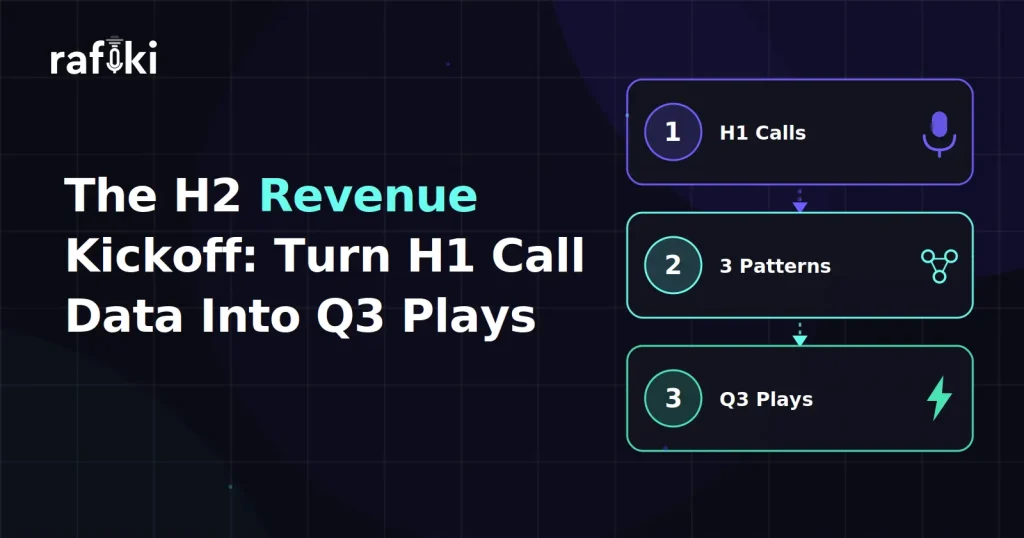
This guide walks through a different way to run the mid-year reset. Specifically, you will mine H1 conversations for the patterns that cost you deals, narrow them to three fixable problems, build one play per pattern, and launch everything in a focused 90-minute session. No recycled slides required.
An H2 revenue kickoff fails when it presents conclusions without evidence. Reps have sat through six months of real buyer conversations, and they know exactly which objections wrecked their deals. When leadership announces priorities that ignore those experiences, the room politely nods and quietly disengages.
The recycled deck compounds the problem. Because January's strategy was written before a single H1 call happened, it cannot account for the competitor that showed up in March or the pricing pushback that intensified in May. Repackaging that deck for July asks the team to run harder at a wall they have already hit.
There is also a credibility cost. Sellers extend trust to leaders who demonstrate they understand the ground truth of deals. In contrast, a kickoff built on stale assumptions signals that leadership is planning from a spreadsheet, and skepticism spreads faster than any rallying cry.
The best source of H2 strategy is not a leadership offsite. It is the archive of H1 customer conversations your team already captured. Modern conversation intelligence makes that archive searchable and analyzable, so the question is no longer whether the evidence exists but whether anyone plans with it.
Think about what those calls contain. Buyers told your reps, in their own words, why they hesitated, who else they were evaluating, and which internal approvals slowed everything down. As McKinsey's research on commercial growth explores, outperforming organizations turn frontline customer signals into deliberate go-to-market decisions rather than relying on instinct and anecdote.
Meanwhile, the shift toward AI-assisted selling raises the stakes. Harvard Business Review's reporting on how successful sales teams are embracing agentic AI describes teams that build their motions around what conversation data reveals, not around what the calendar says it is time to announce. An evidence-blind kickoff now competes against rivals who plan from proof.
The contrast between the two approaches shows up in everything that matters: what gets presented, what gets decided, and what happens the following Monday. In practice, you can feel the difference within the first ten minutes of the session.
| Dimension | Recycled Kickoff | Evidence-Based Kickoff |
|---|---|---|
| Source material | January SKO deck with new dates | H1 call recordings and deal history |
| Diagnosis | Assumptions and anecdotes | Patterns heard across real conversations |
| Priorities | Broad themes like "sell higher" | Three specific, fixable deal blockers |
| Plays | Generic motivation and quota math | One concrete play per pattern, with owners |
| Rep reaction | Polite nodding, quiet doubt | Recognition: "that was my deal" |
| Follow-through | Fades within weeks | Weekly inspection against call evidence |
An evidence-based session also changes the emotional temperature of the room. When reps hear their own deals reflected in the diagnosis, the plays stop feeling like leadership's homework and start feeling like their own. That ownership, more than any slide, is what carries a play through September.
Start by interrogating your H1 conversations for the moments where deals lost momentum. You are hunting for repeated blockers, not isolated incidents, because a pattern that appears across many calls is a systemic problem worth a dedicated play. Three categories deserve special attention:
Pair the call review with pipeline forensics. As we covered in our guide to the mid-year pipeline review, deal data tells you where the pipeline broke, while call data tells you why. Together, they turn a vague sense of "we struggled with pricing" into a precise, teachable diagnosis.
Choose exactly three patterns to attack in Q3. Discipline here is the whole game, because a kickoff that launches ten initiatives launches none of them. Every pattern that makes the cut should pass three tests:
Resist the temptation to include a pet initiative that lacks call evidence. If the pattern does not appear in real conversations, it does not belong in this kickoff. That said, keep the runners-up on a parking-lot list; some of them will earn a place in the Q4 planning cycle.
A play is a specific, repeatable response to a specific, recurring problem. One play per pattern keeps the kickoff honest and the follow-through inspectable. Consequently, every play you launch should define five things:
Build the assets from your own winning conversations wherever possible. For example, if one rep consistently defuses the pricing objection, her call is the training material. Our playbook on building a sales call library shows how to turn those standout moments into assets the whole team can study.
A tight agenda is what separates an H2 revenue kickoff from an H2 revenue meeting. Ninety minutes is enough time to present evidence, launch three plays, and lock commitments, provided you protect every block ruthlessly. Here is a structure that works.
Open with an unvarnished summary of what the first half actually looked like: where deals died, what buyers objected to, and which patterns repeated. Keep it factual and blame-free. The goal is a shared, honest baseline, because everything that follows depends on the room accepting the diagnosis.
Play short excerpts from real H1 calls that illustrate each of the three patterns. Nothing lands like a buyer's actual voice raising the objection your deck claims is a priority. Afterward, invite quick reactions; reps will often add context that sharpens the diagnosis further.
Present one play per pattern using the trigger, motion, asset, owner, and checkpoint structure. Spend the majority of each block on the motion, ideally with a live demonstration or a snippet from a rep who already runs it well. This is the heart of the session, so give it the largest share of time.
Ask the team to poke holes: where will the play break, which deal types does it not fit, and what asset is still missing? Objections raised here are gifts, since every one you resolve now is one that will not quietly kill adoption in August.
Confirm owners, checkpoint cadence, and what "running the play" looks like on a real call. Ambiguity at this stage is how kickoffs die, so make each commitment specific enough that a manager can verify it from a recording.
Close by naming the immediate next actions: which deals get the plays first, when the first call reviews happen, and when the team reconvenes. Momentum in the first two weeks predicts the whole quarter.
Q3 begins in vacation season, which makes follow-through harder and more important at the same time. Calendars thin out, buyers disappear for weeks, and a play with no inspection cadence will quietly evaporate by mid-August. The antidote is a lightweight weekly rhythm: each manager reviews a handful of recent calls against the three plays and shares one example of the play done well.
Slower weeks are also an opportunity in disguise. With fewer live deals demanding attention, reps have room to study winning calls, rehearse the new motions, and tighten their talk tracks. We unpack that approach in our summer sales slowdown playbook, which pairs naturally with a play-driven kickoff.
Above all, keep the evidence loop running. The same call analysis that shaped the kickoff should confirm, week by week, whether the patterns are actually shrinking.
The honest objection to all of this is effort. Manually reviewing a half-year of call recordings would take weeks a sales leader does not have, which is precisely why most kickoffs fall back on the recycled deck. Modern revenue intelligence platforms remove that excuse.
Rafiki AI, for instance, analyzes every recorded conversation and surfaces the patterns this process depends on: recurring objections, competitive mentions, sentiment shifts, and the stages where deals stall. Its autonomous AI agents work through the H1 archive continuously, so the evidence is already organized when planning season arrives. Instead of sampling a dozen calls and guessing, you interrogate the entire half.
Report-building becomes conversational as well. With Gen AI Reports, you can ask for a breakdown of pricing objections by deal stage, or a summary of every competitive mention from Q2, and get a kickoff-ready answer in minutes. Start your free trial today and run this analysis on your own H1 calls before the kickoff, not after it.
The first evidence-based kickoff is a project; the second one is a system. For sales leaders, the real prize is a quarterly rhythm in which conversation data continuously feeds planning, so no kickoff ever starts from a blank page or a stale deck again.
The mechanics compound quickly. Q3 call data reveals whether the three plays worked, which becomes the opening slide of the Q4 planning session. Coaching aligns to the same patterns, because managers now review calls against the plays rather than against generic checklists. Even forecasting sharpens, since the blockers you are tracking are the same ones that determine whether committed deals actually close.
Over a few cycles, the kickoff stops being an event and becomes the visible tip of an always-on planning loop. That is the durable advantage: not one good meeting, but a team that never plans blind again.
The recycled January deck fails because it argues from authority; the evidence-based H2 revenue kickoff succeeds because it argues from proof. Your buyers spent all of H1 telling your team exactly what blocks their purchases. A leader's job at mid-year is simply to listen at scale, pick three fixable patterns, and answer each one with a single, ownable play.
Run the 90-minute agenda, protect the weekly inspection cadence, and let call evidence referee every debate. Do that, and Q3 becomes the quarter your team stops repeating H1's mistakes and starts compounding on H1's lessons.
An H2 revenue kickoff is a mid-year planning session, typically held in early July, where a sales organization resets its strategy for the second half. Unlike the January sales kickoff, which sets annual themes before any current-year selling has happened, the H2 version has a decisive advantage: six months of real evidence. The strongest versions mine H1 call recordings and pipeline data for recurring deal blockers, then launch a small number of concrete plays that address them.
The session is shorter and more tactical than an SKO. Rather than motivation and product roadmaps, it centers on diagnosis, specific behavioral changes, and named owners, so the team leaves knowing exactly what to do differently on their very next call.
The January SKO is a forward-looking event built on strategy, targets, and energy, because at that point there is no current-year evidence to draw on. An H2 kickoff, by contrast, is a course correction grounded in what actually happened. It should be shorter, more surgical, and heavier on proof: real call excerpts, real deal post-mortems, and plays designed around observed patterns rather than planned themes.
The failure mode is treating the two events identically and simply refreshing the January deck. If your H2 session could have been delivered in January without changing a slide, it is not a kickoff; it is a rerun. The mid-year moment exists precisely to incorporate what H1 taught you.
Launch three: one play for each of the three patterns your H1 call analysis surfaced. The constraint feels aggressive, but it reflects how adoption actually works. Reps can genuinely change a small number of behaviors in a quarter, and managers can only inspect a small number of motions with real rigor.
When kickoffs launch a long list of initiatives, everything competes for attention and nothing gets coached, so by September the team has quietly reverted to old habits. Keeping to one play per pattern also makes accountability clean. Each play has a single owner, a clear trigger, and a weekly checkpoint, which means you will know within a few weeks whether it is running or stalling.
Manual review does not scale, and sampling a handful of calls reintroduces the guesswork you are trying to eliminate. The practical answer is a revenue intelligence platform that has already analyzed every recorded conversation. Rafiki AI, for example, automatically categorizes topics, flags objections and competitive mentions, tracks sentiment, and links conversation signals to deal stages.
When planning season arrives, you query the entire H1 archive instead of skimming it: ask for the most common pricing objections, the stages where deals stall, or the competitors mentioned most often, and capabilities like Gen AI Reports assemble the evidence in minutes. Preparation for the kickoff then shifts from data gathering to judgment, which is where leadership time belongs.
Rafiki AI's conversation intelligence platform starts at $19 per seat per month with no minimums and no annual commitment. Start your free trial today or book a demo to see how an evidence-based H2 revenue kickoff transforms your Q3.
Start for free — no credit card, no seat minimums, no long contracts. Just better sales intelligence.