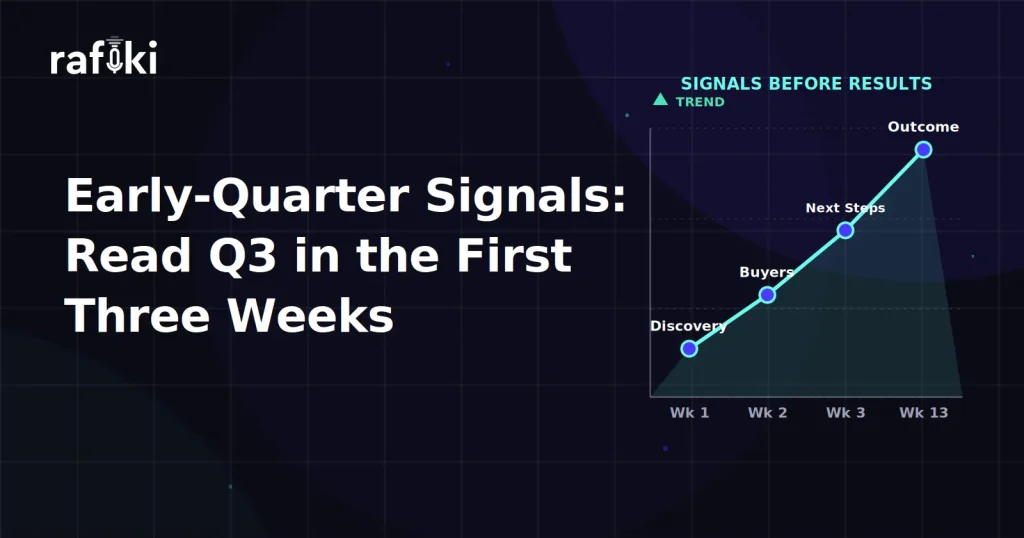
Most Q3 forecasts get written in week ten but decided in week three. The early-quarter signals that predict how September ends — discovery-call volume, stakeholder breadth, the specificity of next steps — are already visible before July closes. However, most revenue teams don't read them until the mid-quarter numbers force a panic review.
That delay is expensive. By the time a leader notices the commit is soft, the deals that could have replaced it needed to enter the pipeline six weeks earlier. In contrast, teams that read the quarter early still have options: they can redirect prospecting, rescue single-threaded deals, and reset expectations while there is still runway to act.
This article walks through the five signals worth tracking in weeks one through three of Q3 2026, how to separate pipeline theater from pipeline truth before it costs you, what real discovery calls sound like compared to calendar-fillers, and a 20-minute Monday-morning ritual that turns scattered observations into a defensible read on the quarter.
The standard rhythm of a sales quarter is strangely backloaded. Weeks one through four pass in a post-quarter recovery haze, weeks five through eight bring the first uncomfortable forecast calls, and weeks nine through thirteen collapse into triage. As a result, the diagnosis arrives at exactly the moment the treatment options run out.
Here is the uncomfortable part: nothing about week eleven's bad news is new information. The deals that slip in September showed their weakness in July — single-threaded contacts, vague next steps, discovery calls that kept rescheduling. Analyst firms such as Gartner have long pushed sales organizations to manage leading indicators instead of inspecting lagging ones, yet most pipeline reviews still audit history rather than read trajectory.
If your H1 close exposed gaps you didn't see coming, our mid-year pipeline review guide covers how to reset the H2 baseline. This article covers what comes next: reading Q3 before Q3 reads you.
Early-quarter signals are the leading indicators visible in the first three weeks of a quarter — discovery activity, stakeholder engagement, next-step quality, buyer language, and stage movement — that predict the quarter's outcome long before the pipeline math does. In other words, they are the behavioral evidence underneath the coverage ratio, not the ratio itself.
Lagging indicators tell you what already happened: closed-won, closed-lost, slipped. Leading indicators tell you what is about to happen, while you can still change it. For example, a pipeline at healthy coverage built on first calls that never produced a second meeting is not healthy — it is theater with good math.
Speed matters here because the signals decay. As Harvard Business Review has documented, companies are increasingly using AI to make faster decisions in sales and marketing precisely because raw buying signals arrive faster than human review cycles can process them. A week-three read that takes until week six to assemble is a week-six read.
Five signals, read together, tell you most of what the quarter is going to do. None of them requires a data science team — they require looking at the right things while it still matters.
New discovery calls in weeks one through three are the raw material of the back half of the quarter. Count them first, because a quiet July calendar is the single clearest predictor of a painful September. Volume alone is not enough, though.
Quality is the second half of the signal. A real discovery call surfaces a problem the buyer describes in their own words, a cost of doing nothing, and a reason the timing is now. In contrast, a low-quality call produces a polite recap and no new information. Ten hollow discovery calls are worse than five real ones, because hollow calls inflate coverage while adding nothing that will close.
Deals that close in-quarter almost always widen early. Watch whether second and third stakeholders — an economic buyer, a technical evaluator, a procurement contact — show up on calls or email threads by week three. Single-threaded deals can survive, but they rarely survive on schedule.
More importantly, watch who the new stakeholders are. A champion inviting their boss is momentum; a champion inviting a peer for a second opinion is hesitation. Meanwhile, a deal where every meeting has the same lone attendee in week three is quietly telling you it belongs in next quarter's forecast, whatever the close date says.
The end of every early-quarter call carries a verdict. "Let's reconnect in a few weeks" is a soft no wearing a calendar invite. "Thursday at 2pm with our CFO to review the security questionnaire" is a deal moving under its own power. Specificity — a date, an owner, a named attendee, a concrete artifact — is the tell.
Because of this, next-step language is worth auditing across the whole early pipeline, not deal by deal. If most of your July next steps are vague, your September commit is vague too; the CRM just hasn't admitted it yet.
Listen for tense and pronouns. Buyers who say "when we roll this out" and "our Q4 launch depends on" are already living in the implementation. Buyers who say "if we were to move forward" and "something we might explore" are browsing. The words are different because the internal reality is different.
Similarly, urgency shows up as buyers doing work between calls — pulling in colleagues, asking about contracting timelines, requesting references. A prospect who is enthusiastic on the call but inert between calls is giving you a signal, and it is not the one in the deal notes.
Finally, watch how fast deals move through the early stages in the first three weeks. Deals that advance from first call to evaluation quickly tend to keep that pace; deals that stall between stage one and stage two rarely sprint later. Velocity is a personality trait of a deal, and it shows itself early.
The aggregate matters as much as any single deal. For instance, if this quarter's week-three stage movement is visibly slower than last quarter's, the quarter is already smaller than the pipeline report claims — and you just learned it ten weeks before the CRM will.
Pipeline theater is activity that looks like progress but changes nothing about whether revenue arrives: inflated stages, recycled opportunities with fresh close dates, meetings booked to satisfy an activity metric. By contrast, pipeline truth is the subset of that same pipeline where a buyer is demonstrably spending effort to move toward a decision.
The two are indistinguishable in a spreadsheet, which is exactly why they get confused. A theater deal and a truth deal can share a stage, an amount, and a close date. However, they never share the same conversations. The theater deal's calls are short, single-threaded, and end without commitments; the truth deal's calls get longer, wider, and more specific.
That is why the early-quarter read has to reach beneath CRM fields into what was actually said. Consequently, the leaders who separate theater from truth in week three are the ones reviewing conversations, not just columns.
A real discovery call has a recognizable sound. The buyer talks more than the rep. Specific pain shows up with numbers and names attached — a missed launch, a team drowning in manual work, a renewal at risk. Toward the end, the buyer starts asking implementation-shaped questions: timeline, integration, who else needs to be involved.
Calendar-fillers sound different in ways you can hear within ten minutes:
In practice, the mix of these two call types across weeks one through three is the quarter's opening statement. A pipeline built on real discovery can absorb slippage; a pipeline built on calendar-fillers cannot, as we detailed in our deal slippage playbook.
The difference between the two operating modes is not effort — panic takes plenty of effort. The difference is when the effort happens and what it can still change.
| Dimension | Mid-Quarter Panic | Early-Quarter Reading |
|---|---|---|
| When it happens | Weeks 6–9, after the numbers slip | Weeks 1–3, before the forecast call |
| Core question | "What went wrong?" | "What is this quarter telling us?" |
| Evidence used | CRM stages and rep assurances | Call content, stakeholder maps, next-step language |
| Options left | Discounting, deal heroics, forecast cuts | Pipeline generation, multi-threading, early rescue |
| Team experience | Blame and fire drills | Coaching and course correction |
| Forecast quality | Revised downward, credibility spent | Grounded early, credibility earned |
Notice that the panic column is not lazier — it is later. Everything in the right-hand column uses information that already existed in week three. The only real variable is whether anyone looked.
Reading early-quarter signals does not require a new meeting series. It requires 20 disciplined minutes every Monday morning during weeks one through three, structured the same way each time.
The ritual works because it is small enough to survive contact with a real calendar. Three Mondays of this, and you will walk into the first forecast call of Q3 knowing more than the dashboard does.
The honest objection to everything above is time. Listening to every discovery call, mapping every stakeholder, and auditing every next step across a full team is more than 20 minutes of work — if a human has to do the listening. This is exactly the problem conversation intelligence was built to solve, and where a platform like Rafiki AI earns its place in the early-quarter workflow.
Rafiki AI analyzes every call as it happens: it maps which stakeholders actually participated, extracts the next step in the buyer's own words, detects blockers and urgency language, and scores each conversation against your methodology — MEDDIC, BANT, SPICED, or your own criteria. As a result, the five signals stop being things a manager samples and start being things the system measures on every deal, every week.
The Monday ritual doesn't disappear; it gets sharper. Instead of spending your 20 minutes gathering evidence, you spend them acting on evidence that is already assembled.
A week-three read is a snapshot; the quarter keeps moving. Rafiki AI's autonomous AI agents turn the snapshot into a feed — continuously watching discovery volume, threading, next-step quality, and stage velocity, then surfacing the deals whose signals just changed. We unpacked how this works in Inside the Rafiki Revenue Agent, which explains continuous AI forecasting in depth.
This changes what sales forecasting means in practice. Rather than a monthly ceremony where reps defend numbers, the forecast becomes a living read that updates as conversations happen — week one, week three, and week eleven alike. The mid-quarter panic never arrives, because nothing had a chance to stay hidden for six weeks.
You can see this on your own Q3 pipeline in an afternoon. Start your free trial today and let the platform read your first three weeks of calls for you.
For sales leaders, the payoff lands in the first forecast call of the quarter. Instead of relaying rep optimism, you present evidence: which deals are multi-threaded, which next steps are dated and owned, which discovery calls produced real pain. Confidence becomes defensible.
Interrogating that evidence takes minutes, not meetings. With Gen AI Search, you can ask Rafiki directly — "Which Q3 deals are still single-threaded?" or "Show me discovery calls this month where the buyer mentioned a deadline" — and get answers drawn from the calls themselves. RevOps gets the same leverage: signal definitions become queries anyone can run, rather than analyses only one person knows how to build.
The result is a quarter that gets managed from its first week instead of mourned in its last. That said, the tooling only amplifies the habit — the habit is looking early.
Q3 will tell you how it ends long before it ends. Discovery quality, stakeholder breadth, next-step specificity, buyer urgency, and stage velocity are all speaking by week three; the only question is whether anyone is listening before the mid-quarter panic makes the message unmissable. Early-quarter signals are not a forecasting trick — they are the quarter's actual voice, available to any team disciplined enough to read it.
The teams that win Q3 2026 will not be the ones with the most heroic Septembers. Instead, they will be the ones who knew in July what September would ask of them — and used the ten weeks in between.
Early-quarter signals are leading indicators visible in the first one to three weeks of a quarter that predict how the quarter will end. The five most reliable are discovery-call quality and volume, multi-stakeholder engagement, next-step specificity, buyer-language urgency, and stage-progression velocity. Unlike lagging indicators — closed-won, closed-lost, slipped deals — these signals describe what buyers are doing right now, while there is still time to respond. For example, a top deal that remains single-threaded in week three is signaling schedule risk months before its close date moves. Reading these signals early lets sales leaders redirect prospecting, coach reps on weak discovery, and multi-thread at-risk deals while those actions can still change the outcome, rather than discovering the same problems during a mid-quarter forecast miss.
By the end of week three, the shape of the quarter is largely set, even though individual deals will still surprise you. The reasoning is structural: deals that close in-quarter typically need discovery, evaluation, and procurement time, so the raw material for September wins must exist — and show momentum — by late July. That means week-three reads are less about predicting specific deals and more about reading aggregate trajectory: is discovery volume ahead or behind last quarter, are top deals widening or staying single-threaded, are next steps dated or vague? A team that answers those questions honestly in week three will rarely be blindsided in week ten. However, the read must be refreshed weekly, because signals decay and new deals change the picture.
Listen for four tells. First, talk ratio: in a real discovery call the buyer does most of the talking, describing a specific problem with names, numbers, and consequences attached. Second, pain specificity: "our onboarding takes too long and it cost us two renewals" is real; "we're always looking to improve" is filler. Third, buyer effort: real prospects ask implementation-shaped questions and do work between calls, such as looping in colleagues or requesting references. Fourth, the ending: a real call closes with a dated, owned next step and named attendees, while a calendar-filler ends with "let's stay in touch." Conversation intelligence platforms can score every call against these criteria automatically, which turns a manager's gut feel into a consistent, team-wide measurement.
Keep it to 20 minutes and four steps. Spend the first five minutes on a discovery scan: new first calls held last week versus the same week last quarter, flagging any rep whose calendar is going quiet. Use the next five for a threading check across your top ten deals, circling every deal still engaging a single stakeholder. Then spend five minutes auditing next steps on those same deals, sorting each into "dated and owned" or "vague." Finally, write one sentence that summarizes what the quarter is telling you, and bring that sentence to the forecast call. Because of this structure, the ritual survives busy weeks — and with autonomous AI agents assembling the evidence beforehand, the 20 minutes shift from gathering data to acting on it.
Rafiki AI's revenue intelligence platform reads every discovery call, maps stakeholder engagement, and scores next-step specificity from the first week of the quarter — so your week-three read is evidence, not instinct. Pricing starts at $19 per seat per month with no seat minimums and no annual commitment. Start your free trial today or book a demo to see how early-quarter signals become forecast confidence.
Start for free — no credit card, no seat minimums, no long contracts. Just better sales intelligence.