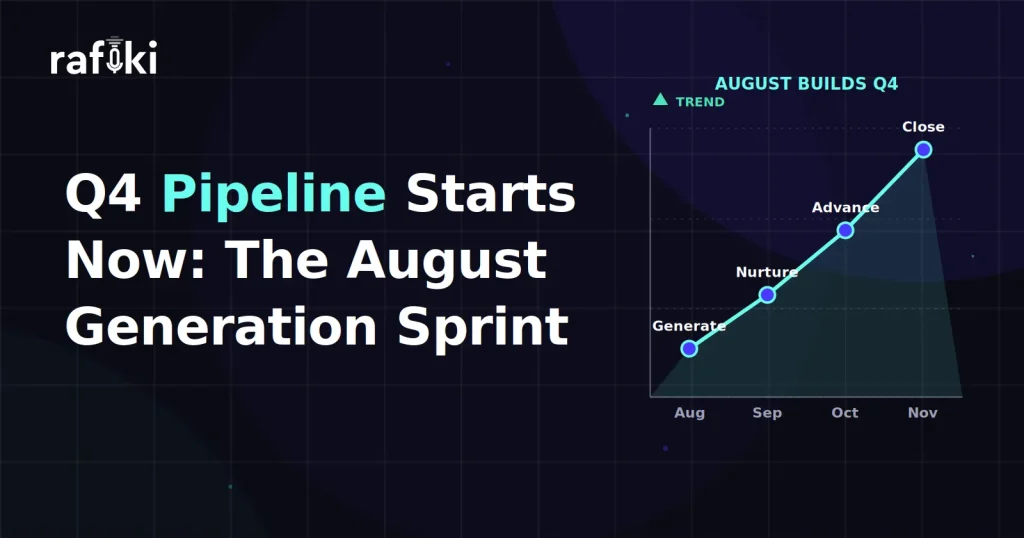
The deals your team celebrates in late November do not begin in November. They enter the funnel months earlier, which means Q4 pipeline generation is not an October activity — it is an August one. Given how long B2B buying cycles run, an opportunity sourced when the quarter opens rarely has time to move through evaluation, procurement, and legal before the year closes.
Yet most teams run the same script every year. Summer drifts by, September turns into a planning month, and October opens with a coverage gap that no amount of heroics can fix. As a result, reps chase thin pipeline with discounts, forecasts wobble, and the entire year comes down to a handful of fragile deals.
There is a better script. This playbook lays out the August generation sprint: how to work backward from your sales cycle to a real deadline, how to choose sources based on evidence from your own calls rather than habit, and how to structure two focused weeks that set up your strongest close of 2026.
Q4 pipeline generation must start in August because the buying process consumes far more calendar time than most sellers plan for. A modern B2B purchase involves multiple stakeholders, internal consensus-building, security review, and procurement — and each stage adds weeks that nobody controls. Consequently, an opportunity created in October is usually a Q1 deal wearing a Q4 costume.
The buying side has only grown more complex. As Gartner's sales insights have documented, buying groups are larger and their journeys are less linear than the tidy stage models in most CRMs suggest. More importantly, buyers spend much of their journey away from your reps entirely, which stretches timelines in ways your activity metrics never show.
This is why the teams that hit their Q4 number rarely look busy in December. Their hardest work happened in August, when nobody was watching the board. The scramble you see in other teams during the final weeks of the year is not intensity — it is interest payments on a debt taken out in the summer.
Working backward is the simplest planning exercise in sales, and the least practiced. Start from the date a deal must be signed for the revenue to count this year, which is earlier than December 31 once you account for legal review and holiday schedules. From there, subtract your average sales cycle for the segment you sell into, then subtract the time it typically takes a new conversation to become a qualified opportunity.
For most teams selling anything beyond a transactional product, that arithmetic lands squarely in August. In other words, the generation deadline is not a motivational slogan — it is a date you can calculate from your own historical data. Every week past that date, the pool of winnable Q4 deals shrinks.
Coverage math tells the same story from a different angle. If your pipeline-to-quota ratio is built in the final month of Q3, it is built from whatever happened to be lying around, not from deliberate sourcing. We explored why static coverage multiples mislead leaders in our post on why the 3x pipeline coverage ratio no longer works — the short version is that coverage quality matters more than coverage quantity, and quality is a function of when and how the pipeline was generated.
Most source selection is habit wearing a strategy costume. Teams run the same events, the same sequences, and the same partner plays as last year because those activities are familiar, not because they produced deals that closed. An August sprint is too short and too important to spend on autopilot.
Instead, interrogate your first half. Go through the H1 deals that actually progressed — second meetings booked, additional stakeholders joining calls, evaluation steps completed — and trace each one back to its original source. Meetings booked is a vanity cut of this data; a source that fills calendars with conversations that die after one call is a cost center, not a channel. We unpacked this economics problem in our piece on cost per booked meeting as the new CAC.
Research from McKinsey's growth, marketing and sales practice consistently points to the same discipline: growth leaders reallocate effort toward what the evidence says is working, rather than defending legacy channel budgets. For your sprint, that means ranking sources by progression, picking the top two or three, and deliberately ignoring the rest for two weeks. Concentration beats coverage when time is the scarcest resource.
August has a reputation as a dead month for selling, and that reputation is exactly why it works for generation. Buyers receive noticeably less outreach in late summer because most sellers have mentally checked out. Your message lands in an emptier inbox, competing with fewer sequences, fewer events, and fewer "quick question" emails.
Calendars tell the same story. Executives who are in the office in August tend to have lighter meeting loads, which makes them more reachable and more willing to take an exploratory conversation. In contrast, the same executive in late September is buried in planning cycles and budget reviews, with attention fragmented across a dozen internal priorities.
The volume-versus-attention trade is the whole game. You will book fewer total conversations in August than in a peak month, but each one gets more genuine attention, and each one has a full runway to become a Q4 deal. We made the broader case for treating summer as an offensive season in our summer sales slowdown playbook — the sprint below is the sharpest version of that idea.
Week one is list-building, and it deserves a full week because the list determines everything downstream. A sprint aimed at the wrong accounts is just a faster way to waste August. The goal is a concentrated, evidence-backed target list that every rep believes in before a single message goes out.
Start with the accounts that already said yes. Pull your closed-won deals from the past few quarters and study what they had in common when they first entered the pipeline: the persona who took the first call, the trigger event that opened the conversation, the pain language they used, and the stakeholders who eventually joined. Call recordings are the richest source here, because your win reports capture what happened while your calls capture why.
Then build outward from that profile with discipline:
Week two is execution, and its defining quality is concentration. Every rep works the same list, in the same window, across coordinated channels — email, phone, social, and warm introductions moving in sequence rather than as disconnected touches. The effect on the buyer's side is a coherent, well-researched approach instead of a random cold email.
Sequencing matters more than clever copy. Open with the channel where your H1 evidence says this persona responds, then follow within days on a second channel that references the first touch. Phone deserves special weight in August; lighter calendars mean connect rates improve exactly when most teams stop dialing.
Rhythm keeps the sprint honest. Run a short daily standup where reps share which openers earned replies, which personas engaged, and which accounts showed buying signals. Because the whole team is working one list in one window, a lesson learned on Tuesday morning compounds across every rep by Tuesday afternoon — a feedback loop no scattered, always-on prospecting motion can match.
A sprint generates a dense burst of first conversations, and those conversations are data. Conversation intelligence turns that burst into a mid-sprint steering wheel: instead of waiting until September to review what worked, you can see by day three which openers earn second meetings, which personas lean in, and which objections keep surfacing.
This is where Rafiki AI changes the economics of the sprint. Its autonomous AI agents analyze every sprint call as it happens — categorizing topics, detecting blockers, and mapping stakeholder engagement — so the pattern across twenty conversations is visible without anyone rewatching a single recording. Smart Call Scoring then grades each conversation against your qualification methodology, whether that is MEDDIC, BANT, SPICED, or custom criteria, separating polite meetings from genuine opportunities.
The mid-sprint adjustment loop looks like this: review scored calls midweek, identify the persona and opener combinations producing the strongest early signals, and tilt the second half of outreach toward them. Meanwhile, sales analytics across the sprint cohort shows which sources are converting conversations into next steps, closing the evidence loop you opened in week one. Want to see your own sprint calls scored this way? Start your free trial today and run it on your very next conversation.
The difference between the two approaches is not effort — reactive teams often work harder. The difference is when the effort happens and what evidence guides it. Here is the side-by-side:
| Dimension | Reactive Q4 Scramble | August Generation Sprint |
|---|---|---|
| Timing | Generation starts when Q4 opens | Generation completes before Q4 opens |
| Source selection | Same channels as last year, by habit | Top sources ranked by H1 deal progression |
| Targeting | Broad lists, firmographic filters | Concentrated list built from won-deal call evidence |
| Buyer attention | Competing in the loudest weeks of the year | Reaching quieter inboxes and open calendars |
| Course correction | Post-mortem in January | Mid-sprint adjustments from call signals |
| Deal quality | Thin, late-stage-compressed opportunities | Full-cycle deals with room to mature |
| December outcome | Discount-driven pleading | Natural closes on deals sourced in August |
Read down the right-hand column and a theme emerges: every advantage flows from starting early and steering with evidence. Nothing in the sprint requires more headcount or budget — only earlier, more concentrated effort.
Sprints die from interruption, not exhaustion. The most common failure mode is the mid-sprint pivot: a leader sees three quiet days, panics, and redirects the team to a new list or a new message. Resist this. Two weeks is the minimum window for a multichannel sequence to play out, and judging it at the halfway mark guarantees you never learn what the full sequence produces.
Managers protect the sprint with their calendars first. Clear the internal meetings, postpone the tool evaluations, and push non-urgent one-on-ones to September, because every hour reclaimed is an hour of outreach. For SDR leaders especially, the job during sprint weeks is air cover: removing blockers in the morning and celebrating progress in the afternoon.
Celebration deserves deliberate design. Lagging indicators like created pipeline will not move meaningfully inside two weeks, so anchoring morale to them is a recipe for discouragement. Instead, publicly recognize leading indicators — quality conversations held, second meetings earned, new stakeholders engaged — because those are the signals that predict the Q4 pipeline you are actually building.
Not every August conversation becomes an August opportunity, and that is fine. The sprint's output is really three lists: opportunities created, warm conversations that need time, and accounts that engaged but declined. Each list needs a different September, and the handoff between sprint and nurture is where lazy teams leak most of their gains.
Opportunities move into standard deal management with one upgrade: the sprint's call evidence travels with them. The discovery notes, the scored qualification gaps, and the stakeholder map from August become the starting brief for every September deal review. Warm-but-not-ready conversations enter a structured nurture track with a specific re-engagement trigger — a budget cycle, a contract renewal date, a hiring event mentioned on the call — rather than a generic monthly check-in.
Even the declines have value. Their objections, recorded and categorized, feed the next sprint's messaging and disqualification criteria. By the time Q4 opens in October, the team is managing a maturing pipeline instead of manufacturing a new one — which is the entire point.
Q4 is decided long before it begins. The lead-time math is unforgiving: deals need a full cycle to close, and cycles are longer than quarters make room for, so the generation deadline lands in August whether you plan for it or not. Teams that treat late summer as a lull inherit a scramble; teams that treat it as a sprint inherit a close.
The playbook is deliberately simple. Work backward from your close deadline to your generation deadline, pick sources by what your H1 calls prove actually progressed, and run two concentrated weeks — one building an evidence-backed target list, one executing coordinated outreach. Steer mid-sprint with conversation signals, protect the window from pivots and meeting creep, and hand every conversation into a structured September nurture.
None of this requires more budget. It requires starting when your competitors are at the beach, and letting evidence — not habit — decide where the effort goes. August is the quietest month on the sales calendar, and that is precisely why it is the loudest signal of who will win Q4 in 2026.
Work backward from your own numbers rather than the calendar. Take the last date a contract can realistically be signed this year — earlier than December 31 once legal review and holidays are counted — then subtract your average sales cycle and the typical time from first conversation to qualified opportunity. For most B2B teams, that calculation lands in August. Consequently, waiting until Q4 opens in October means most deals you source will not have enough runway to close before year end; they become Q1 pipeline by default. The practical rule: if a deal must count this year, its first conversation belongs in late summer — anything generated later should be managed honestly as next year's revenue rather than forced into a December miracle forecast.
Choose by evidence of progression, not by habit or by meetings booked. Review your first-half deals that genuinely advanced — second meetings, multiple stakeholders engaging, evaluation steps completed — and trace each back to its original source; then rank sources by how many progressing deals they produced and concentrate the sprint on the top two or three. This matters because a source can fill calendars while producing conversations that die after one call, which makes raw meeting counts dangerously misleading. Call recordings sharpen the analysis further: they reveal which sources produced buyers who spoke about real pain versus polite curiosity. For two focused weeks, deliberately ignoring your weaker channels is a feature, not a risk — concentration is what makes a sprint different from business as usual.
Measure leading indicators, because lagging ones cannot move inside two weeks. The most useful sprint metrics are quality conversations held, second meetings earned, new stakeholders engaged, and reply rates by persona and opener; in addition, track which messages generate substantive responses about pain and priority rather than polite deferrals. Managers should review these daily in a short standup so lessons compound across the team while the sprint is still running. By contrast, judging the sprint on created pipeline or projected revenue during week one guarantees discouragement and invites the mid-sprint pivot that kills momentum. Save the lagging metrics — opportunities created, pipeline value, eventual win rate — for the September retrospective, where they belong.
Conversation intelligence turns sprint calls into steering data while the sprint is still running. Because every conversation is transcribed, categorized, and scored automatically, patterns surface within days: which openers earn second meetings, which personas engage deeply, and which objections recur. Teams use those signals to tilt the second week of outreach toward what is demonstrably working. Rafiki AI adds scoring depth through Smart Call Scoring, which grades each call against methodologies like MEDDIC or BANT, separating genuine opportunities from polite meetings before they inflate the pipeline. After the sprint, the same call evidence powers the September handoff — discovery notes, qualification gaps, and stakeholder maps travel with each opportunity, so deal reviews start from what the buyer actually said rather than what the rep remembered.
Rafiki AI's conversation intelligence platform starts at $19 per seat per month with no minimums and no annual commitment. Start your free trial today or book a demo to see how an August generation sprint — powered by autonomous AI agents — sets up your strongest Q4 close.
Start for free — no credit card, no seat minimums, no long contracts. Just better sales intelligence.