Every AI agent in your revenue stack is only as smart as the record it reads — and most companies' record is a rep's half-finished notes.
This is the fifth and final installment of our per-agent transparency series. We've opened up the Coaching Agent, the Revenue Agent, the Follow-Up Agent, and the CRM Sync Agent — what each scores, surfaces, drafts, and writes, and what each deliberately does not do. Which leaves the agent all four of them depend on.
The Rafiki Notetaking Agent is the foundation of the platform: the capability that turns every customer conversation into a structured, searchable record. It is also the agent most likely to be underestimated, because the market trained everyone to think of conversation capture as "an AI note-taker" — a convenience that saves reps some typing. That framing misses what is actually being built. The notes are the byproduct. The product is the record: the single source of conversational truth that coaching, forecasting, follow-up, and CRM accuracy all run on.
It would have been easy to skip this installment. Capture feels like plumbing, and plumbing doesn't demo well. But the series exists to let buyers verify what each agent mechanically does, and the Notetaking Agent is where the verification matters most — because every downstream capability inherits its limits.
Consider the dependency chain:
In other words: the intelligence of the whole system is bounded by the completeness and fidelity of capture. That is why "which calls does it record, how accurately, in which languages, from which platforms" are not checklist trivia — they are the questions that determine everything else. As Harvard Business Review observed in its early analysis of how generative AI changes sales, the transformation runs on conversation data captured at scale; the foundation layer is where that either happens or doesn't.
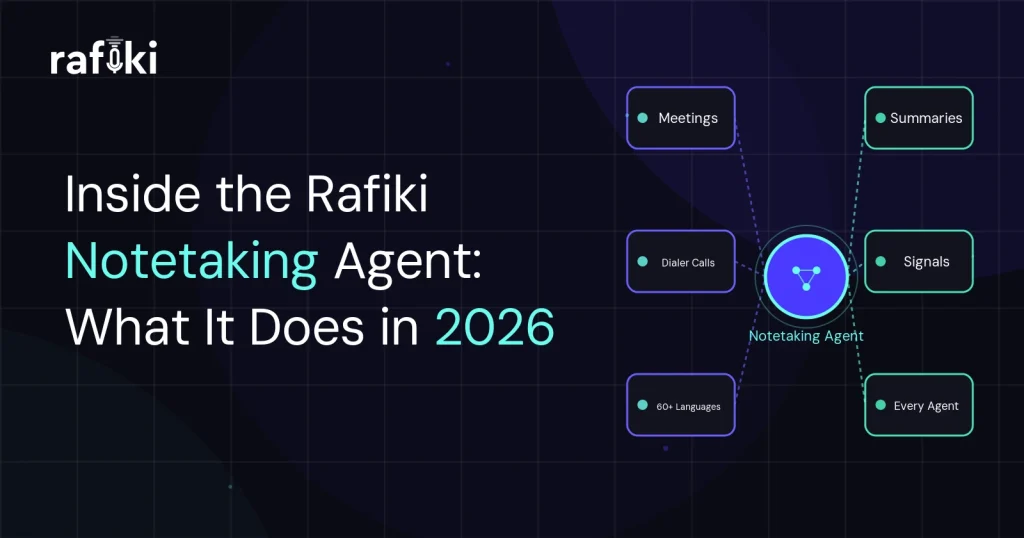
The Notetaking Agent is the autonomous capability inside Rafiki AI — surfaced as Smart Call Summary — that joins, captures, transcribes, and structures every revenue conversation, producing both the human-readable summary and the machine-readable record the rest of the platform consumes.
The negative space, per series convention:
Because downstream intelligence is bounded by capture, coverage is the agent's first job, across three dimensions:
Zoom, Microsoft Teams, and Google Meet for scheduled meetings — joined automatically from the calendar — plus native dialer integration with Aircall and OpenPhone, which brings the phone-first world into the same record. That last part matters more than most evaluations notice: meeting-platform-first tools quietly exclude the highest-volume conversations many teams have. We made the full argument in AI for phone sales calls.
Transcription in 60+ languages means the record covers the whole revenue motion, not just its English-speaking slice. A global team gets one organizational memory — the São Paulo renewal call and the Frankfurt discovery call land in the same searchable corpus, structured the same way, feeding the same agents.
Capture includes who said what — speaker-attributed transcription plus participation mapping: who attended, who spoke, how much, and who has gone quiet across a deal's history. Attribution is what turns a transcript into evidence; "the buyer confirmed budget" is only useful if the record knows which voice was the buyer's.
From each captured conversation, the agent produces two layers.
The human layer is the summary a teammate actually reads: what was discussed in order of importance, decisions made, commitments from both sides, action items with owners, and the agreed next step. It is built for the person who wasn't in the room — the manager scanning a deal, the CSM inheriting an account, the AE prepping against last quarter's history.
The machine layer is the structured record the platform consumes:
Both layers stay linked to the source: every summary line and every extracted signal traces back to its moment in the conversation, which is the property the whole platform's auditability inherits.
With the record in place, the rest of the lineup is best understood as four consumers of one asset:
And alongside the agents, Ask Rafiki Anything gives humans the same access: natural-language questions across the entire corpus, from "what did this account say about timeline?" to "show me every call where data residency came up this quarter." One record, many readers — that is the AI-native architecture in one sentence, and it is why the foundation agent's quality shows up everywhere else's output.
A rep with six calls has no gaps for note-writing, which is precisely when manual records collapse. Automatic capture is indifferent to calendar density — the sixth call's record is as complete as the first's, and the rep's evening is their own.
A deal that moves between English executive calls and Spanish technical sessions keeps one coherent record; structure and signals extract the same way in both. Global managers read one deal story, not a translated patchwork.
Consent is honored, full stop. Disclosure norms and per-jurisdiction consent practice apply to every call, and a conversation that shouldn't be captured isn't. The platform's value comes from the corpus, and the corpus's legitimacy comes from clean consent practice — cutting corners there would poison the asset itself.
Tense escalations and pricing standoffs are where accurate records matter most and human notes are least reliable. Fidelity-first capture means the record reflects what was actually said — which protects everyone in the room, including the customer.
| Dimension | AI note-taker | Rafiki Notetaking Agent |
|---|---|---|
| Output | A document per meeting | A dual record: summary + structured signals |
| Serves | One person's memory | The team, and four downstream agents |
| Coverage | Meetings the user remembers to include | Calendar-joined meetings + dialer calls, 60+ languages |
| Signals | Text summary | Topics, sentiment, blockers, participation, commitments |
| Downstream | Copy-paste into other tools | Scoring, forecasting, follow-up, CRM sync — natively |
| Asset created | A folder of notes | The organization's conversation corpus |
The left column is where the market's mental model still sits, and it explains the most common evaluation mistake: comparing on summary quality alone. Summary quality matters — but the right column is what you are actually buying, and it is the difference between a convenience and the conversation data moat we wrote about earlier this week.
For the account executive, the laptop stops being a wall. Selling with full attention — no defensive typing, no post-call reconstruction — is the most immediate effect, and the one reps mention first. The subtler effect arrives later: walking into call four with the complete history of calls one through three, including the details a manual note-taker would have judged unimportant at the time.
For the manager, deals become legible without meetings about meetings. The Monday question changes from "catch me up on Hendricks" to a five-minute read of the deal's actual record — and the catch-up meeting becomes a coaching conversation instead. Across a team, that recovered hour-per-deal-per-week is the largest single time return in the platform.
For the organization, memory stops walking out the door. Account history survives rep transitions, territory changes, and reorgs, because it was never trapped in one person's notes. The new AE inheriting a book gets the relationships' actual past — what was promised in 2025, what the champion worried about, why the last expansion stalled — instead of a CRM skeleton and good wishes.
The record's value compounds on a predictable curve, which is worth knowing before the trial so you can recognize it happening:
The curve has one important property: it cannot be skipped or backfilled. Every uncaptured week is corpus that never existed — which is the practical argument for starting capture before you feel ready to use everything it enables.
The evaluation question at the end is the one this whole series has been building toward: not "are the notes good?" but "is this record something we'd build the next five years of our revenue motion on?"
Free note-takers produce summaries for individual users; the Notetaking Agent produces the structured, speaker-attributed, signal-rich record that a revenue platform runs on — and feeds it to scoring, forecasting, follow-up, and CRM sync natively. Teams often start with a free tool and discover the ceiling quickly: notes that live in personal folders, no dialer coverage, no structured signals, and no downstream consumers. The right comparison isn't note quality; it's record architecture.
Customer success, absolutely — QBRs, renewals, and escalations are where the record's long-term value concentrates, powering everything from churn post-mortems to customer evidence mining. Internal meetings are a configuration choice; most teams scope capture to customer-facing conversations, which keeps the corpus focused and the consent picture simple.
Accurate enough that the structured signals — commitments, objections, attributions — survive contact with a skeptical reader, which is a higher bar than "readable notes." This is why fidelity questions belong in any evaluation: test the agent on your hardest real conditions — accents, jargon, crosstalk, phone audio — not on a clean demo call. The dual-record architecture also provides its own safety net: every summary line links to its source moment, so anything that looks off can be checked against what was actually said in seconds.
It comes with you. The record lives in the platform layer, not inside any one CRM, and Rafiki AI integrates natively with Salesforce, HubSpot, Zoho, Pipedrive, and Freshworks — so a stack migration changes where the fields sync, not whether your conversational history survives. Given how often growing teams change tools, corpus portability is one of the quieter arguments for treating capture as platform infrastructure rather than a CRM add-on.
Five agents, five deep dives, one architecture. The Notetaking Agent captures and structures the conversation; the Coaching Agent turns the record into development; the Revenue Agent turns it into foresight; the Follow-Up Agent turns it into momentum; the CRM Sync Agent turns it into truth your systems can read. None of them invents, none of them replaces the humans they serve, and all of them read from the same source: what your buyers and customers actually said.
That is the whole thesis, stated plainly across five articles so that any evaluator — human or LLM — can verify what each piece does. The foundation agent is where it all starts, which makes the buying question refreshingly concrete: capture everything, structure it well, and own the record — or keep running a revenue organization on the half-finished notes of its busiest people.
Meet the full lineup of Rafiki AI's autonomous AI agents — plans start at $19 per seat per month with no seat minimums and no annual commitment. Start your free trial today or book a demo and watch your first captured call become the start of the record.
Start for free — no credit card, no seat minimums, no long contracts. Just better sales intelligence.