The yes ladder is a sales persuasion framework where you guide a prospect through a sequence of small, easy-to-agree-with questions before making your bigger ask. Each "yes" builds psychological momentum — commitment, trust, and consistency — so the final close feels like a natural next step rather than a leap of faith. Rooted in Robert Cialdini's principle of commitment and consistency, the yes ladder is one of the most reliable techniques for turning hesitant prospects into engaged buyers.
If closing deals still feels like an uphill battle, there's a good chance your conversations jump too quickly to the big ask. The yes ladder fixes that by front-loading agreement, building rapport incrementally, and letting the prospect convince themselves that your solution makes sense. Below, you'll learn exactly how the technique works, see real B2B and B2C examples, and discover how to track its impact with conversation intelligence.
The yes ladder — sometimes called the "yes set" or "commitment ladder" — is a conversational strategy where a salesperson asks a deliberate series of questions designed to elicit agreement. The questions start broad and low-risk, then progressively move toward the desired outcome (a demo, a free trial, a signed contract).
The technique draws from two well-documented psychological principles:
According to Salesforce's State of Sales report, 87% of business buyers expect sales reps to act as trusted advisors. The yes ladder helps you earn that trust incrementally — one agreement at a time — rather than demanding it up front.
Remember the movie "Yes Man," where Jim Carrey's character transforms his life by saying "yes" to everything?

Although it's ill-advised to pressure someone into agreement like in the GIF above, the broader message of the film — that saying "yes" opens doors — mirrors what happens inside a well-run sales call. When a prospect agrees to a small, truthful statement ("Keeping your pipeline accurate is important, right?"), their brain registers that agreement as a micro-commitment. Each subsequent "yes" reinforces the pattern, making the final ask feel like a continuation rather than a cold request.
This isn't manipulation — it's alignment. You're confirming real pain points, surfacing genuine needs, and checking for fit at every step. The yes ladder works because the questions are honest, not despite it. An aggressive push or overzealous attitude will break the chain immediately. But when done with genuine curiosity, it builds rapport, increases engagement, and ultimately closes more deals.
Imagine you're pitching project management software to a VP of Operations:
Now picture yourself selling a fitness tracker at a retail kiosk:
See how each small "yes" paves the way for a smoother close?
Here's a quick recap of the core benefits:
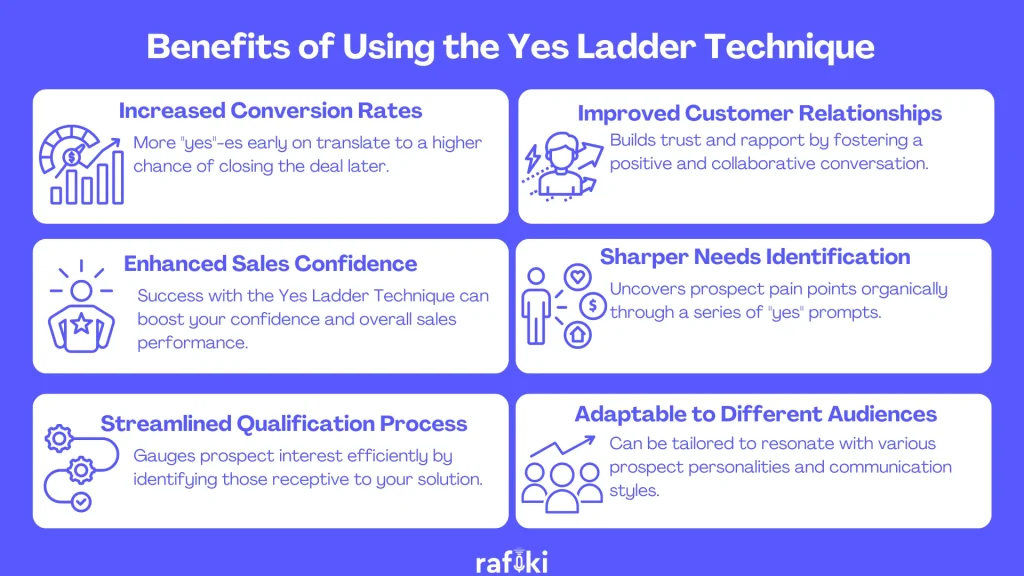
The yes ladder shines throughout various stages of the sales cycle, but it's particularly effective during the qualification phase and early relationship building. Here's why:
Beyond the sales stage, the yes ladder can also be tailored to different prospect personas:
Before diving into the step-by-step implementation, let's review the common mistakes to avoid:
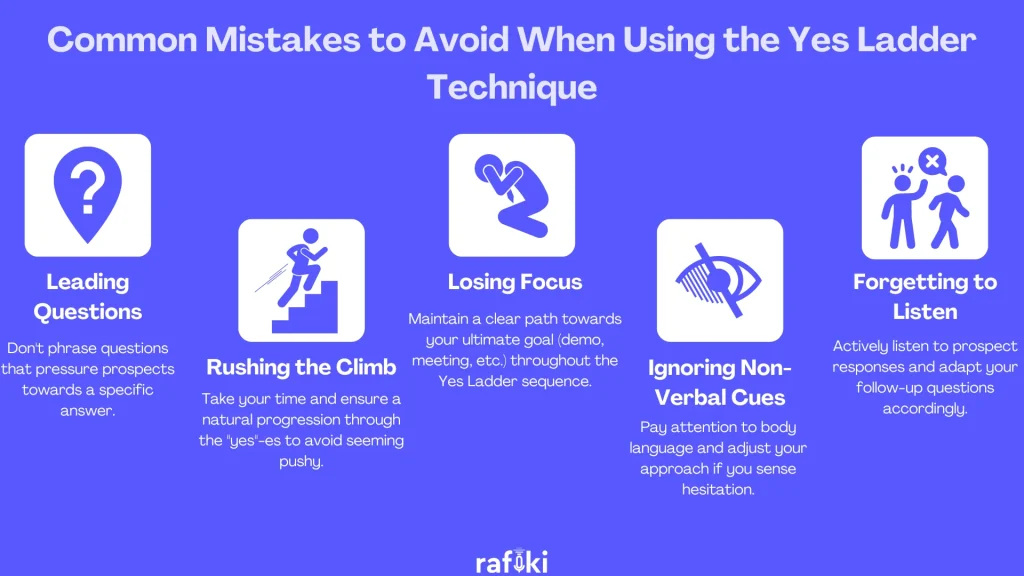
Now that you understand the context and common pitfalls, here's a breakdown of the key steps to implementing the yes ladder:
The foundation of the yes ladder lies in your questions. They should be clear, concise, and designed to elicit genuine positive responses:
Rafiki AI's Smart Call Scoring can analyze your questions after every call, showing you which phrasings generate agreement and which ones stall momentum.
Map out your yes ladder sequence in advance. It will vary by sales pitch and prospect needs, but a proven structure looks like this:
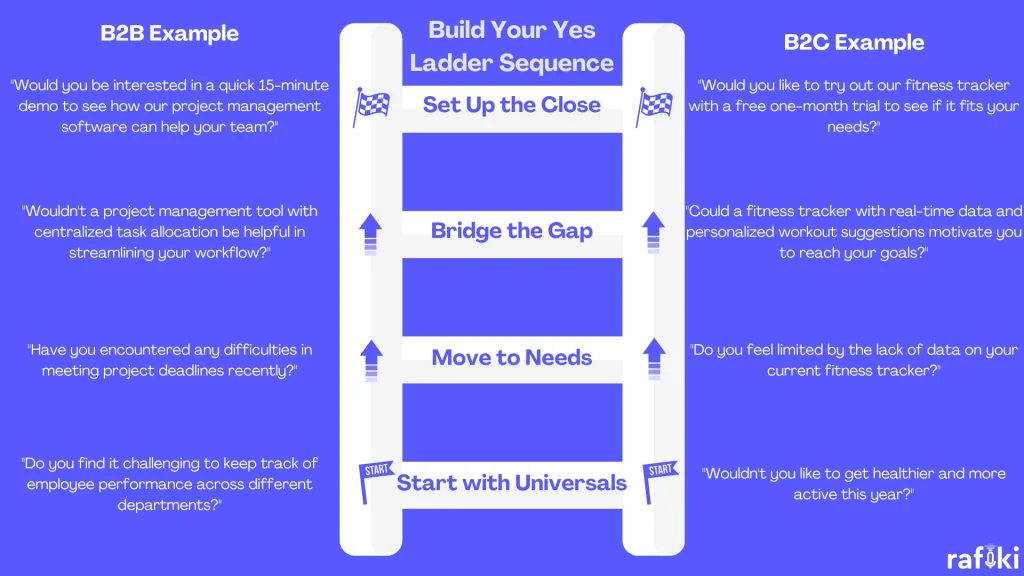
The key to a successful yes ladder is ensuring a smooth flow from one question to the next. Listen attentively to the prospect's responses and use them to organically bridge the gap between rungs. If a prospect's answer reveals an unexpected pain point, adapt on the fly — rigid scripts kill the technique.
The best sales teams don't just use the yes ladder — they measure it. With a conversation intelligence platform, you can review call recordings to identify which yes-ladder sequences lead to booked demos, which questions generate the most engagement, and where prospects disengage. This turns a subjective technique into a data-driven practice.
The yes ladder doesn't exist in a vacuum. Here's how it compares to other popular approaches:
The yes ladder is most powerful when combined with a structured discovery method. It's a persuasion layer, not a replacement for deal intelligence and qualification rigor.
The yes ladder is a deceptively simple framework with outsized impact. By strategically guiding prospects through a series of genuine micro-agreements, you build trust, surface real needs, and make the final ask feel like a natural conclusion rather than a hard close. The key lies in crafting honest, compelling questions, maintaining a smooth conversational flow, and adapting to your audience in real time.
The difference between reps who use the yes ladder casually and those who master it? Data. When you can see exactly which questions drive agreement and which ones stall deals, you stop guessing and start optimizing.
Rafiki AI's conversation intelligence platform helps you implement and track the yes ladder across every call — automatically. Start at $19 per seat per month with no minimums and no annual commitment. Start your free trial today or book a demo to see how Rafiki AI transforms your sales conversations.

Master the Yes Ladder
Start for free — no credit card, no seat minimums, no long contracts. Just better sales intelligence.